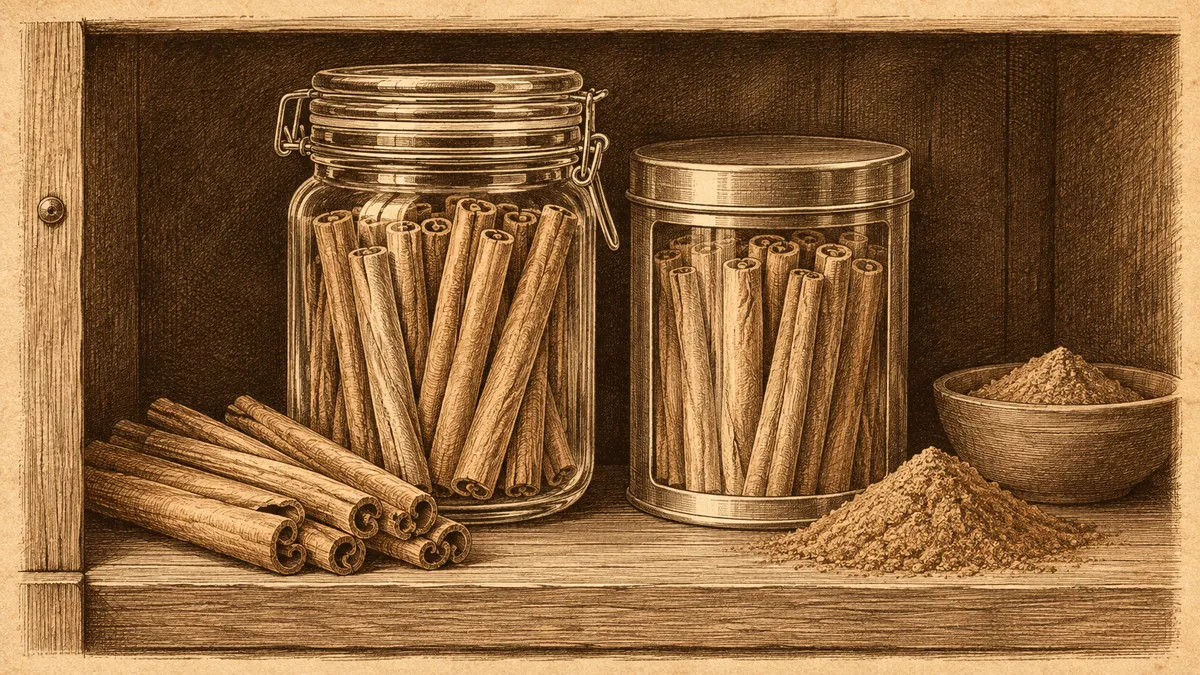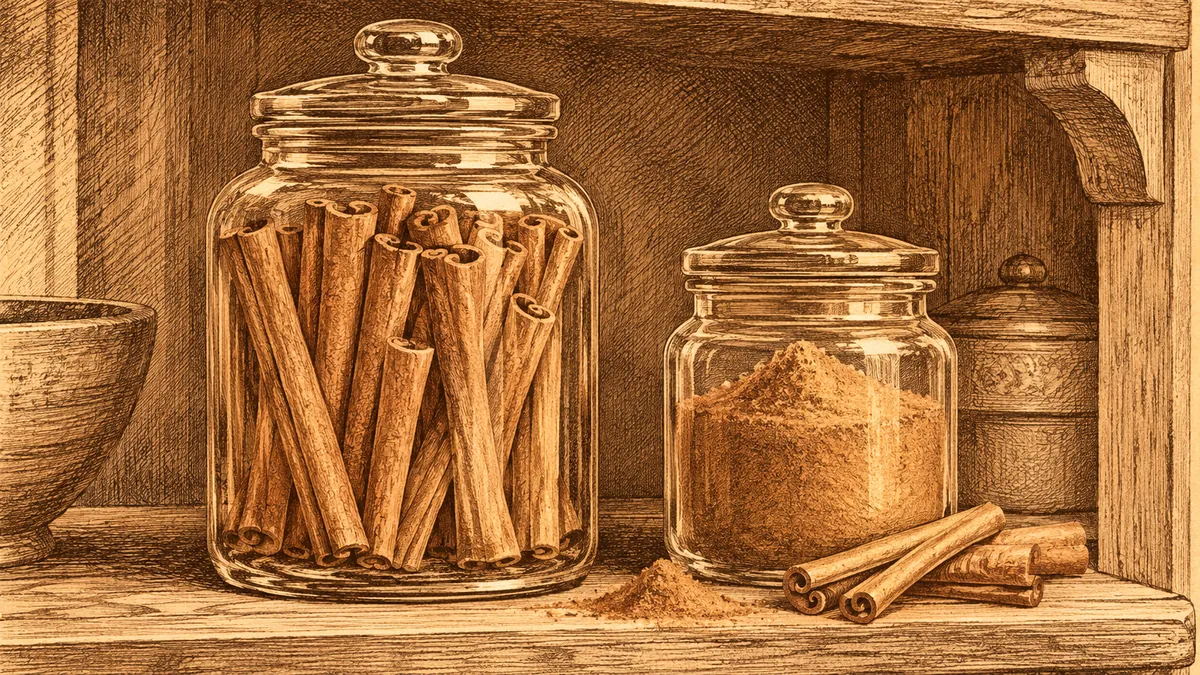
Cinnamon sticks and cinnamon powder are stored the same way, in a cool, dark, dry place in an airtight container, but they keep for very different lengths of time. Whole Ceylon cinnamon sticks, or quills, hold their aroma far longer because less of their surface is exposed to air, lasting a few years when stored well. Ground cinnamon has much more surface area, so it loses its scent and flavour faster, staying at its best for several months to about a year.
Whether you buy Ceylon cinnamon as sticks or as powder, how you store it decides how long it keeps its aroma and flavour. This guide explains how to store each form, why sticks last longer than powder and how to get the most from both. It builds on our pillar guide, the Ceylon cinnamon buying guide.
The short answer
Store both sticks and powder in an airtight container in a cool, dark, dry cupboard, away from heat, light and moisture. Sticks keep well for a few years, powder for several months up to about a year. The storage conditions are the same, but the shelf life is not: whole quills have far less exposed surface than ground cinnamon, so they hold their volatile aroma compounds much longer. This is why many people buy sticks and grind small amounts as needed, rather than keeping a large jar of powder for a long time.
Why the form changes the shelf life
The difference between storing sticks and powder comes down to surface area. A whole cinnamon stick is a tightly rolled quill of bark, with only its outer surface in contact with the air. Grinding that same bark into powder exposes a huge number of tiny particles, each surface meeting the air. The aromatic compounds that give cinnamon its scent and flavour are volatile, meaning they slowly escape into the air, and the more surface is exposed, the faster this happens. So powder loses its character faster than a stick simply because far more of it is open to the air. For more on how long the spice lasts overall, see our guide to how long Ceylon cinnamon lasts.
How to store cinnamon sticks
Store whole Ceylon cinnamon sticks in an airtight container, such as a sealed jar or tin, in a cool, dark, dry cupboard. Keep them away from the heat of the stove or oven, out of direct sunlight, and away from damp, since heat, light and moisture all speed the loss of aroma. Stored this way, good Ceylon cinnamon sticks hold their fragrance well for a few years. Because the quills are whole, they are forgiving and keep their quality for a long time, which is one reason sticks are a practical way to buy cinnamon you will use slowly.
How to store cinnamon powder
Ground cinnamon needs the same conditions, an airtight container in a cool, dark, dry place, but it rewards a little more care because it fades faster. Keep the jar tightly closed between uses, and avoid letting steam reach it, for example by not shaking it directly over a hot, steaming pot, since moisture both clumps the powder and hastens the loss of aroma. Buy powder in amounts you will use within several months to a year, rather than a large jar that will sit for years. Ground cinnamon rarely becomes unsafe if kept dry, but it does grow weak and dull over time, so using it while fresh gives the best flavour.
| Point | Cinnamon sticks (quills) | Cinnamon powder |
|---|---|---|
| Storage conditions | Cool, dark, dry, airtight | Cool, dark, dry, airtight |
| Exposed surface | Small, only the outside | Large, every particle |
| Typical best-flavour life | A few years | Several months to a year |
| Main enemy | Heat, light, damp over time | Air and moisture, faster |
| Best practice | Keep sealed, grind as needed | Buy small, use while fresh |
The case for buying sticks and grinding
Because whole sticks keep so much longer than powder, one practical approach is to buy Ceylon cinnamon as sticks and grind a little into powder only when you need it. This gives you the long shelf life of quills together with fresh-ground flavour each time. Ceylon cinnamon is especially suited to this, as its bark is thin and brittle and grinds more easily than the hard bark of cassia. Our guide to cinnamon sticks versus powder and what to buy looks at this choice in more detail. For everyday cooks who use powder often, though, buying a modest jar and replacing it regularly works perfectly well.
Signs cinnamon has lost its freshness
Both sticks and powder lose aroma gradually rather than spoiling suddenly. The clearest sign is smell: fresh Ceylon cinnamon has a warm, sweet fragrance, and when that scent becomes faint, the cinnamon has passed its best. With powder, a dull colour and a weak aroma when you open the jar are the signs to replace it. With sticks, a quill that smells of little even when scratched or broken has faded. Kept dry, cinnamon does not usually become unsafe, but weak cinnamon gives weak results in cooking, so aroma is the test that matters. Our guide to whether Ceylon cinnamon goes bad covers this in full.
Choosing the right container
The container matters as much as the cupboard. The aim is an airtight seal that keeps air and moisture out, so a glass jar with a tight lid, or a metal tin that closes well, suits both sticks and powder. Glass has the advantage of not holding odours, though a clear jar should be kept in a dark cupboard rather than on an open shelf, since light fades the aroma. For powder especially, a small jar that is opened and closed cleanly is better than a large one that is left part full for a long time, because each opening lets in a little air. Whatever the material, a good seal and a dark, cool spot are what count, and the same container advice applies whether you keep sticks or ground cinnamon.
Common storage mistakes
A few simple mistakes shorten the life of both forms. Keeping cinnamon in a rack above or beside the stove exposes it to heat and steam, which drive off aroma quickly. Leaving a jar open, or using a container that does not seal well, lets the volatile compounds escape. Storing cinnamon in a clear jar on a sunny shelf exposes it to light. And shaking powder straight over a steaming pot lets moisture in. Avoiding these, by keeping cinnamon sealed, cool, dark and dry, is most of what good storage requires, and it applies equally to sticks and powder.
Summary
Cinnamon sticks and cinnamon powder are stored under the same conditions, sealed in an airtight container in a cool, dark, dry place away from heat, light and moisture, but they keep for different lengths of time. Whole Ceylon cinnamon sticks expose little surface to the air, so they hold their aroma well for a few years, while ground cinnamon exposes far more surface and fades faster, staying at its best for several months up to about a year. Because of this, a practical approach is to buy sticks and grind small amounts as needed, while cooks who use powder regularly can keep a modest jar and replace it often. In both cases, aroma is the test of freshness, and keeping cinnamon sealed and away from heat, light and damp is the key to making it last.
Frequently asked questions
Do cinnamon sticks last longer than cinnamon powder?
Yes. Whole sticks expose much less surface to the air than ground powder, so they hold their aroma far longer. Stored well, sticks keep their best flavour for a few years, while powder is best used within several months to about a year.
How should I store cinnamon sticks and powder?
Both should be kept in an airtight container in a cool, dark, dry cupboard, away from heat, light and moisture. The conditions are the same for both forms; only the shelf life differs, with sticks keeping longer than powder.
Does ground cinnamon go bad?
Ground cinnamon kept dry rarely becomes unsafe, but it loses its aroma and flavour over time and becomes dull and weak. The sign to replace it is a faint smell and a flat colour. Using it while fresh gives the best results.
Is it better to buy cinnamon sticks or powder?
For long storage, sticks are better because they keep much longer and can be ground as needed. For frequent, convenient use, powder is fine if bought in modest amounts and replaced regularly. Many people keep sticks for the long term and a small jar of powder for everyday use.
Can I store cinnamon in the fridge or freezer?
It is not necessary. A cool, dark, dry cupboard is ideal. Refrigerators can introduce moisture through condensation, which is unhelpful for a dry spice, so an airtight container in a cupboard away from heat is the simplest and most reliable choice.
This website provides educational information about Ceylon Cinnamon as a spice and food ingredient. It is not intended to provide medical advice or make health claims.