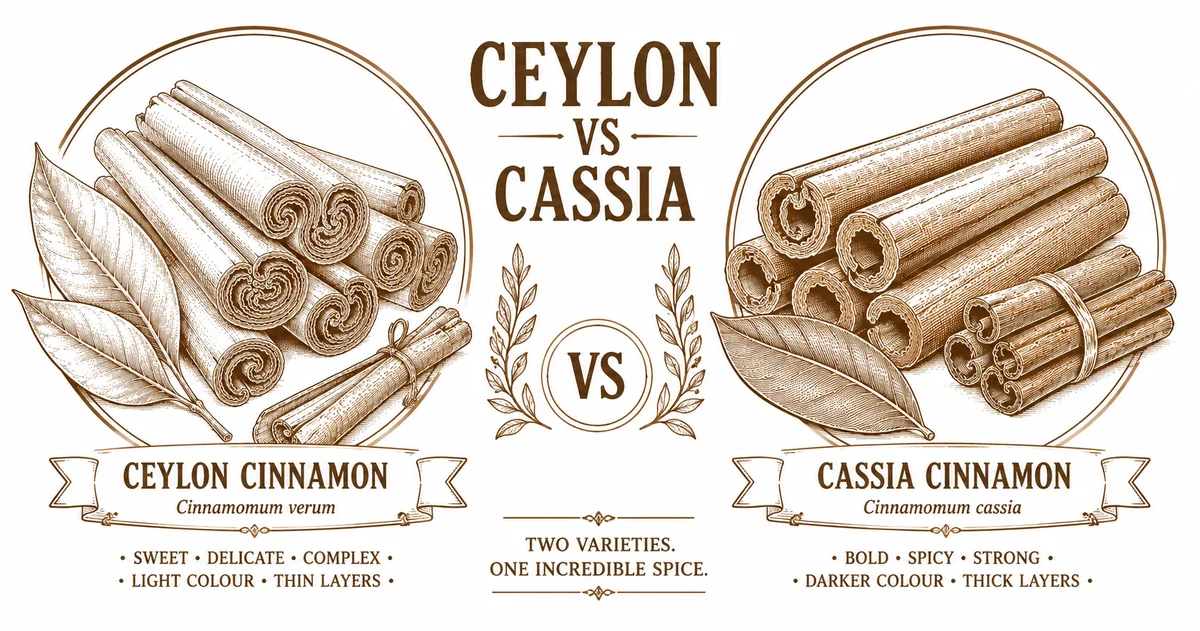
Ceylon cinnamon is the bark of Cinnamomum verum from Sri Lanka; cassia is the bark of several other Cinnamomum species grown mainly in China, Indonesia and Vietnam. The two look, feel and taste different, and cassia contains far more of the naturally occurring compound coumarin. Ceylon is thin, pale and delicately sweet; cassia is thick, dark and boldly pungent. Knowing which is which changes how you shop and cook.
Most people never realise there are two very different products sold under the single word “cinnamon.” This guide sets them side by side, botany, origin, appearance, flavour, bark structure, coumarin and culinary use, so you can tell them apart with confidence. For the fundamentals of true cinnamon itself, start with what is true Ceylon cinnamon.
Quick comparison table
| Feature | Ceylon cinnamon | Cassia cinnamon |
|---|---|---|
| Botanical source | Cinnamomum verum (syn. zeylanicum) | C. cassia, C. burmannii, C. loureiroi |
| Main origin | Sri Lanka | China, Indonesia, Vietnam |
| Bark thickness | Thin and papery | Thick and hard |
| Quill shape | Many fine layers rolled together | Single thick curl, often hollow |
| Colour | Light tan / golden brown | Dark reddish-brown |
| Texture | Brittle, crumbles easily | Hard, snaps or needs a grinder |
| Aroma & flavour | Delicate, sweet, complex | Strong, hot, pungent |
| Coumarin content | Only trace amounts | Considerably higher |
| Typical price | Higher (premium) | Lower (commodity) |
Botanical differences
Both belong to the genus Cinnamomum in the laurel family, but they are different species. True cinnamon is a single species, Cinnamomum verum. “Cassia” is a commercial grouping of several species: C. cassia (Chinese cassia), C. burmannii (Indonesian or Korintje cassia) and C. loureiroi (Saigon or Vietnamese cassia). Because they are botanically distinct, their bark develops a different structure and a different balance of aromatic compounds.
Origin differences
Ceylon cinnamon is overwhelmingly a product of Sri Lanka, where it has been cultivated and hand-processed for centuries; its name is now protected in the EU as a Geographical Indication tied to the island. Cassia is grown across East and South-East Asia and is produced on a far larger industrial scale, which is a major reason it is cheaper and more widely available. The historical reasons behind Sri Lanka’s association with cinnamon are covered in our history of Ceylon cinnamon.
Appearance: how to tell them apart by sight
Place the two side by side and the differences are obvious. A Ceylon quill is light tan and built from many thin layers of soft inner bark rolled tightly together, so the end looks like a coiled cigar. It is fragile and flakes apart easily. A cassia stick is dark reddish-brown, made of a single thick, woody layer curled into a hollow tube, and is hard enough that most people cannot snap it by hand. These cues are the heart of our guide to identifying authentic Ceylon cinnamon.
Bark structure
The structural contrast comes from which part of the bark is used and how it is prepared. Ceylon cinnamon uses only the delicate inner bark, scraped free of the outer layers and rolled while pliable into multi-layered quills. Cassia is made from thicker bark that includes more of the woody outer layers, which is why it is harder, less refined in flavour, and forms that characteristic single curl. Understanding this is easier once you have read how Ceylon cinnamon is made.
Flavour differences
Ceylon cinnamon tastes sweet, mellow and layered, with soft floral and citrus notes. It flavours a dish without dominating it. Cassia is stronger, hotter and more astringent, with a punchy, almost spicy-sweet bite that carries well through robust bakes and heavily spiced dishes. Neither is “better” in the abstract, they simply suit different purposes, which we look at in the culinary uses of Ceylon cinnamon.
The coumarin difference
One of the most discussed differences is coumarin, a naturally occurring aromatic compound present in the bark. Cassia contains substantially more coumarin than Ceylon cinnamon, which carries only trace amounts. Food-safety authorities such as the European Food Safety Authority have established a tolerable daily intake for coumarin, and this is one reason some consumers who use cinnamon frequently, or in large quantities, choose Ceylon. This is a compositional, food-ingredient distinction rather than a health claim.
Culinary differences: which should you use?
As a rule of thumb, reach for Ceylon cinnamon where its subtlety can shine, delicate custards and rice puddings, milk and cream dishes, fine pastry, fragrant Sri Lankan and South Indian curries, and drinks where you do not want harshness. Choose cassia where you want a bold, unmistakable cinnamon punch that stands up to sugar and strong flavours, such as cinnamon rolls, robust spice blends and long-cooked stews. Many cooks keep both. If you are buying Ceylon for the first time, our buying guide explains what to look for.
Why do people confuse Ceylon cinnamon and cassia?
The confusion is largely a labelling issue. In many countries, both can legally be sold simply as “cinnamon,” with no species named on the jar. Because cassia is cheaper and more plentiful, it makes up the majority of the mass market, so most shoppers have only ever encountered cassia and assume it is the standard. Only when the label specifies Cinnamomum verum, “true cinnamon” or “Ceylon cinnamon,” and names Sri Lanka as the origin, can you be confident you are getting the real thing.
The different types of cassia
“Cassia” is not one thing but a family of species, and they vary in their own right:
- Chinese cassia (C. cassia), the classic cassia, dark and strong, widely used across Asia.
- Indonesian / Korintje cassia (C. burmannii), the most common cinnamon in North American supermarkets, sweetly pungent.
- Saigon / Vietnamese cassia (C. loureiroi), the boldest and most intensely flavoured, prized by some bakers for its punch.
All three are still cassia, thicker-barked, higher in coumarin and more forceful than Ceylon cinnamon. If a premium-priced “cinnamon” names one of these species or simply says “cinnamon,” it is cassia, not true cinnamon.
Price and availability
Cassia’s lower price is a direct result of how it is produced: it grows across large areas of Asia, is farmed on an industrial scale, and its thicker bark is easier to harvest and does not require the delicate hand-peeling that Ceylon cinnamon demands. Ceylon cinnamon, grown in a smaller region and processed by skilled peelers as described in how Ceylon cinnamon is made, is naturally scarcer and dearer. This is why cassia dominates supermarket shelves worldwide while true cinnamon is more often found in specialist shops and from dedicated suppliers.
How to choose between them in practice
A simple way to decide: if the cinnamon flavour is the star of the dish, a custard, a spiced latte, a delicate cake, a fragrant curry, reach for Ceylon. If cinnamon is a supporting note that needs to punch through sugar, chocolate or strong spices, cassia does the job cheaply. Serious cooks often keep a jar of each: Ceylon for finesse and everyday enjoyment, cassia for occasions that call for a bold hit. Whichever you choose, checking the label for the species and origin, as covered in our identification guide, ensures you know exactly what you are getting.
Beyond flavour: everyday considerations
For most households the choice comes down to three practical factors: flavour, frequency of use and budget. If you cook with cinnamon only occasionally and want maximum punch for minimum cost, cassia is perfectly serviceable. If you use cinnamon often, value a refined taste, or simply prefer the very low coumarin content of true cinnamon, Ceylon rewards the modest extra outlay. Neither choice is wrong; they suit different priorities. What matters is knowing which one you are buying, so that the decision is yours to make rather than the supermarket’s to make for you.
A note on other “cinnamon” products
The Ceylon-versus-cassia distinction also applies to processed products. Cinnamon powder, cinnamon tea, cinnamon-flavoured baked goods and cinnamon oil can be made from either type, and the label rarely says which. If the species matters to you, look for products that specifically state Ceylon cinnamon or Cinnamomum verum, and treat unlabelled “cinnamon” products as most likely cassia-based. The identification guide and buying guide both help you navigate these products with confidence.
Summary
Ceylon cinnamon and cassia are related but genuinely different spices. Ceylon, Cinnamomum verum from Sri Lanka, is thin, pale, brittle, delicately sweet and very low in coumarin. Cassia is thick, dark, hard, boldly pungent and much higher in coumarin, produced cheaply across Asia. Tell them apart by colour, bark structure and texture, and choose between them by the dish: Ceylon for finesse, cassia for punch. When a label does not name the species or origin, it is usually cassia.
Frequently asked questions
Is cassia cinnamon bad for you?
Cassia is a widely used culinary spice. It simply contains more coumarin than Ceylon cinnamon, which is why some people who use cinnamon heavily prefer Ceylon. This is an ingredient-composition point, not medical advice.
Can I substitute cassia for Ceylon cinnamon?
Yes, but expect a stronger, hotter flavour from cassia, so you may want to use a little less. For delicate dishes, Ceylon’s subtlety is hard to replace.
Which cinnamon is in my supermarket?
Unless the label specifically says Ceylon cinnamon or Cinnamomum verum, it is almost certainly cassia.
Is Ceylon cinnamon worth the extra cost?
For its refined flavour, pale delicate quills and low coumarin, many cooks find it well worth it, especially for baking and drinks where the flavour is front and centre.
This website provides educational information about Ceylon Cinnamon as a spice and food ingredient. It is not intended to provide medical advice or make health claims.
Leave a Reply