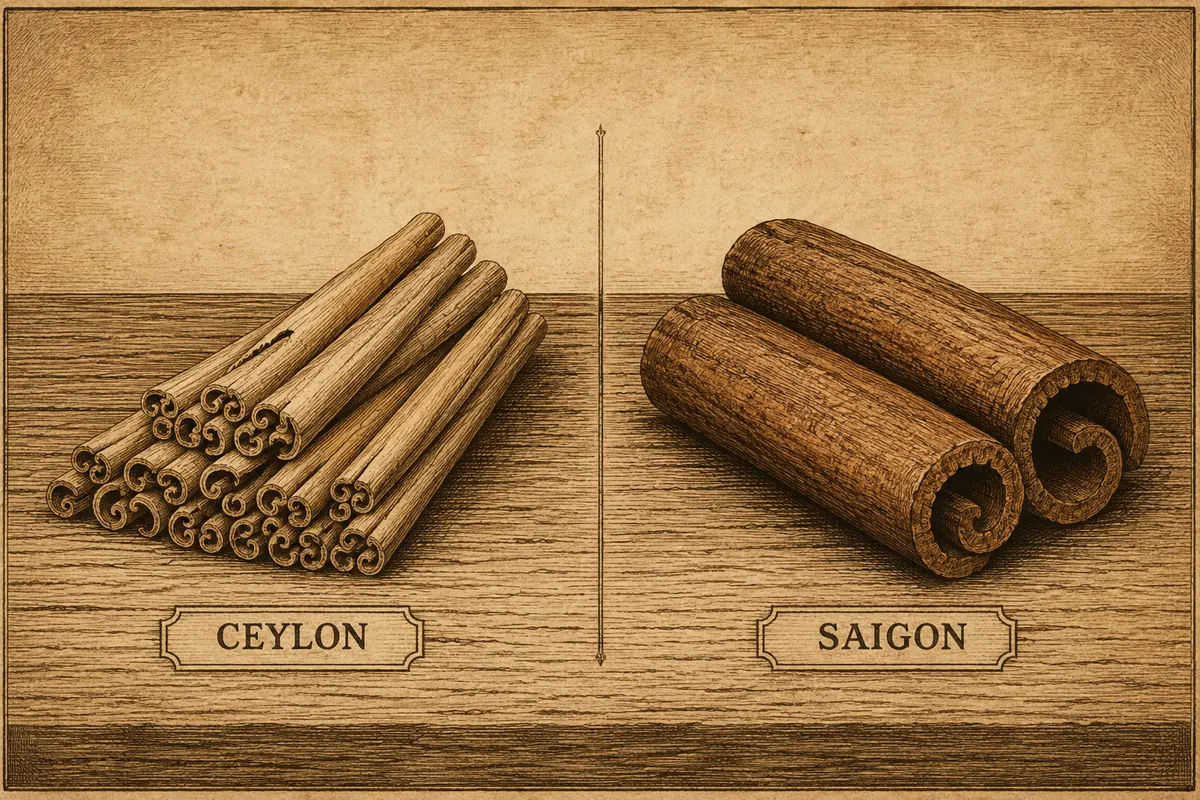
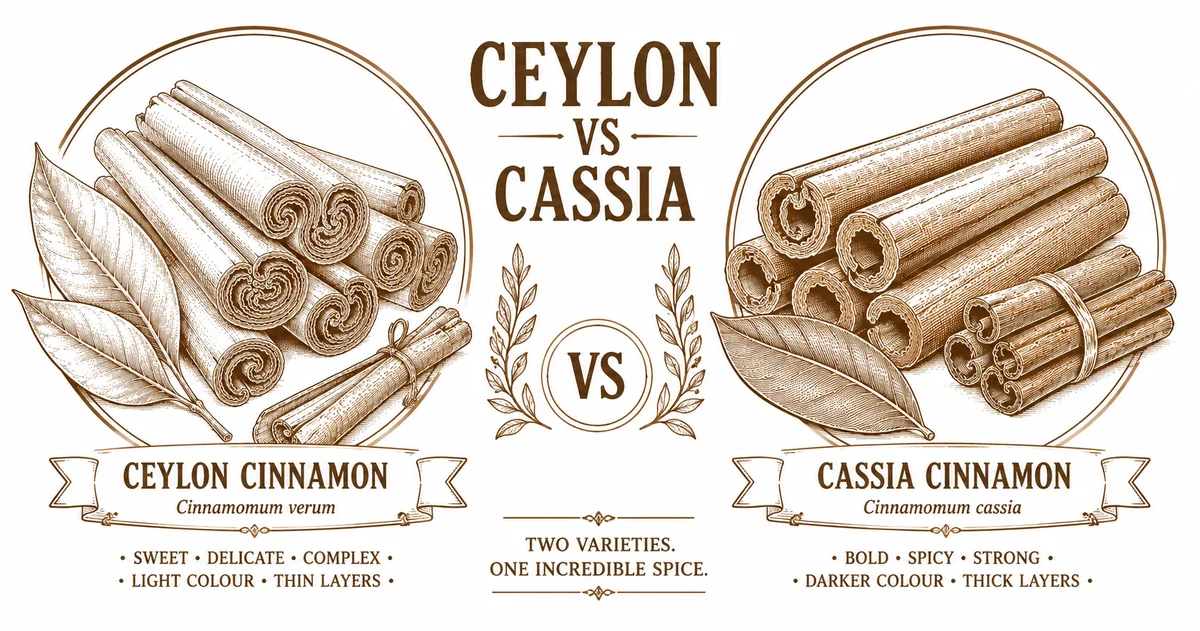
People confuse Ceylon cinnamon and cassia because both are sold simply as “cinnamon”, both come as rolled brown bark with a similar warm smell, and in powder form they look almost identical. Yet they are different spices: Ceylon cinnamon is the bark of Cinnamomum verum from Sri Lanka, while cassia comes from other Cinnamomum species grown mainly in China, Indonesia and Vietnam. Loose labelling, lower cassia prices and a shared everyday name are the main reasons the two are so often mixed up.
If you have ever wondered why “cinnamon” can mean two quite different spices, you are not alone. This guide explains exactly why Ceylon cinnamon and cassia are so easily confused, and how to tell them apart. It builds on our pillar guide, Ceylon cinnamon versus cassia.
The short answer
The confusion comes down to the shared name “cinnamon”, a similar appearance and aroma, and labels that rarely state the species. In many countries the word cinnamon is used for both true Ceylon cinnamon and the cheaper cassia, so shops, recipes and packaging seldom distinguish them. Because cassia is far more common and less costly, most of the “cinnamon” people meet is actually cassia, which makes the two blur together in everyday use. The difference becomes clear only when you look at the species name, the bark structure and the flavour, rather than the generic label.
They share one everyday name
The biggest reason for the confusion is language. The word cinnamon is used loosely for several related spices, so a jar simply marked cinnamon could be either true Ceylon cinnamon or cassia. Most dictionaries, recipes and supermarkets treat cinnamon as a single thing, even though botanically it is not. This shared name means a shopper can buy, cook with and talk about cinnamon for years without ever learning that two different spices sit behind the word. Our guide to reading cinnamon labels correctly shows how the species name, when it appears, cuts through this.
They look alike, especially as powder
Ceylon cinnamon and cassia also look similar enough to be mistaken for each other, particularly once ground. As a fine brown powder, the two are hard to tell apart by eye, which is why so much ground cinnamon is cassia without the buyer realising. As sticks there are real differences, since Ceylon quills are thin, soft and made of many fine layers, while cassia is a thick, hard single curl, but a casual glance may miss this. Our guide to how to tell if cinnamon powder is Ceylon explains what to look and ask for when the visual clues are gone.
| Reason for confusion | What is really going on |
|---|---|
| Shared name | “Cinnamon” is used for both spices |
| Similar look | Both are rolled brown bark, alike as powder |
| Similar smell | Both are warm and sweet-spicy at first |
| Price and supply | Cassia is cheaper and far more common |
| Vague labels | Species and origin are often not stated |
Their aromas are similar at first
Smell adds to the mix-up, because both spices are warm and sweet-spicy when you first open the jar. To a casual nose they seem like the same thing. On closer attention the two differ: true Ceylon cinnamon is delicate, sweet and complex, while cassia is stronger, sharper and more one-note. But most people do not sniff the two side by side, so the first warm impression is enough to treat them as identical. Our guide to coumarin levels in Ceylon cinnamon versus cassia looks at one real difference behind the two barks.
Cassia is cheaper and more common
Economics is a large part of the story. Cassia is easier to grow and harvest and costs much less than true Ceylon cinnamon, so it dominates the cinnamon sold around the world. Most supermarket cinnamon, and most cinnamon in processed foods, is cassia. Because true Ceylon cinnamon is the rarer and dearer of the two, many people have simply never knowingly tasted it, and assume the common cassia is what cinnamon is meant to be. This everyday dominance of cassia is why the two are so readily confused, and why the Ceylon name has to be stated clearly to stand apart.
Labels rarely tell you the species
Even a careful shopper is often left guessing, because many labels do not state the species or origin. A packet marked only cinnamon, with no mention of Cinnamomum verum or Sri Lanka, gives no way to know which spice is inside. In some markets the word cinnamon on a label is more likely to mean cassia than true cinnamon. Without a clear species name, the buyer cannot resolve the confusion at the point of sale, and the generic label quietly keeps the two spices blurred together. This is why checking for the species name and origin is the surest way to know what you have.
Where the confusion shows up
The mix-up appears in everyday places rather than in any single mistake. In supermarkets, a shelf of jars marked only cinnamon usually holds cassia, with true Ceylon cinnamon either absent or tucked away at a higher price. In recipes, a line that calls for a teaspoon of cinnamon does not say which spice, so cooks use whatever their jar contains. In conversation, people describe a warm, sweet flavour as cinnamon without ever distinguishing the two. Even many gift sets, spiced blends and flavoured products lean on cassia while calling it cinnamon. Because the confusion is spread thinly across so many small moments, most people never notice it, which is exactly why it persists.
How to stop confusing them
The confusion clears once you know what to look for. Check the label for the species name Cinnamomum verum and a statement of Sri Lankan origin, since this is the clearest sign of true Ceylon cinnamon. With sticks, look at the bark: Ceylon quills are thin and made of many soft layers rolled together, while cassia is a thick, hard single curl. With aroma, compare them and notice that Ceylon cinnamon is sweeter and more delicate. Knowing that two spices hide behind one word is itself most of the answer, because once you expect the difference, you start to see and taste it.
Why the distinction is worth making
Telling the two apart matters because they are not interchangeable in every way. Their flavour differs, with Ceylon cinnamon milder and more refined, and they are also different barks with different characteristics. For anyone who wants the genuine article, whether for its taste, its origin or its heritage, the generic word cinnamon is not enough. Learning why the confusion exists is the first step to buying with confidence, so that when you want true Ceylon cinnamon you can recognise it rather than relying on a label that treats every cinnamon as the same.
Summary
People confuse Ceylon cinnamon and cassia because both are sold under the single word cinnamon, both are rolled brown bark that looks alike, and both smell warm and sweet at first, especially as powder. Behind the shared name are different spices: Ceylon cinnamon is the bark of Cinnamomum verum from Sri Lanka, while cassia comes from other Cinnamomum species grown mainly in China, Indonesia and Vietnam. Because cassia is cheaper and far more common, it is the cinnamon most people meet, and vague labels that omit the species keep the two blurred. The confusion clears once you check for the species name and Sri Lankan origin, look at the bark structure, and compare the aromas, since true Ceylon cinnamon is thinner, softer, sweeter and more delicate than cassia.
Frequently asked questions
Why are Ceylon cinnamon and cassia both called cinnamon?
Because the word cinnamon is used loosely for several related spices from the Cinnamomum family. Shops, recipes and labels rarely separate them, so both true Ceylon cinnamon and the cheaper cassia are simply sold and spoken of as cinnamon.
Is most cinnamon actually cassia?
In many markets, yes. Cassia is cheaper and more widely grown, so much of the cinnamon in supermarkets and processed foods is cassia rather than true Ceylon cinnamon. This is a large reason the two are so often confused.
How can I tell Ceylon cinnamon from cassia?
Check the label for Cinnamomum verum and Sri Lankan origin. As sticks, Ceylon cinnamon is thin and made of many soft layers, while cassia is a thick, hard single curl. In aroma, Ceylon cinnamon is sweeter and more delicate than the sharper cassia.
Do Ceylon cinnamon and cassia taste the same?
They are similar at first but not the same. True Ceylon cinnamon is milder, sweeter and more complex, while cassia is stronger and sharper. Because many people have only tasted cassia, they often assume that is simply what cinnamon tastes like.
Why does the difference between them matter?
Because they are different spices with different flavour and bark, and are not fully interchangeable. If you want genuine Ceylon cinnamon for its taste, origin or heritage, the generic cinnamon label is not enough, so knowing the difference helps you buy what you actually want.
This website provides educational information about Ceylon Cinnamon as a spice and food ingredient. It is not intended to provide medical advice or make health claims.