Tag: Cinnamon comparison

  • Ceylon Cinnamon vs Indonesian Cinnamon

    Ceylon Cinnamon vs Indonesian Cinnamon

    Ceylon cinnamon and Indonesian cinnamon are two different barks sold under the same everyday name. Ceylon cinnamon is true cinnamon, Cinnamomum verum, grown in Sri Lanka, with a thin, papery bark and a mild, sweet flavour. Indonesian cinnamon is a type of cassia, usually Cinnamomum burmannii, often called korintje or Padang cassia, with a thick, hard bark and a stronger, hotter taste. Knowing which one you have helps you buy and cook with confidence.

    Indonesian cinnamon is one of the most common cinnamons on supermarket shelves, so it is worth knowing how it compares with true Ceylon cinnamon. This guide sets out the botanical, origin, appearance and flavour differences in plain terms. It builds on our pillar comparison, Ceylon cinnamon versus cassia.

    The short answer

    Ceylon cinnamon is true cinnamon from the species Cinnamomum verum, native to Sri Lanka, while Indonesian cinnamon is a cassia, usually Cinnamomum burmannii, grown in Indonesia. Ceylon has a thin, layered quill and a gentle, sweet flavour. Indonesian cassia has a thick, single-layer bark and a bolder, spicier flavour, and it is the cinnamon most often used in mass-market ground cinnamon.

    What is Indonesian cinnamon?

    Indonesian cinnamon comes from Cinnamomum burmannii, a tree grown mainly on the island of Sumatra. It is widely known in the spice trade as korintje or Padang cassia, after the Padang region and port. Because Indonesia produces a very large share of the world’s cassia, much of the ground cinnamon sold in North America and parts of Europe is Indonesian cassia, even when the label simply reads “cinnamon”.

    Indonesian cinnamon is a genuine cinnamon in the broad sense, since it belongs to the Cinnamomum family. It is not the same species as true Ceylon cinnamon, though, and the two differ in bark structure, flavour and the way they are used.

    What is Ceylon cinnamon?

    Ceylon cinnamon is true cinnamon, Cinnamomum verum, grown in Sri Lanka, the island once known as Ceylon. It is made from the thin inner bark of the tree, which is peeled and rolled into delicate quills built up from many fine layers. Its flavour is mild, sweet and lightly citrus, with a soft aroma. To read more about the species itself, see our guide to what true Ceylon cinnamon is.

    Botanical differences

    The clearest difference is the species. True Ceylon cinnamon is Cinnamomum verum (once called Cinnamomum zeylanicum). Indonesian cinnamon is Cinnamomum burmannii, one of several cassia species alongside Cinnamomum cassia from China and Cinnamomum loureiroi from Vietnam. All are in the same plant family, but they are distinct trees with their own bark and flavour.

    This matters because the name “cinnamon” on a label does not tell you the species. The botanical name does. A label that reads Cinnamomum verum points to Ceylon cinnamon, while Cinnamomum burmannii points to Indonesian cassia.

    Origin differences

    Ceylon cinnamon is grown in Sri Lanka, which remains the main source of true cinnamon. Indonesian cinnamon is grown in Indonesia, chiefly on Sumatra. Both countries have warm, humid tropical climates that suit the trees, but the growing regions and the plants themselves are different. When a label states “Product of Sri Lanka”, it lines up with Ceylon cinnamon. “Product of Indonesia” points to cassia.

    Appearance and bark structure

    The two barks look quite different once you know what to look for. A Ceylon cinnamon quill is made of many thin layers rolled tightly together, so it looks like a packed cigar and feels light and brittle. It snaps and crumbles easily. An Indonesian cassia stick is a thick, single curl of hard bark that is much tougher to break, often with a darker, redder brown colour.

    Ground cinnamon is harder to tell apart by eye, which is why the species name on the label matters most for powder. If you want to tell the barks apart in your own kitchen, our guide on how to identify authentic Ceylon cinnamon sets out the simple checks.

    Flavour differences

    Ceylon cinnamon has a mild, sweet and delicate flavour with gentle citrus notes. It adds warmth without heat, which makes it a good match for desserts and light dishes. Indonesian cassia is bolder and spicier, with a stronger, hotter edge and a deeper colour. Many people recognise this fuller flavour because Indonesian cassia is so common in everyday baking blends and breakfast cereals.

    Neither is simply better. For delicate custards and milk-based sweets, the softness of Ceylon cinnamon suits the dish. For a strong cinnamon hit in a spiced bun or a hearty stew, the intensity of cassia can be a good fit.

    How they are used in cooking

    The two cinnamons tend to suit different jobs in the kitchen. Ceylon cinnamon, with its gentle sweetness, is a natural fit for puddings, custards, fruit dishes and milk-based drinks, where a softer spice lets the other flavours come through. It also works well in delicate Sri Lankan sweets and in lightly spiced teas and coffees. Indonesian cassia, being stronger and hotter, carries its flavour through heavier bakes, spiced buns, breakfast cereals and mulled drinks, and it is the cinnamon most people picture when they think of a bold cinnamon taste.

    In practice, many cooks keep both. A thin Ceylon quill can be simmered in syrup or milk and lifted out, while ground cassia is often stirred straight into doughs and batters for a deeper, warmer note. Choosing between them is less about quality and more about how much cinnamon flavour a dish needs.

    Price and availability

    Indonesian cassia is cheaper and more widely available than true Ceylon cinnamon, which is part of why it fills so many supermarket shelves. Cassia trees grow quickly and yield thick bark, so the spice is produced in large volumes at lower cost. True Ceylon cinnamon is more labour intensive to peel and roll by hand, and Sri Lanka produces a smaller share of the global cinnamon trade, so it usually costs more and is more often found in specialist shops or online. The higher price reflects the careful handwork and the thin, delicate quills rather than any single measure of quality.

    Ceylon cinnamon versus Indonesian cinnamon at a glance

    FeatureCeylon cinnamonIndonesian cinnamon
    TypeTrue cinnamonCassia
    SpeciesCinnamomum verumCinnamomum burmannii
    Common nameCeylon, true cinnamonKorintje, Padang cassia
    OriginSri LankaIndonesia (mainly Sumatra)
    BarkThin, many layers, brittleThick, single layer, hard
    FlavourMild, sweet, delicateBold, spicy, stronger
    ColourLight tanDarker red-brown

    Which one is in your kitchen?

    If your cinnamon came in a plain supermarket jar labelled only “cinnamon” or “ground cinnamon”, it is most likely Indonesian or another cassia, since cassia dominates the mass market. If you bought thin, crumbly quills labelled Cinnamomum verum and marked as a product of Sri Lanka, you have true Ceylon cinnamon. The surest way to know is to read the species name and origin on the label, and to look at the bark if you have whole sticks. For a wider comparison with other cassia types, see our guide to Ceylon cinnamon versus Chinese cinnamon.

    Frequently asked questions

    Is Indonesian cinnamon real cinnamon?

    Indonesian cinnamon is a real cinnamon in the broad sense, since it belongs to the Cinnamomum family. It is a cassia, usually Cinnamomum burmannii, rather than true cinnamon. True cinnamon is the separate species Cinnamomum verum, grown in Sri Lanka.

    What is korintje cinnamon?

    Korintje is a common trade name for Indonesian cassia, Cinnamomum burmannii, grown on Sumatra. It is also called Padang cassia. It is the same bark as Indonesian cinnamon, so korintje and Indonesian cinnamon refer to the same thing.

    Is Ceylon or Indonesian cinnamon better for baking?

    It depends on the result you want. Indonesian cassia gives a strong, spicy cinnamon flavour that suits bold baked goods. Ceylon cinnamon gives a milder, sweeter warmth that suits delicate desserts. Both work in baking, so the choice is about flavour strength.

    Why is most supermarket cinnamon Indonesian?

    Indonesia produces a very large share of the world’s cassia, and cassia is cheaper and more widely traded than true cinnamon. As a result, much of the ground cinnamon sold in shops is Indonesian cassia, often labelled simply as “cinnamon”.

    Summary

    Ceylon cinnamon and Indonesian cinnamon are different barks. Ceylon cinnamon is true cinnamon, Cinnamomum verum, from Sri Lanka, with a thin, layered quill and a mild, sweet flavour. Indonesian cinnamon is a cassia, usually Cinnamomum burmannii and known as korintje, grown in Indonesia, with a thick, hard bark and a bolder, spicier taste. The species name and origin on the label are the clearest way to tell which bark you are buying, and each has its place depending on the dish and the flavour you want.

    This website provides educational information about Ceylon Cinnamon as a spice and food ingredient. It is not intended to provide medical advice or make health claims.

  • Coumarin Levels in Ceylon Cinnamon vs Cassia

    Coumarin Levels in Ceylon Cinnamon vs Cassia

    The main difference in coumarin between the two kinds of cinnamon is one of quantity. Coumarin is a naturally occurring aromatic compound found in the bark of cinnamon trees, and true Ceylon cinnamon, Cinnamomum verum, contains only trace amounts of it, while cassia cinnamon contains much more. This difference in coumarin content is one of the most studied and most talked about contrasts between Ceylon cinnamon and cassia.

    Coumarin comes up often when people compare the two cinnamons, yet it is frequently misunderstood. This guide explains what coumarin is, why the levels differ, and what researchers and food-safety bodies have said about it, in plain and factual terms. It builds on our pillar guide to Ceylon cinnamon vs cassia cinnamon.

    The short answer

    Ceylon cinnamon contains only trace levels of coumarin, whereas cassia cinnamon contains substantially higher levels. Coumarin is a naturally occurring compound that gives a sweet, hay-like note and is present in many plants. In cinnamon it sits in the bark, and the amount varies a great deal by species. True Ceylon cinnamon is consistently very low in coumarin, which is one reason it is often distinguished from the cassia types sold as ordinary cinnamon.

    What coumarin is

    Coumarin is a naturally occurring aromatic compound found in a range of plants, including cinnamon, tonka beans and sweet clover. It has a pleasant, sweet, grassy or hay-like smell and contributes to the aroma of the plants that contain it. In cinnamon, coumarin is one of many naturally occurring compounds in the bark, alongside the aroma compound cinnamaldehyde that gives cinnamon much of its character. You can read more about the aroma side in our guide to what gives Ceylon cinnamon its aroma. Coumarin is studied by researchers as a marker that helps tell cinnamon species apart, because the amount present is closely tied to which species the bark came from. It is the same compound that gives freshly cut hay and certain grasses their characteristic sweet, warm scent, which is why it is described as having a hay-like note.

    Why the levels differ between Ceylon and cassia

    The difference comes down to species. True Ceylon cinnamon is made from Cinnamomum verum, which naturally produces very little coumarin in its bark. The cassia cinnamons, which include Cinnamomum cassia, Cinnamomum burmannii and Cinnamomum loureiroi, naturally contain far more. So the gap is not about processing or quality but about the botany of the trees themselves. This is why laboratories can use coumarin content, along with other markers, to check whether a sample is genuine Ceylon cinnamon or one of the cassia types often sold simply as cinnamon. The way these show up on packaging is covered in our guide to reading cinnamon labels correctly.

    How much coumarin each type contains

    Exact figures vary from sample to sample, because coumarin levels depend on the particular batch, the growing conditions and the part of the bark. As a general picture, though, researchers consistently report that Ceylon cinnamon contains only trace amounts of coumarin, while cassia contains many times more. The table below gives a simplified comparison of the typical pattern rather than precise numbers, since published measurements range widely.

    A simplified comparison of coumarin in Ceylon cinnamon and cassia.
    FeatureCeylon cinnamonCassia cinnamon
    SpeciesCinnamomum verumC. cassia, burmannii, loureiroi
    Typical coumarin levelTrace amountsMuch higher
    Main originSri LankaChina, Indonesia, Vietnam
    Used as a species markerLow readingHigh reading

    How coumarin is measured in cinnamon

    Coumarin is measured in a laboratory rather than by eye or by taste. A small, ground sample of the bark is prepared and analysed using techniques such as high-performance liquid chromatography, often shortened to HPLC, which separates the compounds in the sample and measures how much of each is present. The result is usually given as a concentration, for example milligrams of coumarin per kilogram of cinnamon. Because the figure depends on the exact batch, the growing conditions and even which part of the bark was tested, individual readings vary, which is why researchers describe a range rather than a single fixed number. What stays consistent across studies is the pattern: samples confirmed as Cinnamomum verum read very low, and samples of the cassia species read much higher. This reliability is what makes coumarin useful as a species marker. It is worth noting that you cannot judge coumarin content at home, because it has only a faint aroma and no obvious taste at the levels found in cinnamon, so laboratory testing is the only way to measure it accurately.

    What researchers and food-safety bodies say

    Coumarin in food has been studied by researchers and reviewed by food-safety authorities. Bodies such as the European Food Safety Authority have looked at coumarin as a naturally occurring food compound and published guidance on it, including a tolerable daily intake figure used in food-safety assessment. Because cassia is higher in coumarin, these discussions often focus on cassia-based products. Ceylon cinnamon, by contrast, is consistently reported as very low in coumarin. This website does not give health or medical advice, and anyone with specific dietary questions should speak to a qualified professional. What can be said factually is that the two cinnamons differ markedly in coumarin content, and that this difference is well documented in the scientific literature.

    Why this difference matters for identification

    For the purposes of this educational resource, the most useful point is that coumarin content is a reliable way to tell the two cinnamons apart in a laboratory. Because the level is tied so closely to species, a low coumarin reading points to Ceylon cinnamon and a high reading points to cassia. This makes coumarin one of several scientific markers, alongside the look, aroma and bark structure, that together confirm whether a sample is true Ceylon cinnamon. For the home cook, the practical takeaway is simply that true Ceylon cinnamon and cassia are different products with different compositions, and that knowing which one you have starts with knowing the species and origin.

    This is also part of why the two cinnamons are not simply interchangeable in the way they are often assumed to be. They look different, they taste different, and they differ in measurable composition, coumarin included. A label that names Cinnamomum verum or Cinnamomum zeylanicum and gives a Sri Lankan or Ceylon origin is pointing to the low-coumarin true cinnamon, while a bare cinnamon label with no species or origin is, more often than not, one of the higher-coumarin cassia types. Understanding the coumarin difference therefore reinforces the broader message of this resource: that true Ceylon cinnamon is a distinct spice, and that the clearest way to be sure of what you are buying is to check the species and the country of origin on the label rather than relying on the single word cinnamon.

    Frequently asked questions

    Does Ceylon cinnamon contain coumarin?

    Yes, but only in trace amounts. Coumarin is a naturally occurring compound in cinnamon bark, and true Ceylon cinnamon, Cinnamomum verum, naturally contains very little of it, far less than the cassia types of cinnamon.

    Why does cassia have more coumarin than Ceylon cinnamon?

    The difference is down to species. Cassia cinnamons such as Cinnamomum cassia and Cinnamomum burmannii naturally produce much more coumarin in their bark than Cinnamomum verum does. It is a feature of the trees themselves rather than of how the cinnamon is processed.

    Can coumarin be used to tell Ceylon cinnamon from cassia?

    Yes. Because coumarin content is closely tied to species, laboratories use it as one marker to distinguish true Ceylon cinnamon, which reads very low, from cassia, which reads much higher. It is used alongside other checks such as appearance and aroma.

    Is coumarin natural in cinnamon?

    Yes. Coumarin is a naturally occurring aromatic compound found in many plants, including cinnamon, tonka beans and sweet clover. It is not added to cinnamon; it is simply present in the bark in differing amounts depending on the species.

    Summary

    Coumarin is a naturally occurring aromatic compound found in cinnamon bark, and the key difference between the two cinnamons is how much of it they contain. True Ceylon cinnamon, made from Cinnamomum verum, holds only trace amounts of coumarin, while the cassia types, Cinnamomum cassia, burmannii and loureiroi, contain substantially more. The gap is a matter of species rather than processing, which is why laboratories use coumarin as a marker to tell genuine Ceylon cinnamon from cassia: a low reading points to Ceylon, a high reading to cassia. Researchers and food-safety bodies have studied coumarin as a food compound, and this difference is well documented. For anyone trying to understand the two cinnamons, coumarin is one more clear, measurable way in which true Ceylon cinnamon stands apart from the common cassia sold as ordinary cinnamon.

    This website provides educational information about Ceylon Cinnamon as a spice and food ingredient. It is not intended to provide medical advice or make health claims.
  • Ceylon Cinnamon vs Chinese Cinnamon

    Ceylon Cinnamon vs Chinese Cinnamon

    Ceylon cinnamon and Chinese cinnamon are two different spices. Ceylon cinnamon is the dried inner bark of Cinnamomum verum, native to Sri Lanka, prized for its soft, sweet, delicate flavour and thin, layered quills. Chinese cinnamon, also called Chinese cassia, comes from Cinnamomum cassia, a related tree grown mainly in China and South-East Asia. It is a thicker, harder, single-layer bark with a stronger, sharper, more pungent flavour, and it is the most common cassia sold simply as “cinnamon” around the world.

    Chinese cinnamon is one of the main types of cassia that people confuse with true cinnamon. This guide compares the two so you can tell them apart. It builds on our pillar guide to Ceylon cinnamon versus cassia.

    The short answer

    Ceylon cinnamon (Cinnamomum verum) is the true cinnamon of Sri Lanka, mild and sweet with thin layered quills, while Chinese cinnamon (Cinnamomum cassia) is a type of cassia from China with a thick single-layer bark and a stronger, sharper taste. They are different species from the same broad family, and Chinese cassia is the bolder, cheaper, more widely sold of the two.

    What is Chinese cinnamon?

    Chinese cinnamon is the common name for Cinnamomum cassia, also known as Chinese cassia or simply cassia. It is one of the main cassia species, alongside others such as Indonesian and Saigon (Vietnamese) cinnamon. Grown chiefly in southern China and neighbouring regions, it has been used for a very long time in Chinese cooking and trade. Because it is cheaper to produce than true cinnamon and has a strong, familiar flavour, Chinese cassia is what many shoppers around the world are actually buying when a product is labelled just “cinnamon”.

    What is Ceylon cinnamon?

    Ceylon cinnamon is true cinnamon, Cinnamomum verum, native to Sri Lanka (once called Ceylon). It is made from the thin, papery inner bark of the tree, which is peeled and rolled into delicate, multi-layered quills. Its flavour is soft, sweet and gently spicy, more refined and less sharp than cassia. To understand the true spice more fully, see our guide to what true Ceylon cinnamon is.

    Ceylon vs Chinese cinnamon at a glance

    Comparing Ceylon cinnamon and Chinese cinnamon (cassia).
    FeatureCeylon cinnamonChinese cinnamon (cassia)
    SpeciesCinnamomum verumCinnamomum cassia
    OriginSri LankaChina and nearby regions
    BarkThin, papery, many layersThick, hard, single layer
    Quill shapeScroll of fine layersSingle thick curl
    ColourPale tanDarker reddish brown
    FlavourSoft, sweet, delicateStrong, sharp, pungent
    PriceHigherLower

    Botanical and origin differences

    Although both belong to the Cinnamomum group of trees, Ceylon and Chinese cinnamon are distinct species with different homes. Ceylon cinnamon, Cinnamomum verum, is native to Sri Lanka, which remains the source of the finest true cinnamon. Chinese cinnamon, Cinnamomum cassia, is native to and grown mainly in China and the surrounding region. This difference in species and origin is the root of all the other contrasts between them, from bark structure to flavour.

    Appearance: how to tell them apart

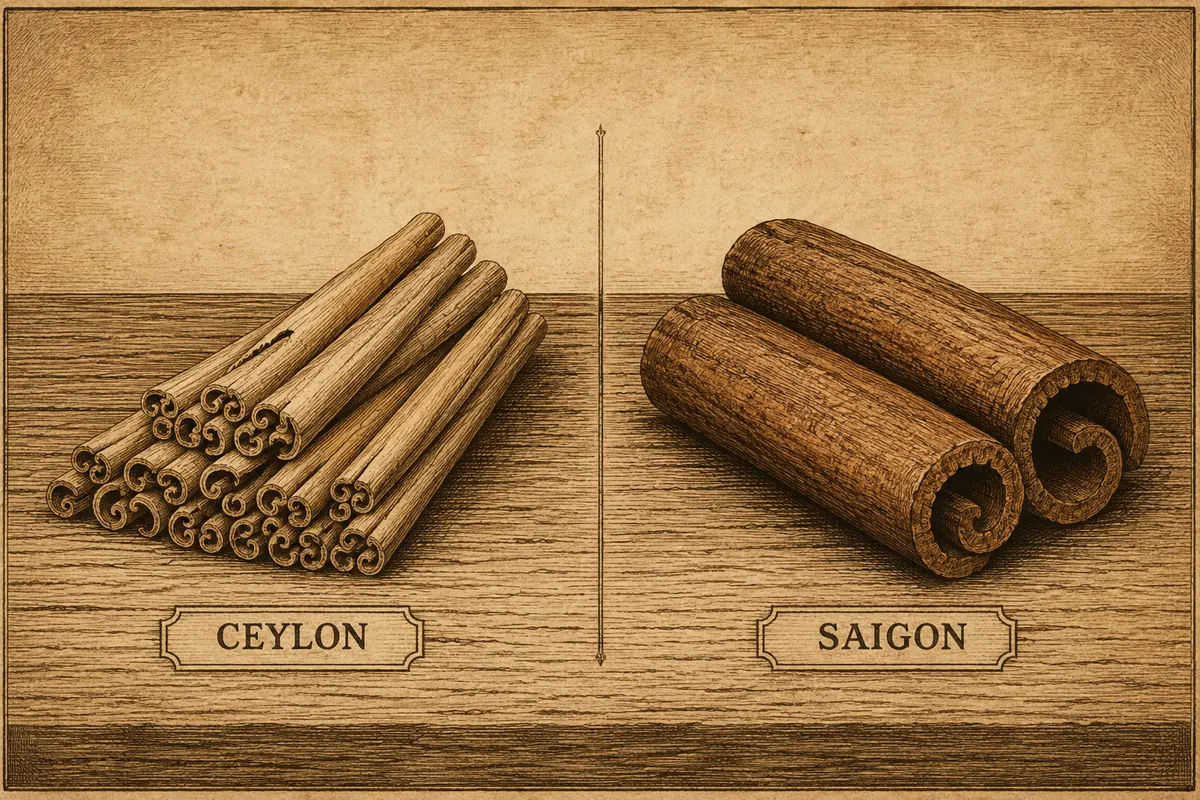
    The clearest way to distinguish the two is by looking at the bark, especially whole sticks. Ceylon cinnamon quills are pale, thin and made of many soft layers rolled together, like a little scroll, and they are brittle enough to snap easily. Chinese cassia sticks are darker, thicker and harder, formed from a single tough layer curled into a hollow tube. Cassia is difficult to break by hand, while Ceylon crumbles readily. This visual test is one of the simplest checks, covered in our guide on how to identify real Ceylon cinnamon.

    Flavour and aroma

    The taste difference is easy to notice once you know it. Ceylon cinnamon is mild, sweet and subtly complex, with gentle floral and citrus notes that make it well suited to delicate dishes and desserts. Chinese cinnamon is much bolder: strong, sharp and intensely spicy, with a pungent warmth that stands up well to robust, savoury cooking. Neither is simply better; they suit different purposes. The difference in strength comes largely from the balance of aromatic compounds in each bark, including cinnamaldehyde, which our guide to cinnamaldehyde explains.

    A note on composition

    One well-known difference between the two is the level of a naturally occurring compound called coumarin. Cassia barks, including Chinese cassia, contain notably higher levels of coumarin than true Ceylon cinnamon, which is very low in it. This is a compositional difference that researchers and food scientists often point to when distinguishing the two spices. Here we note it simply as a factual difference in makeup rather than a health matter; it is one more way in which true Ceylon cinnamon and cassia are genuinely different products.

    Culinary uses

    Both spices are used in cooking, but their strengths differ. Ceylon cinnamon’s gentle sweetness makes it a favourite for baking, desserts, delicate drinks and dishes where a refined cinnamon note is wanted without overwhelming other flavours. Chinese cassia’s bold, punchy character suits hearty savoury dishes, spiced stews, strong mulled drinks and recipes where a powerful cinnamon hit is the aim. Many classic Chinese and other Asian dishes are built around the robust flavour of cassia. Choosing between them is really about matching the spice to the dish.

    Why they are often confused

    The confusion between Ceylon and Chinese cinnamon comes down to labelling. In many countries the word “cinnamon” on its own is most often cassia, frequently Chinese or Indonesian, rather than true Ceylon cinnamon. Since both are warm, brown, sweet-smelling barks from related trees, shoppers rarely realise they are buying a different spice. Only when the label specifically says Ceylon cinnamon or Cinnamomum verum can you be sure of true cinnamon. This same pattern of confusion appears with other cassia types, as our comparison of Ceylon and Saigon cinnamon describes.

    Cost and why cassia dominates shelves

    A big reason Chinese cassia is so common comes down to cost and scale. Cassia trees grow readily and the thick bark is quicker and cheaper to harvest and process than the delicate hand-peeled quills of true cinnamon. That lower cost, combined with a strong flavour that carries well in mass-market products, means cassia fills most supermarket shelves and flavours most inexpensive cinnamon goods. True Ceylon cinnamon, made by skilled hand peeling in Sri Lanka, costs more to produce and so sits at the premium end. When you understand this, the price gap between a cheap jar of “cinnamon” and genuine Ceylon cinnamon makes sense: you are usually comparing mass-produced cassia with a carefully crafted specialty spice.

    Which should you choose?

    The right choice depends on what you want. If you are after the fine, sweet, delicate spice with the greatest reputation for quality, and you value the true cinnamon of Sri Lanka, choose Ceylon cinnamon. If you want a strong, inexpensive, boldly flavoured cinnamon for hearty cooking, Chinese cassia does the job. Many cooks keep true Ceylon cinnamon for baking and refined dishes and reach for cassia when they want a powerful punch. Knowing the difference simply lets you choose on purpose rather than by accident.

    Frequently asked questions

    Is Chinese cinnamon the same as Ceylon cinnamon?

    No. They are different species. Ceylon cinnamon is true cinnamon, Cinnamomum verum, from Sri Lanka, with thin, layered quills and a mild, sweet flavour. Chinese cinnamon is a cassia, Cinnamomum cassia, from China, with a thick, hard bark and a strong, sharp taste.

    Is Chinese cinnamon real cinnamon?

    Chinese cinnamon is a type of cassia, which is a close relative of true cinnamon rather than the same spice. It is very widely sold simply as “cinnamon”, but only Cinnamomum verum, Ceylon cinnamon, is considered true cinnamon.

    How can I tell Ceylon from Chinese cinnamon?

    Look at the sticks. Ceylon cinnamon is pale, thin and made of many soft layers that snap easily, like a scroll. Chinese cassia is darker, thicker and harder, a single curled layer that resists breaking. With powder, rely on the label, checking for Ceylon cinnamon or Cinnamomum verum.

    Which is better, Ceylon or Chinese cinnamon?

    Neither is simply better; they suit different uses. Ceylon cinnamon is milder, sweeter and more refined, ideal for baking and delicate dishes. Chinese cassia is stronger and cheaper, good for bold, hearty cooking. The best choice depends on the flavour and budget you want.

    Summary

    Ceylon cinnamon and Chinese cinnamon are two distinct spices from related trees. Ceylon cinnamon, Cinnamomum verum from Sri Lanka, is the true cinnamon: pale, thin, many-layered and mild, sweet and delicate in flavour. Chinese cinnamon, Cinnamomum cassia from China, is a cassia: a thick, hard, single-layer bark with a strong, sharp, pungent taste, cheaper and more widely sold. They differ in species, origin, appearance, flavour and composition, and they are often confused only because both are sold as “cinnamon”. Knowing the difference lets you choose true Ceylon cinnamon when you want it and use cassia knowingly when a bolder flavour suits.

    This website provides educational information about Ceylon Cinnamon as a spice and food ingredient. It is not intended to provide medical advice or make health claims.

  • Ceylon Cinnamon vs Saigon Cinnamon

    Ceylon Cinnamon vs Saigon Cinnamon

    Ceylon cinnamon and Saigon cinnamon are two very different spices that share a name. Ceylon cinnamon is true cinnamon (Cinnamomum verum) from Sri Lanka, prized for its light, sweet, delicate flavour. Saigon cinnamon is a type of cassia (Cinnamomum loureiroi) from Vietnam, known for its bold, intense, spicy punch. If you have seen both on a shelf and wondered which is which, this guide explains the differences in plain terms.

    Saigon cinnamon, sometimes sold as Vietnamese cinnamon, is one of the strongest and most aromatic cassia types, which is why it is popular with bakers who want a big, warming flavour. It is still a cassia, though, and that puts it in a different family from true Ceylon cinnamon. For the wider picture, this article sits alongside our pillar guide on Ceylon cinnamon vs cassia.

    The short answer

    Ceylon cinnamon is true cinnamon with a mild, complex, sweet flavour and thin, soft bark. Saigon cinnamon is a premium cassia with a strong, sweet-hot flavour and thick, hard bark. Both are real spices with their own uses, but they are botanically distinct: Ceylon comes from Cinnamomum verum, Saigon from Cinnamomum loureiroi. Saigon also has a much higher level of a naturally occurring compound called coumarin, which is worth knowing about, as our guide on the coumarin difference explains.

    What is Saigon cinnamon?

    Saigon cinnamon is the bark of Cinnamomum loureiroi, a tree grown mainly in Vietnam. It is a member of the cassia group of cinnamons rather than the true cinnamon group. Among cassias it is often considered the most flavourful, with a high oil content that gives it a powerful, sweet, spicy taste. Because of that strength, it is a favourite for baking, where a bold cinnamon flavour is wanted in cakes, rolls and cookies.

    Despite the intense flavour, Saigon cinnamon shares the physical traits of other cassias: a thick, hard, single-layer bark that curls into a solid tube. This sets it apart from the thin, papery, multi-layered quills of true Ceylon cinnamon.

    What is Ceylon cinnamon?

    Ceylon cinnamon is the dried inner bark of Cinnamomum verum, native to Sri Lanka. It is known as true cinnamon and has a light brown colour, a soft and brittle texture, and a delicate, sweet, layered flavour with gentle floral and citrus notes. Its quills are made of many thin layers rolled together, which crumble easily. To learn the essentials, see our guide to what true Ceylon cinnamon is.

    Ceylon vs Saigon: the key differences

    Botanical source

    The most basic difference is the plant. Ceylon cinnamon comes from Cinnamomum verum, the only species considered true cinnamon. Saigon cinnamon comes from Cinnamomum loureiroi, one of several cassia species. They are related but distinct trees.

    Flavour

    Ceylon cinnamon is mild, sweet and complex, with a refined taste that does not overpower a dish. Saigon cinnamon is the opposite: strong, sweet and hot, with a pronounced spicy kick. Where Ceylon adds a gentle background warmth, Saigon makes cinnamon the star of the flavour.

    Appearance and texture

    Ceylon quills are pale, thin and soft, rolling up like a fragile cigar of many layers. Saigon quills are darker, thicker and hard, forming a tough single-curl tube. If you can snap it easily and see thin papery layers, it is Ceylon; if it is hard and dense, it is a cassia such as Saigon. Our guide on how to identify real Ceylon cinnamon covers these tests in more detail.

    Coumarin content

    Like other cassias, Saigon cinnamon naturally contains a much higher level of coumarin than Ceylon cinnamon, which has only trace amounts. This is a simple botanical fact about the two spices rather than a health claim, and it is one reason some people choose Ceylon for everyday use.

    Price

    Ceylon cinnamon is usually more expensive because it is hand-processed and produced in smaller quantities. Saigon cinnamon costs more than ordinary supermarket cassia but is generally still cheaper than true Ceylon cinnamon.

    Ceylon cinnamon vs Saigon cinnamon at a glance

    A side-by-side comparison of Ceylon and Saigon cinnamon.
    FeatureCeylon cinnamonSaigon cinnamon
    SpeciesCinnamomum verum (true cinnamon)Cinnamomum loureiroi (a cassia)
    Main originSri LankaVietnam
    FlavourMild, sweet, complexStrong, sweet, spicy
    BarkThin, soft, many layersThick, hard, single curl
    ColourLight tan brownDarker reddish brown
    CoumarinVery low (trace)High
    Typical priceHigher, premiumMid-range

    Which one should you use?

    The right choice depends on the dish and the flavour you want. Saigon cinnamon suits recipes where a strong, dominant cinnamon flavour is the goal, such as cinnamon rolls, spiced cookies and bold baked goods. Ceylon cinnamon suits dishes where you want a subtle, refined sweetness that blends with other flavours, such as delicate desserts, drinks, fruit dishes and light curries.

    Many cooks keep both: Saigon for a punchy hit in baking, and Ceylon for a gentle, everyday warmth. Neither is simply better than the other; they are different tools for different jobs. If you mostly drink cinnamon in tea or add it to fruit and porridge, the softer Ceylon flavour tends to be more pleasant. If you bake big, sweet, spiced treats, the boldness of Saigon can be the better match. Trying a small amount of each side by side is the quickest way to learn which you prefer.

    Where each spice comes from

    Origin is a big part of the story. Ceylon cinnamon is tied to Sri Lanka, the island that has grown and traded true cinnamon for centuries and remains its main home today. The spice is a point of national pride there, and the finest grades still come from the south-western coastal districts.

    Saigon cinnamon takes its name from the city and region of southern Vietnam, and Vietnam is its main growing area. The country has a long tradition of producing aromatic cassia, and Saigon cinnamon is regarded as the top tier of that trade. So while both spices come from Asia, they are rooted in different countries, different species and different traditions.

    Can you substitute one for the other?

    You can swap them, but you need to adjust for strength. Because Saigon cinnamon is much bolder, using it in place of Ceylon can overpower a delicate recipe, so it is wise to start with a little less. Going the other way, replacing Saigon with Ceylon in a recipe that wants a strong cinnamon hit may give a softer, gentler result, so you may choose to use a touch more.

    For most everyday cooking either will work, as long as you remember the golden rule: Ceylon is the quiet, sweet one, and Saigon is the loud, spicy one. Taste as you go and adjust to suit the dish.

    How to tell them apart at home

    Telling Ceylon from Saigon is straightforward once you know the signs. Look at the quill: Ceylon is pale, thin and made of many soft layers that crumble, while Saigon is darker, thick and hard. Check the label for the species name, since Cinnamomum verum means true Ceylon cinnamon and Cinnamomum loureiroi means Saigon cassia. And note the smell and taste: Ceylon is soft and sweet, Saigon is intense and hot. These simple checks are covered further in our guide to identifying real Ceylon cinnamon.

    Frequently asked questions

    Is Saigon cinnamon the same as Ceylon cinnamon?

    No. Saigon cinnamon is a type of cassia from the tree Cinnamomum loureiroi, grown mainly in Vietnam. Ceylon cinnamon is true cinnamon from Cinnamomum verum, grown mainly in Sri Lanka. They are different species with different flavour and texture.

    Is Saigon cinnamon better than Ceylon cinnamon?

    Neither is simply better. Saigon has a stronger, spicier flavour that many bakers love, while Ceylon has a milder, sweeter, more delicate taste. The best choice depends on the dish and your personal preference.

    Why does Saigon cinnamon taste so strong?

    Saigon cinnamon has a high content of the naturally occurring oils that give cinnamon its flavour, which makes its taste bold and spicy compared with the gentler Ceylon cinnamon.

    Does Saigon cinnamon contain more coumarin than Ceylon?

    Yes. As a cassia, Saigon cinnamon naturally contains a much higher level of coumarin than Ceylon cinnamon, which has only trace amounts. This is a botanical difference between the two spices.

    Summary

    Ceylon cinnamon and Saigon cinnamon are different spices with a shared name. Ceylon cinnamon is true cinnamon from Cinnamomum verum in Sri Lanka, with a mild, sweet, complex flavour and thin, soft bark. Saigon cinnamon is a premium cassia from Cinnamomum loureiroi in Vietnam, with a strong, spicy flavour, thick hard bark, and a much higher coumarin level. Choose Saigon when you want a bold cinnamon punch and Ceylon when you want a gentle, refined sweetness. Checking the species name on the label, along with the colour and texture of the quills, makes it easy to know which one you have.

    This website provides educational information about Ceylon Cinnamon as a spice and food ingredient. It is not intended to provide medical advice or make health claims.
  • Ceylon Cinnamon vs Cassia: The Coumarin Difference

    Ceylon Cinnamon vs Cassia: The Coumarin Difference

    The single biggest chemical difference between Ceylon cinnamon and cassia is coumarin, a naturally occurring aromatic compound. Ceylon cinnamon (Cinnamomum verum) contains only trace amounts of it, while cassia contains substantially more. This difference in coumarin content is one of the main reasons the two spices are treated as distinct, and it is a key point for anyone choosing between them.

    If you have read that “real” cinnamon and the common supermarket kind differ in coumarin, this guide explains exactly what that means. It looks at what coumarin is, how much of it each spice contains, why the gap exists, and why it matters when you are deciding which cinnamon to buy. For the wider comparison, see our pillar guide on Ceylon cinnamon vs cassia.

    What is coumarin?

    Coumarin is a naturally occurring aromatic compound found in many plants, including certain grasses, tonka beans, and the bark of cassia cinnamon. It contributes to the warm, sweet, hay-like scent associated with those plants. In cinnamon, coumarin occurs naturally in the bark, and the amount present depends heavily on the species of tree the bark comes from. It is, in other words, simply part of the plant’s natural chemistry rather than an additive.

    How much coumarin is in Ceylon vs cassia?

    This is where the two spices diverge sharply. Ceylon cinnamon contains only trace amounts of coumarin, so little that it is often described as negligible. Cassia, by contrast, contains considerably more. Published analyses have reported that cassia can contain many times the coumarin found in Ceylon cinnamon; figures vary by source and sample, but the consistent finding is a large gap, with cassia measuring substantially higher across studies.

    The practical takeaway is straightforward: if you want cinnamon with very low coumarin, you want genuine Ceylon cinnamon. Because most supermarket cinnamon is actually cassia, as explained in what is true Ceylon cinnamon, the everyday product many people use is the higher-coumarin type without their realising it.

    Why the difference exists

    The coumarin gap comes down to botany. Ceylon cinnamon and cassia are not the same plant. Ceylon cinnamon is the bark of Cinnamomum verum, native to Sri Lanka, while “cassia” is a group of related species, most commonly Cinnamomum cassia, Cinnamomum burmannii and Cinnamomum loureiroi, grown mainly in China, Indonesia and Vietnam. Each species produces bark with a different natural chemistry, and the cassia species simply contain more coumarin than Cinnamomum verum does. The compound is natural to the plant, so no amount of processing turns a high-coumarin cassia into a low-coumarin Ceylon cinnamon; the difference is fixed by which tree the bark came from.

    Ceylon vs cassia: coumarin at a glance

    A simplified comparison focused on coumarin. See the full guide for all differences.
    FeatureCeylon CinnamonCassia Cinnamon
    Botanical sourceCinnamomum verumC. cassia, C. burmannii, C. loureiroi
    Coumarin contentTrace / very lowSubstantially higher
    Main originSri LankaChina, Indonesia, Vietnam
    Typical priceHigherLower
    Common useSought out deliberatelyMost common supermarket cinnamon

    Why coumarin content matters when buying cinnamon

    For occasional use, both spices are enjoyed in kitchens worldwide. But coumarin content becomes a consideration for people who use cinnamon frequently or in large quantities, for example, those who add a spoonful to food or drinks every day. Such users often deliberately choose Ceylon cinnamon precisely because of its very low coumarin content. Food-safety authorities in some regions have published guidance on coumarin as a food component, which is part of why labelling the species has become more important to informed shoppers. This website does not offer health advice; the point here is simply that the two spices differ measurably in this compound, and that difference is a factual reason many people seek out true cinnamon.

    Can you tell coumarin content by looking?

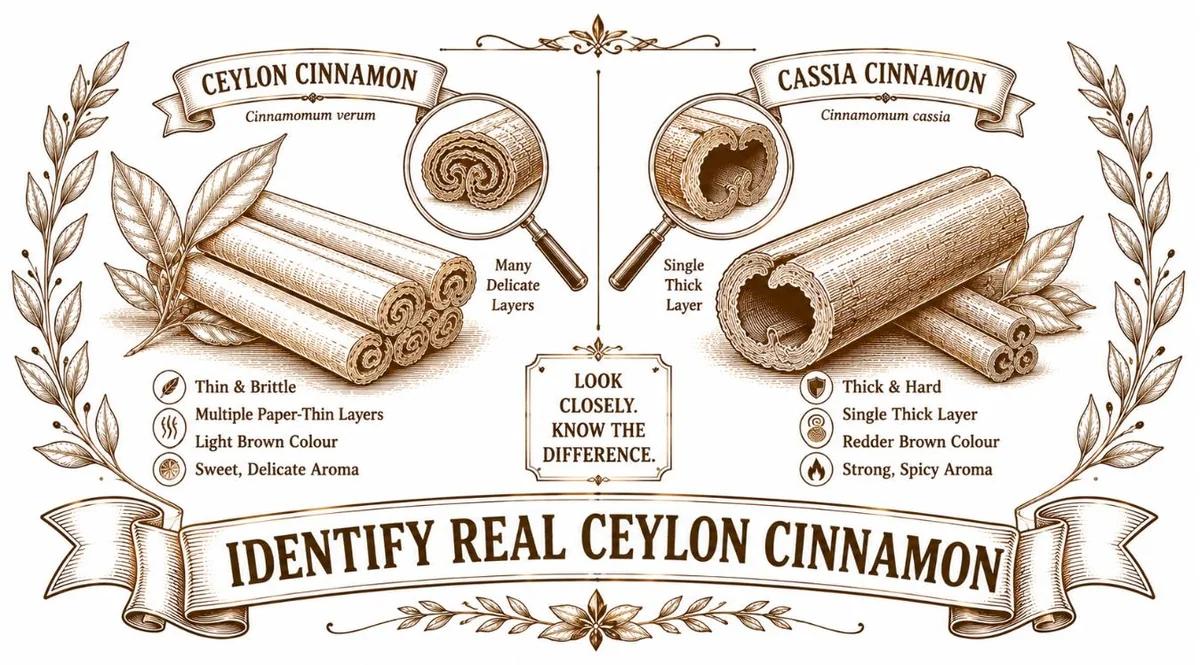
    No. You cannot see, smell or taste coumarin levels directly, and there is no reliable home test for the exact amount. What you can do is identify which species you have, because coumarin content follows from the species. Genuine Ceylon cinnamon has thin, papery, multi-layered quills and a light colour, while cassia is a thick, hard single curl in a darker reddish-brown, as covered in how to identify authentic Ceylon cinnamon. Identifying the species is, in effect, how you judge the likely coumarin level.

    The role of the label

    Because appearance is only a guide, the label remains the most dependable clue. Genuine Ceylon cinnamon is usually named as such and often lists Cinnamomum verum (or the older name zeylanicum) and Sri Lanka as the origin. A jar marked simply “cinnamon”, with no species or origin, is far more likely to be cassia and therefore higher in coumarin. Reading the label carefully is the single most practical step you can take, a theme we return to in the Ceylon cinnamon buying guide.

    Is cassia’s coumarin a reason to avoid it entirely?

    Not necessarily. Cassia is a genuine, widely used spice with a bold, warming flavour that suits many dishes, and it has been part of cooking around the world for a very long time. The coumarin difference does not make cassia “bad”, it simply makes it different, and it is a factor that matters more the more cinnamon you use. The sensible approach is to know which spice you are buying so you can choose intentionally: cassia for its punchy flavour in the right dishes, Ceylon when you specifically want the low-coumarin, delicately flavoured true cinnamon.

    How is coumarin in cinnamon measured?

    Coumarin content is not something you can gauge at home; it is determined in a laboratory. Analysts typically use techniques such as high-performance liquid chromatography (HPLC) to separate and quantify the compound in a bark sample, reporting the result as a percentage of the sample’s weight or in milligrams per kilogram. This is why any figure you see quoted comes from laboratory testing rather than casual observation, and why reputable suppliers of Ceylon cinnamon can sometimes provide a certificate of analysis showing the measured content. For the ordinary shopper, though, the species and origin on the label remain the practical shortcut, since the laboratory numbers consistently track the botanical difference between Cinnamomum verum and the cassia species.

    Does the coumarin difference affect flavour?

    Coumarin contributes to the warm, sweet, hay-like note in the background of cinnamon’s aroma, so it plays a small part in the overall scent, but it is not the main driver of cinnamon’s flavour. The bigger flavour differences between Ceylon and cassia come from other compounds and from the concentration of the essential oils in the bark: cassia tends to be stronger, hotter and more pungent, while Ceylon is more delicate, sweet and complex. In other words, the coumarin gap and the flavour gap are related, both stem from the different species, but you should think of coumarin primarily as a compositional difference rather than the reason the two spices taste distinct. The flavour contrast is covered more fully in the Ceylon cinnamon vs cassia pillar guide.

    How coumarin fits the bigger picture

    Coumarin is only one of several ways Ceylon cinnamon and cassia differ. They also diverge in appearance, aroma, flavour, bark structure and price, all of which are covered in the pillar guide on Ceylon cinnamon vs cassia. What makes coumarin especially useful as a talking point is that it is a concrete, measurable chemical distinction rather than a matter of taste, a clear marker of the fact that these really are two different spices from two different groups of trees.

    Summary

    The coumarin difference is one of the defining distinctions between Ceylon cinnamon and cassia. Coumarin is a naturally occurring aromatic compound present in cinnamon bark, and its level depends on the species: Ceylon cinnamon (Cinnamomum verum) contains only trace amounts, while cassia species contain substantially more. You cannot detect coumarin directly, so the practical way to judge it is to identify the species, through the quill’s appearance and, most reliably, the label. Cassia is not “bad”, but people who use cinnamon frequently often choose genuine Ceylon cinnamon precisely for its very low coumarin content.

    Frequently asked questions

    Does Ceylon cinnamon contain coumarin?

    Only in trace amounts. Ceylon cinnamon (Cinnamomum verum) is very low in coumarin compared with cassia, which contains substantially more.

    Which cinnamon is higher in coumarin, Ceylon or cassia?

    Cassia. Cassia species contain considerably more coumarin than Ceylon cinnamon, which contains only trace levels.

    Can I tell how much coumarin cinnamon has by looking at it?

    Not directly. But you can identify the species from the quill’s appearance and the label, and coumarin content follows from the species, Ceylon is low, cassia is higher.

    Is the cinnamon in supermarkets high in coumarin?

    Often, because most supermarket cinnamon is cassia rather than Ceylon. Check the label for Cinnamomum verum and Sri Lanka if you want the low-coumarin true cinnamon.

    This website provides educational information about Ceylon Cinnamon as a spice and food ingredient. It is not intended to provide medical advice or make health claims.
  • How to Identify Authentic Ceylon Cinnamon

    How to Identify Authentic Ceylon Cinnamon

    You can identify authentic Ceylon cinnamon by its light tan colour, its thin bark rolled into many nested layers, its brittle texture that crumbles easily, its sweet and delicate aroma, and a label that names Cinnamomum verum and Sri Lanka. Cassia, the common substitute, is dark, thick, hard and single-curled. A few simple checks at home will tell the two apart with confidence.

    Because both true cinnamon and cassia are often sold simply as “cinnamon,” telling them apart is a practical skill worth having. This guide gives you clear visual, textural and aroma tests, plus label-reading tips. For the underlying differences, see Ceylon cinnamon vs cassia.

    The quick 5-point check

    Five fast ways to distinguish Ceylon cinnamon from cassia.
    CheckCeylon cinnamonCassia
    ColourLight tan / goldenDark reddish-brown
    Bark & rollThin, many layers, like a rolled cigarThick, single hollow curl
    TextureBrittle, crumbles by handHard, difficult to snap
    AromaSweet, delicate, fragrantStrong, hot, pungent
    LabelSays Cinnamomum verum / Ceylon / Sri LankaOften just “cinnamon,” or names cassia

    1. Look at the colour

    Genuine Ceylon cinnamon is a pale, warm tan, sometimes almost golden. Cassia is noticeably darker and redder. Colour alone is not definitive, but combined with the other checks it is a strong first clue, and it applies to powder too, where Ceylon tends to be lighter brown and cassia a deeper rusty red.

    2. Examine the roll and bark thickness

    This is the most reliable visual test. Look at the end of the stick. A Ceylon quill is made of many thin layers of fine bark rolled tightly together, so the cross-section looks like a coiled newspaper or cigar. Cassia is a single thick curl, often hollow in the middle, formed from one hard layer of bark. If you see one solid tube, it is almost certainly cassia.

    3. Test the texture

    Ceylon cinnamon’s thin bark is brittle. Press or snap a quill and it tends to crack and crumble into flaky layers, you can often break it with your fingers. Cassia is hard and woody, difficult to snap by hand, and usually needs a sturdy grinder. This “snap test” is quick and telling.

    4. Smell the aroma

    Ceylon cinnamon has a sweet, warm, fragrant aroma with subtle floral and citrus notes. Cassia smells stronger and hotter, more one-dimensional and sometimes slightly harsh. With a little practice the difference in the nose is easy to recognise, and it carries through into the flavour of finished dishes, as discussed in culinary uses of Ceylon cinnamon.

    5. Read the label carefully

    Authentic Ceylon cinnamon will usually state one or more of the following: Cinnamomum verum (or the older Cinnamomum zeylanicum), “true cinnamon,” “Ceylon cinnamon,” and Sri Lanka as the country of origin. Be cautious of jars labelled simply “cinnamon” with no species or origin, these are usually cassia. Watch too for the assumption that “organic” means Ceylon: organic refers to how it was grown, not to the species, so an organic product can still be cassia.

    Identifying Ceylon cinnamon powder

    Powder is harder to judge because you cannot inspect the quill. Rely on colour (Ceylon is a lighter brown), aroma (sweeter and more delicate), and above all a trustworthy, clearly labelled source that names the species and origin. When in doubt, buy whole quills you can inspect and grind them yourself.

    Common ways cinnamon is mislabelled

    Most mislabelling is not deliberate fraud but the loose use of the word “cinnamon” for what is really cassia. Because cassia dominates the mass market, shoppers often pay Ceylon prices for cassia, or assume the harsher cassia flavour is what cinnamon is “supposed” to taste like. Knowing the checks above protects you, and pairs naturally with the advice in our buying guide.

    Identifying by taste

    If you are able to taste a small amount, the difference is clear. Ceylon cinnamon is mild, sweet and mellow, dissolving into a gentle warmth with subtle floral notes. Cassia delivers a sharper, hotter, more astringent hit that lingers and can slightly dry the mouth. Once you have tasted them side by side, the flavour test becomes one of the easiest ways to tell them apart, and it explains why the two behave so differently in the recipes covered in our culinary guide.

    Informal tests and their limits

    You may come across “home tests” for cinnamon online, such as judging by how a powder behaves in liquid. Treat these with caution: they are unreliable and can be affected by grind size, additives and freshness. The dependable checks remain the physical ones, colour, the multi-layered roll, brittleness and aroma, combined with honest labelling. There is no substitute for inspecting a whole quill and reading what the packaging actually states.

    Buying online safely

    When you cannot handle the product before buying, labelling and seller transparency become your main tools. Look for listings that clearly state Cinnamomum verum, name Sri Lanka as the origin, specify a grade, and show clear photographs of the quills’ layered ends. Be wary of listings that rely on vague health language instead of concrete product detail, or that price “cinnamon” suspiciously low. These same principles underpin our buying guide.

    Why labels can be misleading

    In many markets the word “cinnamon” can legally cover both true cinnamon and cassia, so a jar can be entirely accurate in calling cassia “cinnamon” while telling you nothing about the species. Country-of-origin labelling adds another layer: origin tells you where a product was packed or grown but not necessarily which species it is. The only reliable confirmation is an explicit botanical name plus a Sri Lankan origin, everything else is a clue rather than proof.

    What about the “curl” direction?

    People sometimes ask whether the way a stick curls reveals its type. The reliable structural clue is not the direction of the curl but the number of layers: Ceylon cinnamon is built from many thin sheets of inner bark rolled tightly together, so it looks layered like a rolled newspaper, while cassia forms one thick, hard curl that is often hollow. Focus on that layered cross-section rather than on which way the ends turn. Combined with colour, brittleness and aroma, the layered structure is the most dependable visual test of all.

    Putting the checks together

    No single test is foolproof on its own, but together the checks are decisive. Imagine picking up an unlabelled stick: if it is pale tan, made of many thin layers rolled like a cigar, crumbles when you press it, and smells sweetly fragrant, you can be confident it is Ceylon cinnamon. If it is dark and reddish, a single hard curl, difficult to snap, and smells hot and sharp, it is cassia. The more of these signals point the same way, the more certain you can be. Whole quills are always easier to judge than powder, which is why buying sticks and grinding your own is the surest route to authenticity.

    Why identification is worth the effort

    Learning these checks pays off in three ways. You avoid paying a premium for cassia sold loosely as “cinnamon”; you get the delicate flavour that recipes calling for true cinnamon actually intend; and you can enjoy the naturally low coumarin content of Ceylon cinnamon when you use the spice often. Pair this identification know-how with the practical advice in our buying guide and the background in what is true Ceylon cinnamon, and you will rarely be fooled again.

    Summary

    To identify authentic Ceylon cinnamon, look for a pale tan colour, thin bark rolled into many nested layers, a brittle texture that crumbles easily, and a sweet, delicate aroma, then confirm with a label naming Cinnamomum verum and Sri Lanka. Cassia, by contrast, is dark, thick, hard, single-curled and pungent. For powder, trust colour, aroma and a reputable labelled source, or grind your own from quills. A handful of simple checks is all it takes to be sure you have the real thing.

    Frequently asked questions

    How can I tell if my cinnamon is Ceylon or cassia?

    Check the roll: Ceylon has many thin layers like a cigar and crumbles easily, while cassia is a single hard, thick curl. Ceylon is also paler and sweeter smelling.

    Does “organic” mean it is Ceylon cinnamon?

    No. Organic describes how the plant was grown, not the species. Organic cinnamon can still be cassia, so check for Cinnamomum verum and Sri Lanka on the label.

    Can I identify Ceylon cinnamon powder?

    It is harder. Ceylon powder is usually lighter brown with a sweeter, more delicate aroma, but the safest approach is a clearly labelled trusted source or grinding your own quills.

    Is lighter-coloured cinnamon always Ceylon?

    Colour is a useful clue but not proof on its own. Combine it with the bark structure, texture, aroma and label checks for confidence.

    This website provides educational information about Ceylon Cinnamon as a spice and food ingredient. It is not intended to provide medical advice or make health claims.

  • Ceylon Cinnamon vs Cassia Cinnamon

    Ceylon Cinnamon vs Cassia Cinnamon

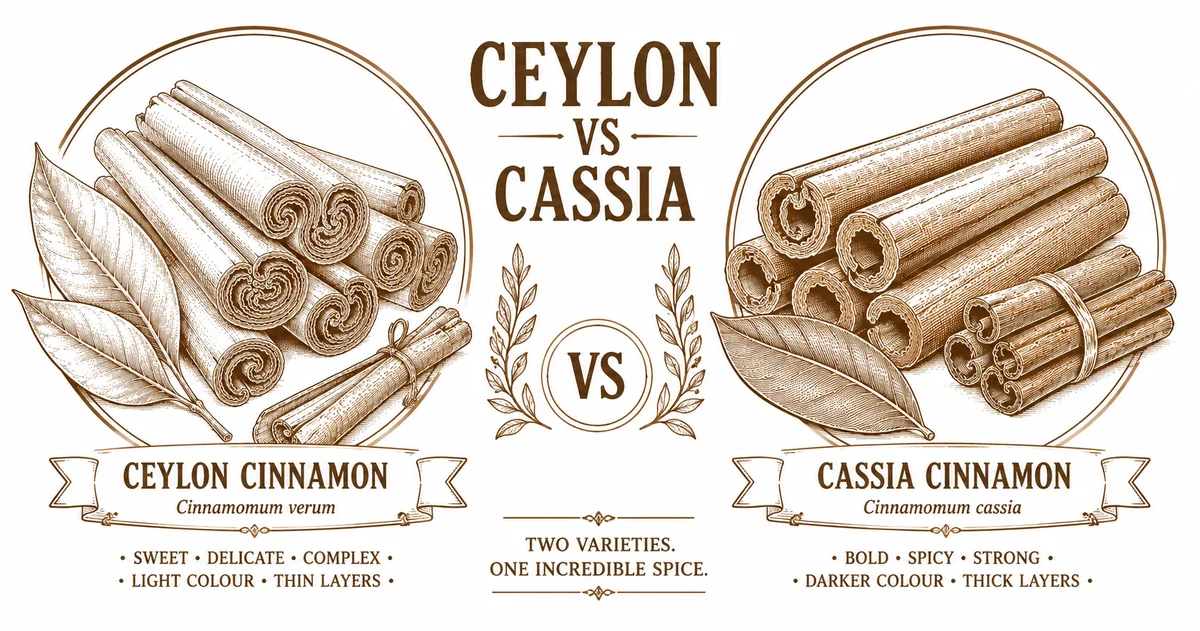
    Ceylon cinnamon is the bark of Cinnamomum verum from Sri Lanka; cassia is the bark of several other Cinnamomum species grown mainly in China, Indonesia and Vietnam. The two look, feel and taste different, and cassia contains far more of the naturally occurring compound coumarin. Ceylon is thin, pale and delicately sweet; cassia is thick, dark and boldly pungent. Knowing which is which changes how you shop and cook.

    Most people never realise there are two very different products sold under the single word “cinnamon.” This guide sets them side by side, botany, origin, appearance, flavour, bark structure, coumarin and culinary use, so you can tell them apart with confidence. For the fundamentals of true cinnamon itself, start with what is true Ceylon cinnamon.

    Quick comparison table

    Ceylon cinnamon vs cassia, the essential differences.
    FeatureCeylon cinnamonCassia cinnamon
    Botanical sourceCinnamomum verum (syn. zeylanicum)C. cassia, C. burmannii, C. loureiroi
    Main originSri LankaChina, Indonesia, Vietnam
    Bark thicknessThin and paperyThick and hard
    Quill shapeMany fine layers rolled togetherSingle thick curl, often hollow
    ColourLight tan / golden brownDark reddish-brown
    TextureBrittle, crumbles easilyHard, snaps or needs a grinder
    Aroma & flavourDelicate, sweet, complexStrong, hot, pungent
    Coumarin contentOnly trace amountsConsiderably higher
    Typical priceHigher (premium)Lower (commodity)

    Botanical differences

    Both belong to the genus Cinnamomum in the laurel family, but they are different species. True cinnamon is a single species, Cinnamomum verum. “Cassia” is a commercial grouping of several species: C. cassia (Chinese cassia), C. burmannii (Indonesian or Korintje cassia) and C. loureiroi (Saigon or Vietnamese cassia). Because they are botanically distinct, their bark develops a different structure and a different balance of aromatic compounds.

    Origin differences

    Ceylon cinnamon is overwhelmingly a product of Sri Lanka, where it has been cultivated and hand-processed for centuries; its name is now protected in the EU as a Geographical Indication tied to the island. Cassia is grown across East and South-East Asia and is produced on a far larger industrial scale, which is a major reason it is cheaper and more widely available. The historical reasons behind Sri Lanka’s association with cinnamon are covered in our history of Ceylon cinnamon.

    Appearance: how to tell them apart by sight

    Place the two side by side and the differences are obvious. A Ceylon quill is light tan and built from many thin layers of soft inner bark rolled tightly together, so the end looks like a coiled cigar. It is fragile and flakes apart easily. A cassia stick is dark reddish-brown, made of a single thick, woody layer curled into a hollow tube, and is hard enough that most people cannot snap it by hand. These cues are the heart of our guide to identifying authentic Ceylon cinnamon.

    Bark structure

    The structural contrast comes from which part of the bark is used and how it is prepared. Ceylon cinnamon uses only the delicate inner bark, scraped free of the outer layers and rolled while pliable into multi-layered quills. Cassia is made from thicker bark that includes more of the woody outer layers, which is why it is harder, less refined in flavour, and forms that characteristic single curl. Understanding this is easier once you have read how Ceylon cinnamon is made.

    Flavour differences

    Ceylon cinnamon tastes sweet, mellow and layered, with soft floral and citrus notes. It flavours a dish without dominating it. Cassia is stronger, hotter and more astringent, with a punchy, almost spicy-sweet bite that carries well through robust bakes and heavily spiced dishes. Neither is “better” in the abstract, they simply suit different purposes, which we look at in the culinary uses of Ceylon cinnamon.

    The coumarin difference

    One of the most discussed differences is coumarin, a naturally occurring aromatic compound present in the bark. Cassia contains substantially more coumarin than Ceylon cinnamon, which carries only trace amounts. Food-safety authorities such as the European Food Safety Authority have established a tolerable daily intake for coumarin, and this is one reason some consumers who use cinnamon frequently, or in large quantities, choose Ceylon. This is a compositional, food-ingredient distinction rather than a health claim.

    Culinary differences: which should you use?

    As a rule of thumb, reach for Ceylon cinnamon where its subtlety can shine, delicate custards and rice puddings, milk and cream dishes, fine pastry, fragrant Sri Lankan and South Indian curries, and drinks where you do not want harshness. Choose cassia where you want a bold, unmistakable cinnamon punch that stands up to sugar and strong flavours, such as cinnamon rolls, robust spice blends and long-cooked stews. Many cooks keep both. If you are buying Ceylon for the first time, our buying guide explains what to look for.

    Why do people confuse Ceylon cinnamon and cassia?

    The confusion is largely a labelling issue. In many countries, both can legally be sold simply as “cinnamon,” with no species named on the jar. Because cassia is cheaper and more plentiful, it makes up the majority of the mass market, so most shoppers have only ever encountered cassia and assume it is the standard. Only when the label specifies Cinnamomum verum, “true cinnamon” or “Ceylon cinnamon,” and names Sri Lanka as the origin, can you be confident you are getting the real thing.

    The different types of cassia

    “Cassia” is not one thing but a family of species, and they vary in their own right:

    • Chinese cassia (C. cassia), the classic cassia, dark and strong, widely used across Asia.
    • Indonesian / Korintje cassia (C. burmannii), the most common cinnamon in North American supermarkets, sweetly pungent.
    • Saigon / Vietnamese cassia (C. loureiroi), the boldest and most intensely flavoured, prized by some bakers for its punch.

    All three are still cassia, thicker-barked, higher in coumarin and more forceful than Ceylon cinnamon. If a premium-priced “cinnamon” names one of these species or simply says “cinnamon,” it is cassia, not true cinnamon.

    Price and availability

    Cassia’s lower price is a direct result of how it is produced: it grows across large areas of Asia, is farmed on an industrial scale, and its thicker bark is easier to harvest and does not require the delicate hand-peeling that Ceylon cinnamon demands. Ceylon cinnamon, grown in a smaller region and processed by skilled peelers as described in how Ceylon cinnamon is made, is naturally scarcer and dearer. This is why cassia dominates supermarket shelves worldwide while true cinnamon is more often found in specialist shops and from dedicated suppliers.

    How to choose between them in practice

    A simple way to decide: if the cinnamon flavour is the star of the dish, a custard, a spiced latte, a delicate cake, a fragrant curry, reach for Ceylon. If cinnamon is a supporting note that needs to punch through sugar, chocolate or strong spices, cassia does the job cheaply. Serious cooks often keep a jar of each: Ceylon for finesse and everyday enjoyment, cassia for occasions that call for a bold hit. Whichever you choose, checking the label for the species and origin, as covered in our identification guide, ensures you know exactly what you are getting.

    Beyond flavour: everyday considerations

    For most households the choice comes down to three practical factors: flavour, frequency of use and budget. If you cook with cinnamon only occasionally and want maximum punch for minimum cost, cassia is perfectly serviceable. If you use cinnamon often, value a refined taste, or simply prefer the very low coumarin content of true cinnamon, Ceylon rewards the modest extra outlay. Neither choice is wrong; they suit different priorities. What matters is knowing which one you are buying, so that the decision is yours to make rather than the supermarket’s to make for you.

    A note on other “cinnamon” products

    The Ceylon-versus-cassia distinction also applies to processed products. Cinnamon powder, cinnamon tea, cinnamon-flavoured baked goods and cinnamon oil can be made from either type, and the label rarely says which. If the species matters to you, look for products that specifically state Ceylon cinnamon or Cinnamomum verum, and treat unlabelled “cinnamon” products as most likely cassia-based. The identification guide and buying guide both help you navigate these products with confidence.

    Summary

    Ceylon cinnamon and cassia are related but genuinely different spices. Ceylon, Cinnamomum verum from Sri Lanka, is thin, pale, brittle, delicately sweet and very low in coumarin. Cassia is thick, dark, hard, boldly pungent and much higher in coumarin, produced cheaply across Asia. Tell them apart by colour, bark structure and texture, and choose between them by the dish: Ceylon for finesse, cassia for punch. When a label does not name the species or origin, it is usually cassia.

    Frequently asked questions

    Is cassia cinnamon bad for you?

    Cassia is a widely used culinary spice. It simply contains more coumarin than Ceylon cinnamon, which is why some people who use cinnamon heavily prefer Ceylon. This is an ingredient-composition point, not medical advice.

    Can I substitute cassia for Ceylon cinnamon?

    Yes, but expect a stronger, hotter flavour from cassia, so you may want to use a little less. For delicate dishes, Ceylon’s subtlety is hard to replace.

    Which cinnamon is in my supermarket?

    Unless the label specifically says Ceylon cinnamon or Cinnamomum verum, it is almost certainly cassia.

    Is Ceylon cinnamon worth the extra cost?

    For its refined flavour, pale delicate quills and low coumarin, many cooks find it well worth it, especially for baking and drinks where the flavour is front and centre.

    This website provides educational information about Ceylon Cinnamon as a spice and food ingredient. It is not intended to provide medical advice or make health claims.