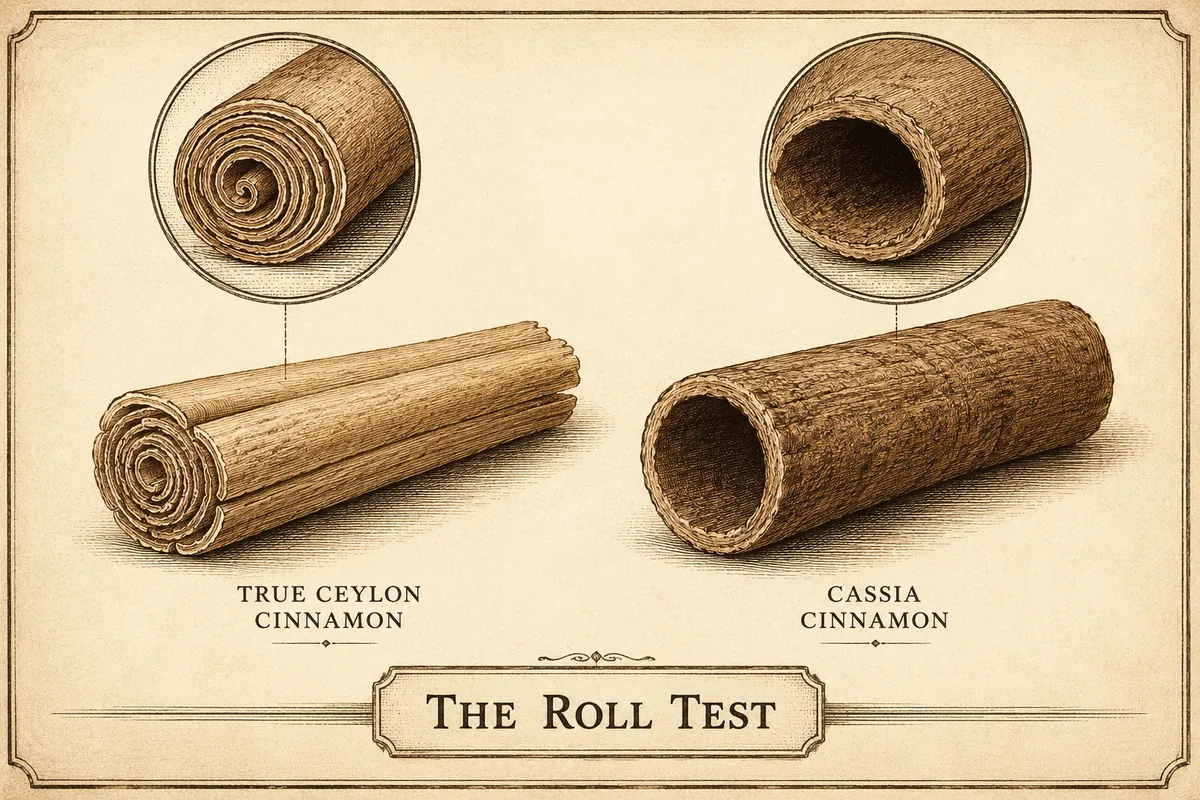
The roll test is a quick, simple way to tell true Ceylon cinnamon from cassia just by looking at the shape of the stick. A Ceylon cinnamon quill is made of many thin, soft layers of bark rolled tightly together, so its cut end looks like a little scroll or a rolled-up cigar. A cassia stick, by contrast, is a single thick, hard layer that curls into one hollow tube. Look at how the bark rolls, and you can usually tell the two apart at a glance.
This test is one of the easiest checks any shopper can do, and it needs no special tools. This guide explains how the roll test works, why the two barks roll so differently, and how to use it alongside other simple checks. It builds on our pillar guide on how to identify real Ceylon cinnamon.
The short answer
Look at the end of the stick: many thin layers rolled up like a scroll means Ceylon cinnamon, while a single thick curl means cassia. True Ceylon cinnamon is made from delicate inner bark layered and rolled by hand, giving a multi-layered quill. Cassia is a thick, tough bark that curls once. This difference in the roll is one of the clearest visual clues to which spice you are holding. It is the kind of detail you only need to see once to remember: after your first side-by-side comparison, the scrolled Ceylon quill and the single-curl cassia stick become instantly recognisable, and you will spot the difference almost without thinking whenever you handle a cinnamon stick.
Why the two barks roll differently
The reason comes down to the bark itself. True Ceylon cinnamon uses only the thin, papery inner bark of the tree, and several fine strips are layered inside one another and rolled together to build a quill. This produces the signature look of many soft, tight layers, a little like a rolled scroll. Cassia uses a much thicker, harder bark, and a single piece curls into one solid tube. So the roll test is really a test of bark thickness and structure, a difference explained further in our guide to what a cinnamon quill is.
How to do the roll test
The test is simple and takes seconds. Pick up the stick and look closely at its cut end and its overall shape.
Look at the end
The clearest sign is the cross-section at the end of the stick. If you see many thin layers curled up together, like the rings of a tiny scroll, it is Ceylon cinnamon. If you see one thick layer forming a single hollow tube, it is cassia.
Look at the whole stick
Ceylon quills are usually pale tan, slender and light, and they often have that rolled, papery, layered look along their length. Cassia sticks are darker reddish brown, thicker, heavier and harder, curling in a single tight roll. The overall shape backs up what you see at the end.
Feel and snap
You can add a touch test. Ceylon cinnamon is brittle and crumbly, and a quill snaps easily into pieces because the thin layers break readily. Cassia is hard and woody and resists snapping. If the stick shatters lightly in your fingers, that points to Ceylon; if it is tough and solid, that points to cassia. This links closely to the checks in our guide on how to spot fake Ceylon cinnamon.
Roll test results at a glance
| Feature | Ceylon cinnamon | Cassia |
|---|---|---|
| Roll shape | Many thin layers, like a scroll | Single thick curl |
| Bark | Thin, papery inner bark | Thick, hard bark |
| Colour | Pale tan brown | Darker reddish brown |
| Weight | Light | Heavier |
| Snap | Brittle, crumbles easily | Hard, resists breaking |
Why the roll test is so useful
The roll test is popular because anyone can do it, anywhere, with no equipment. In a shop, at home or in the kitchen, a quick look at the end of the stick gives a strong hint about which cinnamon you have. It is not a laboratory test, and edge cases exist, but for whole sticks it is one of the fastest and most reliable visual checks. Because cassia is often sold simply as “cinnamon”, this simple habit of looking at the roll can save you from mistaking one for the other, a theme at the heart of our guide to Ceylon cinnamon vs cassia.
When the roll test does not help
The roll test only works on whole sticks. Once cinnamon is ground into powder, the roll is gone, and you cannot use this method; there you have to rely on colour, smell and, above all, the label. Very short or broken pieces can also be harder to read. In these cases, checking that the product is clearly labelled as Ceylon cinnamon or Cinnamomum verum, ideally from Sri Lanka, is the surest guide. For whole quills, though, the roll test remains a quick and handy first check.
The roll test in the shop and the kitchen
One of the best things about the roll test is where you can use it. In a shop, you can hold a jar or packet of whole quills up to the light and look at the ends of the sticks before you buy, choosing the ones with the fine, scrolled, many-layered look. At home, it is a quick way to check what you already have in the cupboard: pull out a stick, look at the end, and you will usually know at once whether it is Ceylon or cassia. It is also a lovely thing to show children or guests, since the difference between a soft, rolled Ceylon scroll and a hard cassia tube is easy to see once it is pointed out. A small habit like this quietly builds your confidence as a buyer.
Combining the roll test with other checks
The roll test is strongest when used alongside a couple of other simple signs. Colour is a good partner: true Ceylon cinnamon tends to be a pale, warm tan, while cassia is a darker reddish brown. Aroma helps too, as Ceylon has a soft, sweet, delicate smell, whereas cassia is sharper and more pungent. And the label is the final word, since only true cinnamon should carry the name Ceylon cinnamon or Cinnamomum verum. Put together, the roll, the colour, the smell and the label give a clear, confident picture, which is exactly the layered approach set out in our pillar guide on how to identify real Ceylon cinnamon.
Frequently asked questions
What is the roll test for cinnamon?
It is a simple visual check that tells Ceylon cinnamon from cassia by the shape of the stick. Ceylon cinnamon has many thin layers rolled together like a scroll, while cassia is a single thick curl. Looking at the rolled end of the stick reveals which one it is.
How can you tell Ceylon cinnamon from cassia by looking?
Look at the end of the stick and its overall form. Many fine layers, a pale colour and a light, brittle feel point to Ceylon cinnamon. A single thick curl, a darker colour and a hard, heavy feel point to cassia.
Does the roll test work on ground cinnamon?
No. The roll test only works on whole sticks, because it relies on seeing how the bark is rolled. For ground cinnamon you must rely on colour, aroma and the label, checking for Ceylon cinnamon or Cinnamomum verum from Sri Lanka.
Is the roll test always accurate?
It is a strong, quick guide for whole sticks, but not a laboratory test. Most Ceylon and cassia sticks are easy to tell apart by their roll, though broken or unusual pieces can be harder to read. Pairing the roll test with colour, smell and the label gives the most confidence.
Summary
The roll test is a fast, no-tools way to tell true Ceylon cinnamon from cassia. Ceylon cinnamon is made from thin inner bark rolled into many soft layers, so its end looks like a little scroll, and the stick is pale, light and brittle. Cassia is a single thick, hard curl, darker and heavier. By looking at the rolled end of a whole stick, and adding a gentle snap test, you can usually tell the two apart in seconds. The method does not work on powder, where the label is your best guide, but for whole quills the roll test is one of the simplest and most useful checks there is. Once you have made it a habit, telling true Ceylon cinnamon from cassia becomes second nature every time you shop or cook.
This website provides educational information about Ceylon Cinnamon as a spice and food ingredient. It is not intended to provide medical advice or make health claims.
Leave a Reply