Tag: Cinnamon quills

  • Cinnamon Quills vs Cinnamon Sticks: Same Thing?

    Cinnamon Quills vs Cinnamon Sticks: Same Thing?

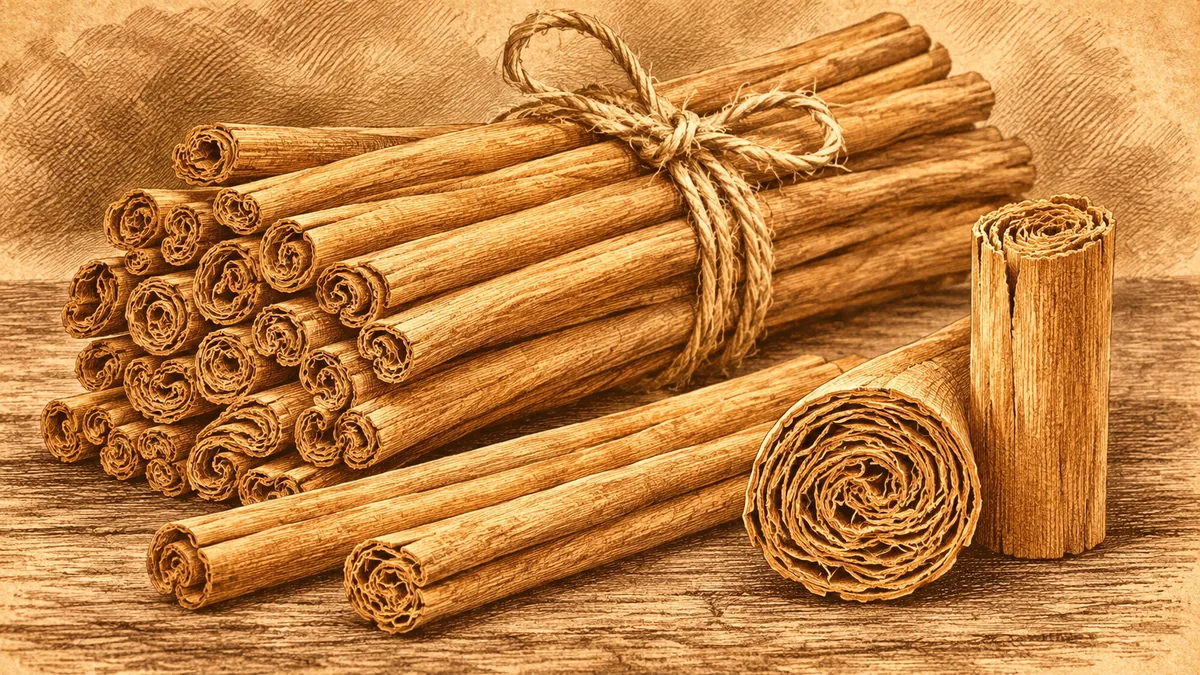
    Cinnamon quills and cinnamon sticks are essentially the same thing: both are rolled tubes of dried cinnamon bark. “Quill” is the traditional trade term for the rolled bark of true cinnamon, Cinnamomum verum, from Sri Lanka, while “stick” is the everyday word most shoppers use. So a Ceylon cinnamon quill is a cinnamon stick, though the word quill is most often used for the fine, many-layered rolls of true Ceylon cinnamon, and “stick” is used loosely for any rolled cinnamon, including thick cassia.

    If you have seen cinnamon sold as both “quills” and “sticks” and wondered whether they differ, the short answer is that they are the same form under two names. This guide explains the terms, where they come from, and the small distinctions worth knowing. It builds on our pillar guide to Ceylon cinnamon grades.

    The short answer

    A cinnamon quill and a cinnamon stick are the same thing, a rolled tube of dried cinnamon bark; quill is the traditional trade name and stick is the common everyday name. In the Ceylon cinnamon trade, the rolled bark is called a quill, and quills are graded by their quality and size. In shops and recipes, the same rolls are usually called sticks. The only nuance is that quill almost always refers to genuine Ceylon cinnamon, while stick is used more loosely for any rolled cinnamon, true or cassia. In practice, if you buy Ceylon cinnamon quills or Ceylon cinnamon sticks, you are buying the same form.

    What a quill is

    A quill is the name given to the rolled, dried inner bark of the cinnamon tree. When Ceylon cinnamon is made, thin pieces of peeled inner bark are rolled together into long tubes, which are dried and cut to length. These tubes are the quills. The word comes from the way the rolled bark resembles a writing quill or a hollow reed. In the Ceylon cinnamon trade, quill is the standard term, and it is used in grading and export. Our guide to the definition and origin of the cinnamon quill looks at the word and the form in more detail.

    What a stick is

    A stick is simply the common name for the same rolled tube of cinnamon bark. When you buy cinnamon sticks in a supermarket, you are buying quills under a more familiar name. The word stick describes the shape well for everyday use, and most cooks and recipes use it. Because stick is a loose, general word, it is applied to any rolled cinnamon, whether it is fine Ceylon cinnamon or the thicker, harder cassia. So while every quill is a stick, not every stick sold as cinnamon is a true Ceylon quill, which is where a little care with labels helps.

    TermWhat it means
    QuillTrade name for rolled cinnamon bark, usually Ceylon
    StickEveryday name for the same rolled form
    Same form?Yes, both are rolled tubes of dried bark
    Usual use of “quill”Genuine Ceylon cinnamon, in the trade
    Usual use of “stick”Any rolled cinnamon, Ceylon or cassia

    Why there are two words

    The two names exist because cinnamon is spoken of in two worlds: the trade and the kitchen. In the growing and export trade of Sri Lanka, the rolled bark has long been called a quill, and the term carries into grading, where quills are sorted by quality and diameter. In everyday shopping and cooking, people naturally call the same thing a stick, because that is what it looks like. Neither word is wrong; they simply come from different settings. Knowing that they mean the same form helps when you see Ceylon cinnamon described either way.

    The difference that does matter

    While quill and stick describe the same form, the real difference to watch is not the word but the type of cinnamon. True Ceylon cinnamon quills are thin and soft, made of many fine layers rolled together, and they crumble easily. Cassia sticks are thick, hard and usually a single curl of coarse bark. Both may be sold loosely as cinnamon sticks, so the useful question is not quill versus stick but Ceylon versus cassia. Our guide to how cinnamon quills are rolled by hand shows how the fine Ceylon quills are made, which is part of what sets them apart.

    Quills, quillings, featherings and chips

    Within the Ceylon cinnamon trade, quill is one of several terms for the different forms the bark takes. Alongside whole quills there are quillings, which are the broken pieces of quill, featherings, which are the thin shavings and inner bark too small to roll, and chips, which are rough pieces of outer bark. These are all graded and sold for different uses. So while a shopper mainly meets the whole quill, or stick, the trade recognises a family of related forms. Our glossary of feathering, quilling and chips explains these terms.

    How quills are sized and sold

    In the Ceylon cinnamon trade, quills are not just rolled and sold as they are; they are cut to standard lengths and sorted. Long tubes of rolled bark are trimmed to a set length for export, and the pieces are then graded by their diameter and quality, with finer, thinner quills reaching the higher grades. This is why the word quill carries weight in the trade: it is the unit that grading and pricing are built around. A shopper who buys a few cinnamon sticks is, in trade terms, buying short lengths of graded quill. Knowing this connects the familiar kitchen stick to the graded quill of the export trade, which our pillar guide to Ceylon cinnamon grades sets out in full.

    Where you will see each word

    In practice, the word you meet depends on where you are looking. On a supermarket shelf or in a recipe, you will almost always see cinnamon sticks. On a specialist spice seller’s site, in writing about Sri Lankan cinnamon, or on an export grade description, you will see quills. Some sellers of genuine Ceylon cinnamon deliberately use the word quill to signal that they are offering the true, trade-grade article rather than loose supermarket cinnamon. So while the two words mean the same form, the choice of word can sometimes hint at how close the seller is to the Ceylon cinnamon trade, though it is never a guarantee on its own.

    Which word should you use

    For everyday purposes, either word is fine, and stick is perfectly clear. If you are reading about the cinnamon trade, grades or Sri Lankan production, you will see quill, and it means the same rolled form you know as a stick. The practical advice is to focus less on the choice of word and more on whether the cinnamon is genuine Ceylon cinnamon. Whether a seller calls it a Ceylon cinnamon quill or a Ceylon cinnamon stick, what matters is that it is true Cinnamomum verum from Sri Lanka, thin and many-layered, rather than thick cassia under a loose name.

    Summary

    Cinnamon quills and cinnamon sticks are the same thing: rolled tubes of dried cinnamon bark. Quill is the traditional trade name, used in the Ceylon cinnamon industry and in grading, while stick is the everyday word used by shoppers and cooks. The two terms come from different settings, the trade and the kitchen, but describe one form. The only nuance is that quill almost always means genuine Ceylon cinnamon, Cinnamomum verum, whereas stick is applied loosely to any rolled cinnamon, including cassia. The difference worth attention is therefore not quill versus stick but Ceylon versus cassia: true Ceylon quills are thin, soft and many-layered, while cassia is thick and hard. Whichever word you meet, look for genuine Ceylon cinnamon from Sri Lanka.

    Frequently asked questions

    Are cinnamon quills and cinnamon sticks the same?

    Yes. Both are rolled tubes of dried cinnamon bark. Quill is the traditional trade name, especially for true Ceylon cinnamon, and stick is the everyday name for the same form. If you buy Ceylon cinnamon quills or sticks, you are buying the same thing.

    Why is Ceylon cinnamon called a quill?

    Because the rolled, dried inner bark resembles a writing quill or hollow reed. In the Ceylon cinnamon trade, quill is the standard term for this rolled form, and quills are graded by quality and size for sale and export.

    Is there any difference between a quill and a stick?

    Not in form, since both are rolled cinnamon bark. The small nuance is that quill usually refers to genuine Ceylon cinnamon, while stick is used loosely for any rolled cinnamon, including cassia. So the real difference to check is Ceylon versus cassia, not quill versus stick.

    Are cinnamon sticks always Ceylon cinnamon?

    No. The word stick is used for any rolled cinnamon, so a cinnamon stick may be true Ceylon cinnamon or the thicker, harder cassia. True Ceylon sticks, or quills, are thin and made of many fine layers, while cassia is usually a single thick curl.

    Should I buy quills or sticks?

    They are the same form, so the choice of word does not matter. What matters is buying genuine Ceylon cinnamon, Cinnamomum verum from Sri Lanka. Look for the species name and origin, and for thin, many-layered rolls, whether they are sold as quills or sticks.

    This website provides educational information about Ceylon Cinnamon as a spice and food ingredient. It is not intended to provide medical advice or make health claims.
  • Mexican Grade Ceylon Cinnamon Explained

    Mexican Grade Ceylon Cinnamon Explained

    Mexican grade Ceylon cinnamon is a mid-range grade of true cinnamon, Cinnamomum verum, from Sri Lanka. In the traditional grading scale it sits between the finer Continental grades and the thicker Hamburg grades, so its quills are a little thicker than Alba and Continental but thinner than Hamburg. The name comes from the export market these quills were historically sent to, not from Mexico as an origin. Mexican grade offers a good balance of quality and value, making it a practical everyday choice.

    If you have seen “Mexican” on a Ceylon cinnamon label and wondered what it means, this guide explains the grade in plain terms: where it sits, what the quills are like and when to choose it. It builds on our pillar guide, the complete guide to Ceylon cinnamon grades.

    The short answer

    Mexican grade Ceylon cinnamon is a middle grade of true cinnamon whose quills are thicker than Alba and Continental but thinner than Hamburg. It is still true Ceylon cinnamon, Cinnamomum verum, from Sri Lanka, with the same mild, sweet flavour; the grade simply describes the thickness and appearance of the quill. The “Mexican” name is a traditional export-market label, not a country of origin.

    Where Mexican grade sits in the scale

    Ceylon cinnamon is graded mainly by the thickness of the quill, from the finest and thinnest to the coarsest. The traditional names, from fine to thick, run Alba, then the Continental group, then the Mexican group, and then the Hamburg group. Mexican grade therefore sits in the middle: its quills are noticeably thicker than the delicate Alba and Continental grades, but they are still finer than the heavier Hamburg quills. Thinking of it as the mid-point of the scale is the easiest way to place it. For a plain-language run-through of all these terms, see our guide to cinnamon grading terms made simple.

    Why it is called “Mexican”

    The grade name can be confusing because it sounds like an origin. In fact, Mexican grade Ceylon cinnamon is still grown and made in Sri Lanka like all true cinnamon. The traditional grade names, including Continental, Mexican and Hamburg, were shaped by the export markets that each thickness of quill was historically shipped to. “Mexican” marked the quills destined for that market, and the label stuck as a grade name. So the word describes the grade, not where the cinnamon comes from. The origin is still Sri Lanka, the home of Cinnamomum verum.

    What Mexican grade quills are like

    Mexican grade quills are medium in thickness. They are rolled from the inner bark in the same way as finer grades, but because the bark is a little thicker, the quills are slightly sturdier and less delicate than Alba or Continental. The colour is the familiar tan of true cinnamon, and the flavour is the same mild, sweet, lightly citrus taste that defines Ceylon cinnamon, since the grade reflects thickness and appearance rather than a change in flavour. For everyday cooking, this sturdiness can even be an advantage, as the quills hold up well to simmering.

    How Mexican grade compares with other grades

    Compared with Alba, the finest grade, Mexican grade has thicker, less delicate quills and a lower price, while still being true Ceylon cinnamon. Compared with Continental, it is a step thicker and a little sturdier. Compared with Hamburg, the thickest of the main groups, Mexican grade is finer and neater. In flavour, all these grades share the mild, sweet character of true cinnamon, so the differences are mainly about quill thickness, appearance and price rather than taste. Our guide to Continental grade Ceylon cinnamon covers the grade just above Mexican in the scale.

    How the grade is measured

    Like other Ceylon cinnamon grades, Mexican grade is defined mainly by quill diameter rather than by a vague sense of quality. Sri Lanka’s long-standing grading rules set out the thickness ranges that place a quill in one group or another, so a grade name points to a measurable feature. This is why Mexican grade means roughly the same thing from one careful seller to the next, rather than being a loose description. When you see the grade on a reputable pack, it reflects this shared system, which is part of what makes Ceylon cinnamon a carefully sorted spice. The code grades, such as the C and H systems, describe the same thickness idea in an even more exact, numbered way.

    Where you will see Mexican grade

    Mexican grade turns up on packs of whole Ceylon cinnamon quills, often sold for everyday kitchen use rather than as a premium gift grade. On a label it usually sits alongside the species name and origin, so you might read “Ceylon cinnamon, Cinnamomum verum, Mexican grade, product of Sri Lanka”. Here the species and origin confirm it is true cinnamon, and the grade tells you the quills are a medium thickness. Because it balances quality and price, Mexican grade is a common choice for cooks who use cinnamon regularly and want genuine Ceylon cinnamon without paying the premium for the very finest Alba quills.

    Mexican grade at a glance

    FeatureMexican grade
    TypeTrue Ceylon cinnamon, Cinnamomum verum
    OriginSri Lanka
    Position in scaleMiddle: thicker than Continental, thinner than Hamburg
    QuillMedium thickness, fairly sturdy
    FlavourMild, sweet, lightly citrus
    Best forEveryday cooking and good value

    When to choose Mexican grade

    Mexican grade is a sensible choice when you want true Ceylon cinnamon at a fair price and do not need the very finest quills. It suits everyday cooking, simmering in syrups, stews and drinks, and any dish where the cinnamon is used for its flavour rather than shown off. The sturdier quills stand up well to long simmering, and the lower price compared with Alba makes it easy to use freely. If you want the most delicate quills for a special dish or for presentation, a finer grade such as Alba or C5 Special is worth the extra cost; for most home cooking, though, Mexican grade does the job well. Our guide to C5 Special Ceylon cinnamon covers one of those finer grades.

    Is Mexican grade good quality?

    Yes, Mexican grade is good quality true cinnamon. It is easy to assume that a middle grade means lower quality, but the grade reflects the thickness of the quill rather than whether the cinnamon is good or bad. Mexican grade is still Cinnamomum verum from Sri Lanka, with the same mild, sweet flavour as the finest grades. What you trade for the lower price is the very fine, delicate appearance of Alba, not the character or taste of the spice. For a cook who cares about flavour and value more than the look of the quill, Mexican grade is a strong choice. In practice, many people cannot tell the difference in a finished dish, since the flavour comes through the same way once the quill is simmered or ground. The main place a finer grade shows its advantage is on the plate, where its neat, slender quills look more elegant.

    Frequently asked questions

    Is Mexican grade cinnamon from Mexico?

    No. Mexican grade Ceylon cinnamon is grown and made in Sri Lanka, like all true cinnamon. “Mexican” is a traditional grade name tied to the export market the quills were historically sent to, not a country of origin. The cinnamon itself is Cinnamomum verum from Sri Lanka.

    Is Mexican grade better than Alba?

    Alba is finer, with thinner, more delicate quills, so it sits higher in the grading scale. Mexican grade has thicker quills and a lower price. Neither tastes better, since both are true Ceylon cinnamon; Alba is finer in appearance, while Mexican grade offers better everyday value.

    Does Mexican grade taste different?

    No. Mexican grade has the same mild, sweet, lightly citrus flavour as other grades of true Ceylon cinnamon. The grade describes the thickness and appearance of the quill, not the flavour, so a mid grade tastes much the same as a finer one.

    Is Mexican grade good value?

    Yes. Mexican grade is often good value, giving you genuine Ceylon cinnamon at a lower price than the finest grades. It suits everyday cooking well, and the sturdier quills hold up to simmering, so it is an economical way to use true cinnamon regularly.

    Summary

    Mexican grade Ceylon cinnamon is a mid-range grade of true cinnamon, Cinnamomum verum, from Sri Lanka, with quills thicker than Alba and Continental but thinner than Hamburg. The name reflects a traditional export market rather than a country of origin, so the cinnamon is still Sri Lankan. It has the same mild, sweet flavour as finer grades, with sturdier quills that suit everyday cooking, and it offers good value. For delicate presentation, a finer grade is worth it, but for flavour and everyday use, Mexican grade is a practical, good-quality choice.

    This website provides educational information about Ceylon Cinnamon as a spice and food ingredient. It is not intended to provide medical advice or make health claims.
  • How Cinnamon Quills Are Rolled by Hand

    How Cinnamon Quills Are Rolled by Hand

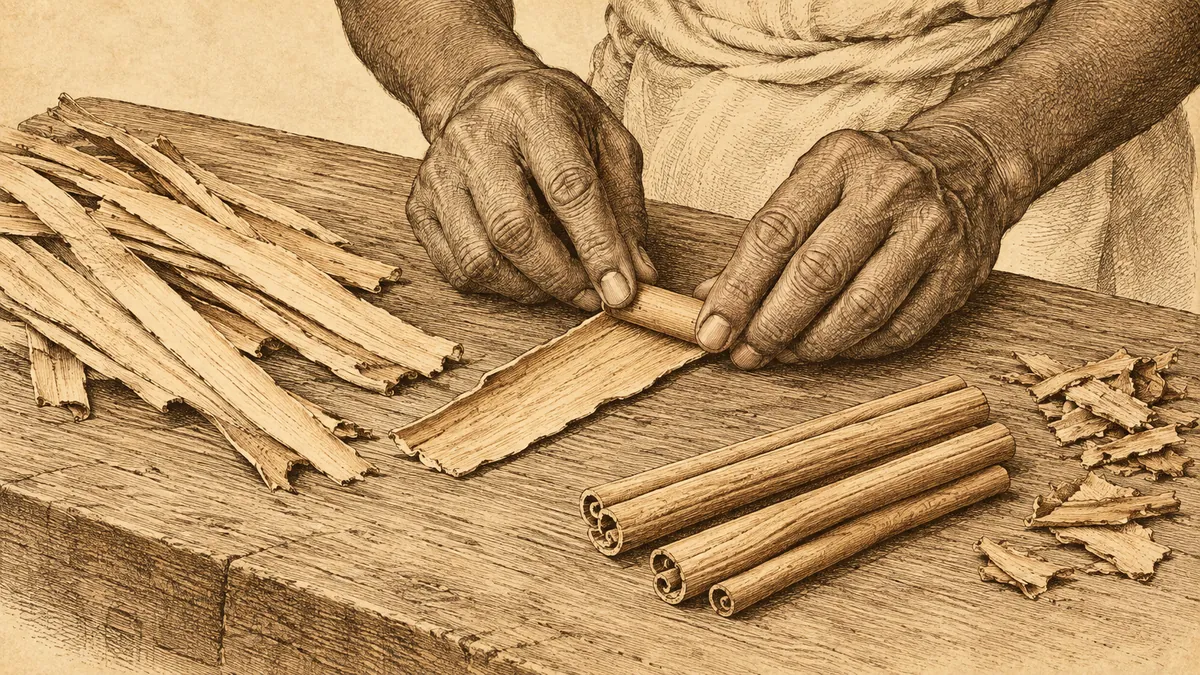
    Cinnamon quills are rolled by hand from strips of the peeled inner bark of the true cinnamon tree, Cinnamomum verum. After the bark is peeled and lightly dried, a skilled worker nests smaller strips inside larger ones and rolls them into a long, tight tube, joining piece after piece end to end to build a quill that can reach around 42 inches. As the rolled bark dries further it shrinks and tightens into the familiar cinnamon stick. This hand rolling is one of the most skilled steps in making Ceylon cinnamon, and it is done almost entirely by hand rather than by machine.

    The rolled cinnamon quill is the signature form of true cinnamon, and the way it is made by hand is part of what sets Ceylon cinnamon apart. This guide explains the process step by step. It builds on our pillar guide to how Ceylon cinnamon is made.

    The short answer

    Cinnamon quills are made by hand-rolling strips of peeled inner bark into long tubes, nesting smaller pieces inside larger ones and joining them end to end, then drying the rolls so they tighten into sticks. A skilled cinnamon worker peels the fine inner bark, lets it wilt slightly, and rolls it on a flat surface into a continuous quill. The quills are then dried, during which the bark curls and firms into the neat rolled sticks sold as Ceylon cinnamon.

    From peeled bark to rolled quill

    Rolling begins only after the bark has been prepared. The outer bark is scraped away and the fine inner bark is carefully peeled off in strips, a delicate job described in our guide to traditional cinnamon peeling methods. These thin, flexible strips of inner bark are the raw material for the quills. They are usually left for a short time so they lose a little moisture and become easier to handle, and it is these strips that the worker then rolls into shape.

    The nesting technique

    The key to a good quill is a technique often described as pipe within a pipe. Rather than rolling a single strip into a hollow tube, the worker places smaller strips and offcuts of inner bark inside the roll as it is formed. This filling holds the tube together, keeps its shape and makes the quill solid rather than empty. As the bark dries and shrinks, the nested pieces bind together into one firm stick. This is why a true Ceylon cinnamon quill is made of many thin layers packed together, which is one of the features that helps tell it apart from the thicker, single-layer bark of cassia.

    Building a long quill

    A single strip of bark is not long enough to make a full quill on its own, so the worker joins strips end to end as they roll. Piece after piece is added, each one continuing the roll, until a long, continuous quill is built up. Traditionally these are made to standard lengths, commonly around 42 inches or 21 inches, which are later trimmed to the sizes buyers want. The result is a long, even tube of tightly rolled bark, which is the classic form of Ceylon cinnamon before it is cut into shorter sticks.

    Rolling and drying

    The rolling itself is done on a flat surface, using the hands and simple tools, with the worker pressing and turning the bark so it curls into a firm, even roll. Once formed, the quills are set out to dry, usually in shade and air rather than harsh sun, so they dry slowly and keep their pale colour. During drying the bark loses moisture, shrinks and curls more tightly, so the quill firms up into a hard stick that holds its shape. Careful drying at this stage is important for the colour, firmness and keeping quality of the finished cinnamon. Rushed or overly hot drying can darken or crack the quills, so the slow, shaded method is preferred where the finest pale quills are wanted.

    The steps at a glance

    The main steps in hand-rolling Ceylon cinnamon quills.
    StepWhat happens
    PeelingThe fine inner bark is peeled off in strips
    WiltingStrips lose a little moisture and become easier to roll
    NestingSmaller pieces are placed inside the roll to fill it
    RollingStrips are rolled and joined end to end into a long quill
    DryingThe quills dry, shrink and tighten into firm sticks

    Why it is skilled work

    Hand-rolling cinnamon is a craft that takes practice to do well. The worker has to judge the moisture of the bark, roll it tightly and evenly, nest the filling neatly and join the strips smoothly, all by feel. A well-made quill is thin, even, tightly rolled and free of gaps, while a poorly rolled one is loose or uneven. Because the neatness and thinness of the quill affect its grade, the skill of the roller has a direct effect on the value of the cinnamon, a link described in our guide to featherings, quillings and chips, the smaller grades that come from the same process. A practised roller can produce a steady stream of even, well-formed quills, while the pieces that are too small or break along the way are set aside as the lower grades. In this sense the quality of a batch of cinnamon is decided partly at the rolling bench, by the hands and judgement of the person shaping each quill.

    Hand-rolled, not machine-made

    One of the striking things about Ceylon cinnamon is that this rolling is still done by hand. There is no simple machine that can peel the delicate inner bark and roll it into fine quills the way a trained worker can, so the craft has been passed down through generations of cinnamon workers in Sri Lanka. This is part of why true Ceylon cinnamon carries the character it does, and part of why it is more costly than mass-produced cassia. The rolled quill you hold is the product of skilled hands, not a factory line.

    What the rolled quill tells you

    The finished quill is also a useful sign of authenticity. A true Ceylon cinnamon quill is thin and light, made of many soft layers rolled together, so it looks like a tightly wound cigar and can be crumbled fairly easily. This layered, hand-rolled structure comes directly from the process described above. It is quite different from cassia, which is usually a thick, hard, single curl of bark. So understanding how quills are rolled by hand also helps you recognise the real thing, as covered in our guide to what a cinnamon quill is.

    Frequently asked questions

    How are cinnamon quills made?

    Cinnamon quills are made by hand-rolling strips of peeled inner bark into long tubes. A skilled worker nests smaller pieces inside larger ones, rolls the bark on a flat surface and joins strips end to end, then dries the rolls so they shrink and tighten into firm sticks.

    Why are cinnamon quills rolled by hand?

    The fine inner bark of true cinnamon is delicate and must be peeled and rolled with care, which no simple machine does as well as a trained worker. So Ceylon cinnamon quills are still rolled by hand, a craft passed down through generations of cinnamon workers in Sri Lanka.

    How long is a cinnamon quill?

    Traditionally, quills are rolled to standard lengths of around 42 inches or 21 inches, built up by joining many strips of bark end to end. They are then cut to the shorter lengths that buyers want, so the sticks you buy are pieces of these longer quills.

    Why are Ceylon cinnamon quills made of many layers?

    Because of the nesting, or pipe within a pipe, technique. Smaller strips are placed inside the roll as it is formed, so the finished quill is made of many thin layers packed together. This layered structure is one of the features that tells true Ceylon cinnamon apart from cassia.

    Summary

    Cinnamon quills are rolled by hand from strips of the peeled inner bark of Cinnamomum verum. After peeling, the strips are lightly wilted, then rolled on a flat surface using a nesting technique that places smaller pieces inside the roll, joined end to end to build a long, continuous quill of around 42 or 21 inches. As the rolled bark dries, it shrinks and curls into a firm stick made of many thin layers. This is skilled manual work, still done by hand rather than by machine, and the neatness of the roll affects the grade. The layered, hand-rolled quill is both the classic form of Ceylon cinnamon and one of the clearest signs that it is the genuine true cinnamon.

    This website provides educational information about Ceylon Cinnamon as a spice and food ingredient. It is not intended to provide medical advice or make health claims.
  • Continental Grade Ceylon Cinnamon Explained

    Continental Grade Ceylon Cinnamon Explained

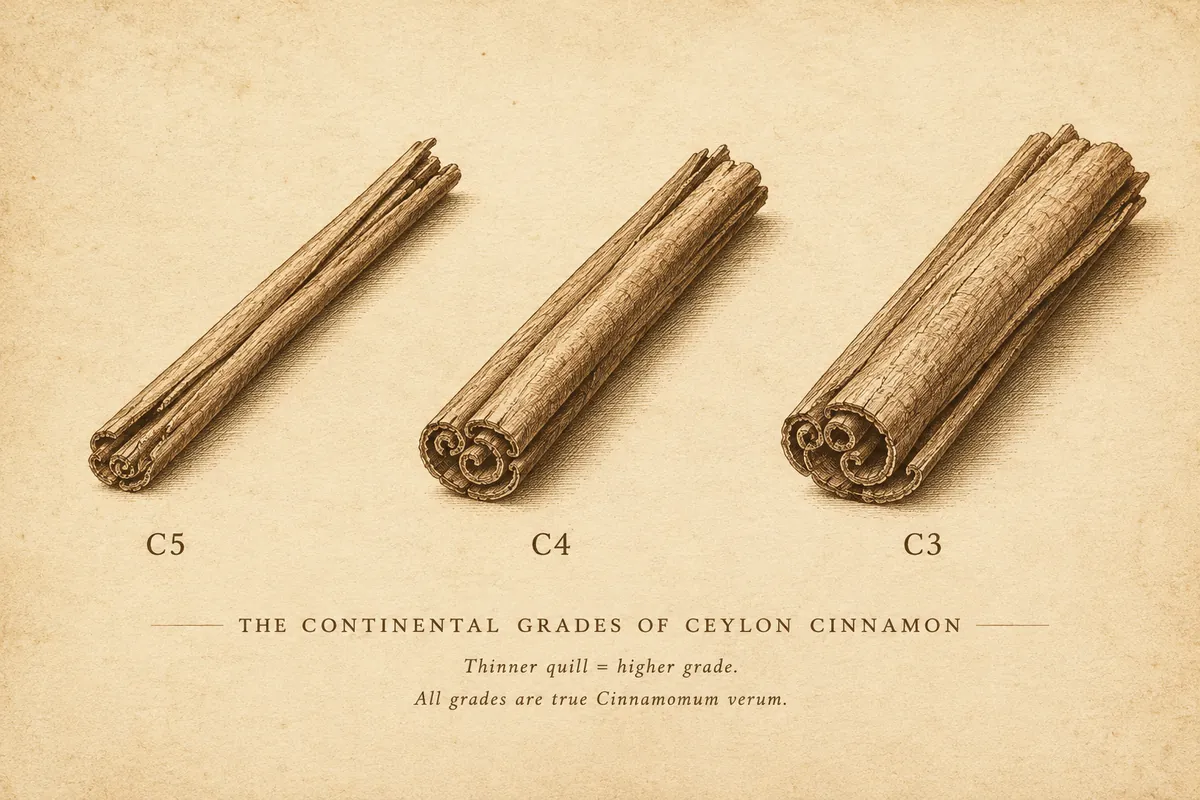
    Continental grade Ceylon cinnamon is one of the main quality groups of true cinnamon quills, sitting just below the finest Alba grade and above the coarser Mexican and Hamburg grades. The name is often shortened to the letter “C”, and the group includes the well known sub-grades C5 Special, C5, C4 and C3, where a higher number means a thinner, finer quill. Continental quills are neat, moderately thin rolls of the inner bark of Cinnamomum verum from Sri Lanka, and they are among the most widely traded grades of Ceylon cinnamon.

    If you have seen codes like “C5” on a bag of cinnamon and wondered what they mean, this guide explains the Continental grade and where it fits. It builds on our full guide to Ceylon cinnamon grades.

    The short answer

    Continental grade is a group of Ceylon cinnamon quill grades, marked with a “C”, that sit between the top Alba grade and the thicker Mexican and Hamburg grades. Within the Continental group, quills are ranked by how thin they are, using codes such as C5 Special, C5, C4 and C3, with the higher numbers being the thinner and finer quills. Continental cinnamon is good quality true cinnamon, popular for everyday use because it balances fine character with a sensible price.

    What “Continental” means in cinnamon grading

    Ceylon cinnamon quills are sorted into named grade groups based on their thickness and appearance. The main groups, from finest to coarsest, are Alba, Continental, Mexican and Hamburg. Continental is the second group, so it is a high grade but not the very finest. The word itself is simply the traditional trade name for this group, and it is usually written as the single letter C on grade codes. So when you see a Ceylon cinnamon grade beginning with C, it belongs to the Continental family.

    The C sub-grades explained

    Within the Continental group there are several sub-grades, and this is where the numbers come in. The quills are graded by diameter, which is measured across the rolled stick. Thinner quills are considered finer and sit higher in the grading, so the sub-grades run in order of thickness.

    The common Continental sub-grades are C5 Special, C5, C4 and C3. C5 Special is the thinnest and finest of the Continental quills, close in quality to the top Alba grade, which is why it is prized. As the number falls from C5 to C3, the quills get gradually thicker. All of them are still good quality true cinnamon; the number simply tells you how thin and refined the quill is. Our detailed guide to C5 Special Ceylon cinnamon looks at the top Continental grade in depth.

    How Continental compares with the other grades

    It helps to see the Continental group next to the others. The four main grade groups differ mainly in the thickness of the quills, which affects their fineness and price.

    The main Ceylon cinnamon quill grade groups compared.
    Grade groupRelative thicknessFinenessTypical position
    AlbaThinnestFinestTop grade, premium
    Continental (C)Thin to mediumHighFine everyday grade
    Mexican (M)MediumGoodMid grade
    Hamburg (H)ThickestCoarserLower grade

    As the table shows, Continental sits near the top. It is finer than the Mexican and Hamburg grades and only a step below Alba. This is why Continental grades, and C5 in particular, are a popular choice for people who want fine true cinnamon without paying the premium for Alba.

    How Continental grade quills are judged

    The grading of Continental cinnamon is based mainly on the diameter of the quills, but a few other things matter too. Graders look at how thin and even the quills are, how neatly they are rolled, their colour, and how free they are of blemishes. A fine Continental quill is thin, smooth, pale tan in colour and tightly rolled. Because the grade is tied to thickness, thinner quills reach the higher C numbers. The result is a clear, consistent system that lets buyers know what to expect from a given grade code without seeing the cinnamon in person.

    What Continental grade is used for

    Continental grade Ceylon cinnamon is a versatile, everyday grade. It is fine enough to be enjoyed as whole quills in cooking, drinks and desserts, yet more affordable than the top Alba grade, so it is a common choice for home cooks and for retail packs of Ceylon cinnamon sticks. The thinner Continental quills, such as C5 Special and C5, are often chosen where appearance and delicacy matter, while the slightly thicker C4 and C3 are practical all-rounders. Whichever sub-grade you choose, you are getting genuine Cinnamomum verum, so the flavour and aroma are the fine, sweet, delicate character of true cinnamon. For most kitchens, a Continental grade strikes a comfortable middle ground: the quills look attractive in a jar or on a plate, they grind and steep well, and they do not cost as much as the rarest Alba sticks. This is a large part of why Continental cinnamon, and C5 in particular, is so widely stocked by retailers around the world.

    Continental grade on labels

    You will most often meet the Continental grade as a short code on a label or a supplier’s grade list, such as “C5” or “C5 Special”. Some sellers write out “Continental” in full, while others use only the letter and number. If you see a Ceylon cinnamon product marked with a C code, you now know it is a Continental grade and roughly where it sits: a fine quill, close to the top of the range. When a label gives both the grade and the species, Cinnamomum verum, together, it is telling you two useful things at once, the exact grade of the quills and that they are genuine true cinnamon. If a product only says “cinnamon” with no grade or species, there is less to go on, so the grade codes are a helpful sign of a seller who is open about what they sell.

    Continental grade and quality

    It is worth repeating that grade and quality are not quite the same thing. The Continental grade tells you about the thickness and neatness of the quills, not whether the cinnamon is genuine. A C3 quill of true Ceylon cinnamon is still real, fine cinnamon, while a thick, cheap stick of cassia is not, whatever it looks like. So the most important checks remain the species and origin: genuine Cinnamomum verum from Sri Lanka. Once you know you have true cinnamon, the Continental grade then tells you how thin and refined the particular quills are, which relates to the wider family of small grades and by-products covered in our glossary of featherings, quillings and chips.

    Frequently asked questions

    What is Continental grade Ceylon cinnamon?

    Continental grade is one of the main groups of Ceylon cinnamon quill grades, marked with a C. It sits below the finest Alba grade and above the coarser Mexican and Hamburg grades, and it includes sub-grades such as C5 Special, C5, C4 and C3, ranked by how thin the quills are.

    What do the C numbers mean?

    The C stands for Continental, and the number refers to the thickness of the quill. Higher numbers, such as C5, are thinner and finer, while lower numbers, such as C3, are slightly thicker. C5 Special is the thinnest and finest of the Continental grades.

    Is Continental grade good quality?

    Yes. Continental is a high grade of true Ceylon cinnamon, second only to Alba among the main groups. It is finer than the Mexican and Hamburg grades and is a popular everyday choice because it balances fine quality with a sensible price.

    Is Continental grade better than Alba?

    Alba is the top grade, with the thinnest quills, so it is graded higher than Continental. Continental, especially C5 Special, comes close to Alba in fineness at a lower price. Both are genuine Cinnamomum verum, so the difference is mainly in the thinness and neatness of the quills, not in whether the cinnamon is true.

    Summary

    Continental grade is one of the four main grade groups of Ceylon cinnamon quills, marked with the letter C and sitting just below the finest Alba grade, above the coarser Mexican and Hamburg grades. Within the Continental group, quills are ranked by thickness using codes such as C5 Special, C5, C4 and C3, where higher numbers mean thinner, finer quills and C5 Special is the top of the group. Continental cinnamon is fine, good quality true cinnamon from Cinnamomum verum, popular as an everyday grade because it offers much of the delicacy of Alba at a more accessible price. As always, the grade describes the thinness and neatness of the quills, while the species and Sri Lankan origin are what confirm that it is genuine Ceylon cinnamon.

    This website provides educational information about Ceylon Cinnamon as a spice and food ingredient. It is not intended to provide medical advice or make health claims.

  • Feathering, Quilling and Chips: A Glossary

    Feathering, Quilling and Chips: A Glossary

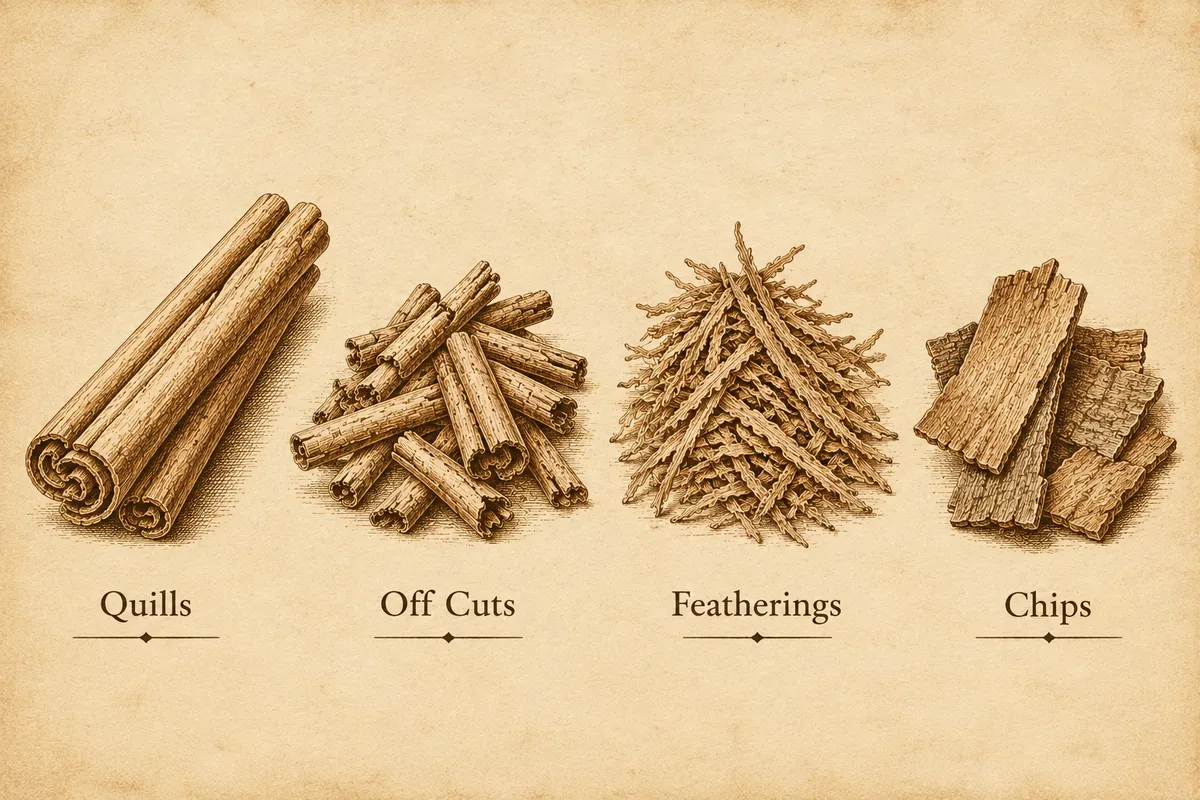
    Off cuts, featherings, quillings and chips are the smaller grades and by-products of Ceylon cinnamon, made from the pieces that are left over when the prime rolled quills are formed and trimmed to size. Off cuts are the short pieces cut off when a quill is trimmed to a customer’s required length; featherings are the thin, feathery inner-bark shavings; quillings are the broken fragments of quills; and chips are the flat pieces of bark that cannot be rolled. All come from the same true cinnamon tree, Cinnamomum verum, and are mostly ground into powder or distilled for oil rather than sold as whole sticks.

    These three words appear on grade lists and in the cinnamon trade, and they often confuse newcomers. This short glossary explains what each one means and how they relate to the familiar cinnamon quill. It builds on our full guide to Ceylon cinnamon grades.

    The short answer

    Off cuts, featherings, quillings and chips are the smaller, lower grades of Ceylon cinnamon left over from making and trimming quills. Off cuts are the pieces cut off when a quill is trimmed to a set length, quillings are broken bits of quill, featherings are thin feathery shavings and small inner-bark curls, and chips are flat pieces of bark that were never rolled. None of them are waste: they carry the same aroma and flavour as the prime quills and are widely used, mostly after grinding or distillation.

    Starting point: the cinnamon quill

    To understand these terms, it helps to start with the quill, the best known form of Ceylon cinnamon. A quill is a tube of dried inner bark, rolled by hand into the familiar stick shape. Making quills is skilled work, and not every piece of bark ends up as a long, perfect quill. The pieces that are too short, too small or the wrong shape become the grades described below. For the full picture of the quill itself, see our guide to what a cinnamon quill is.

    Off cuts

    Off cuts are the short pieces cut from a quill when it is trimmed to a required length. Ceylon cinnamon quills are traditionally hand-made to standard lengths, most often 42 inches or 21 inches. When a customer or buyer needs a particular size, the long quills are cut down to that length, and the remaining cut pieces are gathered and sold as off cuts. They are made of exactly the same fine rolled inner bark as the full quills, and carry the same aroma and taste, so an off cut is really just a shorter length of prime cinnamon. Because they are short and uneven, they cost less than full-length sticks and are a practical choice for cooking, steeping or grinding, where the length of the quill does not matter.

    Quillings

    Quillings are broken pieces and short offcuts of quills. When quills are trimmed to length, or when longer quills break during handling and transport, the small fragments left behind are gathered together and sold as quillings. They are made of exactly the same rolled inner bark as full quills, so they have the same fine aroma and taste. Because they are shorter and broken, they cost less than whole quills and are often chosen for grinding into powder, where the length of the piece does not matter. In short, quillings are true cinnamon in smaller, broken form.

    Featherings

    Featherings, sometimes called feather cinnamon, are the thin, light, feathery pieces of inner bark. During peeling and rolling, small curls and delicate shavings of the inner bark are produced that are too small and fine to form into proper quills. These wispy, feather-like pieces are collected as featherings. They are among the lightest grades of cinnamon and, like quillings, are usually ground or used where whole sticks are not needed. The name captures their look well: light, curly and feather-like.

    Chips

    Chips are flat, unrolled pieces of cinnamon bark. Some bark cannot be made into quills at all, for example thicker or coarser pieces, or the outer bark that is scraped away. These pieces are dried flat and sold as cinnamon chips. Chips are the most basic grade and are used mostly for grinding into powder, for making cinnamon oil by distillation, or for steeping in liquids where a whole quill is not required. Because they are flat rather than rolled, they are easy to tell apart from quills and quillings at a glance.

    Featherings, quillings and chips at a glance

    The by-product grades of Ceylon cinnamon compared.
    TermWhat it isFormCommon use
    QuillPrime rolled inner barkLong rolled tube (42 or 21 inches)Whole sticks, display, cooking
    Off cutsPieces cut when trimming quills to sizeShort rolled piecesCooking, steeping, grinding
    QuillingsBroken pieces of quillShort rolled fragmentsGrinding into powder
    FeatheringsThin feathery inner-bark shavingsLight curls and sliversGrinding, blending
    ChipsFlat unrolled bark piecesFlat chipsPowder, oil, steeping

    Why these grades exist

    All of these grades exist because of how Ceylon cinnamon is made by hand. Peelers separate the inner bark, which is rolled into quills as it dries. The process naturally produces offcuts, breakages, shavings and pieces of bark that will not roll. Rather than being thrown away, these are carefully sorted into featherings, quillings and chips. This sorting is part of good, low-waste cinnamon production, and it means that every usable piece of the fragrant inner bark finds a purpose. The grades are simply a way of organising the different sizes and shapes that come off the tree. This careful sorting also helps buyers, because it lets them choose exactly the format they need. Someone who wants long sticks for display buys quills, while someone who plans to grind their own powder can buy quillings or featherings and pay less for the same fragrant bark. In this sense the grades are as much about matching cinnamon to its use as they are about the pieces themselves.

    Are they lower quality?

    It is important to be clear that lower grade does not mean poor quality here. Featherings, quillings and chips from true Ceylon cinnamon are still true Ceylon cinnamon, with the same sweet, delicate character as the quills. The grade mainly describes the size and shape of the piece, not how good it tastes. What matters most for quality is still the species and origin: genuine Cinnamomum verum from Sri Lanka. A feathering of real Ceylon cinnamon is finer than a whole quill of cassia. So these grades are best thought of as different formats of the same good spice, chosen to suit different jobs.

    How each grade is used

    Because featherings, quillings and chips are smaller and less tidy than whole quills, they are rarely sold as display sticks. Instead, most of them are ground into cinnamon powder, where size and shape do not matter and the flavour is what counts, a process described in our guide to ground Ceylon cinnamon. Chips in particular are also used to make cinnamon oil by distillation, and for steeping in drinks and syrups. This is why buying quillings, featherings or chips can be a sensible choice when you plan to grind or infuse the cinnamon anyway, since you get the true spice at a lower price than perfect whole quills.

    How the grades relate to the wider grading system

    Featherings, quillings and chips sit alongside the more familiar quill grades such as Alba, Continental and the C5 and C4 codes. Where those grades describe the quality and diameter of the rolled quills, featherings, quillings and chips describe the smaller pieces that fall outside the quill grades. Together they make up the full range of Ceylon cinnamon products. To see where the premium rolled grades fit, our guide to C5 Special Ceylon cinnamon explains one of the well known quill grades in detail.

    Frequently asked questions

    What are cinnamon off cuts?

    Off cuts are the short pieces cut from Ceylon cinnamon quills when they are trimmed to a set length. Quills are traditionally made to 42 inches or 21 inches, and when a specific size is needed they are cut down, leaving off cuts. These are the same fine rolled bark as full quills, just shorter, and cost less.

    What are cinnamon featherings?

    Featherings are the thin, light, feathery pieces of Ceylon cinnamon inner bark: small curls and shavings that are too fine to roll into full quills. They are collected during peeling and rolling and are usually ground into powder or used in blends. They carry the same aroma and flavour as the quills.

    What are cinnamon quillings?

    Quillings are the broken pieces and short offcuts of cinnamon quills. They are the same rolled inner bark as whole quills, just in smaller, broken form, and they cost less. Quillings are commonly ground into cinnamon powder.

    What are cinnamon chips?

    Chips are flat, unrolled pieces of cinnamon bark that cannot be made into quills. They are dried flat and used mainly for grinding into powder, making cinnamon oil, or steeping in drinks and syrups.

    Are featherings, quillings and chips lower quality?

    Not in flavour. They are lower grades only in the sense of size and shape, not taste. Featherings, quillings and chips from true Ceylon cinnamon have the same fine, sweet character as the quills. Quality depends on the species and origin, genuine Cinnamomum verum from Sri Lanka, more than on the format.

    Summary

    Off cuts, featherings, quillings and chips are the smaller grades and by-products of Ceylon cinnamon, all made from the same true cinnamon tree, Cinnamomum verum. Off cuts are the pieces cut off when a quill is trimmed from its traditional 42-inch or 21-inch length to a required size, quillings are broken pieces of quill, featherings are thin feathery inner-bark shavings, and chips are flat pieces of bark that were never rolled. They arise naturally from the hand-made process of forming quills, and rather than being wasted they are sorted and sold, mostly for grinding into powder or distilling into oil. Above all, lower grade here means smaller and less tidy, not poorer in taste: these formats carry the same fine aroma and flavour as the prime quills, which makes them a practical way to buy genuine Ceylon cinnamon when you plan to grind or infuse it. The key point is that the grade name tells you about the shape and size of the piece, while the species and origin tell you about the quality, and it is the second of these that decides whether you are getting fine true cinnamon.

    This website provides educational information about Ceylon Cinnamon as a spice and food ingredient. It is not intended to provide medical advice or make health claims.
  • Cinnamon Sticks vs Powder: What to Buy

    Cinnamon Sticks vs Powder: What to Buy

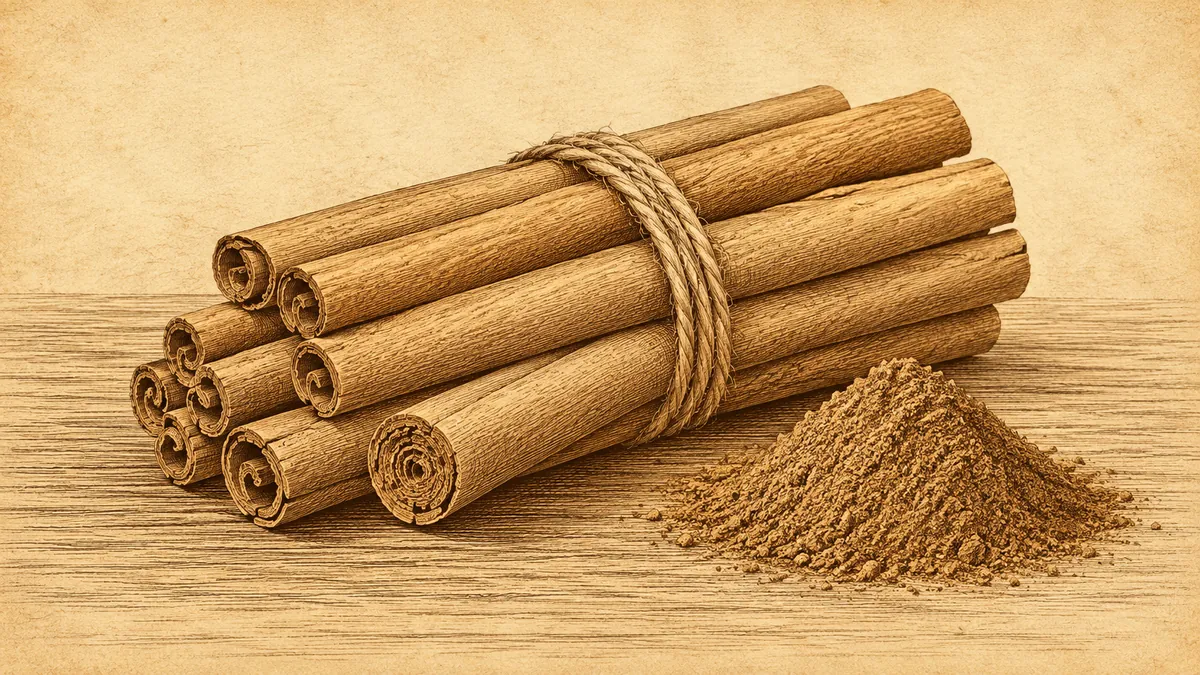
    Whether to buy Ceylon cinnamon as sticks or powder comes down to how you use it. Whole cinnamon sticks, or quills, keep their aroma far longer, are ideal for infusing drinks, curries and slow-cooked dishes, and let you grind fresh powder as needed. Ground cinnamon is more convenient for baking and quick recipes but loses its flavour faster. For the best of both, many people keep whole quills as their main supply and a small jar of powder for everyday use.

    Standing in the spice aisle, the choice between cinnamon sticks and powder is a common one. This guide compares the two forms of Ceylon cinnamon and helps you decide what to buy. It builds on our pillar guide, the Ceylon cinnamon buying guide.

    The short answer

    Buy whole cinnamon sticks for the freshest, longest-lasting flavour and for infusing dishes and drinks, and buy ground cinnamon for convenience in baking and quick cooking. Sticks keep their aroma for years and can be ground fresh, while powder is ready to use but fades faster. The best choice depends on how and how often you cook with cinnamon, and many cooks simply keep both.

    Cinnamon sticks: the case for whole quills

    Whole Ceylon cinnamon sticks are the rolled inner bark of the tree, known as quills. Their biggest advantage is staying power: because the aromatic oils are locked inside the bark, whole sticks keep their flavour and scent for a long time, often three to four years when stored well. They are perfect for simmering in curries, rice dishes, mulled drinks and syrups, where they slowly release their warm flavour and can be removed before serving. You can also grind or grate them at home for the freshest possible powder. The main drawback is that they are less convenient for recipes that need ground cinnamon mixed straight in. To learn more about the form itself, see our guide covering cinnamon sticks.

    Ground cinnamon: the case for powder

    Ground Ceylon cinnamon is simply the bark milled into a fine powder. Its great strength is convenience: it blends instantly into cake batter, sprinkles over porridge or coffee, and mixes easily into doughs and sauces. For baking especially, powder is usually the practical choice. The trade-off is shelf life. With far more surface exposed to the air, ground cinnamon loses its aroma more quickly, keeping its best flavour for around one to two years. Our guide to ground Ceylon cinnamon looks at the powder form in more detail.

    Sticks vs powder at a glance

    Comparing whole cinnamon sticks and ground cinnamon.
    FeatureWhole sticksGround powder
    Shelf lifeAbout 3 to 4 yearsAbout 1 to 2 years
    FreshnessGrind fresh as neededFades faster once opened
    Best forInfusing drinks, curries, slow cookingBaking, quick recipes, sprinkling
    ConvenienceNeeds grinding for powder usesReady to use instantly
    Flavour controlStrong, freshly groundEven, easy to measure

    Which should you buy?

    The right choice depends on how you cook. If you mostly make drinks, curries, stews and slow-cooked dishes, whole sticks are ideal, giving long-lasting value and a gentle infused flavour. If you bake often or like a quick sprinkle of cinnamon, powder is far more practical. Many households find the answer is to keep both: a supply of whole quills as the long-lasting backbone, and a small jar of powder for everyday convenience. Buying whole and grinding small amounts also lets you enjoy the freshest flavour while keeping a longer-lasting reserve.

    Freshness and value over time

    One reason whole sticks often represent good value is their long shelf life. A jar of powder bought in bulk may lose much of its punch before you finish it, whereas whole quills stay fragrant for years, so little is wasted. If you use cinnamon only occasionally, sticks are the more economical choice, since they hold their flavour until you need them. If you get through cinnamon quickly, powder’s faster fading matters less, and its convenience wins. This link between form and freshness is described further in our guide on how long Ceylon cinnamon lasts.

    Grinding your own cinnamon

    One appealing middle path is to buy whole Ceylon cinnamon sticks and grind them at home as needed. True cinnamon is brittle and soft, so it grinds more easily than the harder cassia bark, and a spice grinder or even a sturdy mortar and pestle can turn quills into fresh powder. Grinding your own gives you the strong, bright flavour of freshly milled cinnamon whenever you want it, while the rest of your supply stays sealed in stick form, keeping its aroma. For anyone who cares about flavour, this is a simple way to enjoy the best of both worlds without buying two separate products.

    How each form performs in the kitchen

    The two forms suit different jobs in cooking, and knowing which to reach for makes a real difference. Whole sticks come into their own in anything liquid and slow: a stick dropped into a pot of rice, a simmering curry, a jug of mulled wine or a pan of syrup releases its flavour gradually and can be lifted out at the end, leaving a clean, warm background note. Powder, by contrast, disperses evenly and instantly, which is exactly what you want in a cake batter, a spice rub, a dusting over a latte or a quick stir into yoghurt or oatmeal. Trying to use a stick where you need powder, or powder where you need a gentle infusion, tends to disappoint. Matching the form to the dish is the simplest way to get the most from your cinnamon.

    Converting between sticks and powder

    If a recipe calls for one form and you have the other, a rough guide helps. A standard cinnamon stick, once ground, yields somewhere around half a teaspoon to a teaspoon of powder, though this varies with the size of the quill. For infusing, you can usually drop in a whole stick in place of a measured amount of powder and adjust to taste, removing it once the flavour is right. When grinding sticks for baking, grind a little more than you think you need, since freshly ground Ceylon cinnamon is fragrant and you will not want to run short mid-recipe. These simple conversions mean that keeping just one form on hand need not limit what you can cook.

    Making sure it is real Ceylon cinnamon

    Whichever form you choose, the most important thing is that you are buying genuine Ceylon cinnamon rather than cassia sold simply as “cinnamon”. With whole sticks this is easier to check, since true Ceylon quills are pale, thin and made of many soft layers, while cassia is a hard, thick single curl. With powder it is harder to tell by eye, so the label matters more: look for Ceylon cinnamon or Cinnamomum verum, ideally from Sri Lanka. This is one quiet advantage of sticks, that their authenticity is easier to judge, a point covered in our Ceylon cinnamon buying guide.

    Frequently asked questions

    Should I buy cinnamon sticks or ground cinnamon?

    It depends on how you use it. Buy whole cinnamon sticks for the freshest, longest-lasting flavour and for infusing drinks, curries and slow-cooked dishes. Buy ground cinnamon for convenience in baking and quick recipes. Many people keep both, using sticks as the main supply and powder for everyday use.

    Do cinnamon sticks last longer than powder?

    Yes. Whole cinnamon sticks keep their best flavour for around three to four years, while ground cinnamon holds its flavour for about one to two years. This is because whole quills keep their aromatic oils locked in the bark, whereas powder has far more surface exposed to the air.

    Can I grind cinnamon sticks into powder at home?

    Yes. True Ceylon cinnamon is brittle and grinds easily in a spice grinder or a sturdy mortar and pestle. Grinding your own from whole quills gives the freshest, strongest powder, while keeping the rest of your supply in long-lasting stick form.

    Is it cheaper to buy sticks or powder?

    It depends on how often you use cinnamon. If you use it occasionally, whole sticks are often better value because they stay fragrant for years with little waste. If you get through cinnamon quickly, powder’s convenience may outweigh its faster fading.

    Summary

    Choosing between Ceylon cinnamon sticks and powder comes down to how you cook. Whole sticks keep their aroma for years, are ideal for infusing drinks, curries and slow-cooked dishes, and can be ground fresh at home. Ground cinnamon is more convenient for baking and quick recipes but fades faster. For occasional use and long-lasting value, sticks are the better buy; for frequent baking and convenience, powder wins. Keeping both, with whole quills as the backbone and a small jar of powder for everyday use, gives you fresh flavour and easy convenience together, as long as you make sure it is genuine Ceylon cinnamon.

    This website provides educational information about Ceylon Cinnamon as a spice and food ingredient. It is not intended to provide medical advice or make health claims.
  • The Roll Test: Telling Ceylon From Cassia

    The Roll Test: Telling Ceylon From Cassia

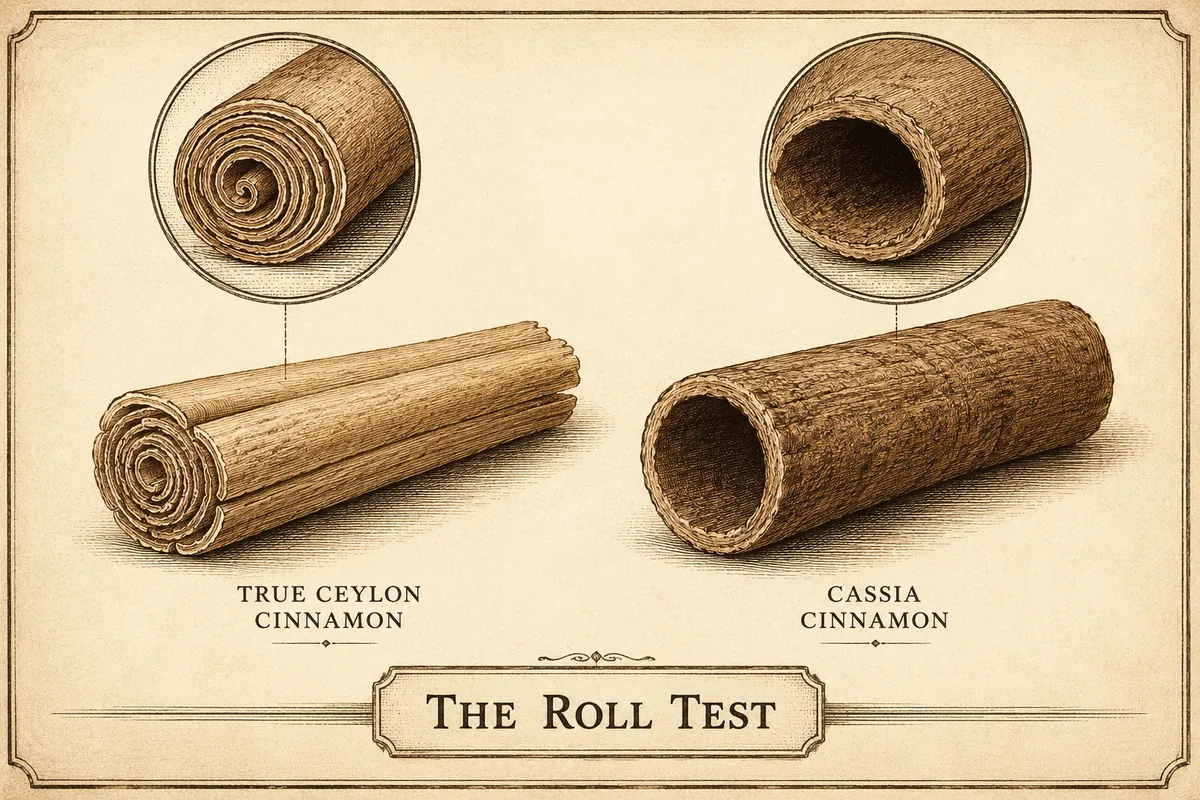
    The roll test is a quick, simple way to tell true Ceylon cinnamon from cassia just by looking at the shape of the stick. A Ceylon cinnamon quill is made of many thin, soft layers of bark rolled tightly together, so its cut end looks like a little scroll or a rolled-up cigar. A cassia stick, by contrast, is a single thick, hard layer that curls into one hollow tube. Look at how the bark rolls, and you can usually tell the two apart at a glance.

    This test is one of the easiest checks any shopper can do, and it needs no special tools. This guide explains how the roll test works, why the two barks roll so differently, and how to use it alongside other simple checks. It builds on our pillar guide on how to identify real Ceylon cinnamon.

    The short answer

    Look at the end of the stick: many thin layers rolled up like a scroll means Ceylon cinnamon, while a single thick curl means cassia. True Ceylon cinnamon is made from delicate inner bark layered and rolled by hand, giving a multi-layered quill. Cassia is a thick, tough bark that curls once. This difference in the roll is one of the clearest visual clues to which spice you are holding. It is the kind of detail you only need to see once to remember: after your first side-by-side comparison, the scrolled Ceylon quill and the single-curl cassia stick become instantly recognisable, and you will spot the difference almost without thinking whenever you handle a cinnamon stick.

    Why the two barks roll differently

    The reason comes down to the bark itself. True Ceylon cinnamon uses only the thin, papery inner bark of the tree, and several fine strips are layered inside one another and rolled together to build a quill. This produces the signature look of many soft, tight layers, a little like a rolled scroll. Cassia uses a much thicker, harder bark, and a single piece curls into one solid tube. So the roll test is really a test of bark thickness and structure, a difference explained further in our guide to what a cinnamon quill is.

    How to do the roll test

    The test is simple and takes seconds. Pick up the stick and look closely at its cut end and its overall shape.

    Look at the end

    The clearest sign is the cross-section at the end of the stick. If you see many thin layers curled up together, like the rings of a tiny scroll, it is Ceylon cinnamon. If you see one thick layer forming a single hollow tube, it is cassia.

    Look at the whole stick

    Ceylon quills are usually pale tan, slender and light, and they often have that rolled, papery, layered look along their length. Cassia sticks are darker reddish brown, thicker, heavier and harder, curling in a single tight roll. The overall shape backs up what you see at the end.

    Feel and snap

    You can add a touch test. Ceylon cinnamon is brittle and crumbly, and a quill snaps easily into pieces because the thin layers break readily. Cassia is hard and woody and resists snapping. If the stick shatters lightly in your fingers, that points to Ceylon; if it is tough and solid, that points to cassia. This links closely to the checks in our guide on how to spot fake Ceylon cinnamon.

    Roll test results at a glance

    What the roll test shows for Ceylon cinnamon and cassia.
    FeatureCeylon cinnamonCassia
    Roll shapeMany thin layers, like a scrollSingle thick curl
    BarkThin, papery inner barkThick, hard bark
    ColourPale tan brownDarker reddish brown
    WeightLightHeavier
    SnapBrittle, crumbles easilyHard, resists breaking

    Why the roll test is so useful

    The roll test is popular because anyone can do it, anywhere, with no equipment. In a shop, at home or in the kitchen, a quick look at the end of the stick gives a strong hint about which cinnamon you have. It is not a laboratory test, and edge cases exist, but for whole sticks it is one of the fastest and most reliable visual checks. Because cassia is often sold simply as “cinnamon”, this simple habit of looking at the roll can save you from mistaking one for the other, a theme at the heart of our guide to Ceylon cinnamon vs cassia.

    When the roll test does not help

    The roll test only works on whole sticks. Once cinnamon is ground into powder, the roll is gone, and you cannot use this method; there you have to rely on colour, smell and, above all, the label. Very short or broken pieces can also be harder to read. In these cases, checking that the product is clearly labelled as Ceylon cinnamon or Cinnamomum verum, ideally from Sri Lanka, is the surest guide. For whole quills, though, the roll test remains a quick and handy first check.

    The roll test in the shop and the kitchen

    One of the best things about the roll test is where you can use it. In a shop, you can hold a jar or packet of whole quills up to the light and look at the ends of the sticks before you buy, choosing the ones with the fine, scrolled, many-layered look. At home, it is a quick way to check what you already have in the cupboard: pull out a stick, look at the end, and you will usually know at once whether it is Ceylon or cassia. It is also a lovely thing to show children or guests, since the difference between a soft, rolled Ceylon scroll and a hard cassia tube is easy to see once it is pointed out. A small habit like this quietly builds your confidence as a buyer.

    Combining the roll test with other checks

    The roll test is strongest when used alongside a couple of other simple signs. Colour is a good partner: true Ceylon cinnamon tends to be a pale, warm tan, while cassia is a darker reddish brown. Aroma helps too, as Ceylon has a soft, sweet, delicate smell, whereas cassia is sharper and more pungent. And the label is the final word, since only true cinnamon should carry the name Ceylon cinnamon or Cinnamomum verum. Put together, the roll, the colour, the smell and the label give a clear, confident picture, which is exactly the layered approach set out in our pillar guide on how to identify real Ceylon cinnamon.

    Frequently asked questions

    What is the roll test for cinnamon?

    It is a simple visual check that tells Ceylon cinnamon from cassia by the shape of the stick. Ceylon cinnamon has many thin layers rolled together like a scroll, while cassia is a single thick curl. Looking at the rolled end of the stick reveals which one it is.

    How can you tell Ceylon cinnamon from cassia by looking?

    Look at the end of the stick and its overall form. Many fine layers, a pale colour and a light, brittle feel point to Ceylon cinnamon. A single thick curl, a darker colour and a hard, heavy feel point to cassia.

    Does the roll test work on ground cinnamon?

    No. The roll test only works on whole sticks, because it relies on seeing how the bark is rolled. For ground cinnamon you must rely on colour, aroma and the label, checking for Ceylon cinnamon or Cinnamomum verum from Sri Lanka.

    Is the roll test always accurate?

    It is a strong, quick guide for whole sticks, but not a laboratory test. Most Ceylon and cassia sticks are easy to tell apart by their roll, though broken or unusual pieces can be harder to read. Pairing the roll test with colour, smell and the label gives the most confidence.

    Summary

    The roll test is a fast, no-tools way to tell true Ceylon cinnamon from cassia. Ceylon cinnamon is made from thin inner bark rolled into many soft layers, so its end looks like a little scroll, and the stick is pale, light and brittle. Cassia is a single thick, hard curl, darker and heavier. By looking at the rolled end of a whole stick, and adding a gentle snap test, you can usually tell the two apart in seconds. The method does not work on powder, where the label is your best guide, but for whole quills the roll test is one of the simplest and most useful checks there is. Once you have made it a habit, telling true Ceylon cinnamon from cassia becomes second nature every time you shop or cook.

    This website provides educational information about Ceylon Cinnamon as a spice and food ingredient. It is not intended to provide medical advice or make health claims.
  • What Is C5 Special Ceylon Cinnamon?

    What Is C5 Special Ceylon Cinnamon?

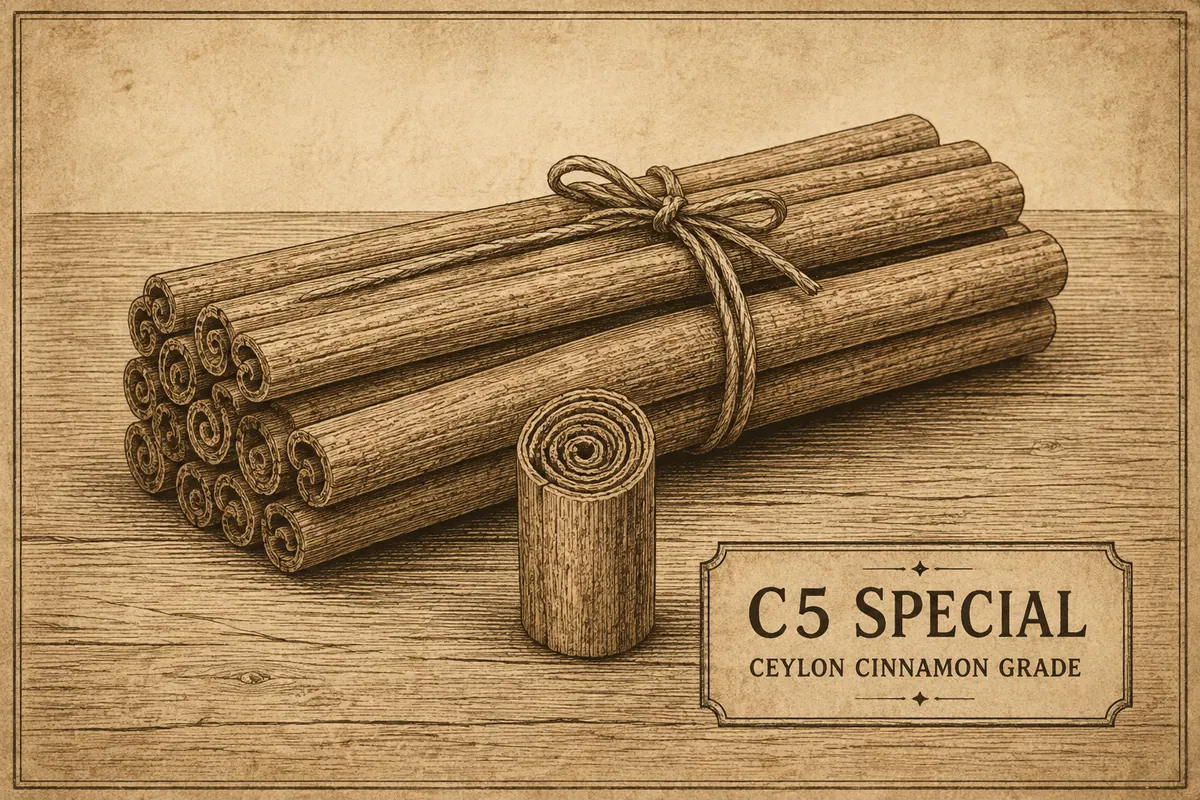
    C5 Special is a premium grade of Ceylon cinnamon, made up of fine, thin, evenly rolled quills of small diameter. In the Ceylon cinnamon grading system, “C” stands for Continental, and the number relates to the thickness of the quill: the smaller the number, the finer the quill. C5 Special sits near the top of the range, just below the very finest Alba grade, and is one of the most popular high-quality grades for everyday premium use.

    Grade codes like C5 Special can look puzzling on a label, but they follow a simple logic once you know the system. This guide explains what C5 Special means, how it fits among the other grades, and why it is so widely chosen. It builds on our full guide to Ceylon cinnamon grades.

    The short answer

    C5 Special is a high grade of Ceylon cinnamon quill, prized for its thin, fine, uniform sticks. The name comes from the Continental grading system, where quills are sorted by diameter and quality. C5 Special quills are slender and neat, giving a delicate flavour and an attractive appearance, which makes this grade a favourite with both home cooks and chefs who want fine quality without paying the very top Alba price.

    What does “C5 Special” mean?

    The label breaks down into two parts. The “C” stands for Continental, one of the traditional groupings used to sort Ceylon cinnamon quills for export. The number, here 5, relates to the diameter of the quill, with smaller numbers meaning thinner, finer quills. “Special” marks it as a select, higher-quality version within that band. So C5 Special describes a Continental-grade quill that is thin, fine and specially selected for quality.

    Why quill diameter matters

    In Ceylon cinnamon, thinner quills are generally finer. The most delicate bark, peeled and rolled with the greatest care, produces slender quills with a smooth surface and a gentle flavour. Thicker quills tend to come from coarser bark. Because grade is tied so closely to quill diameter, the width of the stick is one of the clearest signals of quality, a link set out in our guide to what a cinnamon quill is.

    Where C5 Special sits among the grades

    Ceylon cinnamon is graded from the very finest down to coarser quills and off-cuts. Alba is the finest and most expensive grade, made from the thinnest quills. Just below it come the top Continental grades, including C5 Special, followed by other Continental and Mexican grades, then thicker Hamburg grades, and finally broken pieces such as quillings and featherings. C5 Special therefore sits among the premium quill grades, close to the top of the range.

    Where C5 Special fits, from finest quills to coarser grades.
    GradeQuill characterRough position
    AlbaVery thin, finest barkTop grade
    C5 SpecialThin, fine, select quillsPremium
    C5 / C4Fine to medium quillsHigh to mid
    Mexican (M)Medium quillsMid
    Hamburg (H1 to H3)Thicker, coarser quillsLower
    Quillings / featheringsBroken pieces and shavingsOff-cuts

    The exact boundaries between grades are set by quality standards, as our guide to Ceylon cinnamon quality standards explains.

    C5 Special vs Alba

    Alba is the finest grade of all, made from the very thinnest quills, and it commands the highest price. C5 Special is a step below, with quills that are still thin and fine but a little larger in diameter than Alba. For most buyers, C5 Special offers an excellent balance: close to Alba in quality and appearance, but more affordable and more widely available. Alba is often reserved for gifts or special use, while C5 Special is a practical premium choice for regular cooking. The difference between the two is real but subtle, and for day-to-day use many people find C5 Special more than fine enough, saving the extra cost of Alba for occasions when only the very best will do.

    What C5 Special is good for

    Because its quills are fine and attractive, C5 Special suits any use where you want good-quality Ceylon cinnamon. The slender sticks look elegant in drinks and on a table, infuse cleanly into curries, rice, syrups and mulled drinks, and can be ground fresh for baking. It is a versatile, all-round premium grade rather than a specialist one, which is part of why it is so popular. The flavour is the classic delicate, sweet Ceylon profile, as covered in our pillar on Ceylon cinnamon grades.

    Is C5 Special worth choosing?

    For most people, C5 Special is a very sensible grade to buy. It gives the fine appearance and delicate flavour of top-quality Ceylon cinnamon at a more approachable price than Alba, and its neat, thin quills are pleasant to use. Unless you specifically want the absolute finest for a gift or display, C5 Special delivers premium quality for everyday cooking and drinks, which is exactly why it has become one of the most sought-after grades on the market.

    How C5 Special is sorted

    Grading Ceylon cinnamon is careful handwork. After the quills are peeled, rolled and dried, they are sorted by trained graders who judge each stick by its diameter, colour, smoothness and neatness. Quills that are thin, pale, even and well rolled are set aside for the higher grades, while thicker or rougher quills fall into lower ones, and broken pieces are separated out. C5 Special is one of the select bands within this sorting, so a quill in this grade has been judged fine enough to sit near the top of the range. This is why grade is such a reliable shorthand for quality: it reflects real, physical differences in the bark that a grader can see and feel.

    How to buy C5 Special with confidence

    When buying C5 Special, the grade code is only part of the picture. Look also for a clear statement that the product is Ceylon cinnamon or Cinnamomum verum from Sri Lanka, since the grade only has meaning for true cinnamon. Good C5 Special quills should look thin, pale and neatly rolled, feel light and brittle, and smell sweet and delicate. A reputable seller will state the grade and origin openly. Because grade names are not always policed as tightly as origin, pairing the C5 Special label with these simple checks helps make sure you are getting what the name promises.

    C5 Special in the wider grading picture

    It helps to remember that all these grades describe the same spice, true Ceylon cinnamon, sorted by the fineness of the quill rather than by flavour type. A lower grade is not fake or poor cinnamon; it is simply a thicker or less uniform quill, often perfectly good for grinding or long cooking. C5 Special earns its premium place by being among the finer, more attractive quills, which matters most when the sticks are on show or when you want the most delicate result. Choosing a grade is therefore about matching the quill to the use, and C5 Special is a grade that suits almost any use well.

    Frequently asked questions

    What is C5 Special Ceylon cinnamon?

    C5 Special is a premium grade of Ceylon cinnamon made from thin, fine, specially selected quills. In the Continental grading system, “C” means Continental and the number relates to quill diameter, with smaller numbers being finer. C5 Special sits just below the top Alba grade.

    Is C5 Special better than Alba?

    Alba is the finest grade, made from even thinner quills, and it is more expensive. C5 Special is a step below but still a high, premium grade. Many buyers prefer C5 Special as it offers close-to-Alba quality at a more affordable price.

    What does the C in C5 stand for?

    The “C” stands for Continental, a traditional grouping used to sort Ceylon cinnamon quills. The number relates to the diameter of the quill, with smaller numbers meaning thinner, finer sticks.

    Is C5 Special good for cooking?

    Yes. C5 Special is an excellent all-round grade for cooking and drinks. Its fine, thin quills infuse cleanly into liquids, look attractive in dishes and drinks, and can be ground fresh, all with the classic delicate Ceylon cinnamon flavour.

    Summary

    C5 Special is a premium grade of Ceylon cinnamon, made from thin, fine, evenly rolled quills. Its name comes from the Continental grading system, where “C” means Continental and the number reflects quill diameter, with smaller numbers being finer. C5 Special sits just below the top Alba grade, giving close-to-Alba quality and appearance at a more affordable price. Versatile, elegant and full of the classic delicate Ceylon flavour, it is one of the most popular high-quality grades, and a sensible choice for anyone wanting fine Ceylon cinnamon for everyday use without stepping all the way up to the top Alba price.

    This website provides educational information about Ceylon Cinnamon as a spice and food ingredient. It is not intended to provide medical advice or make health claims.

  • What Is a Cinnamon Quill? Definition and Origin

    What Is a Cinnamon Quill? Definition and Origin

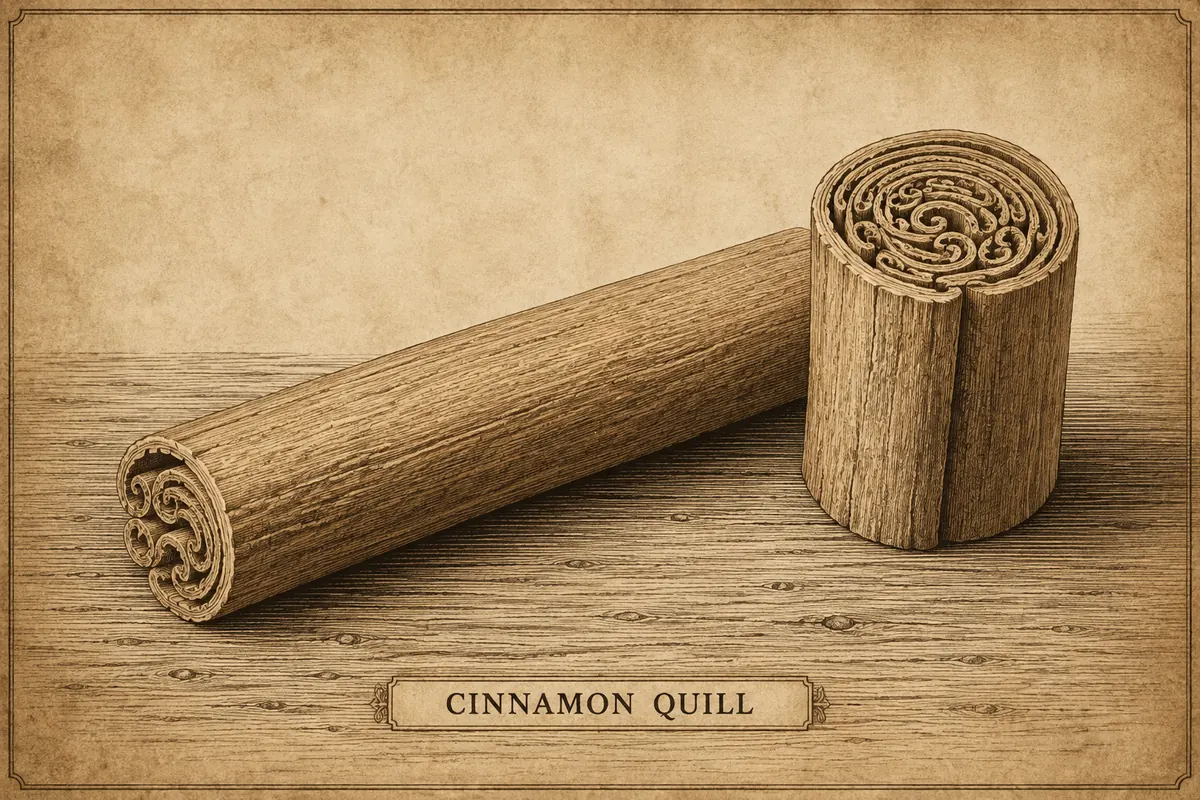
    A cinnamon quill is a stick of dried cinnamon bark that has curled into a hollow tube as it dries. In true Ceylon cinnamon, a quill is made from many thin, soft layers of inner bark rolled together by hand into a single neat roll. The word “quill” comes from the same root as a writing quill and a reed, because the rolled bark looks like a hollow tube or pen.

    “Quill” is the traditional name for what many people simply call a cinnamon stick, and it is the word used in the cinnamon trade. This guide explains exactly what a quill is, where the name comes from, how quills are formed, and how they relate to grades. It builds on our guide to Ceylon cinnamon grades.

    The short answer

    A cinnamon quill is a rolled tube of dried cinnamon bark, the classic form of the whole spice. For Ceylon cinnamon, peelers take the thin inner bark, layer several pieces together and roll them into a long, slender quill that dries into a firm stick. The result is the familiar pale, papery, multi-layered roll that sets true cinnamon apart from the thick, hard single curl of cassia.

    Where does the word “quill” come from?

    The word “quill” originally meant a hollow reed or the hollow shaft of a feather, the kind once cut into a pen. Because a roll of cinnamon bark forms a similar hollow tube, the same word came to be used for it. So a cinnamon quill is named for its shape: a neat, hollow roll. The term has been part of the spice trade for a long time and remains the correct name for a whole rolled cinnamon stick today.

    How a cinnamon quill is formed

    A quill does not simply grow on the tree; it is made through skilled handwork. After the outer bark is scraped away, the peeler lifts off the thin inner bark in strips. Several of these strips are then layered inside one another and rolled together into a long tube. As the roll dries, it tightens and firms into a solid quill. This craft is at the heart of how the spice is produced, as our guide to how Ceylon cinnamon is made explains in full.

    Why Ceylon quills have many layers

    The layered structure is a signature of true Ceylon cinnamon. Because its inner bark is so thin and delicate, several pieces are combined to make one quill, giving the cross-section its distinctive look of many soft, rolled-up layers, a little like a rolled cigar or a tiny scroll. Cassia, by contrast, has thick bark that curls into a single hard layer. This difference is one of the easiest ways to tell the two apart.

    Cinnamon quill vs cinnamon stick

    “Quill” and “stick” describe the same thing. Quill is the traditional trade term for a rolled length of cinnamon bark, while “stick” is the everyday word most shoppers use. There is no difference in the product; a cinnamon stick is a cinnamon quill. You will see “quill” more often on specialist and export packaging, and “stick” more often in supermarkets and recipes. Our guide to cinnamon sticks covers the same form in everyday terms.

    Quill sizes and lengths

    Quills are usually sold cut to a standard length, commonly around 8 to 10 centimetres for retail, though export quills can be much longer before cutting. Their diameter and neatness feed into how they are graded: fine, slender, evenly rolled quills of pale bark are prized, while thicker or broken pieces are graded lower. The finest grades are made from the thinnest, most tightly rolled quills, which is why a well-made quill is a mark of careful peeling and good bark rather than just a pretty shape. The look of the quill is therefore closely tied to quality, a link set out in our guide to Ceylon cinnamon grades.

    Quills and related forms at a glance

    How quills relate to other forms of cinnamon.
    TermWhat it means
    QuillA whole rolled tube of dried cinnamon bark
    StickThe everyday word for a quill
    QuillingsSmall broken pieces of quill
    FeatheringsThin inner bark shavings and small curls
    ChipsCut pieces of bark, often for grinding or infusing
    GroundQuills milled into powder

    These terms are all part of the cinnamon vocabulary, and several appear in our glossary of Ceylon cinnamon terms.

    Why the quill form matters

    The quill is not just how cinnamon looks; it is a practical and useful form. Whole quills keep their aroma far longer than powder, because less of the bark is exposed to air. They can be dropped whole into curries, rice, drinks and syrups to infuse flavour, then lifted out. And their multi-layered structure is a quick visual test of authenticity, since only true Ceylon cinnamon rolls into those thin, soft layers. In short, the quill is both the traditional shape of the spice and a sign of what it is. For anyone learning about Ceylon cinnamon, understanding the quill is a natural starting point, since so much of the spice’s quality, history and identity is wrapped up in that simple rolled tube of bark.

    A short history of the cinnamon quill

    The rolled quill is not a modern invention. For centuries, cinnamon was traded across the world in this form, because rolling the bark made it easier to dry, bundle, pack and ship without it crumbling. The neat tubes could be tied together, graded by eye, and carried great distances while holding their aroma. So the quill is partly a practical answer to an old problem: how to move a delicate spice safely from a small island to distant markets. The shape we still buy today carries that long trading history inside it.

    How to store and use quills

    Because a quill exposes little of its bark to the air, it keeps its flavour well. Stored whole in an airtight jar, away from heat, light and damp, Ceylon cinnamon quills stay fragrant for a long time, often a couple of years. In the kitchen they are used whole: a quill is added to a simmering pot, a warm drink or a syrup, left to infuse its gentle sweetness, then removed before serving. When you want ground cinnamon, a brittle Ceylon quill can be snapped and milled fresh, which gives a brighter flavour than powder that has been sitting open. In this way the quill is both a storage form and a cooking tool.

    Spotting a good quill

    A fine Ceylon quill is pale tan, slender and light, with a smooth surface and a clear pattern of thin rolled layers at the cut ends. It should feel brittle rather than hard, snapping cleanly, and smell sweet and delicate. A very dark, thick, heavy stick that curls in a single hard layer and smells sharp is a cassia quill rather than true cinnamon. Learning to read these signs in the quill itself is one of the simplest ways to judge what you are buying before you even taste it.

    Frequently asked questions

    What is a cinnamon quill?

    A cinnamon quill is a stick of dried cinnamon bark that has rolled into a hollow tube. In Ceylon cinnamon, it is made by layering and rolling several pieces of thin inner bark by hand, which then dry into a firm, pale, multi-layered roll.

    Is a cinnamon quill the same as a cinnamon stick?

    Yes. “Quill” is the traditional trade name and “stick” is the everyday word, but they mean the same thing: a whole rolled length of cinnamon bark.

    Why is it called a quill?

    Because the rolled bark forms a hollow tube, like a reed or the shaft of a feather quill once used as a pen. The name describes the shape of the rolled cinnamon.

    Why do Ceylon cinnamon quills have layers?

    Because the inner bark of true cinnamon is very thin, so several pieces are rolled together to make one quill. This gives the cross-section its distinctive many-layered look, which cassia, with its single thick layer, does not have.

    Summary

    A cinnamon quill is the classic rolled tube of dried cinnamon bark, named after the hollow reed or feather pen it resembles. In true Ceylon cinnamon, a quill is made by hand from many thin layers of inner bark rolled together, giving the pale, papery, multi-layered look that marks it out from cassia. “Quill” and “stick” mean the same thing, with quill being the traditional trade term. The quill form keeps cinnamon fresh, makes it easy to infuse and remove, and offers a quick test of authenticity, which is why it remains the signature shape of the spice.

    This website provides educational information about Ceylon Cinnamon as a spice and food ingredient. It is not intended to provide medical advice or make health claims.

  • Ground Ceylon Cinnamon Explained

    Ground Ceylon cinnamon is simply true cinnamon (Cinnamomum verum) bark that has been dried and milled into a fine, soft powder. It has the same delicate, sweet flavour as the whole quills, but in a form that mixes instantly into baking, drinks and cooking. Because it is ready to use, it is the most convenient way to add cinnamon flavour, though it loses its aroma faster than whole sticks.

    This guide explains what ground Ceylon cinnamon is, how it is made, how to use it, and how it compares with whole sticks. It pairs with our pillar guide on the culinary uses of Ceylon cinnamon.

    What is ground Ceylon cinnamon?

    Ground Ceylon cinnamon is powdered true cinnamon, made by grinding the dried inner bark of the Cinnamomum verum tree. It is the same spice as a cinnamon quill, just milled fine so it can be measured by the spoon and stirred straight into food. True Ceylon cinnamon powder is a light tan brown, with a soft, mellow, sweet aroma, which sets it apart from the darker, harsher powder of cassia. To understand the raw spice behind the powder, see our guide to what true Ceylon cinnamon is.

    How ground cinnamon is made

    Ground cinnamon starts as whole quills. The thin inner bark is peeled, rolled and dried into sticks, then the sticks, along with smaller pieces and off-cuts, are milled into powder. Because Ceylon cinnamon bark is thin and soft, it grinds easily into a fine, pale powder. The whole process, from bark to powder, follows the same careful steps set out in our guide to how Ceylon cinnamon is made, with grinding as the final stage.

    How to use ground Ceylon cinnamon

    Ground cinnamon is the go-to form for anything where the spice needs to be mixed in evenly. Stir it into cake batter, cookie dough, bread and pastry; sprinkle it over porridge, yoghurt, fruit and toast; whisk it into smoothies, coffee and hot chocolate; and add it to spice blends and rubs. Its fine texture means it blends without leaving lumps, giving an even flavour throughout the dish. For baking in particular it is far easier than a whole stick, as our guide on Ceylon cinnamon in baking explains.

    Ground cinnamon vs cinnamon sticks

    Both are the same spice in different forms, and each suits different jobs. Ground cinnamon gives instant, even flavour and is best for baking and sprinkling. Whole sticks release their flavour slowly and cleanly into liquids, and keep their aroma much longer in storage. Many cooks keep both, reaching for powder when they want quick, mixed-in flavour and sticks when they want a slow infusion. Our guide on how to cinnamon sticks covers the whole form in detail.

    Ground Ceylon cinnamon compared with whole cinnamon sticks.
    FeatureGround cinnamonCinnamon sticks
    FormFine powderWhole rolled quills
    Flavour releaseInstantSlow infusion
    Best forBaking, sprinkling, blendingCurries, rice, drinks, syrups
    Mixes into foodYes, evenlyNo, removed after use
    Shelf life of aromaShorter, monthsLonger, years
    ConvenienceVery highNeeds infusing

    How much ground cinnamon to use

    Ground cinnamon is concentrated, so a little goes a long way. For most recipes, half a teaspoon to a teaspoon flavours a dish for four to six people. Because Ceylon cinnamon is mild and sweet rather than sharp, you can use a generous hand without it turning bitter, but it is still wise to start modestly and add more to taste. As a rough rule, one whole stick is roughly equal to about half a teaspoon of ground cinnamon, though this varies with freshness.

    Why ground cinnamon loses flavour faster

    Once bark is ground, far more of its surface is exposed to air, so the aromatic oils fade more quickly than in a whole stick. This is why ground cinnamon is best bought in small amounts and used within a few months to a year, while whole quills keep their aroma for much longer. Storing powder well slows this down. Keep it in an airtight jar, away from heat, light and moisture, as set out in our guide on how to store Ceylon cinnamon properly.

    How to spot good ground Ceylon cinnamon

    Good ground Ceylon cinnamon is a soft, light tan brown, not a dark reddish brown, and it smells sweet and delicate rather than sharp and hot. The label should name Ceylon cinnamon or Cinnamomum verum, ideally with Sri Lanka as the origin. A very cheap, very dark, strongly pungent powder is usually cassia rather than true cinnamon. Buying from a seller who states the type and origin clearly is the simplest way to be sure you are getting real Ceylon cinnamon powder.

    Can you grind your own?

    Yes, and it is a good way to keep the flavour fresh. Because Ceylon quills are thin and brittle, they break up easily and can be ground at home in a spice grinder, or even crushed with a pestle and mortar. Grinding a small amount as you need it means the powder is at its most aromatic, since it has not been sitting exposed to air. This is a simple way to enjoy the convenience of powder with the freshness of whole sticks. If you buy quills for slow cooking anyway, grinding a few of them when your powder runs low saves money and gives a noticeably brighter flavour than a jar of powder that has sat open for months. A short blitz in a clean, dry grinder is usually all it takes to turn brittle Ceylon quills into a fine, fragrant powder.

    Everyday ways to use the powder

    Part of the appeal of ground cinnamon is how easily it slips into daily food. A pinch stirred into morning oats or yoghurt adds gentle warmth, and a light dusting over buttered toast or a warm scone is a simple treat. In drinks, a small spoonful whisked into coffee, warm milk or a smoothie carries the flavour right through. It works in savoury cooking too, blended into curry powders, spice rubs for roast vegetables, and warm grain dishes. Because true Ceylon cinnamon is soft and sweet rather than fiery, it suits both sweet and savoury food without dominating, which makes it one of the friendliest spices to keep within reach.

    Colour, texture and freshness

    The look and feel of the powder tell you a lot. Fresh ground Ceylon cinnamon is a warm, light tan, fine and slightly fluffy, and it releases a clear sweet scent as soon as the jar is opened. As it ages, the colour dulls a little and, more tellingly, the aroma weakens. A quick sniff is the best test: if the powder smells faint, it has passed its best and will give a weaker flavour, so it is worth refreshing your jar. Keeping only a small amount at a time, and topping it up often, is the easiest way to make sure the cinnamon you cook with is always fragrant.

    Frequently asked questions

    What is ground Ceylon cinnamon?

    It is true cinnamon powder, made by milling the dried inner bark of the Cinnamomum verum tree. It is the same spice as a Ceylon cinnamon stick, ground fine so it mixes straight into food and drink.

    Is ground cinnamon the same as cinnamon sticks?

    It is the same spice in a different form. Ground cinnamon is powder that gives instant, even flavour and suits baking and sprinkling. Sticks are whole quills that infuse slowly into liquids and keep their aroma longer. Which to use depends on the dish.

    How long does ground Ceylon cinnamon last?

    Ground cinnamon keeps its best flavour for a few months up to about a year if stored in an airtight jar away from heat, light and moisture. It fades faster than whole sticks because grinding exposes more of the bark to air.

    How can I tell if ground cinnamon is Ceylon?

    True Ceylon cinnamon powder is a light tan brown with a soft, sweet smell, and the label names Ceylon cinnamon or Cinnamomum verum. A very dark, strongly pungent, very cheap powder is usually cassia instead.

    Summary

    Ground Ceylon cinnamon is true cinnamon bark milled into a fine, light tan powder with the same sweet, delicate flavour as the whole quills. It is the most convenient form, mixing instantly into baking, drinks, cereals and spice blends, though it loses its aroma faster than sticks and is best used within a few months to a year. Whole sticks suit slow infusions and long storage, while ground cinnamon suits quick, even flavour. Look for a soft pale colour, a sweet smell and a clear Ceylon or Cinnamomum verum label to be sure you are buying the real thing.

    This website provides educational information about Ceylon Cinnamon as a spice and food ingredient. It is not intended to provide medical advice or make health claims.