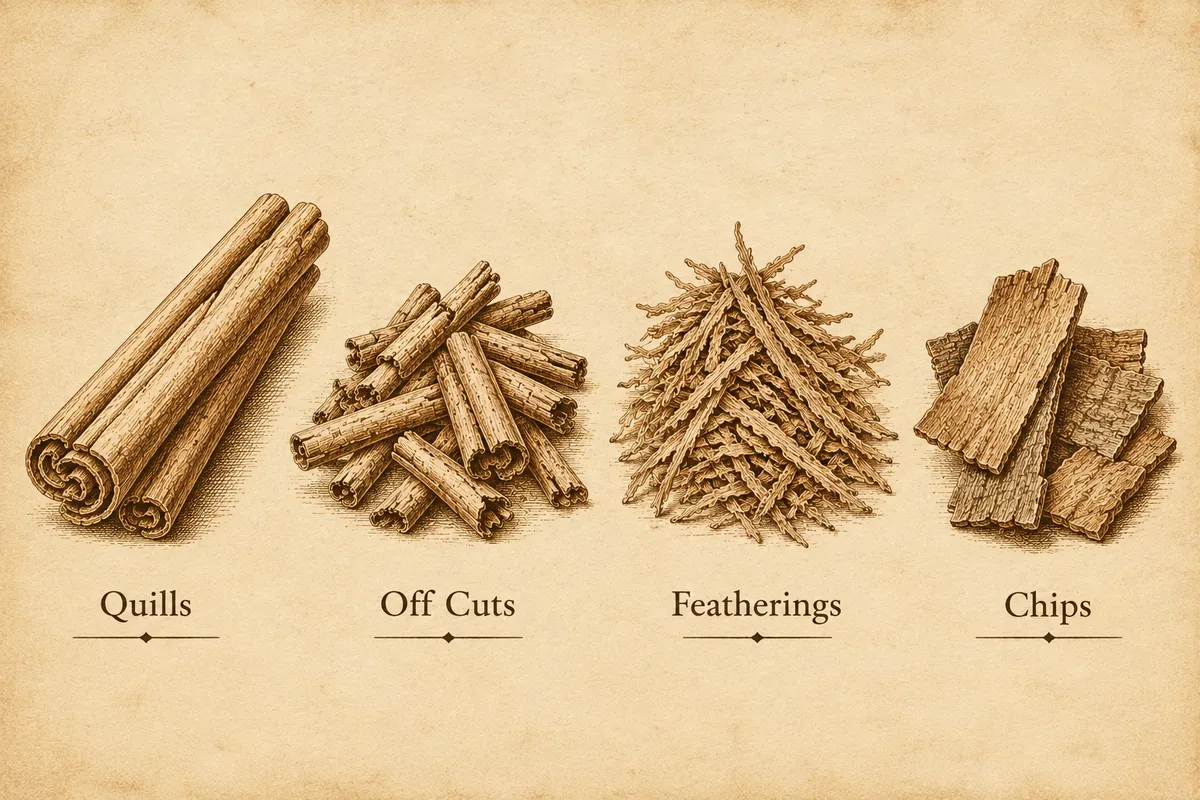
Off cuts, featherings, quillings and chips are the smaller grades and by-products of Ceylon cinnamon, made from the pieces that are left over when the prime rolled quills are formed and trimmed to size. Off cuts are the short pieces cut off when a quill is trimmed to a customer’s required length; featherings are the thin, feathery inner-bark shavings; quillings are the broken fragments of quills; and chips are the flat pieces of bark that cannot be rolled. All come from the same true cinnamon tree, Cinnamomum verum, and are mostly ground into powder or distilled for oil rather than sold as whole sticks.
These three words appear on grade lists and in the cinnamon trade, and they often confuse newcomers. This short glossary explains what each one means and how they relate to the familiar cinnamon quill. It builds on our full guide to Ceylon cinnamon grades.
The short answer
Off cuts, featherings, quillings and chips are the smaller, lower grades of Ceylon cinnamon left over from making and trimming quills. Off cuts are the pieces cut off when a quill is trimmed to a set length, quillings are broken bits of quill, featherings are thin feathery shavings and small inner-bark curls, and chips are flat pieces of bark that were never rolled. None of them are waste: they carry the same aroma and flavour as the prime quills and are widely used, mostly after grinding or distillation.
Starting point: the cinnamon quill
To understand these terms, it helps to start with the quill, the best known form of Ceylon cinnamon. A quill is a tube of dried inner bark, rolled by hand into the familiar stick shape. Making quills is skilled work, and not every piece of bark ends up as a long, perfect quill. The pieces that are too short, too small or the wrong shape become the grades described below. For the full picture of the quill itself, see our guide to what a cinnamon quill is.
Off cuts
Off cuts are the short pieces cut from a quill when it is trimmed to a required length. Ceylon cinnamon quills are traditionally hand-made to standard lengths, most often 42 inches or 21 inches. When a customer or buyer needs a particular size, the long quills are cut down to that length, and the remaining cut pieces are gathered and sold as off cuts. They are made of exactly the same fine rolled inner bark as the full quills, and carry the same aroma and taste, so an off cut is really just a shorter length of prime cinnamon. Because they are short and uneven, they cost less than full-length sticks and are a practical choice for cooking, steeping or grinding, where the length of the quill does not matter.
Quillings
Quillings are broken pieces and short offcuts of quills. When quills are trimmed to length, or when longer quills break during handling and transport, the small fragments left behind are gathered together and sold as quillings. They are made of exactly the same rolled inner bark as full quills, so they have the same fine aroma and taste. Because they are shorter and broken, they cost less than whole quills and are often chosen for grinding into powder, where the length of the piece does not matter. In short, quillings are true cinnamon in smaller, broken form.
Featherings
Featherings, sometimes called feather cinnamon, are the thin, light, feathery pieces of inner bark. During peeling and rolling, small curls and delicate shavings of the inner bark are produced that are too small and fine to form into proper quills. These wispy, feather-like pieces are collected as featherings. They are among the lightest grades of cinnamon and, like quillings, are usually ground or used where whole sticks are not needed. The name captures their look well: light, curly and feather-like.
Chips
Chips are flat, unrolled pieces of cinnamon bark. Some bark cannot be made into quills at all, for example thicker or coarser pieces, or the outer bark that is scraped away. These pieces are dried flat and sold as cinnamon chips. Chips are the most basic grade and are used mostly for grinding into powder, for making cinnamon oil by distillation, or for steeping in liquids where a whole quill is not required. Because they are flat rather than rolled, they are easy to tell apart from quills and quillings at a glance.
Featherings, quillings and chips at a glance
| Term | What it is | Form | Common use |
|---|---|---|---|
| Quill | Prime rolled inner bark | Long rolled tube (42 or 21 inches) | Whole sticks, display, cooking |
| Off cuts | Pieces cut when trimming quills to size | Short rolled pieces | Cooking, steeping, grinding |
| Quillings | Broken pieces of quill | Short rolled fragments | Grinding into powder |
| Featherings | Thin feathery inner-bark shavings | Light curls and slivers | Grinding, blending |
| Chips | Flat unrolled bark pieces | Flat chips | Powder, oil, steeping |
Why these grades exist
All of these grades exist because of how Ceylon cinnamon is made by hand. Peelers separate the inner bark, which is rolled into quills as it dries. The process naturally produces offcuts, breakages, shavings and pieces of bark that will not roll. Rather than being thrown away, these are carefully sorted into featherings, quillings and chips. This sorting is part of good, low-waste cinnamon production, and it means that every usable piece of the fragrant inner bark finds a purpose. The grades are simply a way of organising the different sizes and shapes that come off the tree. This careful sorting also helps buyers, because it lets them choose exactly the format they need. Someone who wants long sticks for display buys quills, while someone who plans to grind their own powder can buy quillings or featherings and pay less for the same fragrant bark. In this sense the grades are as much about matching cinnamon to its use as they are about the pieces themselves.
Are they lower quality?
It is important to be clear that lower grade does not mean poor quality here. Featherings, quillings and chips from true Ceylon cinnamon are still true Ceylon cinnamon, with the same sweet, delicate character as the quills. The grade mainly describes the size and shape of the piece, not how good it tastes. What matters most for quality is still the species and origin: genuine Cinnamomum verum from Sri Lanka. A feathering of real Ceylon cinnamon is finer than a whole quill of cassia. So these grades are best thought of as different formats of the same good spice, chosen to suit different jobs.
How each grade is used
Because featherings, quillings and chips are smaller and less tidy than whole quills, they are rarely sold as display sticks. Instead, most of them are ground into cinnamon powder, where size and shape do not matter and the flavour is what counts, a process described in our guide to ground Ceylon cinnamon. Chips in particular are also used to make cinnamon oil by distillation, and for steeping in drinks and syrups. This is why buying quillings, featherings or chips can be a sensible choice when you plan to grind or infuse the cinnamon anyway, since you get the true spice at a lower price than perfect whole quills.
How the grades relate to the wider grading system
Featherings, quillings and chips sit alongside the more familiar quill grades such as Alba, Continental and the C5 and C4 codes. Where those grades describe the quality and diameter of the rolled quills, featherings, quillings and chips describe the smaller pieces that fall outside the quill grades. Together they make up the full range of Ceylon cinnamon products. To see where the premium rolled grades fit, our guide to C5 Special Ceylon cinnamon explains one of the well known quill grades in detail.
Frequently asked questions
What are cinnamon off cuts?
Off cuts are the short pieces cut from Ceylon cinnamon quills when they are trimmed to a set length. Quills are traditionally made to 42 inches or 21 inches, and when a specific size is needed they are cut down, leaving off cuts. These are the same fine rolled bark as full quills, just shorter, and cost less.
What are cinnamon featherings?
Featherings are the thin, light, feathery pieces of Ceylon cinnamon inner bark: small curls and shavings that are too fine to roll into full quills. They are collected during peeling and rolling and are usually ground into powder or used in blends. They carry the same aroma and flavour as the quills.
What are cinnamon quillings?
Quillings are the broken pieces and short offcuts of cinnamon quills. They are the same rolled inner bark as whole quills, just in smaller, broken form, and they cost less. Quillings are commonly ground into cinnamon powder.
What are cinnamon chips?
Chips are flat, unrolled pieces of cinnamon bark that cannot be made into quills. They are dried flat and used mainly for grinding into powder, making cinnamon oil, or steeping in drinks and syrups.
Are featherings, quillings and chips lower quality?
Not in flavour. They are lower grades only in the sense of size and shape, not taste. Featherings, quillings and chips from true Ceylon cinnamon have the same fine, sweet character as the quills. Quality depends on the species and origin, genuine Cinnamomum verum from Sri Lanka, more than on the format.
Summary
Off cuts, featherings, quillings and chips are the smaller grades and by-products of Ceylon cinnamon, all made from the same true cinnamon tree, Cinnamomum verum. Off cuts are the pieces cut off when a quill is trimmed from its traditional 42-inch or 21-inch length to a required size, quillings are broken pieces of quill, featherings are thin feathery inner-bark shavings, and chips are flat pieces of bark that were never rolled. They arise naturally from the hand-made process of forming quills, and rather than being wasted they are sorted and sold, mostly for grinding into powder or distilling into oil. Above all, lower grade here means smaller and less tidy, not poorer in taste: these formats carry the same fine aroma and flavour as the prime quills, which makes them a practical way to buy genuine Ceylon cinnamon when you plan to grind or infuse it. The key point is that the grade name tells you about the shape and size of the piece, while the species and origin tell you about the quality, and it is the second of these that decides whether you are getting fine true cinnamon.
This website provides educational information about Ceylon Cinnamon as a spice and food ingredient. It is not intended to provide medical advice or make health claims.
Leave a Reply