Tag: Cinnamon processing

  • How Ceylon Cinnamon Is Dried

    How Ceylon Cinnamon Is Dried

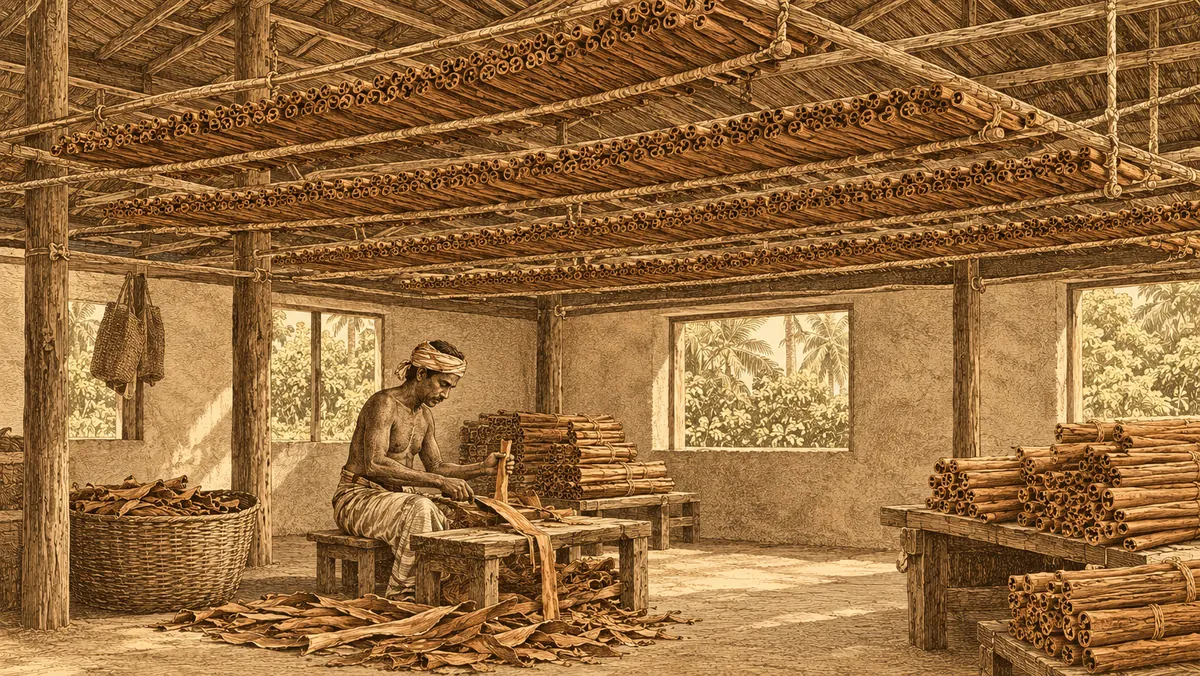
    Ceylon cinnamon is dried by resting the freshly peeled and rolled bark in shade and gentle air for several days, so the quills lose moisture slowly, keep their pale colour and tighten as they set. The peeled bark is formed into quills and dried on raised rope racks suspended overhead inside the roofed peeling sheds, turned as it firms, never out in the open. Careful drying is what gives true Ceylon cinnamon its light colour, smooth quills and fine aroma.

    Drying is one of the quiet but decisive steps in making Ceylon cinnamon. Done well, it sets the quill, locks in the aroma and keeps the colour pale. Done badly, it can darken the bark, invite mould or leave the quills loose. This guide explains how Ceylon cinnamon is dried, why the method matters and how it shapes the final spice. It builds on our pillar guide to how Ceylon cinnamon is made.

    The short answer

    Ceylon cinnamon is dried slowly and mostly in the shade, not baked hard in strong sun. After the bark is peeled and rolled into quills, it is left to dry over several days in shaded, airy conditions. As the quills lose water they shrink and tighten, so peelers roll and firm them during this time. The drying is done indoors on raised rope racks, in shade with good airflow, because strong direct sun can darken and crack the delicate bark. The aim is a quill that is dry, firm, pale and fragrant.

    Where drying fits in the process

    Drying comes after harvesting, peeling and rolling. First the stems are cut and the outer bark is scraped away. Then the thin inner bark is carefully lifted off in strips, a skill explained in our guide to traditional cinnamon peeling methods. These strips are shaped into the familiar quills, as described in how cinnamon quills are rolled by hand. Only then does drying begin, turning soft, moist bark into a stable, storable spice. Because the bark is still damp and flexible when rolling starts, drying and shaping overlap: the quill is formed, then set as it dries.

    Why slow shade drying is preferred

    Ceylon cinnamon bark is thin and delicate, so it responds badly to fast, harsh drying. Strong direct sun can dry the outside too quickly while the inside is still moist, which can crack the quill, darken the colour and trap moisture inside. Slow drying in shade, with good airflow, lets water leave the bark evenly from the inside out. This keeps the quill smooth and pale, helps it hold its shape, and protects the gentle aroma that sets true cinnamon apart. The traditional preference for shade is a practical response to how fragile the bark is.

    How the quills are dried day by day

    In the early stage, the freshly rolled quills are soft and still shrinking. Peelers rest them across raised rope racks, horizontal lines of rope strung inside the peeling shed about eight to nine feet above the floor. This height matters: it keeps the drying quills in the warm, moving air near the roof, lets workers move and peel freely in the space below, and is still within easy reach so peelers can lift each batch of freshly peeled quills straight up onto the racks as they finish. Over the first days, as the bark loses water, the quills tighten around themselves, and the peelers roll and press them so they stay firm and even rather than loosening. The quills are turned so they dry on all sides. After several days the bark becomes firm and dry enough to hold its shape and can be taken down to sort and bundle. All of this happens inside the shed, never out in the open.

    Sun drying versus shade drying

    People often picture spices drying in the open sun, but quality Ceylon cinnamon is different. Shade drying is gentle and slow, protecting colour and shape, which is why the quills are dried indoors on the raised racks rather than in the open. Strong sun is faster but risks darkening and cracking the thin Ceylon bark, so direct sun drying is avoided for the delicate quills. In practice, good Ceylon cinnamon is dried in the shaded, airy space of the peeling shed from start to finish.

    AspectShade dryingSun drying
    SpeedSlow and gentleFaster
    Effect on colourKeeps quills paleCan darken the bark
    Effect on shapeQuills set smoothlyCan crack if too harsh
    Best useWhole drying processGenerally avoided
    RiskSlower, needs airflowCracking and colour loss

    What good drying does for the spice

    Proper drying shapes almost everything a buyer notices later. It fixes the quill so it stays tight and neat, which matters for grading, since smooth, even quills reach higher grades. It keeps the colour the pale tan that marks genuine Ceylon cinnamon rather than a dark, over-dried brown. It protects the delicate, sweet aroma instead of driving it off with excess heat. And by lowering moisture to a safe level, it makes the spice stable enough to store and ship without spoiling. In short, drying is where the quality built up during peeling and rolling is either preserved or lost.

    Weather, humidity and the drying space

    Drying depends heavily on the weather and the space it is done in. Sri Lanka’s cinnamon districts are warm and humid, so simply leaving bark in the open air is not enough on its own. Peelers dry quills on the raised rope racks inside the roofed peeling sheds, which keep off rain and harsh midday sun while their open sides still let breezes pass through. In damp or rainy spells, drying takes longer and needs extra care, because high humidity slows moisture loss and raises the risk of mould. Good ventilation is as important as shade, since moving air carries away the moisture leaving the bark. This is why the drying space, not just the sun, shapes the result.

    How peelers know the quills are ready

    Experienced peelers judge dryness by feel, sound and look rather than by instruments. A properly dried quill feels light and firm, holds its rolled shape without softness, and has an even pale colour along its length. It should not feel damp or flexible in the middle, which would signal moisture still trapped inside. This judgement is part of the craft passed down in cinnamon families, built on long experience with how the bark behaves as it dries. The same hands that peel and roll the bark also decide when it has dried enough to sort, bundle and store.

    Moisture, storage and shelf life

    The point of drying is to bring the bark down to a low, stable moisture level. Bark that is still damp can grow mould or lose aroma, while properly dried quills keep well for a long time. This is why drying links directly to storage: a well-dried quill stored in a cool, dry, airtight place holds its flavour for a year or more. For how long the finished spice lasts once dried, see our guide to how long Ceylon cinnamon lasts.

    Summary

    Ceylon cinnamon is dried slowly, mostly in shade with good airflow, over several days after the bark is peeled and rolled into quills. Because the inner bark is thin and delicate, gentle drying protects the pale colour, the smooth quill shape and the fine aroma, while harsh sun is avoided because it can darken and crack the bark. As the quills lose moisture they tighten, and peelers firm them during this stage on raised rope racks suspended inside the shed, never out in the open. Good drying sets the quill, preserves the quality built during peeling and rolling, and lowers moisture enough for safe storage, which is why it is a decisive step in producing true Ceylon cinnamon.

    Frequently asked questions

    Is Ceylon cinnamon dried in the sun or the shade?

    In the shade, indoors. The delicate bark is dried slowly on raised rope racks inside the roofed peeling sheds to protect its colour and shape. Direct sun is avoided because it can darken and crack the quills, so the cinnamon is not dried out in the open.

    How long does it take to dry Ceylon cinnamon?

    Several days. The exact time depends on the weather, the thickness of the bark and the airflow, but the quills are dried over a number of days until they are firm, pale and low in moisture.

    Why is Ceylon cinnamon dried slowly?

    Because the inner bark is thin and fragile. Slow drying lets moisture leave evenly, keeping the quill smooth, pale and fragrant. Fast, harsh drying can crack the bark, darken the colour and trap moisture inside.

    Does drying affect the colour of cinnamon?

    Yes. Gentle shade drying keeps the pale tan colour that marks genuine Ceylon cinnamon, while over-drying or strong sun can turn the bark darker. Colour is one of the clues people use to judge quality.

    Why does drying matter for storage?

    Drying lowers the moisture in the bark to a safe level. Well-dried quills resist mould and keep their aroma, so they store and ship well. Bark that is not dried enough can spoil or lose flavour quickly.

    This website provides educational information about Ceylon Cinnamon as a spice and food ingredient. It is not intended to provide medical advice or make health claims.
  • How Cinnamon Quills Are Rolled by Hand

    How Cinnamon Quills Are Rolled by Hand

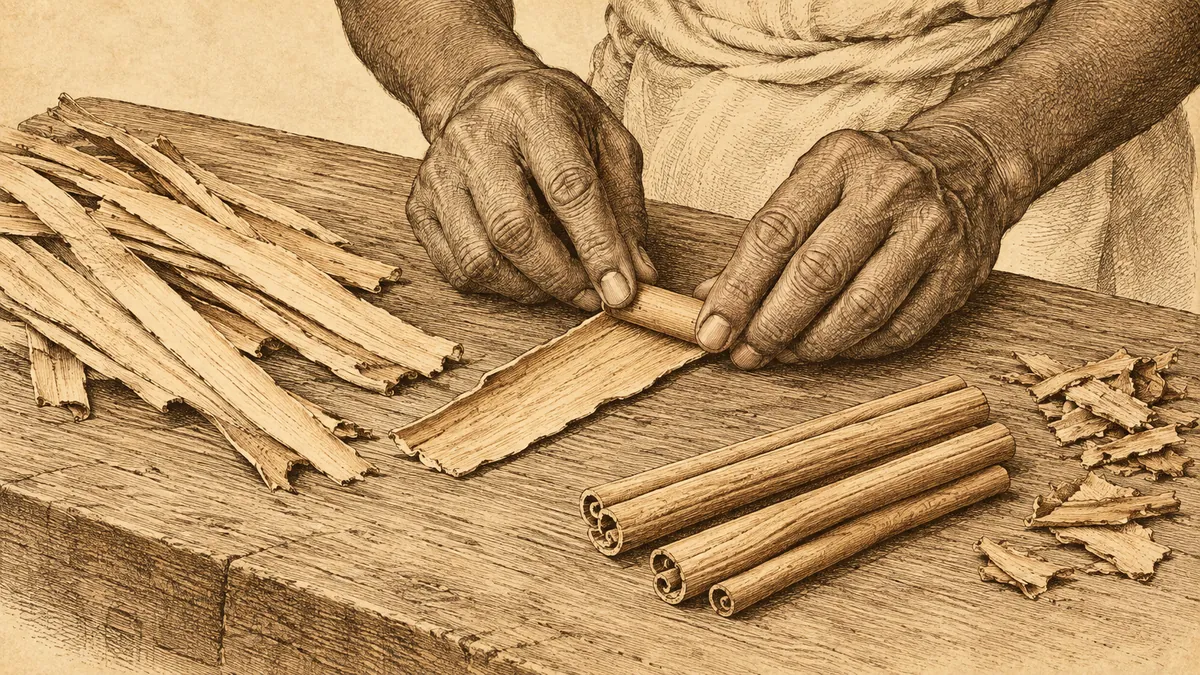
    Cinnamon quills are rolled by hand from strips of the peeled inner bark of the true cinnamon tree, Cinnamomum verum. After the bark is peeled and lightly dried, a skilled worker nests smaller strips inside larger ones and rolls them into a long, tight tube, joining piece after piece end to end to build a quill that can reach around 42 inches. As the rolled bark dries further it shrinks and tightens into the familiar cinnamon stick. This hand rolling is one of the most skilled steps in making Ceylon cinnamon, and it is done almost entirely by hand rather than by machine.

    The rolled cinnamon quill is the signature form of true cinnamon, and the way it is made by hand is part of what sets Ceylon cinnamon apart. This guide explains the process step by step. It builds on our pillar guide to how Ceylon cinnamon is made.

    The short answer

    Cinnamon quills are made by hand-rolling strips of peeled inner bark into long tubes, nesting smaller pieces inside larger ones and joining them end to end, then drying the rolls so they tighten into sticks. A skilled cinnamon worker peels the fine inner bark, lets it wilt slightly, and rolls it on a flat surface into a continuous quill. The quills are then dried, during which the bark curls and firms into the neat rolled sticks sold as Ceylon cinnamon.

    From peeled bark to rolled quill

    Rolling begins only after the bark has been prepared. The outer bark is scraped away and the fine inner bark is carefully peeled off in strips, a delicate job described in our guide to traditional cinnamon peeling methods. These thin, flexible strips of inner bark are the raw material for the quills. They are usually left for a short time so they lose a little moisture and become easier to handle, and it is these strips that the worker then rolls into shape.

    The nesting technique

    The key to a good quill is a technique often described as pipe within a pipe. Rather than rolling a single strip into a hollow tube, the worker places smaller strips and offcuts of inner bark inside the roll as it is formed. This filling holds the tube together, keeps its shape and makes the quill solid rather than empty. As the bark dries and shrinks, the nested pieces bind together into one firm stick. This is why a true Ceylon cinnamon quill is made of many thin layers packed together, which is one of the features that helps tell it apart from the thicker, single-layer bark of cassia.

    Building a long quill

    A single strip of bark is not long enough to make a full quill on its own, so the worker joins strips end to end as they roll. Piece after piece is added, each one continuing the roll, until a long, continuous quill is built up. Traditionally these are made to standard lengths, commonly around 42 inches or 21 inches, which are later trimmed to the sizes buyers want. The result is a long, even tube of tightly rolled bark, which is the classic form of Ceylon cinnamon before it is cut into shorter sticks.

    Rolling and drying

    The rolling itself is done on a flat surface, using the hands and simple tools, with the worker pressing and turning the bark so it curls into a firm, even roll. Once formed, the quills are set out to dry, usually in shade and air rather than harsh sun, so they dry slowly and keep their pale colour. During drying the bark loses moisture, shrinks and curls more tightly, so the quill firms up into a hard stick that holds its shape. Careful drying at this stage is important for the colour, firmness and keeping quality of the finished cinnamon. Rushed or overly hot drying can darken or crack the quills, so the slow, shaded method is preferred where the finest pale quills are wanted.

    The steps at a glance

    The main steps in hand-rolling Ceylon cinnamon quills.
    StepWhat happens
    PeelingThe fine inner bark is peeled off in strips
    WiltingStrips lose a little moisture and become easier to roll
    NestingSmaller pieces are placed inside the roll to fill it
    RollingStrips are rolled and joined end to end into a long quill
    DryingThe quills dry, shrink and tighten into firm sticks

    Why it is skilled work

    Hand-rolling cinnamon is a craft that takes practice to do well. The worker has to judge the moisture of the bark, roll it tightly and evenly, nest the filling neatly and join the strips smoothly, all by feel. A well-made quill is thin, even, tightly rolled and free of gaps, while a poorly rolled one is loose or uneven. Because the neatness and thinness of the quill affect its grade, the skill of the roller has a direct effect on the value of the cinnamon, a link described in our guide to featherings, quillings and chips, the smaller grades that come from the same process. A practised roller can produce a steady stream of even, well-formed quills, while the pieces that are too small or break along the way are set aside as the lower grades. In this sense the quality of a batch of cinnamon is decided partly at the rolling bench, by the hands and judgement of the person shaping each quill.

    Hand-rolled, not machine-made

    One of the striking things about Ceylon cinnamon is that this rolling is still done by hand. There is no simple machine that can peel the delicate inner bark and roll it into fine quills the way a trained worker can, so the craft has been passed down through generations of cinnamon workers in Sri Lanka. This is part of why true Ceylon cinnamon carries the character it does, and part of why it is more costly than mass-produced cassia. The rolled quill you hold is the product of skilled hands, not a factory line.

    What the rolled quill tells you

    The finished quill is also a useful sign of authenticity. A true Ceylon cinnamon quill is thin and light, made of many soft layers rolled together, so it looks like a tightly wound cigar and can be crumbled fairly easily. This layered, hand-rolled structure comes directly from the process described above. It is quite different from cassia, which is usually a thick, hard, single curl of bark. So understanding how quills are rolled by hand also helps you recognise the real thing, as covered in our guide to what a cinnamon quill is.

    Frequently asked questions

    How are cinnamon quills made?

    Cinnamon quills are made by hand-rolling strips of peeled inner bark into long tubes. A skilled worker nests smaller pieces inside larger ones, rolls the bark on a flat surface and joins strips end to end, then dries the rolls so they shrink and tighten into firm sticks.

    Why are cinnamon quills rolled by hand?

    The fine inner bark of true cinnamon is delicate and must be peeled and rolled with care, which no simple machine does as well as a trained worker. So Ceylon cinnamon quills are still rolled by hand, a craft passed down through generations of cinnamon workers in Sri Lanka.

    How long is a cinnamon quill?

    Traditionally, quills are rolled to standard lengths of around 42 inches or 21 inches, built up by joining many strips of bark end to end. They are then cut to the shorter lengths that buyers want, so the sticks you buy are pieces of these longer quills.

    Why are Ceylon cinnamon quills made of many layers?

    Because of the nesting, or pipe within a pipe, technique. Smaller strips are placed inside the roll as it is formed, so the finished quill is made of many thin layers packed together. This layered structure is one of the features that tells true Ceylon cinnamon apart from cassia.

    Summary

    Cinnamon quills are rolled by hand from strips of the peeled inner bark of Cinnamomum verum. After peeling, the strips are lightly wilted, then rolled on a flat surface using a nesting technique that places smaller pieces inside the roll, joined end to end to build a long, continuous quill of around 42 or 21 inches. As the rolled bark dries, it shrinks and curls into a firm stick made of many thin layers. This is skilled manual work, still done by hand rather than by machine, and the neatness of the roll affects the grade. The layered, hand-rolled quill is both the classic form of Ceylon cinnamon and one of the clearest signs that it is the genuine true cinnamon.

    This website provides educational information about Ceylon Cinnamon as a spice and food ingredient. It is not intended to provide medical advice or make health claims.

  • Feathering, Quilling and Chips: A Glossary

    Feathering, Quilling and Chips: A Glossary

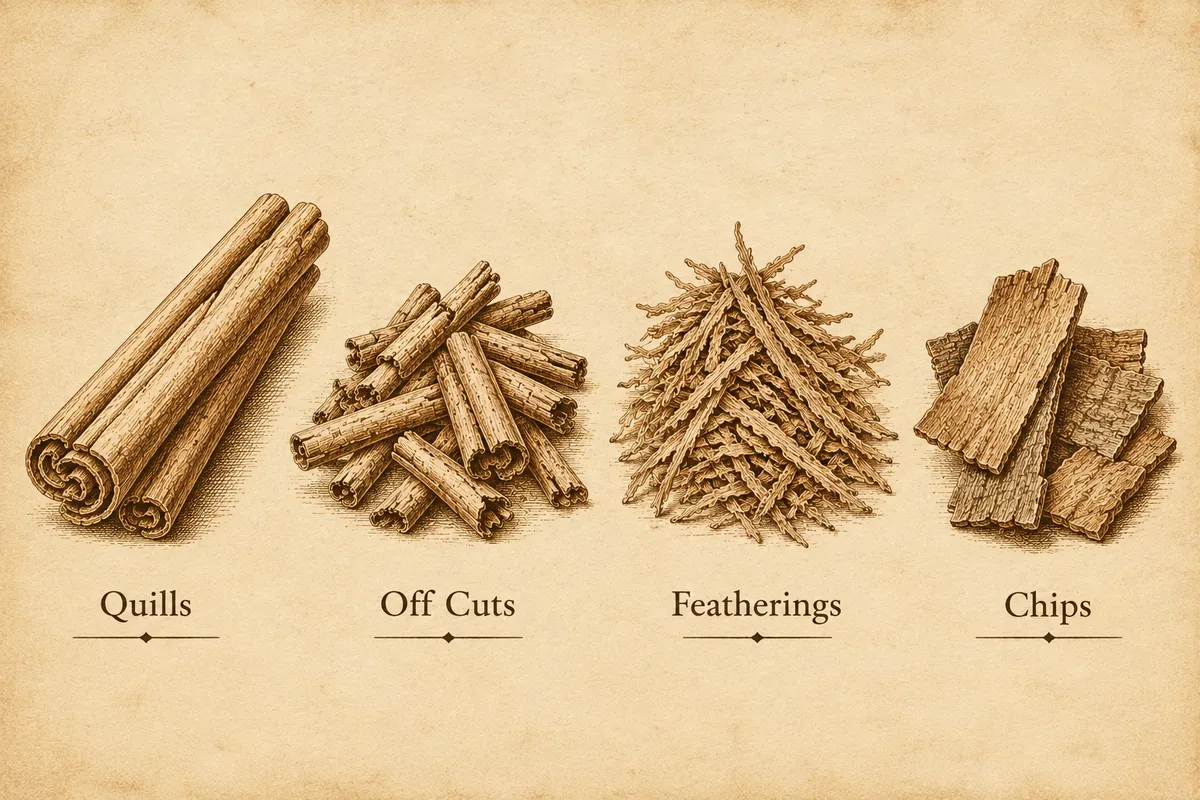
    Off cuts, featherings, quillings and chips are the smaller grades and by-products of Ceylon cinnamon, made from the pieces that are left over when the prime rolled quills are formed and trimmed to size. Off cuts are the short pieces cut off when a quill is trimmed to a customer’s required length; featherings are the thin, feathery inner-bark shavings; quillings are the broken fragments of quills; and chips are the flat pieces of bark that cannot be rolled. All come from the same true cinnamon tree, Cinnamomum verum, and are mostly ground into powder or distilled for oil rather than sold as whole sticks.

    These three words appear on grade lists and in the cinnamon trade, and they often confuse newcomers. This short glossary explains what each one means and how they relate to the familiar cinnamon quill. It builds on our full guide to Ceylon cinnamon grades.

    The short answer

    Off cuts, featherings, quillings and chips are the smaller, lower grades of Ceylon cinnamon left over from making and trimming quills. Off cuts are the pieces cut off when a quill is trimmed to a set length, quillings are broken bits of quill, featherings are thin feathery shavings and small inner-bark curls, and chips are flat pieces of bark that were never rolled. None of them are waste: they carry the same aroma and flavour as the prime quills and are widely used, mostly after grinding or distillation.

    Starting point: the cinnamon quill

    To understand these terms, it helps to start with the quill, the best known form of Ceylon cinnamon. A quill is a tube of dried inner bark, rolled by hand into the familiar stick shape. Making quills is skilled work, and not every piece of bark ends up as a long, perfect quill. The pieces that are too short, too small or the wrong shape become the grades described below. For the full picture of the quill itself, see our guide to what a cinnamon quill is.

    Off cuts

    Off cuts are the short pieces cut from a quill when it is trimmed to a required length. Ceylon cinnamon quills are traditionally hand-made to standard lengths, most often 42 inches or 21 inches. When a customer or buyer needs a particular size, the long quills are cut down to that length, and the remaining cut pieces are gathered and sold as off cuts. They are made of exactly the same fine rolled inner bark as the full quills, and carry the same aroma and taste, so an off cut is really just a shorter length of prime cinnamon. Because they are short and uneven, they cost less than full-length sticks and are a practical choice for cooking, steeping or grinding, where the length of the quill does not matter.

    Quillings

    Quillings are broken pieces and short offcuts of quills. When quills are trimmed to length, or when longer quills break during handling and transport, the small fragments left behind are gathered together and sold as quillings. They are made of exactly the same rolled inner bark as full quills, so they have the same fine aroma and taste. Because they are shorter and broken, they cost less than whole quills and are often chosen for grinding into powder, where the length of the piece does not matter. In short, quillings are true cinnamon in smaller, broken form.

    Featherings

    Featherings, sometimes called feather cinnamon, are the thin, light, feathery pieces of inner bark. During peeling and rolling, small curls and delicate shavings of the inner bark are produced that are too small and fine to form into proper quills. These wispy, feather-like pieces are collected as featherings. They are among the lightest grades of cinnamon and, like quillings, are usually ground or used where whole sticks are not needed. The name captures their look well: light, curly and feather-like.

    Chips

    Chips are flat, unrolled pieces of cinnamon bark. Some bark cannot be made into quills at all, for example thicker or coarser pieces, or the outer bark that is scraped away. These pieces are dried flat and sold as cinnamon chips. Chips are the most basic grade and are used mostly for grinding into powder, for making cinnamon oil by distillation, or for steeping in liquids where a whole quill is not required. Because they are flat rather than rolled, they are easy to tell apart from quills and quillings at a glance.

    Featherings, quillings and chips at a glance

    The by-product grades of Ceylon cinnamon compared.
    TermWhat it isFormCommon use
    QuillPrime rolled inner barkLong rolled tube (42 or 21 inches)Whole sticks, display, cooking
    Off cutsPieces cut when trimming quills to sizeShort rolled piecesCooking, steeping, grinding
    QuillingsBroken pieces of quillShort rolled fragmentsGrinding into powder
    FeatheringsThin feathery inner-bark shavingsLight curls and sliversGrinding, blending
    ChipsFlat unrolled bark piecesFlat chipsPowder, oil, steeping

    Why these grades exist

    All of these grades exist because of how Ceylon cinnamon is made by hand. Peelers separate the inner bark, which is rolled into quills as it dries. The process naturally produces offcuts, breakages, shavings and pieces of bark that will not roll. Rather than being thrown away, these are carefully sorted into featherings, quillings and chips. This sorting is part of good, low-waste cinnamon production, and it means that every usable piece of the fragrant inner bark finds a purpose. The grades are simply a way of organising the different sizes and shapes that come off the tree. This careful sorting also helps buyers, because it lets them choose exactly the format they need. Someone who wants long sticks for display buys quills, while someone who plans to grind their own powder can buy quillings or featherings and pay less for the same fragrant bark. In this sense the grades are as much about matching cinnamon to its use as they are about the pieces themselves.

    Are they lower quality?

    It is important to be clear that lower grade does not mean poor quality here. Featherings, quillings and chips from true Ceylon cinnamon are still true Ceylon cinnamon, with the same sweet, delicate character as the quills. The grade mainly describes the size and shape of the piece, not how good it tastes. What matters most for quality is still the species and origin: genuine Cinnamomum verum from Sri Lanka. A feathering of real Ceylon cinnamon is finer than a whole quill of cassia. So these grades are best thought of as different formats of the same good spice, chosen to suit different jobs.

    How each grade is used

    Because featherings, quillings and chips are smaller and less tidy than whole quills, they are rarely sold as display sticks. Instead, most of them are ground into cinnamon powder, where size and shape do not matter and the flavour is what counts, a process described in our guide to ground Ceylon cinnamon. Chips in particular are also used to make cinnamon oil by distillation, and for steeping in drinks and syrups. This is why buying quillings, featherings or chips can be a sensible choice when you plan to grind or infuse the cinnamon anyway, since you get the true spice at a lower price than perfect whole quills.

    How the grades relate to the wider grading system

    Featherings, quillings and chips sit alongside the more familiar quill grades such as Alba, Continental and the C5 and C4 codes. Where those grades describe the quality and diameter of the rolled quills, featherings, quillings and chips describe the smaller pieces that fall outside the quill grades. Together they make up the full range of Ceylon cinnamon products. To see where the premium rolled grades fit, our guide to C5 Special Ceylon cinnamon explains one of the well known quill grades in detail.

    Frequently asked questions

    What are cinnamon off cuts?

    Off cuts are the short pieces cut from Ceylon cinnamon quills when they are trimmed to a set length. Quills are traditionally made to 42 inches or 21 inches, and when a specific size is needed they are cut down, leaving off cuts. These are the same fine rolled bark as full quills, just shorter, and cost less.

    What are cinnamon featherings?

    Featherings are the thin, light, feathery pieces of Ceylon cinnamon inner bark: small curls and shavings that are too fine to roll into full quills. They are collected during peeling and rolling and are usually ground into powder or used in blends. They carry the same aroma and flavour as the quills.

    What are cinnamon quillings?

    Quillings are the broken pieces and short offcuts of cinnamon quills. They are the same rolled inner bark as whole quills, just in smaller, broken form, and they cost less. Quillings are commonly ground into cinnamon powder.

    What are cinnamon chips?

    Chips are flat, unrolled pieces of cinnamon bark that cannot be made into quills. They are dried flat and used mainly for grinding into powder, making cinnamon oil, or steeping in drinks and syrups.

    Are featherings, quillings and chips lower quality?

    Not in flavour. They are lower grades only in the sense of size and shape, not taste. Featherings, quillings and chips from true Ceylon cinnamon have the same fine, sweet character as the quills. Quality depends on the species and origin, genuine Cinnamomum verum from Sri Lanka, more than on the format.

    Summary

    Off cuts, featherings, quillings and chips are the smaller grades and by-products of Ceylon cinnamon, all made from the same true cinnamon tree, Cinnamomum verum. Off cuts are the pieces cut off when a quill is trimmed from its traditional 42-inch or 21-inch length to a required size, quillings are broken pieces of quill, featherings are thin feathery inner-bark shavings, and chips are flat pieces of bark that were never rolled. They arise naturally from the hand-made process of forming quills, and rather than being wasted they are sorted and sold, mostly for grinding into powder or distilling into oil. Above all, lower grade here means smaller and less tidy, not poorer in taste: these formats carry the same fine aroma and flavour as the prime quills, which makes them a practical way to buy genuine Ceylon cinnamon when you plan to grind or infuse it. The key point is that the grade name tells you about the shape and size of the piece, while the species and origin tell you about the quality, and it is the second of these that decides whether you are getting fine true cinnamon.

    This website provides educational information about Ceylon Cinnamon as a spice and food ingredient. It is not intended to provide medical advice or make health claims.

  • How Ceylon Cinnamon Is Made

    How Ceylon Cinnamon Is Made

    Ceylon cinnamon is made by cutting mature stems from the Cinnamomum verum bush, scraping and loosening the bark, peeling away the thin inner bark by hand, rolling it into quills, drying it in the shade and sun, then sorting and grading it. Almost every step is done by skilled hands, which is why true cinnamon is a craft product rather than an industrial one. This guide walks through the journey from tree to quill.

    The delicate character of Ceylon cinnamon, explained in what is true Ceylon cinnamon, is a direct result of how it is processed. The spice is not simply dried bark; it is the wafer-thin inner bark, carefully separated and rolled while still pliable. Getting that right takes years of practice.

    1. Farming and growing

    Ceylon cinnamon begins in the plantations and smallholdings of Sri Lanka’s wet south-west. Rather than being grown as tall trees, the plants are kept as low, multi-stemmed bushes through coppicing, cutting them back so they send up many straight, harvestable shoots. This is covered in depth in Sri Lankan cinnamon farming. A young plant is typically ready for its first harvest a few years after planting, after which it can be harvested repeatedly.

    2. Harvesting the stems

    Harvesting happens when the stems are the right thickness and the bark separates easily, often after rain when the sap is rising. Peelers select brown, mature shoots roughly the diameter of a thumb and cut them close to the base. The cut stems are gathered into bundles and taken to the peeling shed the same day, because the bark is easiest to remove while fresh.

    3. Scraping and loosening the bark

    Before the prized inner bark can be removed, the rough outer bark is scraped away. The peeler rubs and polishes the stem with a curved knife and a brass rod, then works the surface to loosen the bark from the wood. This “rubbing” stage is key: it frees the bark cleanly so it will come away in long, unbroken strips.

    4. Peeling the inner bark

    Peeling is the heart of the craft. Using a specialised small knife and a pointed brass tool called a peeling rod, the peeler slits the loosened bark and carefully lifts the thin inner layer away from the stem in long ribbons. This is painstaking, highly skilled work, a good peeler produces fine, even, unbroken strips with very little waste, and the skill has traditionally been passed down within families and communities. The thinness of these strips is exactly what gives Ceylon cinnamon its characteristic multi-layered quill.

    5. Rolling the quills

    The fresh inner-bark strips are still soft and flexible. The peeler layers several strips together and rolls them by hand into a quill, tucking smaller pieces and shavings inside so nothing is wasted. As the quill dries it contracts around these inner layers, producing the tightly nested, cigar-like cross-section that distinguishes true cinnamon from the single hollow curl of cassia. The leftover shavings become featherings and offcuts become quillings, described in our guide to grades.

    6. Drying

    The freshly rolled quills are first dried in the shade for a few days so they firm up without cracking, then finished in gentle sun to bring the moisture down to a stable level. During drying the quills shrink, tighten and develop their pale golden colour. Careful drying is essential: too fast and the quills split; too slow or too humid and mould can develop. Controlling moisture content is one of the quiet skills that separates good cinnamon from poor.

    7. Sorting and grading

    Once dry, the long quills are trimmed to standard lengths and sorted by diameter, colour and neatness into grades, from fine, pale Alba down through Continental, Mexican and Hamburg categories. This grading, done largely by eye and hand, determines the quill’s market name and price. The full system is explained in the complete guide to Ceylon cinnamon grades.

    8. Grinding into powder (optional)

    Some cinnamon is milled into powder rather than sold as quills. Quills, quillings or featherings are ground, with higher grades producing paler, more fragrant powder. Because ground cinnamon loses its aroma faster and cannot be checked by eye, quality and clear labelling matter even more, a point we return to in the buying guide.

    By-products: nothing is wasted

    Traditional cinnamon processing is remarkably efficient. Beyond quills and powder, the harvest yields featherings and chips, while the leaves and thin twigs can be distilled to produce cinnamon leaf oil, and the bark to produce cinnamon bark oil. These oils have their own aromatic character and are valued in the flavour and fragrance trades.

    Why it is still done by hand

    Despite modern machinery, the peeling and rolling of Ceylon cinnamon remains stubbornly manual. The inner bark is too thin and irregular for machines to handle without damaging it, and the judgement involved, which stems to cut, how to loosen the bark, how tightly to roll, depends on human skill. This is why authentic Ceylon cinnamon is best understood as an artisanal product, and why the tradition is central to its history.

    The skill and time involved

    What looks like a simple strip of bark represents hours of careful work. A skilled peeler spends years learning to judge which stems are ready, how to loosen the bark without tearing it, and how to lift the inner layer in long, even ribbons with minimal waste. The best peelers produce fine, uniform quills quickly, but the work is physically demanding and cannot be rushed without damaging the bark. Because so much depends on the human hand, the availability of trained peelers directly affects both the quantity and quality of cinnamon a region can produce.

    Quality control and moisture

    Throughout processing, controlling moisture is critical. Bark that is dried too quickly cracks and splits; bark left damp in humid conditions can develop mould and lose value. Peelers and graders monitor the quills as they dry, moving them between shade and sun and checking that they reach a stable, low moisture level before packing. Consistent moisture also protects the aromatic oils that give the spice its fragrance, which is why careful drying is as important as skilful peeling.

    Traditional craft in a modern market

    Although machinery is used for tasks like grinding powder and distilling oil, the core steps of peeling and rolling remain traditional and manual. Efforts to modernise focus on supporting peelers with better tools, hygienic processing sheds and fair prices rather than replacing the craft itself. This blend of age-old skill and modern quality standards is part of what earned Ceylon Cinnamon its protected status, and it connects directly to the spice’s long history and the farming systems that supply it.

    The tools of the trade

    The peeler’s craft relies on a small, specialised toolkit refined over generations. A curved knife scrapes and trims the outer bark; a smooth brass rod is used to rub and loosen the bark from the stem; and a fine peeling knife slits and lifts the inner bark in ribbons. Brass is favoured because it does not react with the bark or discolour it. Simple drying racks, mats and sorting boards complete the setup. It is a striking example of how a premium global product can still be made with modest, traditional equipment in the hands of skilled workers.

    From peeling shed to export

    Once graded, quills are bundled to standard lengths, weighed and packed for market. Reputable processors also attend to hygiene and moisture control at this stage, since cinnamon destined for export must meet food-safety and quality expectations. The finished quills may then be sold whole, cut into quillings, or milled into powder. This final journey from peeling shed to packed product connects the traditional craft directly to the shelves and kitchens described in our buying guide, and it is the last step in turning a freshly cut stem into the fragrant spice you cook with.

    Summary

    Making Ceylon cinnamon is a hand-crafted journey: coppiced bushes are harvested for mature stems, the outer bark is scraped away, the thin inner bark is skilfully peeled into ribbons, rolled into multi-layered quills, dried in shade and sun, then sorted into grades. Offcuts become quillings and featherings, and leaves and bark can be distilled into oils. This labour-intensive craft, impossible to fully mechanise, is the reason true cinnamon is thin, pale, fragrant and prized the world over.

    Frequently asked questions

    How is Ceylon cinnamon harvested?

    Skilled workers cut mature brown stems from coppiced bushes, usually when the bark separates easily, then take them to a shed to be peeled the same day.

    Why is Ceylon cinnamon rolled into thin quills?

    Because only the thin inner bark is used. Several soft strips are layered and rolled by hand, and as they dry they tighten into the characteristic multi-layered quill.

    Is Ceylon cinnamon made by hand or machine?

    Mostly by hand. The inner bark is too fine and irregular for machines, so peeling and rolling rely on human skill passed down over generations.

    What happens to the leftover bark?

    Little is wasted: offcuts become quillings and featherings, and leaves and bark can be distilled into cinnamon leaf oil and bark oil.

    This website provides educational information about Ceylon Cinnamon as a spice and food ingredient. It is not intended to provide medical advice or make health claims.