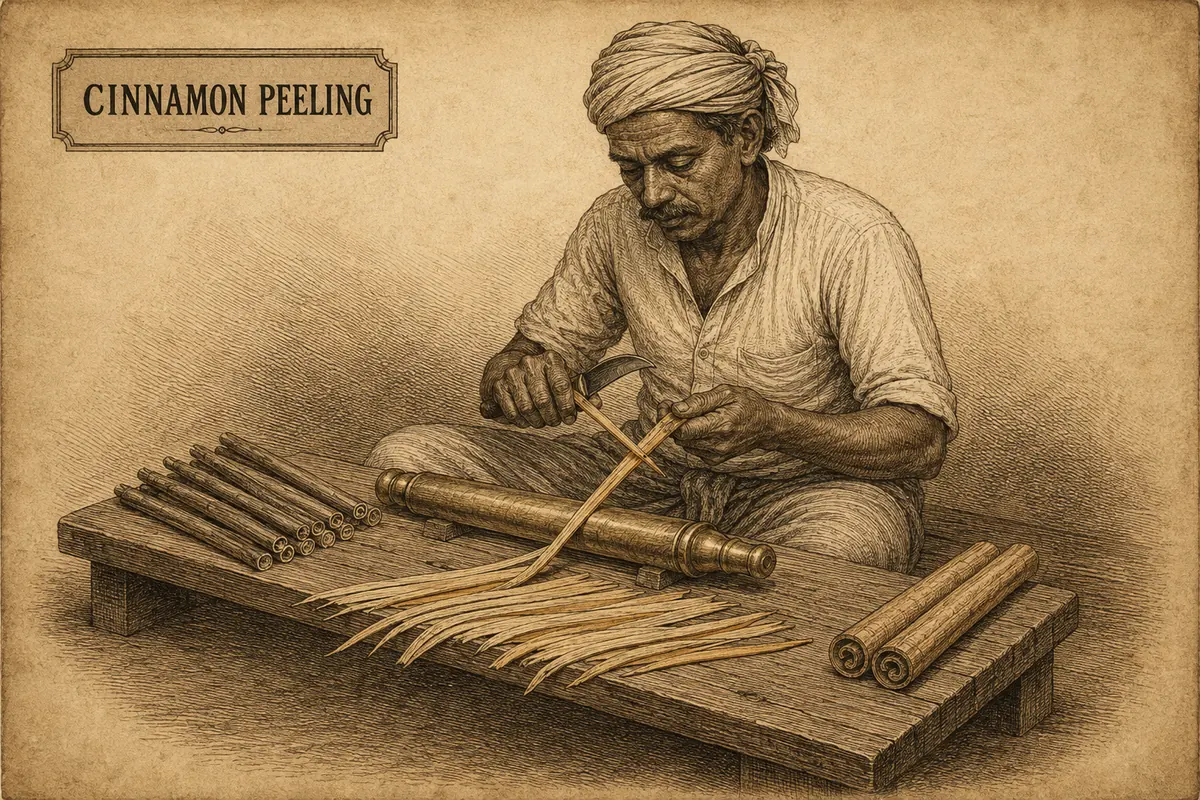
Traditional cinnamon peeling is the skilled hand-craft of removing the thin inner bark from young cinnamon shoots and rolling it into quills. In Sri Lanka it is done with a few simple tools, in a set sequence of steps: the shoots are cut, the rough outer bark is scraped away, the bark is scored and loosened, the fine inner bark is peeled off in strips, and the strips are rolled into the familiar cinnamon quills to dry.
This craft has changed little in generations and is central to what makes Ceylon cinnamon special. This guide walks through the traditional peeling methods step by step, and pairs with our pillar guide on how Ceylon cinnamon is made.
The short answer
Traditional peeling separates the delicate inner bark of the cinnamon shoot from the wood by hand, then rolls it into quills. A trained peeler uses a small curved knife and a rounded rod to scrape, score and lift the bark, working quickly so the thin inner layer comes away cleanly. The freed strips are then nested and rolled into long tubes that dry into quills. It is patient, delicate work, and the skill of the peeler shapes the quality of the finished spice.
The tools of the peeler
Traditional peeling uses a small set of hand tools rather than machinery. The main ones are a special curved peeling knife for scoring and lifting the bark, and a smooth rounded rod, often of brass, used to rub and loosen the bark before it is peeled. Simple stands or benches hold the shoots, and the rolled quills are laid out to dry. The simplicity of these tools is part of the craft: almost everything depends on the skill of the peeler’s hands rather than on equipment.
The traditional peeling steps
1. Cutting the shoots
Peeling begins with young cinnamon shoots, cut from the coppiced trees at the right stage, when the bark peels most easily. The stems are trimmed to workable lengths and any side twigs and leaves are removed, leaving clean rods of bark-covered wood ready to work. The timing of the harvest matters, as covered in our guide to how Ceylon cinnamon is harvested.
2. Scraping the outer bark
The rough, greenish outer skin is scraped off the shoot, usually with a curved knife, to expose the smooth inner bark beneath. This step, sometimes called rubbing or scraping, cleans the stem so that only the fine, flavourful inner bark will be taken. It is done carefully to avoid cutting into the precious inner layer.
3. Rubbing and loosening
Next the peeler rubs the stem firmly with the rounded brass rod. This polishing action loosens the bond between the inner bark and the wood, so that the bark will lift away cleanly in the next step. Good rubbing is key to a clean peel, and it is one of the skills that separates an experienced peeler from a beginner.
4. Scoring the bark
With the bark loosened, the peeler makes long cuts along the shoot with the tip of the knife, scoring the bark into strips. These cuts run the length of the stem and mark out the pieces of inner bark that will be peeled off. Precise scoring keeps the strips even and reduces waste.
5. Lifting the inner bark
The peeler then slides the knife under the scored bark and carefully lifts the thin inner layer away from the wood. Done well, the wafer-thin bark comes off in clean strips. This is the most delicate stage, since the inner bark is fragile and easily torn, and it is where the peeler’s skill shows most clearly.
6. Rolling the quills
The freed strips of inner bark are then rolled and nested together into long tubes. Several thin pieces are layered inside one another to build up a quill of good length and thickness. This is why true Ceylon cinnamon quills have their signature many-layered structure, as explained in our guide to what a cinnamon quill is.
7. Drying
Finally the rolled quills are set aside to dry, often in shade at first and then in the sun, sometimes laid on racks. As they dry they tighten and firm into the pale, hard sticks we recognise. Once dried, they are sorted and graded ready for sale.
The traditional peeling process at a glance
| Step | What happens |
|---|---|
| Cut shoots | Young stems harvested and trimmed |
| Scrape | Rough outer bark removed |
| Rub | Bark loosened with a brass rod |
| Score | Bark cut into strips along the stem |
| Peel | Thin inner bark lifted off |
| Roll | Strips nested into quills |
| Dry | Quills dried, then sorted and graded |
A craft passed down through generations
Traditional peeling is more than a set of steps; it is a skill handed down within families and communities in the cinnamon-growing districts. Experienced peelers work with remarkable speed and care, and their trained hands make the difference between fine, even quills and rough, wasteful ones. This inherited knowledge is a living tradition, closely tied to the farming communities described in our guide to Sri Lankan cinnamon farming. It is one of the reasons Ceylon cinnamon remains a hand-made, artisan product rather than a factory one.
Why traditional peeling still matters
Machines struggle to separate the wafer-thin inner bark of true cinnamon without damaging it, so the traditional hand method remains the best way to produce fine quills. The care taken at each stage, clean scraping, good rubbing, precise scoring and gentle lifting, decides how neat and how flavourful the finished cinnamon will be. In this sense the traditional peeling craft is not just history; it is still the method behind the quality of real Ceylon cinnamon today.
Timing, moisture and the peeling season
Traditional peeling works best when the conditions are right. Bark lifts most cleanly when the shoots are freshly cut and full of sap, so peeling usually follows soon after harvest, and the craft tends to be busiest during and just after the rains, when the sap is running. If the stems dry out, the bark clings to the wood and is far harder to remove in clean strips. Because of this, peelers often work through the day close to where the shoots are cut, keeping the stems fresh and moist so the bark comes away easily. This close link between weather, timing and workflow is part of why cinnamon farming and peeling follow the rhythm of the seasons.
Quality starts with the peel
The care taken during peeling shows directly in the finished quill. A clean, even peel produces smooth, well-formed quills that dry into fine grades, while rough or hurried work leaves ragged, broken bark that ends up as lower grades or off-cuts. Experienced peelers waste very little, lifting almost all of the usable inner bark and rolling it tightly and neatly. So the grade a quill eventually reaches is set in large part at this stage, long before it is sorted, which is why skilled peeling is so highly valued in the trade.
Frequently asked questions
How is cinnamon traditionally peeled?
Young cinnamon shoots are cut, the rough outer bark is scraped off, the stem is rubbed with a brass rod to loosen the bark, the bark is scored into strips, and the thin inner bark is lifted off by hand. The strips are then rolled into quills and dried.
What tools are used to peel cinnamon?
The main tools are a small curved peeling knife, used to scrape, score and lift the bark, and a smooth rounded rod, often brass, used to rub and loosen the bark. Simple benches and drying racks are also used. Most of the work depends on hand skill.
Why is cinnamon peeled by hand?
Because the inner bark of true Ceylon cinnamon is very thin and delicate, machines tend to damage it. Skilled hand peeling separates the fine bark cleanly and rolls it into quills, which is why the craft is still done by hand.
Who peels the cinnamon?
In Sri Lanka, cinnamon is peeled by trained peelers, a skill traditionally passed down within farming and peeling families in the cinnamon-growing districts. Experienced peelers work quickly and carefully to produce fine quills.
Summary
Traditional cinnamon peeling is the hand-craft of turning young cinnamon shoots into quills. Using a curved knife and a brass rubbing rod, the peeler cuts the shoots, scrapes off the outer bark, rubs the stem to loosen the inner bark, scores it into strips, lifts the thin inner bark away, rolls the strips into quills, and dries them. It is a delicate, skilled process, handed down through generations in Sri Lanka, and it remains the best way to produce the fine, many-layered quills of true Ceylon cinnamon. The quality of the spice starts here, in the trained hands of the peeler.
This website provides educational information about Ceylon Cinnamon as a spice and food ingredient. It is not intended to provide medical advice or make health claims.
Leave a Reply