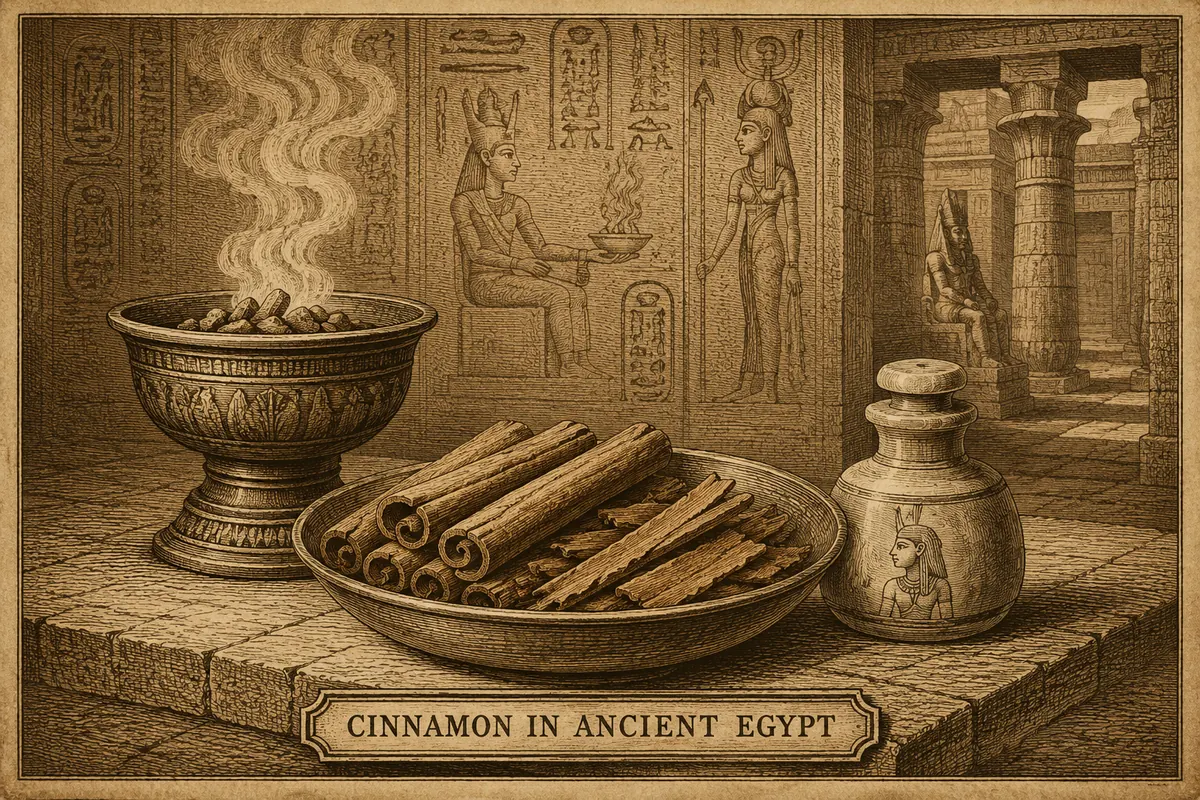
In ancient Egypt, cinnamon was a rare and precious imported spice, valued far more as a fragrant aromatic than as a food. It appears in accounts of embalming, temple incense and perfumed oils, where its warm scent was prized for sacred and luxury uses. Because it came from distant lands through a long chain of traders, cinnamon was costly and exotic, and the Egyptians did not know its true source.
The story of cinnamon in ancient Egypt is part history and part mystery, and it sits within the wider tale of how the spice travelled the ancient world. This guide looks at how the Egyptians used and valued it, and pairs with our pillar guide on the history of Ceylon cinnamon.
The short answer
Ancient Egyptians used cinnamon mainly as a luxury aromatic, in embalming preparations, incense and scented oils, rather than as a cooking spice. It was a high-value import, reserved for religious rites, funerary practices and the wealthy. Reaching Egypt only through long trade routes, cinnamon carried an air of the exotic, and its far-off origin was a closely held secret of the traders who supplied it.
A note on what “cinnamon” meant then
It is worth saying at the start that historians are not always certain which exact spice ancient texts mean by “cinnamon”. The words used in old sources may have covered both true cinnamon (Cinnamomum verum) and the related cassia barks, since the ancient world did not draw the sharp modern distinction between them. What is clear is that a warm, sweet, aromatic bark of this family was highly prized. To understand the difference these names carry today, see our guide to what true Ceylon cinnamon is.
Cinnamon in embalming and funerary rites
One of the best-known ancient uses of cinnamon was in embalming. The fragrant spice was among the aromatic substances associated with preparing the dead, valued for its scent in a practice where perfume and preservation went hand in hand. Cinnamon’s warm aroma made it a fitting part of these solemn, high-status rituals. Its role here shows how far the spice sat from everyday cooking: it was a sacred, luxury material connected with the most important of ceremonies.
Incense, temples and the gods
Aromatics were central to Egyptian religious life, burned as incense to honour the gods and scent the temples. Cinnamon was one of the prized ingredients that could go into such fragrant blends. A famous example is kyphi, a celebrated Egyptian incense made from a mixture of aromatic ingredients and used in temple rites; recipes for such incense drew on precious imported spices. In this world, a sweet-smelling bark like cinnamon was a way of reaching towards the divine, its rising smoke carrying prayers and honour. The finer and rarer the ingredients, the more fitting the gift was thought to be, which gave a costly import like cinnamon a natural place in the most important temple rituals.
Perfumes and scented oils
Beyond the temple, cinnamon featured in the perfumes and scented oils that were so important in Egyptian life. Fragrant oils were used to anoint the body, and warm, spicy aromatics gave them depth and richness. As a costly import, cinnamon-scented preparations were a mark of wealth and refinement, enjoyed by those who could afford such luxuries. Its place in perfumery again shows that the spice was valued first and foremost for its scent.
A precious and mysterious import
Cinnamon did not grow anywhere near Egypt. It reached the Nile only after a long journey through many hands, along trade routes that stretched far to the east. Because of this, it was expensive and surrounded by mystery, and the merchants who supplied it kept its true origin secret to protect their trade. Fantastic stories grew up about where cinnamon came from, and the real source, the island now called Sri Lanka, remained unknown to the Egyptians. This long, secretive trade is part of the wider ancient history of the cinnamon trade.
How the ancient Egyptians used cinnamon at a glance
| Use | Role |
|---|---|
| Embalming | Fragrant aromatic in funerary preparation |
| Incense | Ingredient in temple blends such as kyphi |
| Perfume | Scent in luxury oils and anointing preparations |
| Status | Costly imported luxury for rites and the wealthy |
| Origin | Unknown to Egyptians, a closely guarded trade secret |
Why cinnamon mattered so much
To understand why a simple bark was so treasured, it helps to remember what scent meant in the ancient world. Fragrance was tied to religion, status and the care of the dead, and a sweet, warm, long-lasting aroma that came from far away was doubly precious. Cinnamon offered exactly this. Its rarity, its exotic origin and its beautiful scent combined to make it a fitting gift for the gods and a luxury for the living. In ancient Egypt, cinnamon was less a flavour than a symbol of wealth, devotion and the mysterious riches of distant lands.
From ancient luxury to everyday spice
The contrast with today is striking. What was once a secret, sacred luxury in ancient Egypt is now a familiar spice on kitchen shelves around the world. The long journey from mysterious import to everyday ingredient is the heart of cinnamon’s story, and true Ceylon cinnamon remains the fine, original spice at the centre of it. To follow that journey further, our guide to the history of Ceylon cinnamon traces how the spice travelled from antiquity to the present day.
The trade routes that brought cinnamon to Egypt
Cinnamon’s path to the Nile was long and winding. It moved westward from South and South-East Asia through a series of ports and middlemen, crossing the Indian Ocean and the lands of Arabia before reaching Egyptian markets. No single merchant carried it the whole way; instead it passed from hand to hand, each trader taking a share, which is part of why it grew so costly by the time it arrived. This relay of routes also helped keep the true origin hidden, since even many of the traders did not know where the spice had first been grown. The result was a spice that felt as though it came from the very edge of the known world.
Cinnamon in the ancient imagination
Because its source was unknown, cinnamon gathered legends around it. Ancient writers repeated colourful tales of how the spice was gathered in far-off, dangerous places, stories that made it seem all the more wondrous and rare. Whether or not anyone believed them fully, such tales added to the spice’s mystique and helped justify its high price. In a sense the mystery was part of the product: a fragrant bark from an unknown land, wrapped in wonder, was worth far more than a common local herb. This blend of real trade and rich imagination is one of the most memorable parts of cinnamon’s ancient story.
Frequently asked questions
What did ancient Egyptians use cinnamon for?
Mainly as a luxury aromatic. Cinnamon featured in embalming preparations, in temple incense such as kyphi, and in perfumed oils. It was valued for its scent in sacred and high-status uses, rather than as an everyday cooking spice.
Did ancient Egyptians know where cinnamon came from?
No. Cinnamon reached Egypt through long trade routes, and the merchants who supplied it kept its true origin secret. The real source, the island now called Sri Lanka, was unknown to the Egyptians, and fanciful stories grew up about where the spice came from.
Was Egyptian cinnamon the same as Ceylon cinnamon?
It is not certain. Ancient sources may have used “cinnamon” for both true cinnamon and related cassia barks, since the ancient world did not separate them as we do. What is clear is that a fragrant bark of this family was highly prized.
Why was cinnamon so prized in ancient Egypt?
Because it was a rare, far-travelled import with a beautiful scent, and fragrance was central to Egyptian religion, funerary rites and luxury. Its rarity and exotic origin, combined with its aroma, made cinnamon a precious material fit for the gods and the wealthy.
Summary
In ancient Egypt, cinnamon was a rare and precious aromatic rather than a cooking spice. It appears in accounts of embalming, in temple incense such as kyphi, and in luxury perfumed oils, where its warm scent served sacred and high-status purposes. As a costly import that travelled long trade routes, cinnamon was exotic and mysterious, its true source in distant Sri Lanka kept secret by the traders who supplied it. The spice that was once a guarded luxury of the ancient world is now an everyday favourite, with true Ceylon cinnamon still the fine original at the heart of its long story.
This website provides educational information about Ceylon Cinnamon as a spice and food ingredient. It is not intended to provide medical advice or make health claims.
Leave a Reply