Tag: Ancient trade

  • Cinnamon in the Bible and Antiquity

    Cinnamon in the Bible and Antiquity

    Cinnamon appears in the Bible and across the ancient world as one of the most prized spices of antiquity. In the Hebrew Bible it is named among the ingredients of a sacred anointing oil in the Book of Exodus, and it appears again in Proverbs, the Song of Songs and, in the New Testament, the Book of Revelation. Beyond scripture, cinnamon was valued by the ancient Egyptians, Greeks and Romans as a costly luxury for perfume, incense and ritual, carried west along secret trade routes whose true source lay in and around Sri Lanka, the home of true cinnamon, Cinnamomum verum.

    Few spices carry as much history as cinnamon. This guide looks at where it appears in the Bible and how it was treasured in antiquity. It builds on our pillar guide to the history of Ceylon cinnamon.

    The short answer

    Cinnamon is mentioned several times in the Bible and was one of the most valued luxury spices of the ancient world. In scripture it appears as an ingredient of a holy anointing oil in Exodus, as a perfume in Proverbs and the Song of Songs, and among the goods of a great trading city in Revelation. In wider antiquity, Egyptians, Greeks and Romans prized cinnamon for perfume, incense and ceremony, and its high price and mysterious origin made it a symbol of wealth and the distant East.

    Cinnamon in the Bible

    Cinnamon is named directly in several books of the Bible, always as a fragrant, precious substance rather than an everyday food. The references show how highly it was regarded in the ancient Near East.

    The anointing oil in Exodus

    The best known biblical mention comes in the Book of Exodus, where cinnamon is listed among the ingredients of a sacred anointing oil, alongside other costly aromatics such as myrrh and cassia. This oil was set apart for holy use, which tells us that cinnamon was considered fine and precious enough to belong in a sacred preparation. Being placed beside myrrh, one of the most treasured perfumes of the ancient world, shows the high standing cinnamon held.

    Proverbs and the Song of Songs

    Cinnamon also appears as a perfume. In the Book of Proverbs it is named among the scents used to perfume a bed, and in the Song of Songs it is listed among the choice spices of a fragrant garden, together with other aromatics. In both cases cinnamon stands for luxury, sweetness and desirability. These poetic uses confirm that, in the biblical world, cinnamon was a byword for something rare and delightful to the senses. The same spice appears in these very different settings, sacred ritual and love poetry alike, which shows how widely admired its fragrance was.

    Revelation and the spice trade

    In the New Testament, cinnamon appears in the Book of Revelation among a long list of precious goods traded by a great commercial city. Its place on that list, beside gold, fine cloth and other luxuries, reflects the reality of the ancient spice trade, in which cinnamon was a high-value commodity carried over great distances. The mention is a reminder that, by the time of the early Roman Empire, cinnamon was a well established article of international trade.

    Cinnamon in ancient Egypt

    Outside the Bible, cinnamon was treasured across the ancient world, and Egypt is one of the earliest places associated with it. The ancient Egyptians valued fragrant spices and resins for perfume, incense and their embalming practices, and cinnamon was among the aromatics linked to these uses. Because it had to be brought from far away, it was a mark of wealth and status, reserved for temples, the wealthy and the rites of the dead rather than everyday cooking. The care the Egyptians took over fragrant spices, and the long distances these goods travelled to reach the Nile, help explain why cinnamon carried such prestige throughout the ancient Mediterranean. Our guide to cinnamon in ancient Egypt looks at this early chapter in more detail.

    Cinnamon in ancient Greece and Rome

    The Greeks and Romans wrote about cinnamon with a mixture of admiration and mystery. The Greek historian Herodotus recorded a famous tale that cinnamon was gathered from the nests of great birds, a story that shows how little the Mediterranean world knew about where the spice truly came from. Traders, most likely Arab middlemen, deliberately kept the real source secret to protect their business and justify the high prices.

    In Rome, cinnamon was a costly import. The Roman writer Pliny the Elder complained about its high price and noted how far it travelled to reach Roman markets. Cinnamon was burned as fragrant incense and used in perfumes, and Roman sources describe it being used lavishly at grand occasions as a display of wealth. One much repeated anecdote, recorded by Pliny, tells that the Emperor Nero burned a huge quantity of cinnamon at the funeral of his wife, a gesture meant to show extraordinary wealth and grief. Whether or not every detail is exact, the story captures how cinnamon was seen: something so costly that using it freely was itself a statement. Throughout the classical world, then, cinnamon was firmly a luxury, associated with the exotic East and with those who could afford the finest things.

    Where did biblical cinnamon come from?

    Scholars have long discussed exactly which plant the cinnamon of the Bible and antiquity refers to. The Hebrew word usually translated as cinnamon is qinnamon, and ancient writers were often vague about the botanical details, partly because traders hid the true source. What is clear is that the finest true cinnamon, Cinnamomum verum, is native to Sri Lanka, and that the ancient spice routes ultimately connected the Mediterranean world with South Asia. So while the precise identity of every ancient reference is debated, the story of cinnamon in antiquity is bound up with the same true cinnamon and the same distant island that give us Ceylon cinnamon today, which is part of why the spice took on the island’s name, as explained in our guide to why it is called Ceylon cinnamon.

    Why cinnamon was so valued in antiquity

    Several things combined to make cinnamon precious in the ancient world. It had a warm, sweet, lasting fragrance that suited perfume, incense and ceremony. It came from far away, along difficult routes, so supply was limited and prices were high. And its true origin was hidden, which added an air of mystery and wonder. Together these gave cinnamon a reputation as a spice fit for temples, kings and the wealthy. That reputation for rarity and value has echoes today, and it is part of the reason true Ceylon cinnamon is still regarded as a fine spice, as our guide to why Ceylon cinnamon is so expensive explains.

    Frequently asked questions

    Is cinnamon mentioned in the Bible?

    Yes. Cinnamon is named several times in the Bible. It appears as an ingredient of a sacred anointing oil in the Book of Exodus, as a perfume in Proverbs and the Song of Songs, and among the luxury goods of a great trading city in the Book of Revelation.

    What was cinnamon used for in ancient times?

    In antiquity cinnamon was used mainly as a fragrant luxury rather than an everyday food. It featured in perfumes, incense, anointing oils and religious ceremony, and it was a high-value item in the ancient spice trade, treasured by the Egyptians, Greeks and Romans.

    Where did cinnamon come from in antiquity?

    The finest true cinnamon, Cinnamomum verum, is native to Sri Lanka, and the ancient spice routes linked South Asia with the Mediterranean world. Traders kept the true source secret, so ancient Greek and Roman writers were often unsure exactly where it grew.

    Why was cinnamon so expensive in the ancient world?

    Cinnamon was costly because it came from far away over difficult trade routes, its supply was limited, and its true origin was hidden by the merchants who traded it. Its fine fragrance and rarity made it a symbol of wealth and status.

    Summary

    Cinnamon has a long and storied place in the Bible and in antiquity. In scripture it is named as an ingredient of a sacred anointing oil in Exodus, as a perfume in Proverbs and the Song of Songs, and among the precious goods of a great city in Revelation, always standing for something fragrant and precious. In the wider ancient world, the Egyptians, Greeks and Romans prized cinnamon for perfume, incense and ceremony, and writers such as Herodotus and Pliny recorded both its high price and the mystery around its origin. That origin lay in the distant East, and the finest true cinnamon, Cinnamomum verum, comes from Sri Lanka, tying these ancient stories to the same Ceylon cinnamon valued as a fine spice today.

    This website provides educational information about Ceylon Cinnamon as a spice and food ingredient. It is not intended to provide medical advice or make health claims.
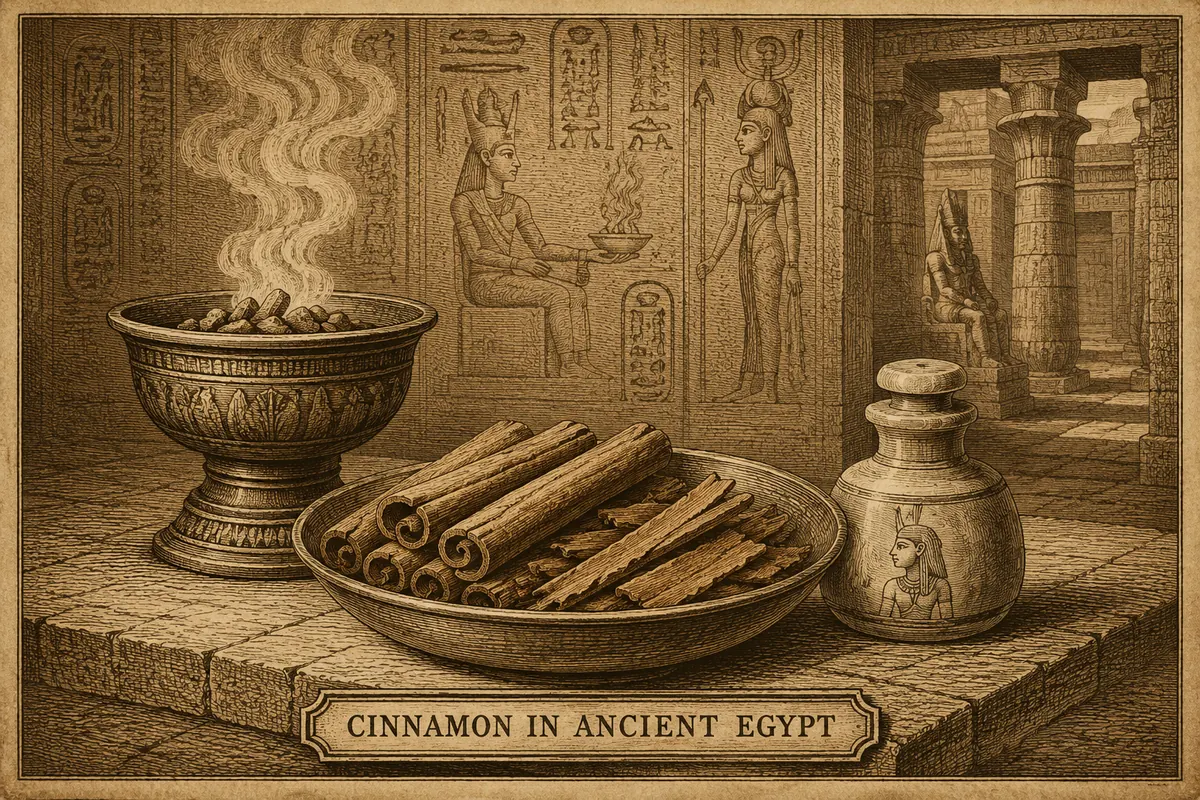
  • Cinnamon in Ancient Egypt

    Cinnamon in Ancient Egypt

    In ancient Egypt, cinnamon was a rare and precious imported spice, valued far more as a fragrant aromatic than as a food. It appears in accounts of embalming, temple incense and perfumed oils, where its warm scent was prized for sacred and luxury uses. Because it came from distant lands through a long chain of traders, cinnamon was costly and exotic, and the Egyptians did not know its true source.

    The story of cinnamon in ancient Egypt is part history and part mystery, and it sits within the wider tale of how the spice travelled the ancient world. This guide looks at how the Egyptians used and valued it, and pairs with our pillar guide on the history of Ceylon cinnamon.

    The short answer

    Ancient Egyptians used cinnamon mainly as a luxury aromatic, in embalming preparations, incense and scented oils, rather than as a cooking spice. It was a high-value import, reserved for religious rites, funerary practices and the wealthy. Reaching Egypt only through long trade routes, cinnamon carried an air of the exotic, and its far-off origin was a closely held secret of the traders who supplied it.

    A note on what “cinnamon” meant then

    It is worth saying at the start that historians are not always certain which exact spice ancient texts mean by “cinnamon”. The words used in old sources may have covered both true cinnamon (Cinnamomum verum) and the related cassia barks, since the ancient world did not draw the sharp modern distinction between them. What is clear is that a warm, sweet, aromatic bark of this family was highly prized. To understand the difference these names carry today, see our guide to what true Ceylon cinnamon is.

    Cinnamon in embalming and funerary rites

    One of the best-known ancient uses of cinnamon was in embalming. The fragrant spice was among the aromatic substances associated with preparing the dead, valued for its scent in a practice where perfume and preservation went hand in hand. Cinnamon’s warm aroma made it a fitting part of these solemn, high-status rituals. Its role here shows how far the spice sat from everyday cooking: it was a sacred, luxury material connected with the most important of ceremonies.

    Incense, temples and the gods

    Aromatics were central to Egyptian religious life, burned as incense to honour the gods and scent the temples. Cinnamon was one of the prized ingredients that could go into such fragrant blends. A famous example is kyphi, a celebrated Egyptian incense made from a mixture of aromatic ingredients and used in temple rites; recipes for such incense drew on precious imported spices. In this world, a sweet-smelling bark like cinnamon was a way of reaching towards the divine, its rising smoke carrying prayers and honour. The finer and rarer the ingredients, the more fitting the gift was thought to be, which gave a costly import like cinnamon a natural place in the most important temple rituals.

    Perfumes and scented oils

    Beyond the temple, cinnamon featured in the perfumes and scented oils that were so important in Egyptian life. Fragrant oils were used to anoint the body, and warm, spicy aromatics gave them depth and richness. As a costly import, cinnamon-scented preparations were a mark of wealth and refinement, enjoyed by those who could afford such luxuries. Its place in perfumery again shows that the spice was valued first and foremost for its scent.

    A precious and mysterious import

    Cinnamon did not grow anywhere near Egypt. It reached the Nile only after a long journey through many hands, along trade routes that stretched far to the east. Because of this, it was expensive and surrounded by mystery, and the merchants who supplied it kept its true origin secret to protect their trade. Fantastic stories grew up about where cinnamon came from, and the real source, the island now called Sri Lanka, remained unknown to the Egyptians. This long, secretive trade is part of the wider ancient history of the cinnamon trade.

    How the ancient Egyptians used cinnamon at a glance

    The main roles of cinnamon in ancient Egypt.
    UseRole
    EmbalmingFragrant aromatic in funerary preparation
    IncenseIngredient in temple blends such as kyphi
    PerfumeScent in luxury oils and anointing preparations
    StatusCostly imported luxury for rites and the wealthy
    OriginUnknown to Egyptians, a closely guarded trade secret

    Why cinnamon mattered so much

    To understand why a simple bark was so treasured, it helps to remember what scent meant in the ancient world. Fragrance was tied to religion, status and the care of the dead, and a sweet, warm, long-lasting aroma that came from far away was doubly precious. Cinnamon offered exactly this. Its rarity, its exotic origin and its beautiful scent combined to make it a fitting gift for the gods and a luxury for the living. In ancient Egypt, cinnamon was less a flavour than a symbol of wealth, devotion and the mysterious riches of distant lands.

    From ancient luxury to everyday spice

    The contrast with today is striking. What was once a secret, sacred luxury in ancient Egypt is now a familiar spice on kitchen shelves around the world. The long journey from mysterious import to everyday ingredient is the heart of cinnamon’s story, and true Ceylon cinnamon remains the fine, original spice at the centre of it. To follow that journey further, our guide to the history of Ceylon cinnamon traces how the spice travelled from antiquity to the present day.

    The trade routes that brought cinnamon to Egypt

    Cinnamon’s path to the Nile was long and winding. It moved westward from South and South-East Asia through a series of ports and middlemen, crossing the Indian Ocean and the lands of Arabia before reaching Egyptian markets. No single merchant carried it the whole way; instead it passed from hand to hand, each trader taking a share, which is part of why it grew so costly by the time it arrived. This relay of routes also helped keep the true origin hidden, since even many of the traders did not know where the spice had first been grown. The result was a spice that felt as though it came from the very edge of the known world.

    Cinnamon in the ancient imagination

    Because its source was unknown, cinnamon gathered legends around it. Ancient writers repeated colourful tales of how the spice was gathered in far-off, dangerous places, stories that made it seem all the more wondrous and rare. Whether or not anyone believed them fully, such tales added to the spice’s mystique and helped justify its high price. In a sense the mystery was part of the product: a fragrant bark from an unknown land, wrapped in wonder, was worth far more than a common local herb. This blend of real trade and rich imagination is one of the most memorable parts of cinnamon’s ancient story.

    Frequently asked questions

    What did ancient Egyptians use cinnamon for?

    Mainly as a luxury aromatic. Cinnamon featured in embalming preparations, in temple incense such as kyphi, and in perfumed oils. It was valued for its scent in sacred and high-status uses, rather than as an everyday cooking spice.

    Did ancient Egyptians know where cinnamon came from?

    No. Cinnamon reached Egypt through long trade routes, and the merchants who supplied it kept its true origin secret. The real source, the island now called Sri Lanka, was unknown to the Egyptians, and fanciful stories grew up about where the spice came from.

    Was Egyptian cinnamon the same as Ceylon cinnamon?

    It is not certain. Ancient sources may have used “cinnamon” for both true cinnamon and related cassia barks, since the ancient world did not separate them as we do. What is clear is that a fragrant bark of this family was highly prized.

    Why was cinnamon so prized in ancient Egypt?

    Because it was a rare, far-travelled import with a beautiful scent, and fragrance was central to Egyptian religion, funerary rites and luxury. Its rarity and exotic origin, combined with its aroma, made cinnamon a precious material fit for the gods and the wealthy.

    Summary

    In ancient Egypt, cinnamon was a rare and precious aromatic rather than a cooking spice. It appears in accounts of embalming, in temple incense such as kyphi, and in luxury perfumed oils, where its warm scent served sacred and high-status purposes. As a costly import that travelled long trade routes, cinnamon was exotic and mysterious, its true source in distant Sri Lanka kept secret by the traders who supplied it. The spice that was once a guarded luxury of the ancient world is now an everyday favourite, with true Ceylon cinnamon still the fine original at the heart of its long story.

    This website provides educational information about Ceylon Cinnamon as a spice and food ingredient. It is not intended to provide medical advice or make health claims.

  • The Ancient History of Cinnamon Trade

    The Ancient History of Cinnamon Trade

    For most of recorded history, cinnamon was one of the world’s most prized and mysterious spices, carried thousands of miles from Sri Lanka to the ancient Mediterranean, where its true origin was hidden for centuries behind deliberate secrecy and fantastical stories. The ancient cinnamon trade is a tale of long sea routes, guarded monopolies, and a spice so valued it was fit for temples, kings and the dead.

    This guide traces cinnamon’s journey through the ancient world: where it really came from, how it reached Egypt, Greece and Rome, why traders worked so hard to conceal its source, and what made it so extraordinarily useful. For the wider story of the spice across the ages, see our pillar guide on the history of Ceylon cinnamon.

    Where did ancient cinnamon really come from?

    The finest cinnamon of antiquity was the bark of Cinnamomum verum, native to the island of Sri Lanka, known for much of history as Ceylon. From there, and from nearby parts of South and Southeast Asia, cinnamon travelled westward along a web of maritime and overland routes long before Europeans had any idea where the island lay. To understand what this spice actually is, see our guide to what is true Ceylon cinnamon. The people who bought cinnamon in ancient Egyptian or Roman markets rarely knew its origin; they simply knew it arrived from “the East” at great cost.

    Cinnamon in the ancient world

    References to cinnamon appear across many ancient cultures, a sign of how far and how early it travelled.

    Ancient Egypt

    Cinnamon and its relative cassia were valued in ancient Egypt, where aromatic spices were used in perfumes, ceremonial oils and embalming. Fragrant imported spices were luxury goods, associated with ritual and status, and their presence in Egypt shows that trade links reaching toward Asia existed thousands of years ago.

    The Hebrew scriptures

    Cinnamon is named among the precious aromatics of the ancient Near East, appearing in early texts as an ingredient in sacred anointing oils and as a symbol of luxury and fragrance. Such mentions place cinnamon firmly among the most treasured trade goods of the age.

    Greece and Rome

    Greek and Roman writers, including the historian Herodotus and later the naturalist Pliny the Elder, wrote about cinnamon with a mixture of fascination and confusion. It was burned as incense, blended into perfumes, and used to flavour and scent. The Romans in particular prized it highly, and Pliny famously grumbled about the enormous prices commanded by the spice after passing through many hands.

    The secret of cinnamon’s origin

    One of the most striking features of the ancient cinnamon trade is that the people who controlled it deliberately hid where the spice came from. Arab and other intermediary traders acted as middlemen between the distant source and the Mediterranean markets, and it was in their interest to keep buyers ignorant. If Greek and Roman merchants had known the true origin, they might have tried to bypass the middlemen and trade directly, collapsing a highly profitable monopoly.

    Tales to guard a monopoly

    To protect their advantage, traders spread fantastical stories about how cinnamon was obtained. Herodotus recorded a famous legend that great birds carried cinnamon sticks to their nests on high cliffs, and that people had to trick the birds to retrieve it. Other tales placed cinnamon in dangerous, faraway lands guarded by fearsome creatures. These stories were almost certainly invented, or at least encouraged, to make the spice seem rare, dangerous to gather, and therefore worth its extraordinary price, while concealing the humble reality of bark peeled from a tree.

    Why was cinnamon so useful?

    Several forces combined to make cinnamon one of antiquity’s costliest goods.

    Enormous distance

    Cinnamon crossed oceans and deserts, passing through many traders, ports and taxes on its long journey west. Every stage added cost, so by the time it reached a Roman market its price had multiplied many times over.

    Controlled supply and secrecy

    Because middlemen guarded the source and the routes, supply was tightly controlled. Scarcity, real and manufactured, kept prices high, and the aura of mystery only added to cinnamon’s prestige.

    Prestige and ritual

    Cinnamon was not an everyday seasoning for most people but a luxury reserved for the wealthy, for temples and for special occasions. Its use in perfumes, sacred rites and funerary practices gave it a symbolic value well beyond its weight, making it a fitting gift for gods and rulers alike.

    The routes cinnamon travelled

    Ancient cinnamon reached the Mediterranean by a combination of sea and land. Maritime traders moved goods across the Indian Ocean, using seasonal monsoon winds to sail between South Asia and the ports of Arabia and the Red Sea. From there, overland caravans and further sea legs carried the spice onward to the great trading cities of the ancient world. This long relay of ships, ports and caravans is why cinnamon was so expensive and why its ultimate source could stay hidden for so long, no single trader needed to know the whole chain from tree to market.

    Ceylon at the heart of the story

    Although ancient buyers did not know it, the island of Ceylon sat near the origin of the finest cinnamon. Over time, its reputation as the home of superb cinnamon became so strong that the spice and the island grew inseparable in name, a connection covered in our guide to Sri Lankan cinnamon farming. The distinction between this true cinnamon and the coarser cassia often sold elsewhere is a very old one, and it still matters today, as explained in Ceylon cinnamon vs cassia.

    Cinnamon and cassia in the ancient trade

    Ancient writers often mentioned “cinnamon” and “cassia” side by side, and the two were not always clearly separated in the markets of antiquity. Both were aromatic barks from related trees carried along the same eastern routes, but they differed in fineness and price, with the more delicate true cinnamon generally the more prized. This ancient blurring of the two is the distant ancestor of a confusion that still exists on supermarket shelves today, where cassia is frequently sold simply as “cinnamon”. The enduring distinction between the two barks, one fine and layered, the other hard and coarse, is set out in our guide to Ceylon cinnamon vs cassia. Understanding it helps make sense of why the ancient sources sometimes seem to describe several different spices under overlapping names.

    How the secret finally unravelled

    No monopoly built on secrecy lasts forever. As centuries passed, knowledge of the eastern sea routes spread, and the fanciful stories lost their power. Eventually the true geography of the spice became known in the West, setting the stage for later eras when European powers sought to control the cinnamon lands directly. That dramatic later chapter, of colonial competition over Ceylon’s cinnamon, belongs to the broader history of Ceylon cinnamon, but its roots lie in these ancient centuries when cinnamon was already worth crossing the world for.

    What the ancient trade tells us

    The story of ancient cinnamon is really a story about value, distance and information. A simple piece of tree bark became one of the most sought-after substances on earth because it was rare in the West, difficult to trace, and wrapped in mystery. The traders who moved it understood that controlling knowledge was as profitable as controlling the goods themselves. Seen this way, cinnamon is not just a spice but a window into how the ancient world traded, competed and imagined the lands beyond its horizon.

    Summary

    In antiquity, cinnamon was a treasure. The best of it was the bark of Cinnamomum verum from the region around Ceylon, carried west across the Indian Ocean and Arabian routes to Egypt, Greece and Rome, where it was used in perfumes, incense, sacred oils and funerary rites. Middlemen guarded its origin fiercely, inventing tales of cinnamon-carrying birds and dangerous distant lands to keep buyers in the dark and prices high. Distance, controlled supply and prestige combined to make cinnamon one of the ancient world’s most useful goods, a reputation that would eventually draw empires to the island where the finest cinnamon grew.

    Frequently asked questions

    Where did cinnamon come from in ancient times?

    The finest ancient cinnamon was the bark of Cinnamomum verum from the region around Sri Lanka (Ceylon). It travelled west through many traders, so buyers in Egypt, Greece and Rome rarely knew its true source.

    Why did ancient traders hide where cinnamon came from?

    To protect a highly profitable monopoly. If buyers had known the true origin, they might have traded directly and bypassed the middlemen, so traders spread fantastical stories to conceal the source and keep prices high.

    What was the myth of the cinnamon birds?

    The historian Herodotus recorded a legend that giant birds carried cinnamon to cliff-top nests, from which people had to retrieve it by trickery. It was almost certainly invented to make cinnamon seem rare and dangerous to gather.

    Why was cinnamon so expensive in the ancient world?

    Because of vast trade distances, many middlemen and taxes, deliberately controlled supply, and its prestige in perfume, ritual and funerary use. Together these pushed cinnamon’s price far above its humble origin as tree bark.

    This website provides educational information about Ceylon Cinnamon as a spice and food ingredient. It is not intended to provide medical advice or make health claims.