Category: History

  • The Dutch East India Company and Cinnamon

    The Dutch East India Company and Cinnamon

    The Dutch East India Company, known by its Dutch initials VOC, controlled the Ceylon cinnamon trade for most of the seventeenth and eighteenth centuries. After taking the cinnamon-growing coasts of Sri Lanka from the Portuguese by 1658, the VOC enforced a strict monopoly over true Ceylon cinnamon, Cinnamomum verum, guarding its supply, fixing its price and eventually moving from gathering wild bark to organised cultivation in cinnamon gardens. For roughly a century and a half, Dutch control shaped how Ceylon cinnamon was grown, peeled, graded and sold, leaving a lasting mark on the island’s most famous spice before the British took over in 1796.

    The story of Ceylon cinnamon is in large part a story of who controlled it, and the Dutch period is one of the most important chapters. This guide explains who the VOC were, how they came to dominate the cinnamon trade, how they ran it, and what their rule left behind. It builds on our pillar guide to the history of Ceylon cinnamon.

    The short answer

    The Dutch East India Company (VOC) ran a tightly controlled monopoly over Ceylon cinnamon from the mid-1600s until 1796, after seizing the trade from the Portuguese. The VOC was a powerful Dutch trading company that dominated much of the Asian spice trade. On the island then called Ceylon, it made cinnamon its most jealously guarded commodity, controlling who could harvest it, how much reached Europe and what price it fetched. Over time the Dutch shifted from relying on wild cinnamon to planting it deliberately, a major change in how the spice was produced.

    Who were the Dutch East India Company?

    The Dutch East India Company, or Vereenigde Oostindische Compagnie, was founded in 1602 as a chartered trading company with sweeping powers to trade, build forts, keep armies and make treaties in Asia on behalf of the Dutch Republic. It became one of the largest commercial enterprises of its age, with a network of trading posts across the Indian Ocean and the East Indies. Spices were at the heart of its business, and among them Ceylon cinnamon held a special place as a high-value luxury. Controlling the source of the finest cinnamon in the world was therefore a major prize for the Company.

    How the Dutch took the cinnamon trade

    Before the Dutch, the Portuguese had controlled the cinnamon-growing coasts of Ceylon for over a century. In the mid-seventeenth century the VOC, allied at times with the Kingdom of Kandy in the island’s interior, fought a long campaign to drive the Portuguese out. By 1658 the Dutch had captured the key coastal strongholds, including the cinnamon lands of the south and west, and taken over the trade. Our guide to the Portuguese and Ceylon cinnamon covers the period before this. With the Portuguese gone from the coast, the VOC became the dominant European power over Ceylon cinnamon.

    PeriodWho controlled Ceylon cinnamon
    Before 1500sLocal rulers and Asian and Arab traders
    1500s to 1658The Portuguese, on the coasts
    1658 to 1796The Dutch East India Company (VOC)
    After 1796The British

    The Dutch cinnamon monopoly

    The heart of Dutch policy was monopoly. The VOC wanted to be the only supplier of true Ceylon cinnamon to Europe, so that it could keep prices high and profits large. To do this it controlled every stage, from harvesting to shipping. The Company restricted who could gather and peel cinnamon, punished unauthorised trade severely, and at times even destroyed surplus stock to keep supply tight and prices from falling. This strict control made Ceylon cinnamon one of the most profitable commodities the VOC handled, and it made the spice a symbol of the Company’s wider dominance over the Asian trade.

    From wild bark to cinnamon gardens

    For a long time, cinnamon was gathered from wild trees growing in the forests of the island, and the peelers were sent out to find and strip the bark. This left supply at the mercy of nature and of access to the interior. In the later eighteenth century the Dutch took a decisive step: they began planting cinnamon deliberately in managed plantations, or cinnamon gardens, especially around Colombo. Cultivated cinnamon gave a more reliable and controllable supply than wild harvesting. This shift from wild gathering to organised cultivation was one of the most important changes in the history of Ceylon cinnamon, and it laid the groundwork for the plantations that followed.

    The peelers and the Salagama community

    Dutch control of cinnamon rested heavily on the skilled peelers who stripped and prepared the bark. This difficult, specialised work was carried out mainly by members of the Salagama community, who were bound to deliver fixed quotas of cinnamon under the Dutch system. The peelers’ knowledge of how to cut, peel and roll the bark into fine quills was essential to the quality of Ceylon cinnamon, and the Company depended on it completely. The way the Dutch organised and obligated this labour was central to how the monopoly worked, and it shaped the social history of cinnamon production on the island for generations.

    Why cinnamon mattered so much to the Dutch

    Ceylon cinnamon was prized by the VOC because it was both rare and sought after. True cinnamon of this quality grew well only on the island, which gave whoever controlled it a near-unique source. In Europe, cinnamon was a luxury spice used in cooking and valued for its aroma and flavour, and demand was strong among the wealthy. By holding the source and the supply, the Dutch could command high prices. Cinnamon was therefore not just one spice among many for the Company but one of its signature commodities, closely guarded and central to its reputation and profits.

    The end of Dutch control

    Dutch dominance over Ceylon cinnamon lasted until the end of the eighteenth century. During the wars that followed the French Revolution, the British moved against Dutch possessions overseas, and in 1796 they took control of the maritime provinces of Ceylon, including the cinnamon lands. The VOC itself, weakened and heavily indebted, was dissolved soon after, at the end of 1799. With the British takeover, control of the Ceylon cinnamon trade passed to a new power, beginning another chapter in its long history. The Dutch monopoly, which had shaped the spice for nearly a century and a half, came to an end.

    What the Dutch period left behind

    The Dutch era left lasting marks on Ceylon cinnamon. The shift to organised cultivation in cinnamon gardens changed the spice from a wild-gathered product into a planted crop, a change that endured. The grading and quality controls developed under tight monopoly conditions reinforced the reputation of Ceylon cinnamon as a premium product. The patterns of labour and the role of the peeling communities shaped the social world of cinnamon for generations. Even the place names and heritage of towns such as Matara, an important Dutch cinnamon centre, carry this history. Our guide to Matara and its cinnamon heritage explores one such place.

    Summary

    The Dutch East India Company, the VOC, controlled Ceylon cinnamon from the mid-seventeenth century until 1796, after taking the trade from the Portuguese by 1658. The Company built a strict monopoly over true Ceylon cinnamon, Cinnamomum verum, controlling harvesting, peeling, shipping and price, and guarding the spice as one of its most profitable commodities. Over time it moved from gathering wild bark to planting cinnamon in managed gardens, a major change in how the spice was produced. Dutch control depended on the skilled peelers, mainly from the Salagama community, who prepared the bark. When the British took the maritime provinces of Ceylon in 1796, Dutch dominance ended, and the VOC was dissolved at the close of 1799. The Dutch period left a lasting legacy in the cultivation, grading and reputation of Ceylon cinnamon, and it remains a key chapter in the island’s spice history. Why the spice carries the name it does is explained in our guide to why it is called Ceylon cinnamon.

    Frequently asked questions

    Did the Dutch East India Company control Ceylon cinnamon?

    Yes. The Dutch East India Company, or VOC, controlled the Ceylon cinnamon trade from the mid-1600s until 1796, after taking it from the Portuguese by 1658. It ran a strict monopoly over the spice, guarding its supply and price as one of its most prized commodities.

    When did the Dutch control cinnamon in Ceylon?

    The Dutch East India Company controlled Ceylon cinnamon from 1658, when it completed its takeover from the Portuguese, until 1796, when the British seized the maritime provinces of the island. This covers most of the seventeenth and eighteenth centuries.

    How did the Dutch run the cinnamon trade?

    Through a tight monopoly. The VOC controlled who could harvest and peel cinnamon, restricted and punished unauthorised trade, and managed supply to keep prices high. It relied on skilled peelers, mainly from the Salagama community, to prepare the bark into fine quills.

    Did the Dutch start cinnamon plantations?

    Yes. For much of their rule the Dutch relied on wild cinnamon, but in the later eighteenth century they began planting it deliberately in managed cinnamon gardens, especially around Colombo. This shift to cultivation gave a more reliable supply and shaped later plantation farming.

    Why was Ceylon cinnamon so important to the Dutch?

    Because it was rare, high in quality and highly prized in Europe. True Ceylon cinnamon grew well only on the island, so controlling it gave the Dutch a near-unique source and the power to set high prices. It was one of the VOC’s signature and most profitable commodities.

    This website provides educational information about Ceylon Cinnamon as a spice and food ingredient. It is not intended to provide medical advice or make health claims.

  • The Portuguese and Ceylon Cinnamon

    The Portuguese and Ceylon Cinnamon

    The Portuguese were the first European power to control the Ceylon cinnamon trade. Arriving on the island of Ceylon, now Sri Lanka, in 1505, they recognised the value of its wild true cinnamon, Cinnamomum verum, and over the following decades took control of the coastal areas where it grew. Through treaties and force they secured the cinnamon supply, taxing and collecting the bark through the local peeler community, until they were displaced by the Dutch in the mid-seventeenth century. Their era marks the start of European competition over Ceylon cinnamon.

    Ceylon cinnamon has a long trade history, and the Portuguese period is a key chapter in it. This guide sets out, in plain terms, how the Portuguese came to Ceylon, how they controlled the cinnamon trade and what their rule meant for the spice. It builds on our pillar guide, the history of Ceylon cinnamon.

    The short answer

    The Portuguese controlled the Ceylon cinnamon trade from the early sixteenth century until the mid-seventeenth century, after arriving on the island in 1505. They were drawn by the island’s wild true cinnamon, took control of the cinnamon-growing coasts, and organised the collection of bark through the traditional peeler community, before the Dutch took over the trade in 1658.

    Why the Portuguese came to Ceylon

    In the early sixteenth century, European powers were seeking direct sea routes to the sources of prized spices, bypassing the overland trade. Cinnamon was one of the most prized of these spices, and the finest came from Ceylon. When Portuguese ships reached the island in 1505, they found true cinnamon, Cinnamomum verum, growing wild in the coastal forests, especially in the southwest. For a trading power built on spices, control of this supply was a major prize, and securing Ceylon cinnamon became a central aim of Portuguese activity in the region. For how the spice was valued in earlier eras, see our guide to cinnamon in the Bible and antiquity.

    How the Portuguese took control

    The Portuguese did not conquer the whole island at once. They first established a presence on the coast, built forts, and formed agreements with local rulers, in particular the kingdom of Kotte in the southwest, where much of the cinnamon grew. Over time these agreements, backed by military force, gave the Portuguese control of the coastal cinnamon lands and the right to collect the spice. The island’s interior kingdoms, especially Kandy, remained beyond their full control, so Portuguese power centred on the cinnamon-rich coasts rather than the whole of Ceylon.

    Cinnamon as tribute and trade

    Under the Portuguese, cinnamon became both a tribute and a traded commodity. Local rulers and communities were required to supply fixed quantities of cinnamon bark, and the Portuguese shipped it to Europe, where it sold at a high price. Because the cinnamon still grew mostly wild at this time rather than on plantations, the supply depended on gathering and peeling bark from trees across the coastal forests. This made the people who did that skilled work central to the whole trade.

    The peelers and the cinnamon supply

    The gathering and peeling of cinnamon was carried out by a traditional community of peelers, who held the specialised knowledge of how to find the right bark and strip it cleanly into quills. Under the Portuguese, this community was bound to deliver set amounts of cinnamon as a duty. The skill of peeling, passed down within these families, was essential, since poorly peeled bark made poor cinnamon. The Portuguese relied heavily on this established system rather than creating a new one, controlling the trade while the actual craft remained in local hands. The hand methods used then are still recognisable today, as our guide to why it is called Ceylon cinnamon touches on.

    Forts, ports and the coastal trade

    Portuguese power in Ceylon was built around the coast, where the cinnamon grew and where ships could load it for the voyage to Europe. They fortified key ports, most importantly Colombo, which became the centre of their activity on the island, and built or held other coastal strongholds to guard the trade. From these bases they controlled the gathering of cinnamon in the surrounding lands and its shipment overseas. Because their strength lay on the coast, the inland kingdom of Kandy stayed independent, and the long contest between the coastal Europeans and the highland kingdom runs through the whole of Ceylon’s colonial cinnamon history. For the Portuguese, holding the ports meant holding the cinnamon.

    The cinnamon that drew Europe

    It is worth remembering what made Ceylon cinnamon such a prize. The island’s wild Cinnamomum verum gave a thin, fragrant bark with a mild, sweet flavour, finer than the coarser cassia barks traded from elsewhere in Asia. In Europe, where cinnamon was a luxury, this quality commanded a high price, and Ceylon was its chief source. That combination of fine quality and limited supply is what turned a single island’s bark into something European empires were willing to fight over. The Portuguese were simply the first of those powers to seize it, and the character of the spice that drew them is the same mild, sweet true cinnamon prized today.

    The Portuguese era in the cinnamon story

    AspectUnder the Portuguese
    ArrivalReached Ceylon in 1505
    InterestWild true cinnamon, Cinnamomum verum
    Area controlledCinnamon-growing coasts, especially the southwest
    Trade methodCinnamon as tribute, shipped to Europe
    LabourTraditional peeler community, bound to supply bark
    End of eraDisplaced by the Dutch by 1658

    The end of Portuguese control

    Portuguese control of Ceylon cinnamon did not last. In the seventeenth century, the Dutch East India Company, a rival European spice power, moved against them, often in alliance with the inland kingdom of Kandy, which resented Portuguese power on the coast. Through a series of campaigns, the Dutch captured the Portuguese coastal forts, and by 1658 they had displaced the Portuguese from the island. Control of the lucrative Ceylon cinnamon trade passed to the Dutch, who would later take cinnamon cultivation further by planting it rather than relying only on wild bark. The Portuguese period thus forms the first chapter of European rivalry over the spice.

    What the Portuguese period changed

    The Portuguese era did not change how cinnamon itself was grown very much, since the spice was still gathered largely from wild trees. What it changed was who controlled the trade and how the bark was collected. By turning cinnamon into a tribute owed to a European power and tying the peeler community to fixed deliveries, the Portuguese set a pattern of outside control over Ceylon cinnamon that later powers would continue and tighten. In the longer history of the spice, their arrival marks the moment Ceylon cinnamon became a prize fought over by European empires rather than an Asian trade good alone.

    Frequently asked questions

    When did the Portuguese arrive in Ceylon?

    The Portuguese first reached the island of Ceylon, now Sri Lanka, in 1505. They were drawn by its wild true cinnamon and, over the following decades, took control of the coastal areas where the spice grew, holding the cinnamon trade until the Dutch displaced them by 1658.

    Why was cinnamon important to the Portuguese?

    Cinnamon was one of the most prized spices in Europe, and the finest, true cinnamon, grew in Ceylon. Controlling this supply gave the Portuguese a highly profitable trade, which is why securing Ceylon cinnamon was a central aim of their presence on the island.

    Did the Portuguese grow cinnamon on plantations?

    No. During the Portuguese period, cinnamon was still gathered mostly from wild trees in the coastal forests rather than grown on plantations. The bark was collected and peeled by a traditional community of peelers. Planned cultivation came later, chiefly under the Dutch.

    Who took over the cinnamon trade after the Portuguese?

    The Dutch East India Company took over the Ceylon cinnamon trade, displacing the Portuguese from the island by 1658. The Dutch later developed cinnamon cultivation by planting it, moving beyond the Portuguese reliance on wild bark.

    Summary

    The Portuguese were the first European power to control Ceylon cinnamon, arriving on the island in 1505 and taking hold of the cinnamon-growing coasts over the following decades. Drawn by the wild true cinnamon, Cinnamomum verum, they turned the spice into a tribute, shipped it to Europe at a high price, and relied on the island’s traditional peeler community to supply the bark. Their control lasted until the Dutch displaced them by 1658. The Portuguese period marks the start of European rivalry over Ceylon cinnamon and set a pattern of outside control that later powers continued. It is remembered today as the first time a single island’s fragrant bark drew a European empire across the sea to claim it.

    This website provides educational information about Ceylon Cinnamon as a spice and food ingredient. It is not intended to provide medical advice or make health claims.
  • Cinnamon in the Bible and Antiquity

    Cinnamon in the Bible and Antiquity

    Cinnamon appears in the Bible and across the ancient world as one of the most prized spices of antiquity. In the Hebrew Bible it is named among the ingredients of a sacred anointing oil in the Book of Exodus, and it appears again in Proverbs, the Song of Songs and, in the New Testament, the Book of Revelation. Beyond scripture, cinnamon was valued by the ancient Egyptians, Greeks and Romans as a costly luxury for perfume, incense and ritual, carried west along secret trade routes whose true source lay in and around Sri Lanka, the home of true cinnamon, Cinnamomum verum.

    Few spices carry as much history as cinnamon. This guide looks at where it appears in the Bible and how it was treasured in antiquity. It builds on our pillar guide to the history of Ceylon cinnamon.

    The short answer

    Cinnamon is mentioned several times in the Bible and was one of the most valued luxury spices of the ancient world. In scripture it appears as an ingredient of a holy anointing oil in Exodus, as a perfume in Proverbs and the Song of Songs, and among the goods of a great trading city in Revelation. In wider antiquity, Egyptians, Greeks and Romans prized cinnamon for perfume, incense and ceremony, and its high price and mysterious origin made it a symbol of wealth and the distant East.

    Cinnamon in the Bible

    Cinnamon is named directly in several books of the Bible, always as a fragrant, precious substance rather than an everyday food. The references show how highly it was regarded in the ancient Near East.

    The anointing oil in Exodus

    The best known biblical mention comes in the Book of Exodus, where cinnamon is listed among the ingredients of a sacred anointing oil, alongside other costly aromatics such as myrrh and cassia. This oil was set apart for holy use, which tells us that cinnamon was considered fine and precious enough to belong in a sacred preparation. Being placed beside myrrh, one of the most treasured perfumes of the ancient world, shows the high standing cinnamon held.

    Proverbs and the Song of Songs

    Cinnamon also appears as a perfume. In the Book of Proverbs it is named among the scents used to perfume a bed, and in the Song of Songs it is listed among the choice spices of a fragrant garden, together with other aromatics. In both cases cinnamon stands for luxury, sweetness and desirability. These poetic uses confirm that, in the biblical world, cinnamon was a byword for something rare and delightful to the senses. The same spice appears in these very different settings, sacred ritual and love poetry alike, which shows how widely admired its fragrance was.

    Revelation and the spice trade

    In the New Testament, cinnamon appears in the Book of Revelation among a long list of precious goods traded by a great commercial city. Its place on that list, beside gold, fine cloth and other luxuries, reflects the reality of the ancient spice trade, in which cinnamon was a high-value commodity carried over great distances. The mention is a reminder that, by the time of the early Roman Empire, cinnamon was a well established article of international trade.

    Cinnamon in ancient Egypt

    Outside the Bible, cinnamon was treasured across the ancient world, and Egypt is one of the earliest places associated with it. The ancient Egyptians valued fragrant spices and resins for perfume, incense and their embalming practices, and cinnamon was among the aromatics linked to these uses. Because it had to be brought from far away, it was a mark of wealth and status, reserved for temples, the wealthy and the rites of the dead rather than everyday cooking. The care the Egyptians took over fragrant spices, and the long distances these goods travelled to reach the Nile, help explain why cinnamon carried such prestige throughout the ancient Mediterranean. Our guide to cinnamon in ancient Egypt looks at this early chapter in more detail.

    Cinnamon in ancient Greece and Rome

    The Greeks and Romans wrote about cinnamon with a mixture of admiration and mystery. The Greek historian Herodotus recorded a famous tale that cinnamon was gathered from the nests of great birds, a story that shows how little the Mediterranean world knew about where the spice truly came from. Traders, most likely Arab middlemen, deliberately kept the real source secret to protect their business and justify the high prices.

    In Rome, cinnamon was a costly import. The Roman writer Pliny the Elder complained about its high price and noted how far it travelled to reach Roman markets. Cinnamon was burned as fragrant incense and used in perfumes, and Roman sources describe it being used lavishly at grand occasions as a display of wealth. One much repeated anecdote, recorded by Pliny, tells that the Emperor Nero burned a huge quantity of cinnamon at the funeral of his wife, a gesture meant to show extraordinary wealth and grief. Whether or not every detail is exact, the story captures how cinnamon was seen: something so costly that using it freely was itself a statement. Throughout the classical world, then, cinnamon was firmly a luxury, associated with the exotic East and with those who could afford the finest things.

    Where did biblical cinnamon come from?

    Scholars have long discussed exactly which plant the cinnamon of the Bible and antiquity refers to. The Hebrew word usually translated as cinnamon is qinnamon, and ancient writers were often vague about the botanical details, partly because traders hid the true source. What is clear is that the finest true cinnamon, Cinnamomum verum, is native to Sri Lanka, and that the ancient spice routes ultimately connected the Mediterranean world with South Asia. So while the precise identity of every ancient reference is debated, the story of cinnamon in antiquity is bound up with the same true cinnamon and the same distant island that give us Ceylon cinnamon today, which is part of why the spice took on the island’s name, as explained in our guide to why it is called Ceylon cinnamon.

    Why cinnamon was so valued in antiquity

    Several things combined to make cinnamon precious in the ancient world. It had a warm, sweet, lasting fragrance that suited perfume, incense and ceremony. It came from far away, along difficult routes, so supply was limited and prices were high. And its true origin was hidden, which added an air of mystery and wonder. Together these gave cinnamon a reputation as a spice fit for temples, kings and the wealthy. That reputation for rarity and value has echoes today, and it is part of the reason true Ceylon cinnamon is still regarded as a fine spice, as our guide to why Ceylon cinnamon is so expensive explains.

    Frequently asked questions

    Is cinnamon mentioned in the Bible?

    Yes. Cinnamon is named several times in the Bible. It appears as an ingredient of a sacred anointing oil in the Book of Exodus, as a perfume in Proverbs and the Song of Songs, and among the luxury goods of a great trading city in the Book of Revelation.

    What was cinnamon used for in ancient times?

    In antiquity cinnamon was used mainly as a fragrant luxury rather than an everyday food. It featured in perfumes, incense, anointing oils and religious ceremony, and it was a high-value item in the ancient spice trade, treasured by the Egyptians, Greeks and Romans.

    Where did cinnamon come from in antiquity?

    The finest true cinnamon, Cinnamomum verum, is native to Sri Lanka, and the ancient spice routes linked South Asia with the Mediterranean world. Traders kept the true source secret, so ancient Greek and Roman writers were often unsure exactly where it grew.

    Why was cinnamon so expensive in the ancient world?

    Cinnamon was costly because it came from far away over difficult trade routes, its supply was limited, and its true origin was hidden by the merchants who traded it. Its fine fragrance and rarity made it a symbol of wealth and status.

    Summary

    Cinnamon has a long and storied place in the Bible and in antiquity. In scripture it is named as an ingredient of a sacred anointing oil in Exodus, as a perfume in Proverbs and the Song of Songs, and among the precious goods of a great city in Revelation, always standing for something fragrant and precious. In the wider ancient world, the Egyptians, Greeks and Romans prized cinnamon for perfume, incense and ceremony, and writers such as Herodotus and Pliny recorded both its high price and the mystery around its origin. That origin lay in the distant East, and the finest true cinnamon, Cinnamomum verum, comes from Sri Lanka, tying these ancient stories to the same Ceylon cinnamon valued as a fine spice today.

    This website provides educational information about Ceylon Cinnamon as a spice and food ingredient. It is not intended to provide medical advice or make health claims.

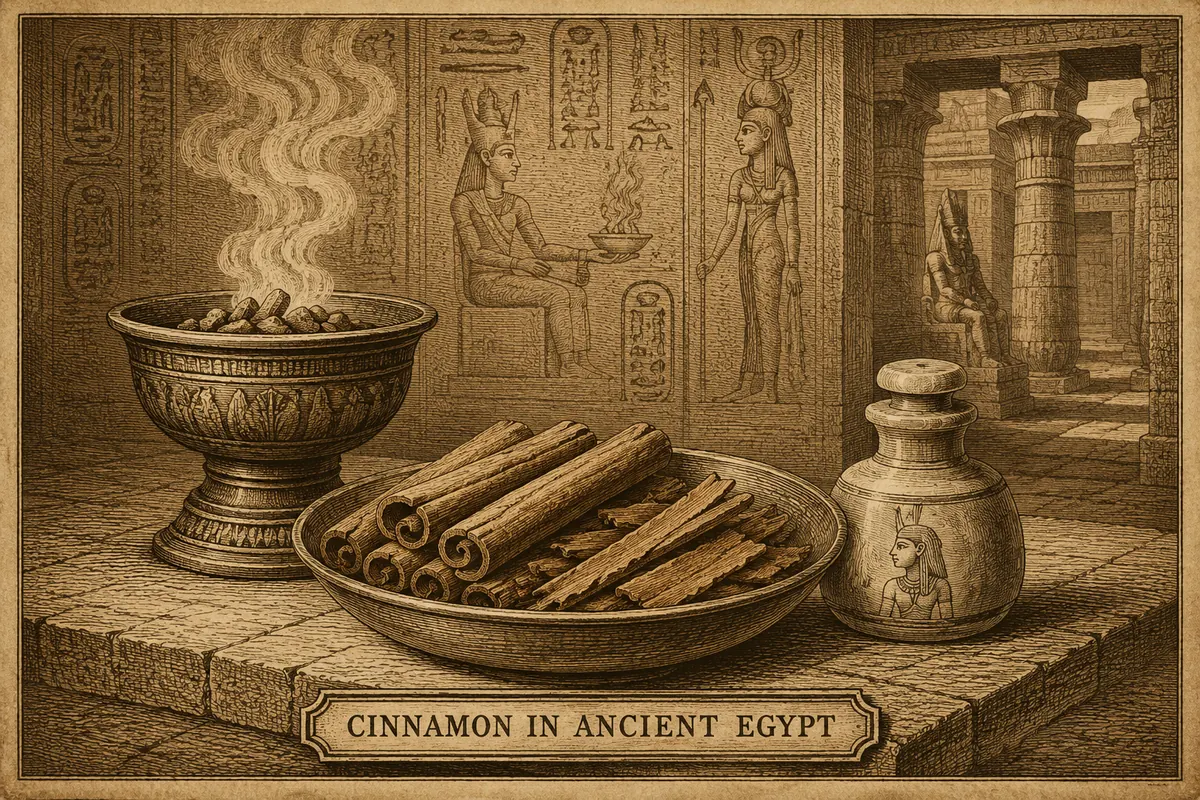
  • Cinnamon in Ancient Egypt

    Cinnamon in Ancient Egypt

    In ancient Egypt, cinnamon was a rare and precious imported spice, valued far more as a fragrant aromatic than as a food. It appears in accounts of embalming, temple incense and perfumed oils, where its warm scent was prized for sacred and luxury uses. Because it came from distant lands through a long chain of traders, cinnamon was costly and exotic, and the Egyptians did not know its true source.

    The story of cinnamon in ancient Egypt is part history and part mystery, and it sits within the wider tale of how the spice travelled the ancient world. This guide looks at how the Egyptians used and valued it, and pairs with our pillar guide on the history of Ceylon cinnamon.

    The short answer

    Ancient Egyptians used cinnamon mainly as a luxury aromatic, in embalming preparations, incense and scented oils, rather than as a cooking spice. It was a high-value import, reserved for religious rites, funerary practices and the wealthy. Reaching Egypt only through long trade routes, cinnamon carried an air of the exotic, and its far-off origin was a closely held secret of the traders who supplied it.

    A note on what “cinnamon” meant then

    It is worth saying at the start that historians are not always certain which exact spice ancient texts mean by “cinnamon”. The words used in old sources may have covered both true cinnamon (Cinnamomum verum) and the related cassia barks, since the ancient world did not draw the sharp modern distinction between them. What is clear is that a warm, sweet, aromatic bark of this family was highly prized. To understand the difference these names carry today, see our guide to what true Ceylon cinnamon is.

    Cinnamon in embalming and funerary rites

    One of the best-known ancient uses of cinnamon was in embalming. The fragrant spice was among the aromatic substances associated with preparing the dead, valued for its scent in a practice where perfume and preservation went hand in hand. Cinnamon’s warm aroma made it a fitting part of these solemn, high-status rituals. Its role here shows how far the spice sat from everyday cooking: it was a sacred, luxury material connected with the most important of ceremonies.

    Incense, temples and the gods

    Aromatics were central to Egyptian religious life, burned as incense to honour the gods and scent the temples. Cinnamon was one of the prized ingredients that could go into such fragrant blends. A famous example is kyphi, a celebrated Egyptian incense made from a mixture of aromatic ingredients and used in temple rites; recipes for such incense drew on precious imported spices. In this world, a sweet-smelling bark like cinnamon was a way of reaching towards the divine, its rising smoke carrying prayers and honour. The finer and rarer the ingredients, the more fitting the gift was thought to be, which gave a costly import like cinnamon a natural place in the most important temple rituals.

    Perfumes and scented oils

    Beyond the temple, cinnamon featured in the perfumes and scented oils that were so important in Egyptian life. Fragrant oils were used to anoint the body, and warm, spicy aromatics gave them depth and richness. As a costly import, cinnamon-scented preparations were a mark of wealth and refinement, enjoyed by those who could afford such luxuries. Its place in perfumery again shows that the spice was valued first and foremost for its scent.

    A precious and mysterious import

    Cinnamon did not grow anywhere near Egypt. It reached the Nile only after a long journey through many hands, along trade routes that stretched far to the east. Because of this, it was expensive and surrounded by mystery, and the merchants who supplied it kept its true origin secret to protect their trade. Fantastic stories grew up about where cinnamon came from, and the real source, the island now called Sri Lanka, remained unknown to the Egyptians. This long, secretive trade is part of the wider ancient history of the cinnamon trade.

    How the ancient Egyptians used cinnamon at a glance

    The main roles of cinnamon in ancient Egypt.
    UseRole
    EmbalmingFragrant aromatic in funerary preparation
    IncenseIngredient in temple blends such as kyphi
    PerfumeScent in luxury oils and anointing preparations
    StatusCostly imported luxury for rites and the wealthy
    OriginUnknown to Egyptians, a closely guarded trade secret

    Why cinnamon mattered so much

    To understand why a simple bark was so treasured, it helps to remember what scent meant in the ancient world. Fragrance was tied to religion, status and the care of the dead, and a sweet, warm, long-lasting aroma that came from far away was doubly precious. Cinnamon offered exactly this. Its rarity, its exotic origin and its beautiful scent combined to make it a fitting gift for the gods and a luxury for the living. In ancient Egypt, cinnamon was less a flavour than a symbol of wealth, devotion and the mysterious riches of distant lands.

    From ancient luxury to everyday spice

    The contrast with today is striking. What was once a secret, sacred luxury in ancient Egypt is now a familiar spice on kitchen shelves around the world. The long journey from mysterious import to everyday ingredient is the heart of cinnamon’s story, and true Ceylon cinnamon remains the fine, original spice at the centre of it. To follow that journey further, our guide to the history of Ceylon cinnamon traces how the spice travelled from antiquity to the present day.

    The trade routes that brought cinnamon to Egypt

    Cinnamon’s path to the Nile was long and winding. It moved westward from South and South-East Asia through a series of ports and middlemen, crossing the Indian Ocean and the lands of Arabia before reaching Egyptian markets. No single merchant carried it the whole way; instead it passed from hand to hand, each trader taking a share, which is part of why it grew so costly by the time it arrived. This relay of routes also helped keep the true origin hidden, since even many of the traders did not know where the spice had first been grown. The result was a spice that felt as though it came from the very edge of the known world.

    Cinnamon in the ancient imagination

    Because its source was unknown, cinnamon gathered legends around it. Ancient writers repeated colourful tales of how the spice was gathered in far-off, dangerous places, stories that made it seem all the more wondrous and rare. Whether or not anyone believed them fully, such tales added to the spice’s mystique and helped justify its high price. In a sense the mystery was part of the product: a fragrant bark from an unknown land, wrapped in wonder, was worth far more than a common local herb. This blend of real trade and rich imagination is one of the most memorable parts of cinnamon’s ancient story.

    Frequently asked questions

    What did ancient Egyptians use cinnamon for?

    Mainly as a luxury aromatic. Cinnamon featured in embalming preparations, in temple incense such as kyphi, and in perfumed oils. It was valued for its scent in sacred and high-status uses, rather than as an everyday cooking spice.

    Did ancient Egyptians know where cinnamon came from?

    No. Cinnamon reached Egypt through long trade routes, and the merchants who supplied it kept its true origin secret. The real source, the island now called Sri Lanka, was unknown to the Egyptians, and fanciful stories grew up about where the spice came from.

    Was Egyptian cinnamon the same as Ceylon cinnamon?

    It is not certain. Ancient sources may have used “cinnamon” for both true cinnamon and related cassia barks, since the ancient world did not separate them as we do. What is clear is that a fragrant bark of this family was highly prized.

    Why was cinnamon so prized in ancient Egypt?

    Because it was a rare, far-travelled import with a beautiful scent, and fragrance was central to Egyptian religion, funerary rites and luxury. Its rarity and exotic origin, combined with its aroma, made cinnamon a precious material fit for the gods and the wealthy.

    Summary

    In ancient Egypt, cinnamon was a rare and precious aromatic rather than a cooking spice. It appears in accounts of embalming, in temple incense such as kyphi, and in luxury perfumed oils, where its warm scent served sacred and high-status purposes. As a costly import that travelled long trade routes, cinnamon was exotic and mysterious, its true source in distant Sri Lanka kept secret by the traders who supplied it. The spice that was once a guarded luxury of the ancient world is now an everyday favourite, with true Ceylon cinnamon still the fine original at the heart of its long story.

    This website provides educational information about Ceylon Cinnamon as a spice and food ingredient. It is not intended to provide medical advice or make health claims.

  • The Ancient History of Cinnamon Trade

    The Ancient History of Cinnamon Trade

    For most of recorded history, cinnamon was one of the world’s most prized and mysterious spices, carried thousands of miles from Sri Lanka to the ancient Mediterranean, where its true origin was hidden for centuries behind deliberate secrecy and fantastical stories. The ancient cinnamon trade is a tale of long sea routes, guarded monopolies, and a spice so valued it was fit for temples, kings and the dead.

    This guide traces cinnamon’s journey through the ancient world: where it really came from, how it reached Egypt, Greece and Rome, why traders worked so hard to conceal its source, and what made it so extraordinarily useful. For the wider story of the spice across the ages, see our pillar guide on the history of Ceylon cinnamon.

    Where did ancient cinnamon really come from?

    The finest cinnamon of antiquity was the bark of Cinnamomum verum, native to the island of Sri Lanka, known for much of history as Ceylon. From there, and from nearby parts of South and Southeast Asia, cinnamon travelled westward along a web of maritime and overland routes long before Europeans had any idea where the island lay. To understand what this spice actually is, see our guide to what is true Ceylon cinnamon. The people who bought cinnamon in ancient Egyptian or Roman markets rarely knew its origin; they simply knew it arrived from “the East” at great cost.

    Cinnamon in the ancient world

    References to cinnamon appear across many ancient cultures, a sign of how far and how early it travelled.

    Ancient Egypt

    Cinnamon and its relative cassia were valued in ancient Egypt, where aromatic spices were used in perfumes, ceremonial oils and embalming. Fragrant imported spices were luxury goods, associated with ritual and status, and their presence in Egypt shows that trade links reaching toward Asia existed thousands of years ago.

    The Hebrew scriptures

    Cinnamon is named among the precious aromatics of the ancient Near East, appearing in early texts as an ingredient in sacred anointing oils and as a symbol of luxury and fragrance. Such mentions place cinnamon firmly among the most treasured trade goods of the age.

    Greece and Rome

    Greek and Roman writers, including the historian Herodotus and later the naturalist Pliny the Elder, wrote about cinnamon with a mixture of fascination and confusion. It was burned as incense, blended into perfumes, and used to flavour and scent. The Romans in particular prized it highly, and Pliny famously grumbled about the enormous prices commanded by the spice after passing through many hands.

    The secret of cinnamon’s origin

    One of the most striking features of the ancient cinnamon trade is that the people who controlled it deliberately hid where the spice came from. Arab and other intermediary traders acted as middlemen between the distant source and the Mediterranean markets, and it was in their interest to keep buyers ignorant. If Greek and Roman merchants had known the true origin, they might have tried to bypass the middlemen and trade directly, collapsing a highly profitable monopoly.

    Tales to guard a monopoly

    To protect their advantage, traders spread fantastical stories about how cinnamon was obtained. Herodotus recorded a famous legend that great birds carried cinnamon sticks to their nests on high cliffs, and that people had to trick the birds to retrieve it. Other tales placed cinnamon in dangerous, faraway lands guarded by fearsome creatures. These stories were almost certainly invented, or at least encouraged, to make the spice seem rare, dangerous to gather, and therefore worth its extraordinary price, while concealing the humble reality of bark peeled from a tree.

    Why was cinnamon so useful?

    Several forces combined to make cinnamon one of antiquity’s costliest goods.

    Enormous distance

    Cinnamon crossed oceans and deserts, passing through many traders, ports and taxes on its long journey west. Every stage added cost, so by the time it reached a Roman market its price had multiplied many times over.

    Controlled supply and secrecy

    Because middlemen guarded the source and the routes, supply was tightly controlled. Scarcity, real and manufactured, kept prices high, and the aura of mystery only added to cinnamon’s prestige.

    Prestige and ritual

    Cinnamon was not an everyday seasoning for most people but a luxury reserved for the wealthy, for temples and for special occasions. Its use in perfumes, sacred rites and funerary practices gave it a symbolic value well beyond its weight, making it a fitting gift for gods and rulers alike.

    The routes cinnamon travelled

    Ancient cinnamon reached the Mediterranean by a combination of sea and land. Maritime traders moved goods across the Indian Ocean, using seasonal monsoon winds to sail between South Asia and the ports of Arabia and the Red Sea. From there, overland caravans and further sea legs carried the spice onward to the great trading cities of the ancient world. This long relay of ships, ports and caravans is why cinnamon was so expensive and why its ultimate source could stay hidden for so long, no single trader needed to know the whole chain from tree to market.

    Ceylon at the heart of the story

    Although ancient buyers did not know it, the island of Ceylon sat near the origin of the finest cinnamon. Over time, its reputation as the home of superb cinnamon became so strong that the spice and the island grew inseparable in name, a connection covered in our guide to Sri Lankan cinnamon farming. The distinction between this true cinnamon and the coarser cassia often sold elsewhere is a very old one, and it still matters today, as explained in Ceylon cinnamon vs cassia.

    Cinnamon and cassia in the ancient trade

    Ancient writers often mentioned “cinnamon” and “cassia” side by side, and the two were not always clearly separated in the markets of antiquity. Both were aromatic barks from related trees carried along the same eastern routes, but they differed in fineness and price, with the more delicate true cinnamon generally the more prized. This ancient blurring of the two is the distant ancestor of a confusion that still exists on supermarket shelves today, where cassia is frequently sold simply as “cinnamon”. The enduring distinction between the two barks, one fine and layered, the other hard and coarse, is set out in our guide to Ceylon cinnamon vs cassia. Understanding it helps make sense of why the ancient sources sometimes seem to describe several different spices under overlapping names.

    How the secret finally unravelled

    No monopoly built on secrecy lasts forever. As centuries passed, knowledge of the eastern sea routes spread, and the fanciful stories lost their power. Eventually the true geography of the spice became known in the West, setting the stage for later eras when European powers sought to control the cinnamon lands directly. That dramatic later chapter, of colonial competition over Ceylon’s cinnamon, belongs to the broader history of Ceylon cinnamon, but its roots lie in these ancient centuries when cinnamon was already worth crossing the world for.

    What the ancient trade tells us

    The story of ancient cinnamon is really a story about value, distance and information. A simple piece of tree bark became one of the most sought-after substances on earth because it was rare in the West, difficult to trace, and wrapped in mystery. The traders who moved it understood that controlling knowledge was as profitable as controlling the goods themselves. Seen this way, cinnamon is not just a spice but a window into how the ancient world traded, competed and imagined the lands beyond its horizon.

    Summary

    In antiquity, cinnamon was a treasure. The best of it was the bark of Cinnamomum verum from the region around Ceylon, carried west across the Indian Ocean and Arabian routes to Egypt, Greece and Rome, where it was used in perfumes, incense, sacred oils and funerary rites. Middlemen guarded its origin fiercely, inventing tales of cinnamon-carrying birds and dangerous distant lands to keep buyers in the dark and prices high. Distance, controlled supply and prestige combined to make cinnamon one of the ancient world’s most useful goods, a reputation that would eventually draw empires to the island where the finest cinnamon grew.

    Frequently asked questions

    Where did cinnamon come from in ancient times?

    The finest ancient cinnamon was the bark of Cinnamomum verum from the region around Sri Lanka (Ceylon). It travelled west through many traders, so buyers in Egypt, Greece and Rome rarely knew its true source.

    Why did ancient traders hide where cinnamon came from?

    To protect a highly profitable monopoly. If buyers had known the true origin, they might have traded directly and bypassed the middlemen, so traders spread fantastical stories to conceal the source and keep prices high.

    What was the myth of the cinnamon birds?

    The historian Herodotus recorded a legend that giant birds carried cinnamon to cliff-top nests, from which people had to retrieve it by trickery. It was almost certainly invented to make cinnamon seem rare and dangerous to gather.

    Why was cinnamon so expensive in the ancient world?

    Because of vast trade distances, many middlemen and taxes, deliberately controlled supply, and its prestige in perfume, ritual and funerary use. Together these pushed cinnamon’s price far above its humble origin as tree bark.

    This website provides educational information about Ceylon Cinnamon as a spice and food ingredient. It is not intended to provide medical advice or make health claims.

  • History of Ceylon Cinnamon

    History of Ceylon Cinnamon

    Ceylon cinnamon has been traded for thousands of years, from the ancient spice routes of the Middle East and the Mediterranean to the colonial rivalries of the Portuguese, Dutch and British in Sri Lanka. Once so useful it was compared to gold, the fragrant bark of Cinnamomum verum shaped exploration, empires and global commerce, and the island of Sri Lanka has sat at the centre of that story throughout.

    Few spices have a history as rich as true cinnamon. To understand why Ceylon cinnamon is held in such regard today, it helps to trace how a thin strip of bark from one tropical island became one of the most sought-after commodities in the world. For the spice itself, see what is true Ceylon cinnamon.

    Cinnamon in the ancient world

    Cinnamon appears in some of humanity’s oldest written records. It is mentioned in ancient Egyptian sources and in classical texts from the Mediterranean world, where it was treasured as a luxurious aromatic for perfuming, flavouring and ceremonial use. The Greeks and Romans prized it highly, and it features in the writings of authors such as Herodotus and Pliny the Elder, who repeated colourful and often fanciful tales about where it came from.

    The secret of its origin

    For centuries the true source of cinnamon was deliberately obscured. Arab and other Middle Eastern traders, who controlled much of the overland and maritime spice trade, guarded the origin of their cinnamon closely to protect their monopoly. Legends were spread, including stories of fearsome birds that built nests of cinnamon on inaccessible cliffs, that kept buyers ignorant of the humble island groves where the bark actually grew. This secrecy helped keep prices extraordinarily high.

    Worth more than gold

    By the medieval period, cinnamon had become a symbol of wealth and status in Europe, where it arrived after a long and costly journey through many middlemen. It was one of the spices whose scarcity and expense helped drive the great Age of Exploration, as European powers sought sea routes to the spice-producing lands of the East in order to cut out intermediaries and control the trade directly.

    The Portuguese era

    The search led Europeans to the island then known as Ceylon. In the early sixteenth century the Portuguese arrived and, recognising the value of its cinnamon, established control over coastal areas and the cinnamon trade. For roughly a century and a half they dominated exports, obtaining cinnamon peeled by the island’s traditional peeler communities and shipping it to Europe at great profit.

    The Dutch and the cinnamon monopoly

    In the seventeenth century the Dutch East India Company (VOC) displaced the Portuguese and took over the cinnamon trade. The Dutch were meticulous and ruthless about protecting their monopoly: they controlled harvesting, tightly regulated who could peel and sell cinnamon, and guarded the supply to keep prices high. It was during this period that cultivation began to be organised more formally, moving beyond purely wild-harvested bark toward managed plantations.

    The British and the end of the monopoly

    At the turn of the nineteenth century the British gained control of Ceylon and, with it, the cinnamon trade. By this time, however, cinnamon’s near-mythical value was fading. Cassia and cinnamon were being grown in other parts of the world, and other crops, famously coffee and later tea, began to reshape Ceylon’s plantation economy. The rigid monopoly gave way to a broader, more competitive global market in which cinnamon remained important but was no longer worth a king’s ransom.

    The legacy in Sri Lanka today

    That long history still shapes the island. The very name “Ceylon cinnamon” preserves the colonial-era name for Sri Lanka, and districts in the south such as Galle and Matara remain heartlands of cultivation, as covered in Sri Lankan cinnamon farming. The traditional hand-peeling craft described in how Ceylon cinnamon is made is a living inheritance from these centuries of trade. Even the leafy Colombo neighbourhood known as Cinnamon Gardens takes its name from the plantations that once grew there.

    A modern mark of origin

    In a fitting modern chapter, Sri Lanka has moved to protect the identity of its most historic export. In February 2022, “Ceylon Cinnamon” became the country’s first product to receive a Protected Geographical Indication (PGI) in the European Union, legally linking the name to cinnamon produced on the island, a formal recognition of a reputation built over millennia.

    The origin of the word “cinnamon”

    The very name carries history. The English word “cinnamon” travelled through Latin and Greek from older Mediterranean and Semitic roots, reflecting the long chain of traders who carried the spice westward long before its source was known in Europe. That the spice was named and prized for centuries while its origin stayed secret is a measure of how tightly the early trade was controlled.

    A brief timeline

    • Antiquity, cinnamon valued in Egypt and the classical Mediterranean; origin kept secret by traders.
    • Medieval period, a costly European luxury arriving via Middle Eastern and Venetian intermediaries.
    • 16th century, the Portuguese take control of Ceylon’s cinnamon trade.
    • 17th century, the Dutch East India Company enforces a strict monopoly and begins organised cultivation.
    • c. 1800, the British take Ceylon; the monopoly fades as cultivation spreads and other crops rise.
    • 2022, “Ceylon Cinnamon” gains EU Protected Geographical Indication status.

    Cinnamon Gardens and living heritage

    Traces of this past survive in Sri Lanka today. The elegant Colombo district of Cinnamon Gardens takes its name from the plantations that once occupied the area, and the traditional peeling communities that supplied the colonial trade are the ancestors of today’s craftspeople. The techniques described in how Ceylon cinnamon is made are, in effect, a living inheritance from these centuries of commerce.

    Why the history still matters

    This long story is more than background colour. It explains why Sri Lanka remains the authoritative home of true cinnamon, why the “Ceylon” name carries such weight, and why protecting that name matters to farmers and consumers alike. When you buy genuine Ceylon cinnamon, you are buying into a tradition thousands of years in the making.

    Myths and legends of cinnamon’s origin

    The secrecy that surrounded cinnamon’s source gave rise to some wonderfully strange stories. Classical writers repeated tales that cinnamon was gathered from the nests of great birds perched on unreachable cliffs, or guarded by winged creatures in distant lands. These legends were almost certainly encouraged by the traders who controlled the supply, since a spice wreathed in danger and mystery could command a higher price and discourage buyers from seeking the true source. Only much later did Europeans confirm that this precious bark grew, quite unremarkably, on modest bushes on a single Indian Ocean island.

    Cinnamon and the Age of Exploration

    It is difficult to overstate how much the demand for spices like cinnamon shaped world history. The desire to reach the source of these luxuries directly, bypassing the chain of intermediaries that made them so costly, helped propel European powers into the great voyages of the fifteenth and sixteenth centuries. Sea routes to the East were sought precisely because spices were so useful, and the fortunes made from the trade funded fleets, companies and colonial ventures. Cinnamon, alongside pepper, cloves and nutmeg, was one of the commodities that quite literally helped redraw the map.

    Traditional communities and craft

    Behind the grand narrative of empires sits a quieter, human story: the communities who actually grew and peeled the cinnamon. In Ceylon, specialised peeler communities developed the skilled hand-craft that turns raw stems into fine quills, passing the techniques down through families over generations. That knowledge, described in how Ceylon cinnamon is made, is arguably the most useful inheritance of the whole history, the reason Sri Lanka can still produce cinnamon of a quality that others struggle to match. Recognising and sustaining that craft is central to the island’s continuing role as the home of true cinnamon.

    Summary

    Ceylon cinnamon’s history stretches from ancient Egypt and classical Rome, through centuries of secrecy maintained by Middle Eastern traders, to the colonial contest between the Portuguese, Dutch and British for control of the island of Ceylon. Once worth more than gold and a driver of the Age of Exploration, cinnamon shaped global trade and left a deep mark on Sri Lanka. Today the island remains the home of true cinnamon, its heritage now protected by a Geographical Indication that ties the celebrated name to its birthplace.

    Frequently asked questions

    Why was cinnamon so useful historically?

    Its scarcity in Europe, the secrecy around its origin and the long, costly trade route made it a luxury symbol of wealth, helping to spur the Age of Exploration.

    Who controlled the Ceylon cinnamon trade?

    Over time, Middle Eastern traders, then the Portuguese, the Dutch East India Company and finally the British each dominated the trade from or through Ceylon.

    Why is it called Ceylon cinnamon?

    Because it comes from the island historically called Ceylon, now Sri Lanka. The name has stuck as a mark of authentic origin.

    Is Ceylon cinnamon still important to Sri Lanka?

    Yes. Sri Lanka remains the world’s main source of true cinnamon, and in 2022 the name gained EU Geographical Indication protection.

    This website provides educational information about Ceylon Cinnamon as a spice and food ingredient. It is not intended to provide medical advice or make health claims.