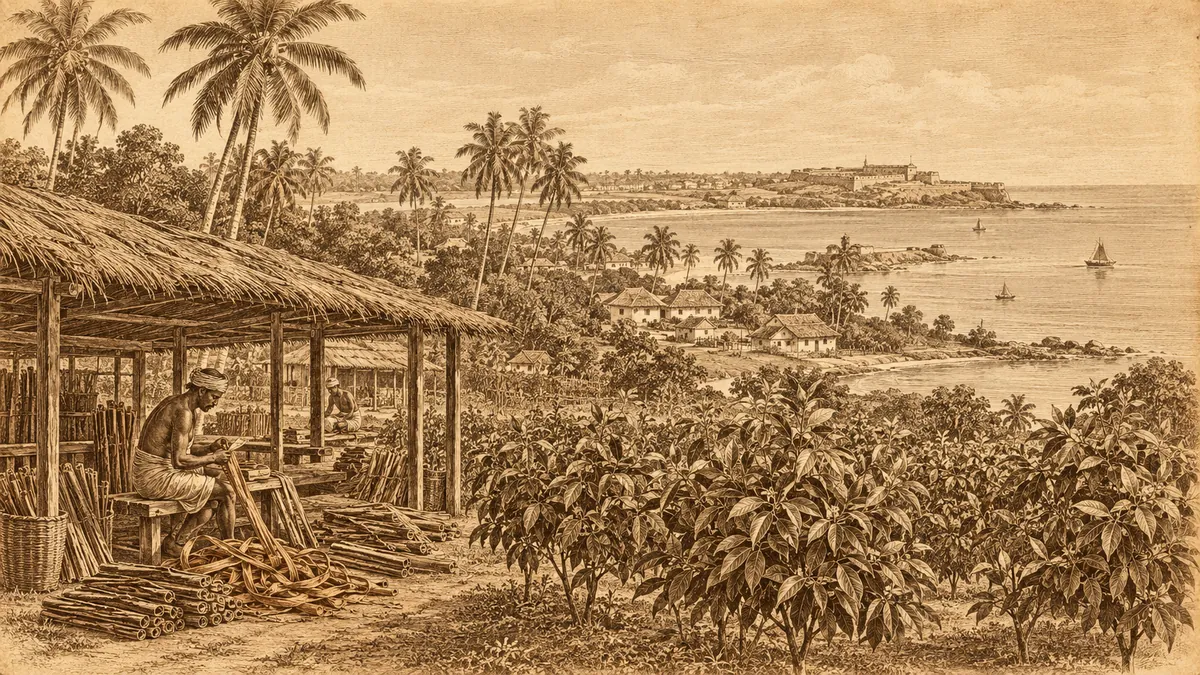
Matara is a district on the southern coast of Sri Lanka and one of the heartlands of Ceylon cinnamon. Its warm climate, sandy coastal soils and long tradition of peeling make it a major source of true cinnamon, Cinnamomum verum. For centuries Matara has grown, peeled and traded cinnamon, and the district remains central to Sri Lanka’s cinnamon industry today, alongside its neighbour Galle.
When people picture where Ceylon cinnamon comes from, the southern coast of Sri Lanka is the answer, and Matara sits at its core. This guide explains why Matara matters to cinnamon, what makes its land suited to the crop, and how its heritage of peeling and trade shaped the spice. It builds on our pillar guide to Sri Lankan cinnamon farming.
The short answer
Matara is one of the main cinnamon-growing districts of Sri Lanka, part of the southern coastal belt where most true cinnamon is produced. Its climate and soils suit Cinnamomum verum, and generations of local families have grown and peeled cinnamon there. The district has a deep heritage in the trade, from the colonial era to the many smallholder farms and peeling families working today. Together with Galle, Matara forms the southern core of Ceylon cinnamon country.
Where Matara is
Matara is a coastal district in the Southern Province of Sri Lanka, with the town of Matara on the Indian Ocean. It lies east of Galle, and the two districts together cover much of the island’s prime cinnamon land. The southern coast here is low, warm and wet, with sandy soils near the shore rising to gentle hills inland. This stretch of coast, running roughly from Galle through Matara, is the belt where true cinnamon has long grown best. For the wider picture of where the crop is grown, see our guide to the cinnamon-growing regions of Sri Lanka.
Why the land suits cinnamon
Cinnamon thrives in Matara because the conditions match what the tree needs. The climate is warm all year, with high rainfall and humidity, and no cold season. The coastal soils are often sandy and well drained, which Cinnamomum verum favours, and the low elevation keeps temperatures steady. These are the same conditions our guide to the climate Ceylon cinnamon needs describes, and Matara has them in good measure. The result is bark with the fine, sweet character that defines true Ceylon cinnamon.
Matara’s cinnamon heritage
Matara’s link to cinnamon goes back centuries. During the colonial period, when European powers controlled the Ceylon cinnamon trade, the southern coast was at the centre of cultivation and export, and Matara was one of its key areas. The district carries the marks of that era in its old fortifications and trading history. More lasting than any building, though, is the human heritage: the families who learned to grow, peel and prepare cinnamon and passed that skill down through generations. This living tradition of craft is a large part of what Matara heritage means.
The peelers of the south
At the heart of Matara’s cinnamon story are its peelers. Peeling true cinnamon is a skilled craft: the thin inner bark must be lifted cleanly and rolled into quills by hand. In Matara and the surrounding south, this skill has been held and handed down within communities for generations, making the region known not just for growing cinnamon but for preparing it well. The quality of a quill depends heavily on the peeler, so a district with deep peeling knowledge, as Matara has, tends to produce fine cinnamon.
Matara and Galle together
Matara is best understood alongside Galle, its western neighbour. The two southern districts form the core of Ceylon cinnamon country, sharing the same coastal climate, soils and traditions. Galle is often described as the heart of the trade, and Matara sits right beside it as a major growing and peeling area. Reading the two together gives the fuller picture of the south, so our guide to Galle, the heart of Ceylon cinnamon, is a natural companion to this one.
| Feature | Matara district |
|---|---|
| Location | Southern coast of Sri Lanka, east of Galle |
| Climate | Warm and wet all year, high humidity |
| Soil | Often sandy and well drained near the coast |
| Main crop role | Major Ceylon cinnamon growing and peeling area |
| Heritage | Centuries of cultivation, peeling and trade |
| Neighbour | Galle, with which it forms the southern core |
Matara in the cinnamon trade today
Matara remains an active part of Sri Lanka’s cinnamon industry. Much of the crop in the district comes from smallholder farms, where families grow cinnamon on modest plots alongside other crops, and peel it in their own sheds. This pattern of many small producers, rather than a few large estates, is typical of the southern cinnamon belt. The district supplies bark into the national trade, where it is graded, bundled and prepared for export. In this way the old heritage continues as a working industry, linking today’s farmers to a tradition that stretches back generations.
Smallholder farms and family plots
Much of Matara’s cinnamon grows on small family plots rather than large plantations. A typical grower may tend a modest area of cinnamon, sometimes mixed with other crops, and manage the cutting, peeling and drying within the household or with a small group of peelers. This smallholder pattern shapes the whole character of cinnamon in the district. It keeps the skill spread widely across many families, ties the crop closely to everyday rural life, and means the quality of the bark rests on countless individual hands rather than a single estate. It also makes cinnamon an important part of the income of ordinary households across the south.
Cinnamon and daily life in the district
In Matara, cinnamon is woven into the rhythm of rural life. The crop can be harvested through much of the year, so peeling sheds are a familiar sight across the district, and the work of cutting, peeling, rolling and drying marks the days of many families. Children often grow up around the craft, learning by watching before they ever lift a peeling knife, which is how the skill survives from one generation to the next. This everyday presence of cinnamon, as both a livelihood and an inherited craft, is a quiet but real part of what makes the district a cinnamon heartland rather than simply a place where the tree happens to grow.
What Matara tells you about Ceylon cinnamon
Understanding Matara helps explain why Ceylon cinnamon is tied so closely to Sri Lanka. True cinnamon is not simply a plant that grows anywhere: it is bound to particular places with the right climate, soils and skills, and the southern coast around Matara and Galle is the clearest example. When a label names Sri Lankan or Ceylon origin, it is this kind of district it points back to. The character of the spice, and the knowledge that prepares it, both come from places like Matara.
Summary
Matara is a district on the southern coast of Sri Lanka and one of the core areas of Ceylon cinnamon. Its warm, wet climate and sandy coastal soils suit Cinnamomum verum, and its people carry a centuries-old heritage of growing, peeling and trading the spice. Together with neighbouring Galle, Matara forms the southern heartland where most true cinnamon is produced, worked largely by smallholder farmers and skilled peeling families. The district shows how closely Ceylon cinnamon is tied to specific Sri Lankan places, their land and their craft, which is why Matara remains central to the story of true cinnamon today.
Frequently asked questions
Is Matara a major cinnamon area in Sri Lanka?
Yes. Matara is one of the main cinnamon-growing districts, part of the southern coastal belt that produces most of Sri Lanka’s true cinnamon. It grows, peels and trades cinnamon on a large scale, mostly through smallholder farms.
Where is Matara?
Matara is a coastal district in the Southern Province of Sri Lanka, on the Indian Ocean, lying east of Galle. The two districts together cover much of the island’s prime cinnamon land.
Why is cinnamon grown in Matara?
The district has the warm, wet climate and sandy, well-drained coastal soils that Cinnamomum verum favours, along with a long tradition of skilled peeling. These conditions and skills together make it well suited to producing fine cinnamon.
What is Matara’s cinnamon heritage?
It is the district’s long history of growing, peeling and trading cinnamon, going back to the colonial era, and the living craft of peeling passed down through local families. This heritage is both historical and a working tradition that continues today.
How is Matara linked to Galle?
Matara and Galle are neighbouring southern districts that together form the core of Ceylon cinnamon country. They share the same coastal climate, soils and traditions, and are best understood as two parts of the same southern cinnamon belt.
This website provides educational information about Ceylon Cinnamon as a spice and food ingredient. It is not intended to provide medical advice or make health claims.
Leave a Reply