Tag: Cinnamon harvesting

  • The Life Cycle of a Cinnamon Plant

    The Life Cycle of a Cinnamon Plant

    The life cycle of a cinnamon plant runs from seed or cutting to a harvestable crop over several years. True Ceylon cinnamon, Cinnamomum verum, starts as a seed or a rooted cutting, grows into a young tree over two to three years, and is then cut back low to the ground in a step called coppicing. This makes it send up many slender shoots, and it is the bark of these shoots that becomes cinnamon. The plant then regrows and is harvested again and again from the same rootstock for decades.

    Understanding how a cinnamon plant grows helps explain why true cinnamon is made the way it is. This guide follows the plant from seed to a mature, repeatedly harvested bush, in plain terms. It builds on our pillar guide to Sri Lankan cinnamon farming.

    The short answer

    A cinnamon plant begins as a seed or cutting, grows for about two to three years, and is then coppiced, meaning cut back near the base so it grows many thin shoots. The bark of these shoots is peeled to make cinnamon. After each harvest the plant regrows new shoots from the same roots, so a single cinnamon plant can be harvested repeatedly for many years without being replanted.

    What kind of plant is cinnamon?

    True Ceylon cinnamon comes from Cinnamomum verum, an evergreen tree in the laurel family, native to Sri Lanka. Left to grow freely, it can reach the size of a small tree, with glossy leaves and small flowers. In cultivation, though, it is almost never allowed to grow tall. Instead it is kept as a low, many-stemmed bush so that farmers can harvest the thin bark of young shoots, which is where the best cinnamon comes from. The plant is hardy and long lived, which is what makes repeated harvesting possible.

    Stage one: seed and propagation

    The cycle usually begins with a seed or a cutting. Cinnamon trees flower and produce small fruits, each holding a seed. Seeds are collected when ripe and sown in a nursery, where they are kept shaded and watered until they sprout and grow into young seedlings. Growers also propagate cinnamon from cuttings or by layering, where a shoot is encouraged to root while still attached to the parent plant. Propagation from cuttings can keep the qualities of a good parent plant, while seeds give a wider mix.

    Seedlings spend their first months in the nursery before they are strong enough to plant out. Good soil and the right climate matter from the start. Our guides on the best soil for cinnamon and the climate Ceylon cinnamon needs cover the conditions young plants need.

    Stage two: planting out and early growth

    Once the seedlings are sturdy, they are planted out in the field, spaced to give each plant room to grow. Over the next two to three years the young plants establish their roots and grow upward, forming a single main stem and some branches. During this time the plant is building the strong root system that will support many later harvests. No bark is taken yet, since the stems are still growing and the plant needs this time to become well rooted.

    This establishment phase is a patient one. The grower weeds, waters in dry spells and protects the young plants, but mostly waits for them to reach the size where the first cut can be made.

    Stage three: coppicing

    After about two to three years, the plant reaches the key moment in its cycle: coppicing. The young tree is cut back close to the ground. Rather than killing the plant, this prompts it to respond by sending up a cluster of new, slender shoots from the base and roots. These straight young shoots are exactly what the cinnamon trade wants, because their thin bark peels cleanly and rolls into fine quills. From this point the plant is kept as a low bush rather than a tall tree.

    Coppicing is the turning point that shapes the rest of the plant’s life. It changes the plant from a single growing tree into a renewable, multi-stemmed source of harvestable shoots.

    Stage four: harvesting the shoots

    The new shoots are left to grow until they reach a suitable thickness and length, often over roughly a year to eighteen months, depending on conditions. When they are ready, they are cut, and the bark is peeled and processed into cinnamon. The thin inner bark is separated, rolled into quills and dried. For the full journey from shoot to finished spice, see our guide on how Ceylon cinnamon is made.

    Harvesting does not end the plant’s life. The cut stems are taken, but the rootstock remains in the ground, ready to grow the next set of shoots.

    Stage five: regrowth and repeated harvest

    After harvest, the plant regrows a fresh crop of shoots from the same base, and the cycle of growing and cutting repeats. A well-managed cinnamon plant can be harvested in this way for many years, often for decades, without needing to be replanted. This long productive life, built on one strong root system, is a defining feature of how cinnamon is grown. Each harvest takes only the young shoots, so the plant is never fully removed and keeps renewing itself.

    Over the years, growers may replace very old or weak plants, but the basic pattern holds: plant once, coppice, then harvest the regrowing shoots again and again.

    Flowering, fruiting and the next generation

    Although cultivated cinnamon is kept low and harvested young, the plant is still a flowering tree by nature. When some plants are allowed to grow taller, they produce small, pale flowers followed by little dark fruits, each carrying a seed. These seeds are the start of the next generation of plants, closing the loop of the life cycle. On a working plantation, most plants are coppiced for bark rather than left to flower, so growers often set aside a few mother plants specifically to flower and provide seed. In this way the plant’s natural reproductive stage and its cultivated, coppiced stage run side by side, one renewing the stock and the other supplying the spice.

    Caring for the plant between harvests

    Between cuttings, a cinnamon plant needs steady care to keep producing good shoots. Growers weed around the base, keep the soil in good condition and manage shade and water so the regrowing shoots come up straight and even. Weak or crowded shoots may be thinned so the plant puts its energy into fewer, better stems. This ongoing care over the plant’s long life is as much a part of the cycle as the cutting itself, since the quality of each harvest depends on how well the plant is tended in between.

    The cinnamon plant life cycle at a glance

    StageWhat happensRough timing
    Seed or cuttingPropagated in a nurseryFirst few months
    Planting outYoung plants establish rootsAbout 2 to 3 years
    CoppicingCut back to spur many shootsAt 2 to 3 years
    Harvesting shootsShoots cut and bark peeledEvery year to 18 months
    RegrowthFresh shoots regrow from rootsRepeated for decades

    Why the life cycle matters for cinnamon quality

    The way a cinnamon plant grows is tied directly to the quality of the spice. Because the finest cinnamon comes from the thin bark of young shoots, coppicing and repeated harvesting are not just practical choices but the source of good quality. A plant kept as a low bush produces many slender, even shoots, which give the thin, fragrant quills the trade prizes. The long life of the rootstock also means a plantation can keep producing cinnamon of a steady character year after year, as the same plants regrow familiar shoots.

    Frequently asked questions

    How long does it take to grow a cinnamon plant?

    A cinnamon plant takes about two to three years from planting before it is first coppiced, and after that its shoots are harvested roughly every year to eighteen months. The same plant can then be harvested repeatedly for many years from the same roots.

    What is coppicing in cinnamon farming?

    Coppicing is cutting the young cinnamon tree back close to the ground so it sends up many thin shoots from the base. The bark of these shoots is what becomes cinnamon. Coppicing turns the plant into a low, renewable bush rather than a tall tree.

    Does harvesting kill the cinnamon plant?

    No. Harvesting takes the young shoots, but the rootstock stays in the ground and grows a fresh crop of shoots. This is why a single cinnamon plant can be harvested again and again over many years without being replanted.

    Is cinnamon grown from seeds or cuttings?

    Both. Cinnamon can be grown from seeds sown in a nursery or propagated from cuttings or by layering. Cuttings can keep the qualities of a chosen parent plant, while seeds give a wider natural mix.

    Summary

    The life cycle of a cinnamon plant moves from seed or cutting, through two to three years of growth, to coppicing, which cuts the plant back so it grows the many thin shoots that become true cinnamon, Cinnamomum verum. The shoots are harvested, and the plant regrows fresh shoots from the same roots, repeating the cycle for decades. This pattern of growing, coppicing and regrowing is what makes cinnamon a long-lived, renewable crop, and it is the reason the finest cinnamon comes from the thin bark of young shoots.

    This website provides educational information about Ceylon Cinnamon as a spice and food ingredient. It is not intended to provide medical advice or make health claims.
  • Traditional Cinnamon Peeling Methods

    Traditional Cinnamon Peeling Methods

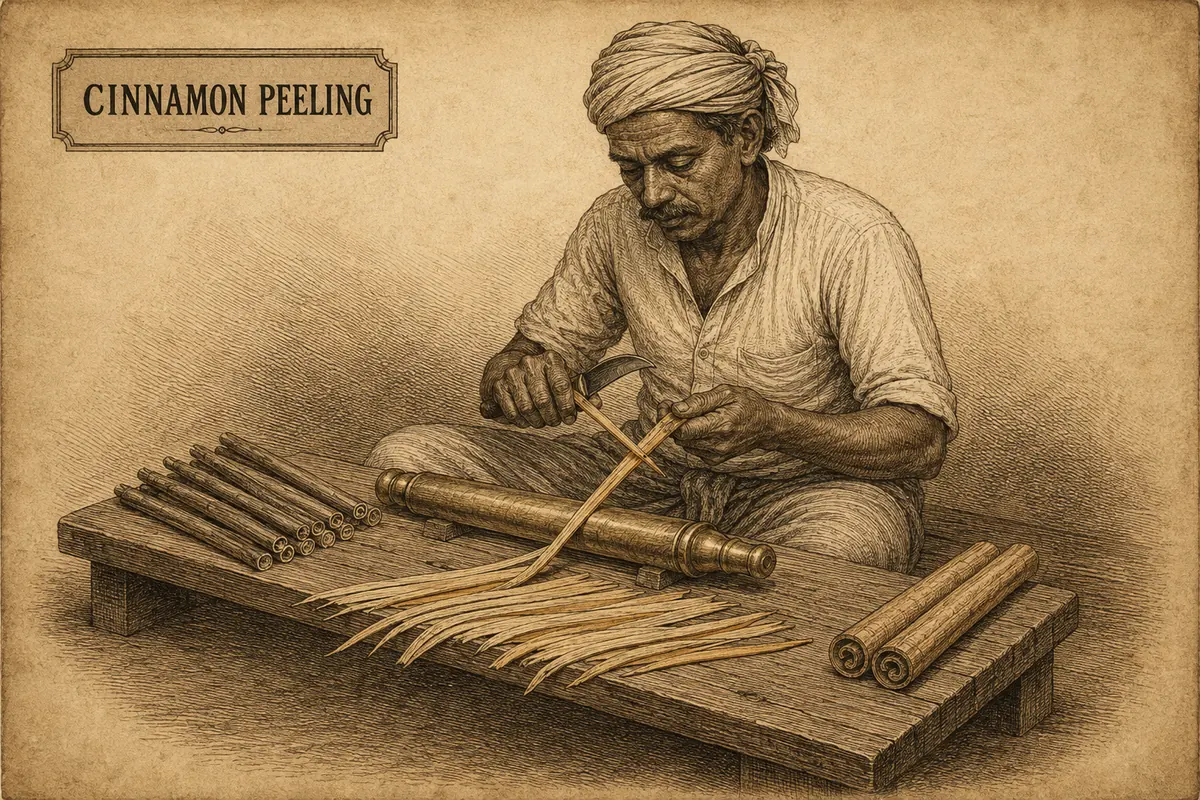
    Traditional cinnamon peeling is the skilled hand-craft of removing the thin inner bark from young cinnamon shoots and rolling it into quills. In Sri Lanka it is done with a few simple tools, in a set sequence of steps: the shoots are cut, the rough outer bark is scraped away, the bark is scored and loosened, the fine inner bark is peeled off in strips, and the strips are rolled into the familiar cinnamon quills to dry.

    This craft has changed little in generations and is central to what makes Ceylon cinnamon special. This guide walks through the traditional peeling methods step by step, and pairs with our pillar guide on how Ceylon cinnamon is made.

    The short answer

    Traditional peeling separates the delicate inner bark of the cinnamon shoot from the wood by hand, then rolls it into quills. A trained peeler uses a small curved knife and a rounded rod to scrape, score and lift the bark, working quickly so the thin inner layer comes away cleanly. The freed strips are then nested and rolled into long tubes that dry into quills. It is patient, delicate work, and the skill of the peeler shapes the quality of the finished spice.

    The tools of the peeler

    Traditional peeling uses a small set of hand tools rather than machinery. The main ones are a special curved peeling knife for scoring and lifting the bark, and a smooth rounded rod, often of brass, used to rub and loosen the bark before it is peeled. Simple stands or benches hold the shoots, and the rolled quills are laid out to dry. The simplicity of these tools is part of the craft: almost everything depends on the skill of the peeler’s hands rather than on equipment.

    The traditional peeling steps

    1. Cutting the shoots

    Peeling begins with young cinnamon shoots, cut from the coppiced trees at the right stage, when the bark peels most easily. The stems are trimmed to workable lengths and any side twigs and leaves are removed, leaving clean rods of bark-covered wood ready to work. The timing of the harvest matters, as covered in our guide to how Ceylon cinnamon is harvested.

    2. Scraping the outer bark

    The rough, greenish outer skin is scraped off the shoot, usually with a curved knife, to expose the smooth inner bark beneath. This step, sometimes called rubbing or scraping, cleans the stem so that only the fine, flavourful inner bark will be taken. It is done carefully to avoid cutting into the precious inner layer.

    3. Rubbing and loosening

    Next the peeler rubs the stem firmly with the rounded brass rod. This polishing action loosens the bond between the inner bark and the wood, so that the bark will lift away cleanly in the next step. Good rubbing is key to a clean peel, and it is one of the skills that separates an experienced peeler from a beginner.

    4. Scoring the bark

    With the bark loosened, the peeler makes long cuts along the shoot with the tip of the knife, scoring the bark into strips. These cuts run the length of the stem and mark out the pieces of inner bark that will be peeled off. Precise scoring keeps the strips even and reduces waste.

    5. Lifting the inner bark

    The peeler then slides the knife under the scored bark and carefully lifts the thin inner layer away from the wood. Done well, the wafer-thin bark comes off in clean strips. This is the most delicate stage, since the inner bark is fragile and easily torn, and it is where the peeler’s skill shows most clearly.

    6. Rolling the quills

    The freed strips of inner bark are then rolled and nested together into long tubes. Several thin pieces are layered inside one another to build up a quill of good length and thickness. This is why true Ceylon cinnamon quills have their signature many-layered structure, as explained in our guide to what a cinnamon quill is.

    7. Drying

    Finally the rolled quills are set aside to dry, often in shade at first and then in the sun, sometimes laid on racks. As they dry they tighten and firm into the pale, hard sticks we recognise. Once dried, they are sorted and graded ready for sale.

    The traditional peeling process at a glance

    The main steps of traditional cinnamon peeling.
    StepWhat happens
    Cut shootsYoung stems harvested and trimmed
    ScrapeRough outer bark removed
    RubBark loosened with a brass rod
    ScoreBark cut into strips along the stem
    PeelThin inner bark lifted off
    RollStrips nested into quills
    DryQuills dried, then sorted and graded

    A craft passed down through generations

    Traditional peeling is more than a set of steps; it is a skill handed down within families and communities in the cinnamon-growing districts. Experienced peelers work with remarkable speed and care, and their trained hands make the difference between fine, even quills and rough, wasteful ones. This inherited knowledge is a living tradition, closely tied to the farming communities described in our guide to Sri Lankan cinnamon farming. It is one of the reasons Ceylon cinnamon remains a hand-made, artisan product rather than a factory one.

    Why traditional peeling still matters

    Machines struggle to separate the wafer-thin inner bark of true cinnamon without damaging it, so the traditional hand method remains the best way to produce fine quills. The care taken at each stage, clean scraping, good rubbing, precise scoring and gentle lifting, decides how neat and how flavourful the finished cinnamon will be. In this sense the traditional peeling craft is not just history; it is still the method behind the quality of real Ceylon cinnamon today.

    Timing, moisture and the peeling season

    Traditional peeling works best when the conditions are right. Bark lifts most cleanly when the shoots are freshly cut and full of sap, so peeling usually follows soon after harvest, and the craft tends to be busiest during and just after the rains, when the sap is running. If the stems dry out, the bark clings to the wood and is far harder to remove in clean strips. Because of this, peelers often work through the day close to where the shoots are cut, keeping the stems fresh and moist so the bark comes away easily. This close link between weather, timing and workflow is part of why cinnamon farming and peeling follow the rhythm of the seasons.

    Quality starts with the peel

    The care taken during peeling shows directly in the finished quill. A clean, even peel produces smooth, well-formed quills that dry into fine grades, while rough or hurried work leaves ragged, broken bark that ends up as lower grades or off-cuts. Experienced peelers waste very little, lifting almost all of the usable inner bark and rolling it tightly and neatly. So the grade a quill eventually reaches is set in large part at this stage, long before it is sorted, which is why skilled peeling is so highly valued in the trade.

    Frequently asked questions

    How is cinnamon traditionally peeled?

    Young cinnamon shoots are cut, the rough outer bark is scraped off, the stem is rubbed with a brass rod to loosen the bark, the bark is scored into strips, and the thin inner bark is lifted off by hand. The strips are then rolled into quills and dried.

    What tools are used to peel cinnamon?

    The main tools are a small curved peeling knife, used to scrape, score and lift the bark, and a smooth rounded rod, often brass, used to rub and loosen the bark. Simple benches and drying racks are also used. Most of the work depends on hand skill.

    Why is cinnamon peeled by hand?

    Because the inner bark of true Ceylon cinnamon is very thin and delicate, machines tend to damage it. Skilled hand peeling separates the fine bark cleanly and rolls it into quills, which is why the craft is still done by hand.

    Who peels the cinnamon?

    In Sri Lanka, cinnamon is peeled by trained peelers, a skill traditionally passed down within farming and peeling families in the cinnamon-growing districts. Experienced peelers work quickly and carefully to produce fine quills.

    Summary

    Traditional cinnamon peeling is the hand-craft of turning young cinnamon shoots into quills. Using a curved knife and a brass rubbing rod, the peeler cuts the shoots, scrapes off the outer bark, rubs the stem to loosen the inner bark, scores it into strips, lifts the thin inner bark away, rolls the strips into quills, and dries them. It is a delicate, skilled process, handed down through generations in Sri Lanka, and it remains the best way to produce the fine, many-layered quills of true Ceylon cinnamon. The quality of the spice starts here, in the trained hands of the peeler.

    This website provides educational information about Ceylon Cinnamon as a spice and food ingredient. It is not intended to provide medical advice or make health claims.

  • How Ceylon Cinnamon Is Harvested

    How Ceylon Cinnamon Is Harvested

    Ceylon cinnamon is harvested by cutting the slender young shoots of the Cinnamomum verum tree, usually two or three times a year, and then peeling the thin inner bark by hand within hours of cutting. Timing matters: harvesting is concentrated in the wetter months, when the sap is flowing and the bark separates cleanly from the wood, which is what makes the delicate hand-peeling possible.

    If you have ever wondered how a spice as fine as true Ceylon cinnamon actually leaves the tree, this guide walks through the harvest step by step: when it happens, which stems are chosen, how they are cut, and what happens in the key hours immediately afterwards. Harvesting is only the first stage of a longer craft, so for the complete journey see our pillar guide on how Ceylon cinnamon is made.

    What does “harvesting” mean for Ceylon cinnamon?

    Harvesting Ceylon cinnamon means cutting the young bark-bearing shoots from the tree, not felling the tree itself. The prized spice is the tree’s thin inner bark, so a harvest is really a careful pruning: harvesters remove the straight, pencil-to-thumb-thick stems that have grown since the last cutting, leaving the rootstock in the ground to send up fresh shoots for next time. This is why a single cinnamon plant can be harvested again and again for decades. The growing side of this story, how those shoots are raised in the first place, is covered in our guide to Sri Lankan cinnamon farming.

    When is Ceylon cinnamon harvested?

    Ceylon cinnamon is typically harvested two to three times a year, with the main harvests falling in the wetter seasons. There are two connected reasons for this timing.

    The bark peels more easily when sap is flowing

    During and just after rain, the tree is actively growing and moisture sits between the bark and the wood. This makes the bark slip away cleanly when a skilled peeler works it, which is essential for producing the fine, unbroken layers that Ceylon cinnamon is known for. In drier spells the bark clings to the wood and tears, wasting the crop.

    The shoots have reached the right maturity

    Harvest is also governed by the age and thickness of the stems. Shoots are usually ready when they are roughly two to three years old, straight, and about one to two centimetres thick, with bark that has turned an even brown. Harvesters read the plant rather than the calendar alone, cutting when the stems are mature enough to yield good bark but still young enough to be supple.

    How harvesters choose which stems to cut

    Not every stem is taken. A good harvester selects shoots that are straight, smooth, and free of side branches, knots or blemishes, because these produce the longest, cleanest quills. Twisted or branched stems are harder to peel and give broken, uneven bark. The colour and feel of the bark are important cues: an even, mid-brown stem with bark that gives slightly under a thumbnail is usually at its peak. Poorer stems may be left to mature further or used for lower grades, a distinction explained in our guide to Ceylon cinnamon grades.

    How the shoots are cut

    The chosen stems are cut low, close to the base of the plant, with a sharp knife or billhook. Cutting near the base encourages the rootstock to throw up a cluster of new shoots, a technique known as coppicing, so the plant renews itself for the next harvest. The cut stems are then trimmed of their leaves and side twigs and gathered into bundles. The leaves and off-cuts are not wasted; smaller material and trimmings are often set aside for distillation into cinnamon leaf oil rather than discarded.

    Why speed matters after cutting

    Once a stem is cut, the clock starts. The bark separates most easily while the shoot is still fresh and full of moisture, so harvested bundles are carried quickly to a nearby peeling shed and worked the same day, ideally within hours. If the stems dry out, the bark hardens and grips the wood, making clean peeling far more difficult. This tight link between cutting and peeling is one reason Ceylon cinnamon is still largely a small-scale, hand-crafted harvest carried out close to where the trees grow, rather than a heavily mechanised one.

    From harvested stem to peeling: the immediate next steps

    Although this guide focuses on the harvest, it helps to see where the cut stems go next, because harvesting and early processing flow into one another on the same day.

    Rubbing and scraping

    The rough outer bark is first scraped and rubbed to loosen it, exposing the smooth inner bark beneath. This preparation makes the delicate peeling that follows much cleaner.

    Peeling the inner bark

    Using specialised knives, the peeler carefully lifts the thin inner bark away in long strips. This is the skilled heart of the whole process, and the quality of the finished spice depends heavily on the peeler’s touch.

    Forming and drying the quills

    The fresh strips are then rolled and nested into the familiar quills and left to dry, gradually curling and tightening as they lose moisture. The full detail of these stages lives in the pillar guide on how Ceylon cinnamon is made.

    Ceylon cinnamon harvesting at a glance

    A simplified overview of the Ceylon cinnamon harvest.
    StageWhat happens
    TimingTwo to three times a year, mainly in wetter months
    SelectionStraight, smooth shoots about 2, 3 years old chosen
    CuttingStems cut low to encourage new shoots (coppicing)
    BundlingLeaves trimmed; stems bundled and moved quickly
    Same-day peelingBark rubbed, peeled and rolled while still fresh

    Why the harvest is done by hand

    Ceylon cinnamon’s harvest resists mechanisation for a simple reason: the value lies in thin, intact bark, and only a trained human hand can select the right stems and peel them without shredding the delicate layers. Machines can grind and pack, but the judgement of choosing a stem and the dexterity of peeling it remain human skills passed down through generations. This craftsmanship is part of why genuine Ceylon cinnamon commands a premium and why its quills look so different from the hard, thick curls of cassia, a contrast we look at in our guide to identifying authentic Ceylon cinnamon.

    Does harvesting damage the cinnamon tree?

    Because harvesting takes only the young shoots and leaves the established rootstock untouched, it does not kill the plant. In fact, cutting the stems low stimulates the base to send up a fresh flush of shoots, much as pruning encourages new growth in a hedge. A well-managed cinnamon plant can therefore be harvested repeatedly for many years, sometimes for decades, from the same rootstock. This regenerative rhythm is part of what makes Ceylon cinnamon a comparatively low-impact, renewable crop: the same plants keep producing, so there is no need to clear and replant with every harvest. The ongoing cycle of cutting and regrowth is a defining feature of how these gardens are managed over the long term.

    How harvesting shapes the final quality

    Every decision made at harvest echoes through to the jar on your shelf. Cutting at the right moisture level, choosing clean straight stems, and peeling promptly all lead to fine, evenly coloured, tightly rolled quills. Rushed or poorly timed harvesting, by contrast, tends to produce thicker, broken or blemished bark that is downgraded. In other words, the harvest is not a mechanical first step but a quality-defining one, setting the ceiling for how good the finished spice can be.

    Summary

    Harvesting Ceylon cinnamon is a careful, hand-led process rather than a simple cut-and-collect. The tree’s young shoots are cut low, usually two or three times a year and mainly in the wetter months when the bark separates cleanly, and only straight, smooth, suitably mature stems are chosen. Because the bark peels best while fresh, cut stems are moved quickly to be rubbed, peeled and rolled the same day. Cutting near the base lets the plant regrow for future harvests, making Ceylon cinnamon a renewable, sustainable crop. Above all, the skill applied at harvest largely determines the fineness and grade of the cinnamon that eventually reaches your kitchen.

    Frequently asked questions

    How often is Ceylon cinnamon harvested?

    Usually two to three times a year, concentrated in the wetter seasons when the bark separates most easily. The exact timing depends on rainfall and on how quickly the shoots mature.

    Is the whole cinnamon tree cut down to harvest it?

    No. Only the young shoots are cut, low near the base, while the rootstock stays in the ground and sends up fresh shoots. This coppicing lets the same plant be harvested for many years.

    Why is Ceylon cinnamon harvested in the rainy season?

    Because moving sap and moisture between the bark and wood let the bark peel away cleanly. Peeling in dry conditions causes the bark to tear, spoiling the fine layers.

    Why must the bark be peeled so soon after cutting?

    Fresh stems still hold the moisture that lets the inner bark lift away smoothly. If they dry out, the bark hardens and grips the wood, making clean peeling much harder.

    This website provides educational information about Ceylon Cinnamon as a spice and food ingredient. It is not intended to provide medical advice or make health claims.