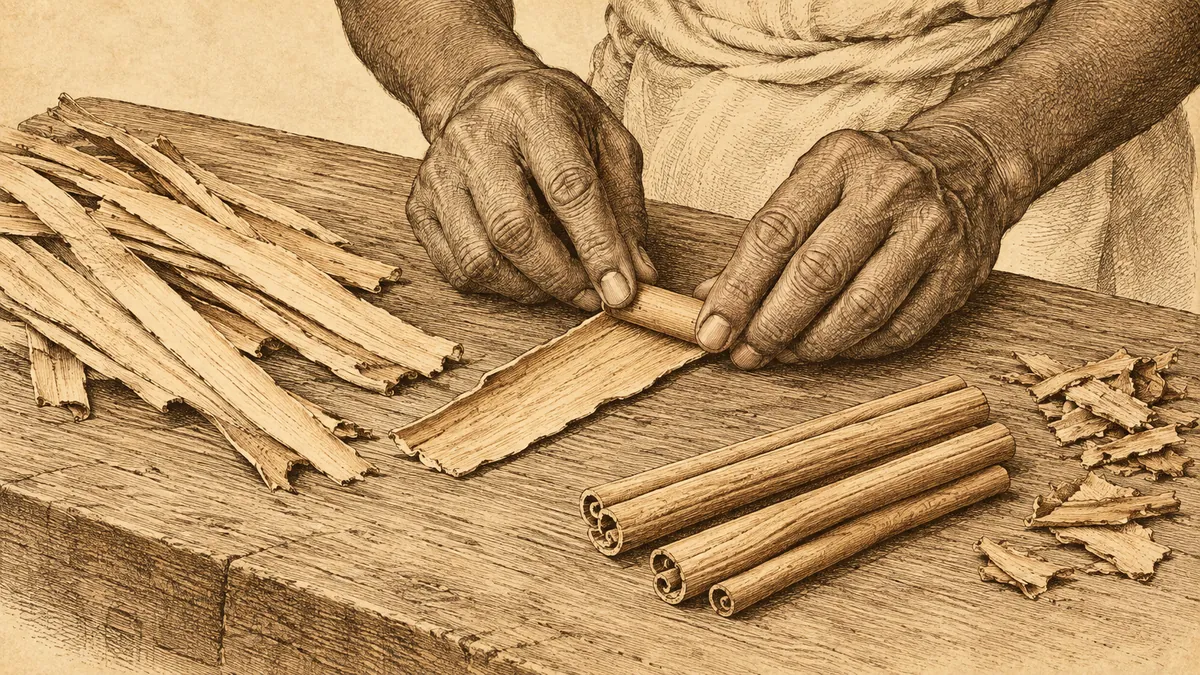
Cinnamon quills are rolled by hand from strips of the peeled inner bark of the true cinnamon tree, Cinnamomum verum. After the bark is peeled and lightly dried, a skilled worker nests smaller strips inside larger ones and rolls them into a long, tight tube, joining piece after piece end to end to build a quill that can reach around 42 inches. As the rolled bark dries further it shrinks and tightens into the familiar cinnamon stick. This hand rolling is one of the most skilled steps in making Ceylon cinnamon, and it is done almost entirely by hand rather than by machine.
The rolled cinnamon quill is the signature form of true cinnamon, and the way it is made by hand is part of what sets Ceylon cinnamon apart. This guide explains the process step by step. It builds on our pillar guide to how Ceylon cinnamon is made.
The short answer
Cinnamon quills are made by hand-rolling strips of peeled inner bark into long tubes, nesting smaller pieces inside larger ones and joining them end to end, then drying the rolls so they tighten into sticks. A skilled cinnamon worker peels the fine inner bark, lets it wilt slightly, and rolls it on a flat surface into a continuous quill. The quills are then dried, during which the bark curls and firms into the neat rolled sticks sold as Ceylon cinnamon.
From peeled bark to rolled quill
Rolling begins only after the bark has been prepared. The outer bark is scraped away and the fine inner bark is carefully peeled off in strips, a delicate job described in our guide to traditional cinnamon peeling methods. These thin, flexible strips of inner bark are the raw material for the quills. They are usually left for a short time so they lose a little moisture and become easier to handle, and it is these strips that the worker then rolls into shape.
The nesting technique
The key to a good quill is a technique often described as pipe within a pipe. Rather than rolling a single strip into a hollow tube, the worker places smaller strips and offcuts of inner bark inside the roll as it is formed. This filling holds the tube together, keeps its shape and makes the quill solid rather than empty. As the bark dries and shrinks, the nested pieces bind together into one firm stick. This is why a true Ceylon cinnamon quill is made of many thin layers packed together, which is one of the features that helps tell it apart from the thicker, single-layer bark of cassia.
Building a long quill
A single strip of bark is not long enough to make a full quill on its own, so the worker joins strips end to end as they roll. Piece after piece is added, each one continuing the roll, until a long, continuous quill is built up. Traditionally these are made to standard lengths, commonly around 42 inches or 21 inches, which are later trimmed to the sizes buyers want. The result is a long, even tube of tightly rolled bark, which is the classic form of Ceylon cinnamon before it is cut into shorter sticks.
Rolling and drying
The rolling itself is done on a flat surface, using the hands and simple tools, with the worker pressing and turning the bark so it curls into a firm, even roll. Once formed, the quills are set out to dry, usually in shade and air rather than harsh sun, so they dry slowly and keep their pale colour. During drying the bark loses moisture, shrinks and curls more tightly, so the quill firms up into a hard stick that holds its shape. Careful drying at this stage is important for the colour, firmness and keeping quality of the finished cinnamon. Rushed or overly hot drying can darken or crack the quills, so the slow, shaded method is preferred where the finest pale quills are wanted.
The steps at a glance
| Step | What happens |
|---|---|
| Peeling | The fine inner bark is peeled off in strips |
| Wilting | Strips lose a little moisture and become easier to roll |
| Nesting | Smaller pieces are placed inside the roll to fill it |
| Rolling | Strips are rolled and joined end to end into a long quill |
| Drying | The quills dry, shrink and tighten into firm sticks |
Why it is skilled work
Hand-rolling cinnamon is a craft that takes practice to do well. The worker has to judge the moisture of the bark, roll it tightly and evenly, nest the filling neatly and join the strips smoothly, all by feel. A well-made quill is thin, even, tightly rolled and free of gaps, while a poorly rolled one is loose or uneven. Because the neatness and thinness of the quill affect its grade, the skill of the roller has a direct effect on the value of the cinnamon, a link described in our guide to featherings, quillings and chips, the smaller grades that come from the same process. A practised roller can produce a steady stream of even, well-formed quills, while the pieces that are too small or break along the way are set aside as the lower grades. In this sense the quality of a batch of cinnamon is decided partly at the rolling bench, by the hands and judgement of the person shaping each quill.
Hand-rolled, not machine-made
One of the striking things about Ceylon cinnamon is that this rolling is still done by hand. There is no simple machine that can peel the delicate inner bark and roll it into fine quills the way a trained worker can, so the craft has been passed down through generations of cinnamon workers in Sri Lanka. This is part of why true Ceylon cinnamon carries the character it does, and part of why it is more costly than mass-produced cassia. The rolled quill you hold is the product of skilled hands, not a factory line.
What the rolled quill tells you
The finished quill is also a useful sign of authenticity. A true Ceylon cinnamon quill is thin and light, made of many soft layers rolled together, so it looks like a tightly wound cigar and can be crumbled fairly easily. This layered, hand-rolled structure comes directly from the process described above. It is quite different from cassia, which is usually a thick, hard, single curl of bark. So understanding how quills are rolled by hand also helps you recognise the real thing, as covered in our guide to what a cinnamon quill is.
Frequently asked questions
How are cinnamon quills made?
Cinnamon quills are made by hand-rolling strips of peeled inner bark into long tubes. A skilled worker nests smaller pieces inside larger ones, rolls the bark on a flat surface and joins strips end to end, then dries the rolls so they shrink and tighten into firm sticks.
Why are cinnamon quills rolled by hand?
The fine inner bark of true cinnamon is delicate and must be peeled and rolled with care, which no simple machine does as well as a trained worker. So Ceylon cinnamon quills are still rolled by hand, a craft passed down through generations of cinnamon workers in Sri Lanka.
How long is a cinnamon quill?
Traditionally, quills are rolled to standard lengths of around 42 inches or 21 inches, built up by joining many strips of bark end to end. They are then cut to the shorter lengths that buyers want, so the sticks you buy are pieces of these longer quills.
Why are Ceylon cinnamon quills made of many layers?
Because of the nesting, or pipe within a pipe, technique. Smaller strips are placed inside the roll as it is formed, so the finished quill is made of many thin layers packed together. This layered structure is one of the features that tells true Ceylon cinnamon apart from cassia.
Summary
Cinnamon quills are rolled by hand from strips of the peeled inner bark of Cinnamomum verum. After peeling, the strips are lightly wilted, then rolled on a flat surface using a nesting technique that places smaller pieces inside the roll, joined end to end to build a long, continuous quill of around 42 or 21 inches. As the rolled bark dries, it shrinks and curls into a firm stick made of many thin layers. This is skilled manual work, still done by hand rather than by machine, and the neatness of the roll affects the grade. The layered, hand-rolled quill is both the classic form of Ceylon cinnamon and one of the clearest signs that it is the genuine true cinnamon.
This website provides educational information about Ceylon Cinnamon as a spice and food ingredient. It is not intended to provide medical advice or make health claims.
Leave a Reply