Category: Glossary

  • What Does ‘Alba’ Mean in Ceylon Cinnamon?

    What Does ‘Alba’ Mean in Ceylon Cinnamon?

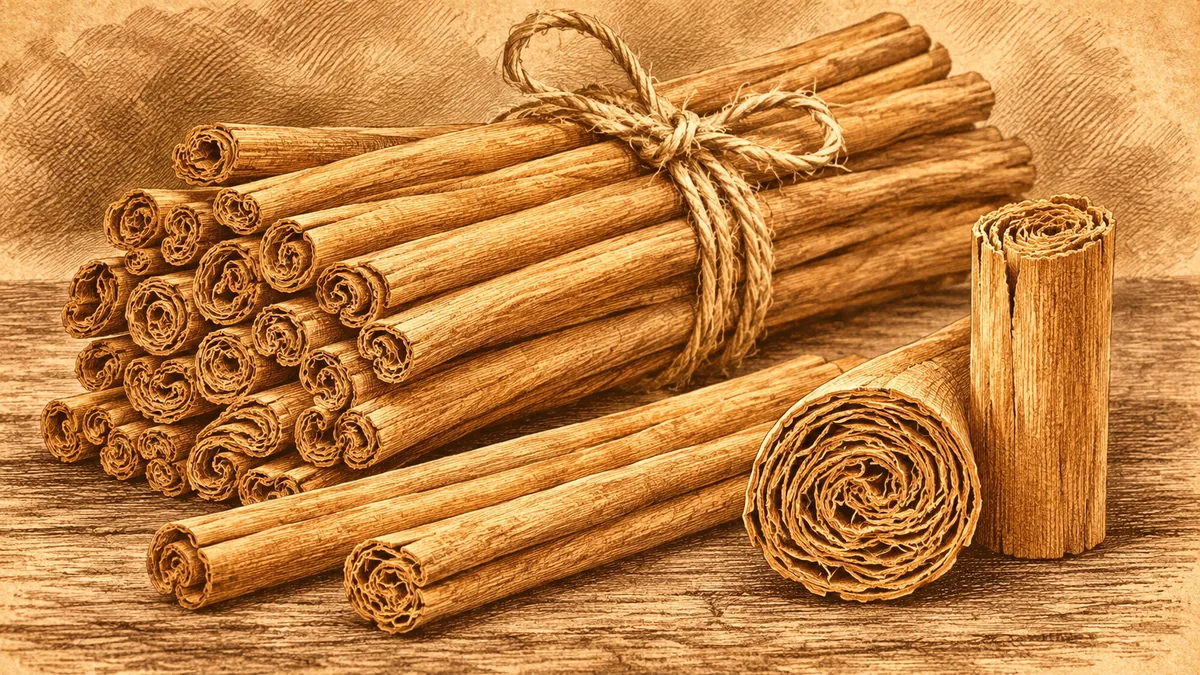
    In cinnamon, “Alba” is the name of the finest and thinnest grade of true Ceylon cinnamon, Cinnamomum verum, from Sri Lanka. An Alba quill has the smallest diameter of all the grades, which makes it the most delicate, the palest in colour and the most highly prized. The word Alba, from the Latin for white, reflects this light, pale, superior quality. When a cinnamon is labelled Alba, it is telling you that the bark has been rolled into very thin, fine quills and sorted into the top tier of the Ceylon cinnamon grading system.

    If you have seen Ceylon cinnamon sold as “Alba” and wondered what the word means, this guide explains it clearly. It covers what Alba is, how it fits into the grading system, how it compares with other grades, and what it means for flavour and value. It builds on our pillar guide to Ceylon cinnamon grades.

    The short answer

    Alba is the top grade of Ceylon cinnamon: the thinnest quills, with the smallest diameter, the palest colour and the most delicate flavour and aroma. Ceylon cinnamon is graded mainly by the thickness, or diameter, of its rolled quills, and the thinner the quill, the higher the grade. Alba sits at the very top, with the finest quills of all. The name comes from the Latin word for white, pointing to the pale, light appearance of these superior quills. So when you see Alba on a label, it signals the finest tier of true Sri Lankan cinnamon.

    Where the word Alba comes from

    Alba is a Latin word meaning white. In the context of Ceylon cinnamon, it refers to the pale, light colour and the refined quality of the thinnest quills. The grading terms used in the Ceylon cinnamon trade come from a long history of export, and several carry Latin or European names from the markets the spice was sold into. Alba marks the whitest, finest tier. The name is a traditional trade label rather than a description of a different plant: Alba cinnamon is the same species, Cinnamomum verum, as every other grade of Ceylon cinnamon, simply sorted into the top class by quill thickness.

    How Alba fits into the grading system

    Ceylon cinnamon is graded by quill diameter, and the grades run from the very fine to the thicker. Alba is the finest of all, with the smallest diameter. Below it come the Continental grades, then the Mexican grades, then the Hamburg grades, each with a larger quill diameter than the one above. Within these there are numbered sub-grades. The system is precise, and Alba is always the top. Our guide to how Ceylon cinnamon is officially graded sets out the full ladder, and the pillar guide above lists every grade in order.

    GradeQuill thicknessPosition
    AlbaThinnest of allTop grade
    ContinentalThinHigh grade
    MexicanMediumMiddle grade
    HamburgThickestLower grade

    What makes Alba the finest grade

    Alba quills are made from the thinnest, most carefully peeled inner bark, rolled into very fine tubes. Producing them takes skill, because the bark must be scraped and shaped precisely to reach such a small diameter. The result is a quill that is pale, smooth and delicate. Because the quills are so thin, Alba has a soft, refined flavour and a gentle aroma, without any of the coarseness of thicker, lower grades. This fineness, and the extra labour it takes to make, is why Alba is the most prized and usually the most expensive grade of Ceylon cinnamon.

    How Alba compares with other grades

    The main difference between Alba and the other grades is quill thickness, and everything else follows from that. Compared with the Continental grade just below it, Alba is thinner, paler and more delicate, though Continental is still a fine, high-quality cinnamon. Compared with the Mexican and Hamburg grades, which have thicker quills, Alba is noticeably finer and lighter in both appearance and flavour. Our guides to the Continental grade and the Mexican grade explain those tiers in detail. All of them are true Ceylon cinnamon; Alba is simply the top of the range.

    What Alba means for flavour

    Because Alba is made of the thinnest bark, its flavour is the most delicate and refined of the grades. Ceylon cinnamon as a whole is known for being sweet, mild and complex rather than hot and sharp, and Alba shows these qualities at their most gentle. The thin quills carry a soft, fragrant warmth that suits dishes where you want cinnamon to perfume without dominating. Lower grades, with their thicker bark, can give a slightly stronger, coarser result, which is fine for hearty cooking. For the finest, most delicate cinnamon flavour, Alba is the grade most often chosen.

    Is Alba worth the higher price?

    Whether Alba is worth its higher price depends on how you use cinnamon. Alba costs more because the thin quills take more skilled labour to produce and because they represent the top of the grading system. For everyday cooking, a slightly lower grade of genuine Ceylon cinnamon, such as Continental, gives much the same character at a lower price, since all grades are the same species. Where Alba stands out is in presentation and in delicate uses, where its pale, fine quills and its gentle flavour are most appreciated. So Alba is worth it when the fineness matters to you, and a lower grade is sensible when it does not, as our pillar guide explains.

    How to recognise Alba

    You can recognise Alba quills by their appearance. They are the thinnest of all Ceylon cinnamon quills, with a small, tight diameter, and they are pale, smooth and light. Next to a thicker grade, the difference in thickness is clear. The quills are also neat and uniform, reflecting the care taken in making them. On a label, the word Alba, usually alongside Ceylon cinnamon or Cinnamomum verum, tells you the grade directly. Combining the label with the look of the quills gives you a good check. Our guide to cinnamon grading terms made simple helps with reading these labels.

    A note on labels and marketing

    Because Alba is the top grade, the name is sometimes used in marketing to signal quality. Most of the time this is accurate, and an Alba label on genuine Ceylon cinnamon means the fine, thin quills described here. It is still worth checking that the cinnamon is true Ceylon cinnamon, Cinnamomum verum from Sri Lanka, rather than cassia, since the Alba grading system belongs to Ceylon cinnamon. A trustworthy seller will state both the species and the grade. When both are given, an Alba label is a clear and meaningful sign that you are buying the finest tier of true Ceylon cinnamon.

    Summary

    In cinnamon, Alba is the name of the finest and thinnest grade of true Ceylon cinnamon, Cinnamomum verum, from Sri Lanka. The word comes from the Latin for white, reflecting the pale, light, superior quality of these very fine quills. Ceylon cinnamon is graded by quill diameter, and Alba sits at the top, with the smallest diameter, above the Continental, Mexican and Hamburg grades. Its thin bark gives it the most delicate flavour and aroma, and the extra skill needed to produce it makes it the most prized and usually the most expensive grade. All grades are the same species, so a lower grade is a sensible choice for everyday cooking, while Alba stands out where fineness and delicacy matter most. On a label, Alba on genuine Ceylon cinnamon signals the finest class of true Sri Lankan cinnamon.

    Frequently asked questions

    What does Alba mean in cinnamon?

    Alba is the name of the finest, thinnest grade of true Ceylon cinnamon. The quills have the smallest diameter and the palest colour, and the word comes from the Latin for white, reflecting this light, superior quality. It is the top of the Ceylon cinnamon grading system.

    Is Alba the best grade of Ceylon cinnamon?

    Yes, Alba is the top grade. Ceylon cinnamon is graded by quill thickness, and Alba has the thinnest quills of all, above the Continental, Mexican and Hamburg grades. It is the most delicate and usually the most expensive, though all grades are the same species.

    Is Alba cinnamon a different plant?

    No. Alba cinnamon is the same species as all Ceylon cinnamon, Cinnamomum verum from Sri Lanka. Alba is only a grade, meaning the finest, thinnest quills. It is sorted into the top class by thickness, not grown from a different tree.

    Why is Alba cinnamon more expensive?

    Because the very thin quills take more skilled labour to peel and roll, and because Alba is the top of the grading ladder. The fineness that makes it the most delicate and prized grade also makes it the most costly to produce, which is reflected in the price.

    Do I need Alba grade for cooking?

    Not usually. Alba gives the finest, most delicate flavour, but a lower grade of genuine Ceylon cinnamon, such as Continental, works well for everyday cooking at a lower price, since all grades are the same species. Alba is best where its fineness and appearance matter.

    This website provides educational information about Ceylon Cinnamon as a spice and food ingredient. It is not intended to provide medical advice or make health claims.
  • Cinnamon Quills vs Cinnamon Sticks: Same Thing?

    Cinnamon Quills vs Cinnamon Sticks: Same Thing?

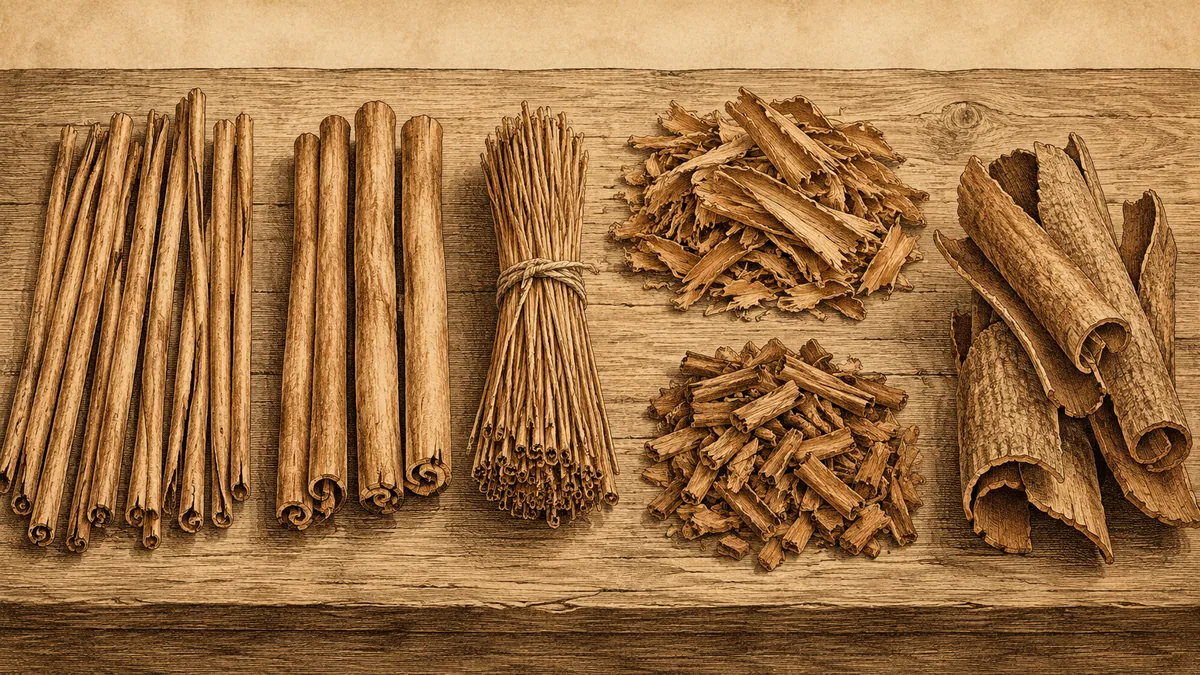
    Cinnamon quills and cinnamon sticks are essentially the same thing: both are rolled tubes of dried cinnamon bark. “Quill” is the traditional trade term for the rolled bark of true cinnamon, Cinnamomum verum, from Sri Lanka, while “stick” is the everyday word most shoppers use. So a Ceylon cinnamon quill is a cinnamon stick, though the word quill is most often used for the fine, many-layered rolls of true Ceylon cinnamon, and “stick” is used loosely for any rolled cinnamon, including thick cassia.

    If you have seen cinnamon sold as both “quills” and “sticks” and wondered whether they differ, the short answer is that they are the same form under two names. This guide explains the terms, where they come from, and the small distinctions worth knowing. It builds on our pillar guide to Ceylon cinnamon grades.

    The short answer

    A cinnamon quill and a cinnamon stick are the same thing, a rolled tube of dried cinnamon bark; quill is the traditional trade name and stick is the common everyday name. In the Ceylon cinnamon trade, the rolled bark is called a quill, and quills are graded by their quality and size. In shops and recipes, the same rolls are usually called sticks. The only nuance is that quill almost always refers to genuine Ceylon cinnamon, while stick is used more loosely for any rolled cinnamon, true or cassia. In practice, if you buy Ceylon cinnamon quills or Ceylon cinnamon sticks, you are buying the same form.

    What a quill is

    A quill is the name given to the rolled, dried inner bark of the cinnamon tree. When Ceylon cinnamon is made, thin pieces of peeled inner bark are rolled together into long tubes, which are dried and cut to length. These tubes are the quills. The word comes from the way the rolled bark resembles a writing quill or a hollow reed. In the Ceylon cinnamon trade, quill is the standard term, and it is used in grading and export. Our guide to the definition and origin of the cinnamon quill looks at the word and the form in more detail.

    What a stick is

    A stick is simply the common name for the same rolled tube of cinnamon bark. When you buy cinnamon sticks in a supermarket, you are buying quills under a more familiar name. The word stick describes the shape well for everyday use, and most cooks and recipes use it. Because stick is a loose, general word, it is applied to any rolled cinnamon, whether it is fine Ceylon cinnamon or the thicker, harder cassia. So while every quill is a stick, not every stick sold as cinnamon is a true Ceylon quill, which is where a little care with labels helps.

    TermWhat it means
    QuillTrade name for rolled cinnamon bark, usually Ceylon
    StickEveryday name for the same rolled form
    Same form?Yes, both are rolled tubes of dried bark
    Usual use of “quill”Genuine Ceylon cinnamon, in the trade
    Usual use of “stick”Any rolled cinnamon, Ceylon or cassia

    Why there are two words

    The two names exist because cinnamon is spoken of in two worlds: the trade and the kitchen. In the growing and export trade of Sri Lanka, the rolled bark has long been called a quill, and the term carries into grading, where quills are sorted by quality and diameter. In everyday shopping and cooking, people naturally call the same thing a stick, because that is what it looks like. Neither word is wrong; they simply come from different settings. Knowing that they mean the same form helps when you see Ceylon cinnamon described either way.

    The difference that does matter

    While quill and stick describe the same form, the real difference to watch is not the word but the type of cinnamon. True Ceylon cinnamon quills are thin and soft, made of many fine layers rolled together, and they crumble easily. Cassia sticks are thick, hard and usually a single curl of coarse bark. Both may be sold loosely as cinnamon sticks, so the useful question is not quill versus stick but Ceylon versus cassia. Our guide to how cinnamon quills are rolled by hand shows how the fine Ceylon quills are made, which is part of what sets them apart.

    Quills, quillings, featherings and chips

    Within the Ceylon cinnamon trade, quill is one of several terms for the different forms the bark takes. Alongside whole quills there are quillings, which are the broken pieces of quill, featherings, which are the thin shavings and inner bark too small to roll, and chips, which are rough pieces of outer bark. These are all graded and sold for different uses. So while a shopper mainly meets the whole quill, or stick, the trade recognises a family of related forms. Our glossary of feathering, quilling and chips explains these terms.

    How quills are sized and sold

    In the Ceylon cinnamon trade, quills are not just rolled and sold as they are; they are cut to standard lengths and sorted. Long tubes of rolled bark are trimmed to a set length for export, and the pieces are then graded by their diameter and quality, with finer, thinner quills reaching the higher grades. This is why the word quill carries weight in the trade: it is the unit that grading and pricing are built around. A shopper who buys a few cinnamon sticks is, in trade terms, buying short lengths of graded quill. Knowing this connects the familiar kitchen stick to the graded quill of the export trade, which our pillar guide to Ceylon cinnamon grades sets out in full.

    Where you will see each word

    In practice, the word you meet depends on where you are looking. On a supermarket shelf or in a recipe, you will almost always see cinnamon sticks. On a specialist spice seller’s site, in writing about Sri Lankan cinnamon, or on an export grade description, you will see quills. Some sellers of genuine Ceylon cinnamon deliberately use the word quill to signal that they are offering the true, trade-grade article rather than loose supermarket cinnamon. So while the two words mean the same form, the choice of word can sometimes hint at how close the seller is to the Ceylon cinnamon trade, though it is never a guarantee on its own.

    Which word should you use

    For everyday purposes, either word is fine, and stick is perfectly clear. If you are reading about the cinnamon trade, grades or Sri Lankan production, you will see quill, and it means the same rolled form you know as a stick. The practical advice is to focus less on the choice of word and more on whether the cinnamon is genuine Ceylon cinnamon. Whether a seller calls it a Ceylon cinnamon quill or a Ceylon cinnamon stick, what matters is that it is true Cinnamomum verum from Sri Lanka, thin and many-layered, rather than thick cassia under a loose name.

    Summary

    Cinnamon quills and cinnamon sticks are the same thing: rolled tubes of dried cinnamon bark. Quill is the traditional trade name, used in the Ceylon cinnamon industry and in grading, while stick is the everyday word used by shoppers and cooks. The two terms come from different settings, the trade and the kitchen, but describe one form. The only nuance is that quill almost always means genuine Ceylon cinnamon, Cinnamomum verum, whereas stick is applied loosely to any rolled cinnamon, including cassia. The difference worth attention is therefore not quill versus stick but Ceylon versus cassia: true Ceylon quills are thin, soft and many-layered, while cassia is thick and hard. Whichever word you meet, look for genuine Ceylon cinnamon from Sri Lanka.

    Frequently asked questions

    Are cinnamon quills and cinnamon sticks the same?

    Yes. Both are rolled tubes of dried cinnamon bark. Quill is the traditional trade name, especially for true Ceylon cinnamon, and stick is the everyday name for the same form. If you buy Ceylon cinnamon quills or sticks, you are buying the same thing.

    Why is Ceylon cinnamon called a quill?

    Because the rolled, dried inner bark resembles a writing quill or hollow reed. In the Ceylon cinnamon trade, quill is the standard term for this rolled form, and quills are graded by quality and size for sale and export.

    Is there any difference between a quill and a stick?

    Not in form, since both are rolled cinnamon bark. The small nuance is that quill usually refers to genuine Ceylon cinnamon, while stick is used loosely for any rolled cinnamon, including cassia. So the real difference to check is Ceylon versus cassia, not quill versus stick.

    Are cinnamon sticks always Ceylon cinnamon?

    No. The word stick is used for any rolled cinnamon, so a cinnamon stick may be true Ceylon cinnamon or the thicker, harder cassia. True Ceylon sticks, or quills, are thin and made of many fine layers, while cassia is usually a single thick curl.

    Should I buy quills or sticks?

    They are the same form, so the choice of word does not matter. What matters is buying genuine Ceylon cinnamon, Cinnamomum verum from Sri Lanka. Look for the species name and origin, and for thin, many-layered rolls, whether they are sold as quills or sticks.

    This website provides educational information about Ceylon Cinnamon as a spice and food ingredient. It is not intended to provide medical advice or make health claims.
  • Cinnamon Grading Terms Made Simple

    Cinnamon Grading Terms Made Simple

    Ceylon cinnamon grading terms describe the thickness, appearance and form of the dried bark, and they can look confusing on a label. The main terms fall into three groups: grade names like Alba, Continental, Mexican and Hamburg, which rank quills from thinnest to thickest; code grades like C5 Special, C5 and C4, and the H grades H1 to H5, which are more precise versions of the same idea; and form terms like quills, quillings, featherings and chips, which describe the shape of the piece rather than its thickness. This guide explains each term in plain language.

    If you have ever looked at a bag of Ceylon cinnamon and wondered what Alba or C5 means, this glossary is for you. It defines the common grading terms simply, so you can read a label with confidence. It builds on our pillar guide, the complete guide to Ceylon cinnamon grades.

    The short answer

    Ceylon cinnamon grading terms sort the bark by how thin and fine the quills are and by their form. Alba is the thinnest and finest grade, followed by Continental, Mexican and Hamburg as the quills get thicker; C and H codes are more exact grades based on quill diameter; and quills, quillings, featherings and chips describe the form of the piece. Thinner quills carry the higher grades, which is why Alba sits at the top.

    Why cinnamon is graded

    Ceylon cinnamon is graded so that buyers and sellers can describe quality consistently. The grade mostly reflects the thickness of the quill: the thinnest, smoothest quills are considered the finest, because they come from young, even shoots and have a delicate flavour and neat appearance. Thicker quills are still good cinnamon, but they sit lower in the grading scale. Grading also separates whole quills from the smaller pieces and offcuts, which have their own terms. Knowing the terms helps you match the grade to what you need, since you do not always need the top grade for everyday cooking.

    Grade names: Alba to Hamburg

    The traditional grade names rank quills from thinnest to thickest. Alba is the finest and thinnest grade, with a smooth, pale, delicate quill, and it is the most prized. Continental comes next, still fine but a little thicker than Alba. Mexican grades are thicker again, and Hamburg grades are the thickest of the main groups, with coarser, stronger quills. These names were shaped by the export markets the grades were historically sent to, but today they work simply as a scale from fine to coarse. Our guide to Continental grade Ceylon cinnamon looks at one of these in detail.

    Code grades: C5, C4 and the H grades

    Alongside the names, Ceylon cinnamon uses letter and number codes that describe the quill more precisely. The C codes, such as C5 Special, C5 and C4, are tied to quill diameter, with the numbers and the word “Special” marking finer, thinner quills. C5 Special is among the finest. The H grades, H1 to H5, are another coded system used for certain quill types, again based on diameter and quality, with H1 the finer end of that range. These codes do the same job as the names, sorting quills by thickness, but in a more exact, measured way. For one example, see our guide to C5 Special Ceylon cinnamon.

    Form terms: quills, quillings, featherings and chips

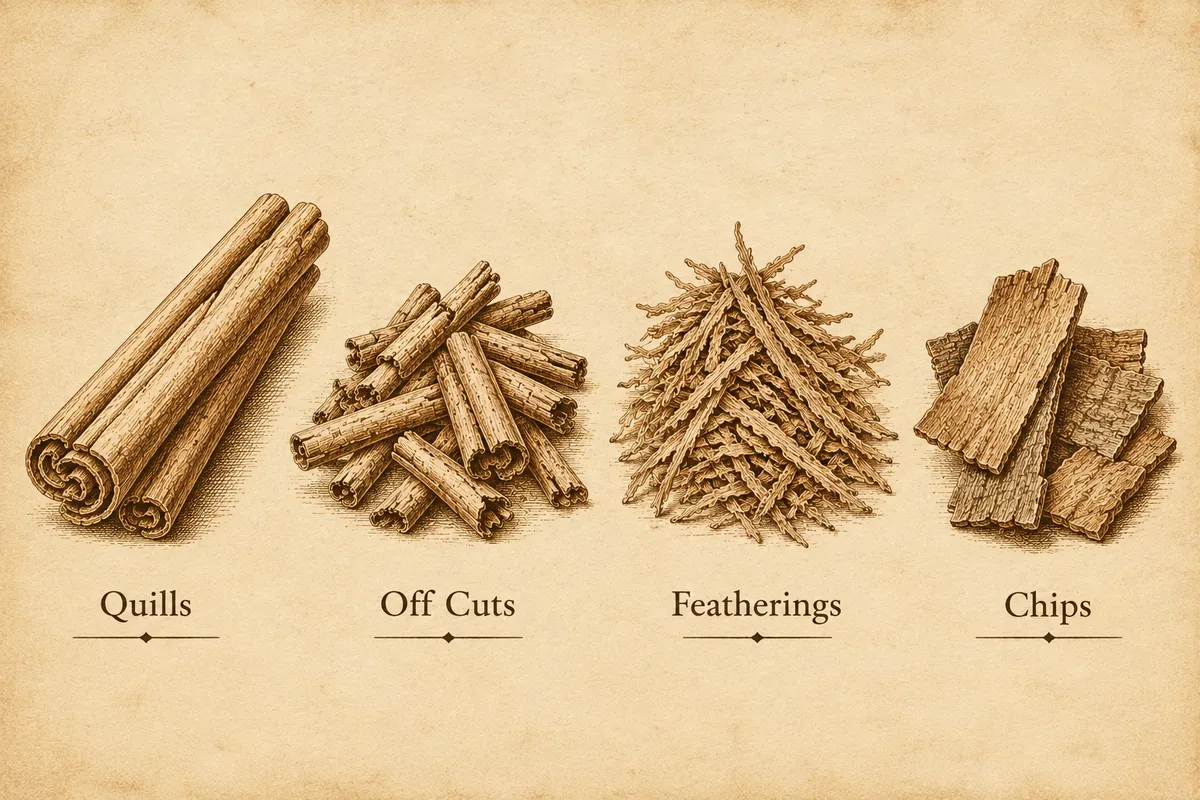
    A second set of terms describes the form of the cinnamon rather than its grade. A quill is a whole rolled stick of bark, the familiar cinnamon stick. Quillings are small broken pieces of quill, the fragments left over when quills are cut and handled. Featherings are thin inner bark and shavings, lighter offcuts that gather during processing. Chips are small pieces of bark, including outer bark, often used for grinding or extraction. These are not lower grades in the thickness sense but different products made from the same tree. Our glossary of featherings, quillings and chips covers these forms more fully.

    How the terms fit together

    It helps to see the terms as answering two different questions. The grade names and codes answer “how thin and fine is the quill?”, running from Alba and C5 Special at the fine end to Hamburg and the thicker codes at the coarse end. The form terms answer “what shape is the piece?”, separating whole quills from quillings, featherings and chips. A label might combine both, naming a grade and a form, such as Alba quills or cinnamon chips. Reading the two parts separately makes the label much easier to understand.

    Where the grading terms come from

    Ceylon cinnamon grading is not just informal trade language; it is backed by recognised standards. Sri Lanka, the home of true cinnamon, has long-established grading rules that define each grade by measurable features such as quill diameter, so a grade name means roughly the same thing from one seller to the next. This is why a term like C5 or Alba carries real meaning rather than being a loose description. When you see these terms on a reputable pack, they point back to this shared system, which is part of what makes Ceylon cinnamon a carefully sorted spice rather than a bag of mixed bark.

    Reading a grade on a real label

    On an actual pack, the grade often sits next to the species name and origin. You might see wording such as “Ceylon cinnamon, Cinnamomum verum, Alba grade, product of Sri Lanka”. Here the species and origin tell you it is true cinnamon, and the grade tells you how fine the quills are. If a label gives a grade but no species or origin, the grade alone still suggests a seller working within the Ceylon system, though it is best confirmed by the species name. A pack that gives neither a grade nor a species leaves you with the least information, which is worth keeping in mind when comparing products.

    Cinnamon grading terms at a glance

    TermTypeWhat it means
    AlbaGrade nameFinest, thinnest quill
    ContinentalGrade nameFine, slightly thicker than Alba
    MexicanGrade nameThicker quill grade
    HamburgGrade nameThickest of the main grades
    C5 Special, C5, C4Code gradeGraded by quill diameter, finer at C5 Special
    H1 to H5Code gradeCoded grades by diameter and quality
    QuillFormA whole rolled cinnamon stick
    QuillingsFormSmall broken pieces of quill
    FeatheringsFormThin inner bark and shavings
    ChipsFormSmall bark pieces for grinding

    Which grade should you choose?

    The right grade depends on what you need. For a special dish where appearance and a delicate flavour matter, a fine grade such as Alba or C5 Special is worth it. For everyday cooking, simmering in syrups or making cinnamon tea, a mid grade works perfectly well and costs less, since the quill will be used for its flavour rather than shown off. If you are grinding your own cinnamon or making an infusion, quillings, featherings or chips can be a good-value choice because the form matters less once the bark is broken up. Matching the grade and form to the job saves money without losing quality where it counts.

    Frequently asked questions

    What is the best grade of Ceylon cinnamon?

    Alba is generally considered the best grade of Ceylon cinnamon, as it has the thinnest, finest and smoothest quills. Code grades such as C5 Special are also at the fine end. “Best” here means the finest and most delicate, though a mid grade is often a more sensible choice for everyday cooking.

    What does C5 mean on cinnamon?

    C5 is a code grade tied to the diameter of the cinnamon quill, marking a fine, thin quill. C5 Special is finer still. The C codes sort Ceylon cinnamon by thickness in a precise, measured way, doing the same job as grade names like Alba and Continental.

    Are featherings and chips lower quality?

    Not exactly. Featherings and chips are different forms rather than lower grades. They are smaller pieces and offcuts of the same cinnamon, often used for grinding or infusion, where the shape of the piece matters less. They can be good value when you do not need whole quills.

    Do higher grades taste better?

    Finer grades such as Alba have a delicate, smooth flavour and a neat appearance, but a mid grade of true Ceylon cinnamon still tastes mild and sweet. The grade reflects thickness and appearance more than a simple better-or-worse flavour, so the right grade depends on the use.

    Summary

    Ceylon cinnamon grading terms become clear once you split them into two questions. Grade names (Alba, Continental, Mexican, Hamburg) and code grades (C5 Special, C5, C4 and H1 to H5) rank the quill by thickness, from fine to coarse, with Alba and C5 Special at the finest end. Form terms (quills, quillings, featherings and chips) describe the shape of the piece, from whole sticks to offcuts. Reading the grade and the form separately makes any label easy to understand, and matching both to the job lets you buy the right Ceylon cinnamon without overpaying.

    This website provides educational information about Ceylon Cinnamon as a spice and food ingredient. It is not intended to provide medical advice or make health claims.

  • Feathering, Quilling and Chips: A Glossary

    Feathering, Quilling and Chips: A Glossary

    Off cuts, featherings, quillings and chips are the smaller grades and by-products of Ceylon cinnamon, made from the pieces that are left over when the prime rolled quills are formed and trimmed to size. Off cuts are the short pieces cut off when a quill is trimmed to a customer’s required length; featherings are the thin, feathery inner-bark shavings; quillings are the broken fragments of quills; and chips are the flat pieces of bark that cannot be rolled. All come from the same true cinnamon tree, Cinnamomum verum, and are mostly ground into powder or distilled for oil rather than sold as whole sticks.

    These three words appear on grade lists and in the cinnamon trade, and they often confuse newcomers. This short glossary explains what each one means and how they relate to the familiar cinnamon quill. It builds on our full guide to Ceylon cinnamon grades.

    The short answer

    Off cuts, featherings, quillings and chips are the smaller, lower grades of Ceylon cinnamon left over from making and trimming quills. Off cuts are the pieces cut off when a quill is trimmed to a set length, quillings are broken bits of quill, featherings are thin feathery shavings and small inner-bark curls, and chips are flat pieces of bark that were never rolled. None of them are waste: they carry the same aroma and flavour as the prime quills and are widely used, mostly after grinding or distillation.

    Starting point: the cinnamon quill

    To understand these terms, it helps to start with the quill, the best known form of Ceylon cinnamon. A quill is a tube of dried inner bark, rolled by hand into the familiar stick shape. Making quills is skilled work, and not every piece of bark ends up as a long, perfect quill. The pieces that are too short, too small or the wrong shape become the grades described below. For the full picture of the quill itself, see our guide to what a cinnamon quill is.

    Off cuts

    Off cuts are the short pieces cut from a quill when it is trimmed to a required length. Ceylon cinnamon quills are traditionally hand-made to standard lengths, most often 42 inches or 21 inches. When a customer or buyer needs a particular size, the long quills are cut down to that length, and the remaining cut pieces are gathered and sold as off cuts. They are made of exactly the same fine rolled inner bark as the full quills, and carry the same aroma and taste, so an off cut is really just a shorter length of prime cinnamon. Because they are short and uneven, they cost less than full-length sticks and are a practical choice for cooking, steeping or grinding, where the length of the quill does not matter.

    Quillings

    Quillings are broken pieces and short offcuts of quills. When quills are trimmed to length, or when longer quills break during handling and transport, the small fragments left behind are gathered together and sold as quillings. They are made of exactly the same rolled inner bark as full quills, so they have the same fine aroma and taste. Because they are shorter and broken, they cost less than whole quills and are often chosen for grinding into powder, where the length of the piece does not matter. In short, quillings are true cinnamon in smaller, broken form.

    Featherings

    Featherings, sometimes called feather cinnamon, are the thin, light, feathery pieces of inner bark. During peeling and rolling, small curls and delicate shavings of the inner bark are produced that are too small and fine to form into proper quills. These wispy, feather-like pieces are collected as featherings. They are among the lightest grades of cinnamon and, like quillings, are usually ground or used where whole sticks are not needed. The name captures their look well: light, curly and feather-like.

    Chips

    Chips are flat, unrolled pieces of cinnamon bark. Some bark cannot be made into quills at all, for example thicker or coarser pieces, or the outer bark that is scraped away. These pieces are dried flat and sold as cinnamon chips. Chips are the most basic grade and are used mostly for grinding into powder, for making cinnamon oil by distillation, or for steeping in liquids where a whole quill is not required. Because they are flat rather than rolled, they are easy to tell apart from quills and quillings at a glance.

    Featherings, quillings and chips at a glance

    The by-product grades of Ceylon cinnamon compared.
    TermWhat it isFormCommon use
    QuillPrime rolled inner barkLong rolled tube (42 or 21 inches)Whole sticks, display, cooking
    Off cutsPieces cut when trimming quills to sizeShort rolled piecesCooking, steeping, grinding
    QuillingsBroken pieces of quillShort rolled fragmentsGrinding into powder
    FeatheringsThin feathery inner-bark shavingsLight curls and sliversGrinding, blending
    ChipsFlat unrolled bark piecesFlat chipsPowder, oil, steeping

    Why these grades exist

    All of these grades exist because of how Ceylon cinnamon is made by hand. Peelers separate the inner bark, which is rolled into quills as it dries. The process naturally produces offcuts, breakages, shavings and pieces of bark that will not roll. Rather than being thrown away, these are carefully sorted into featherings, quillings and chips. This sorting is part of good, low-waste cinnamon production, and it means that every usable piece of the fragrant inner bark finds a purpose. The grades are simply a way of organising the different sizes and shapes that come off the tree. This careful sorting also helps buyers, because it lets them choose exactly the format they need. Someone who wants long sticks for display buys quills, while someone who plans to grind their own powder can buy quillings or featherings and pay less for the same fragrant bark. In this sense the grades are as much about matching cinnamon to its use as they are about the pieces themselves.

    Are they lower quality?

    It is important to be clear that lower grade does not mean poor quality here. Featherings, quillings and chips from true Ceylon cinnamon are still true Ceylon cinnamon, with the same sweet, delicate character as the quills. The grade mainly describes the size and shape of the piece, not how good it tastes. What matters most for quality is still the species and origin: genuine Cinnamomum verum from Sri Lanka. A feathering of real Ceylon cinnamon is finer than a whole quill of cassia. So these grades are best thought of as different formats of the same good spice, chosen to suit different jobs.

    How each grade is used

    Because featherings, quillings and chips are smaller and less tidy than whole quills, they are rarely sold as display sticks. Instead, most of them are ground into cinnamon powder, where size and shape do not matter and the flavour is what counts, a process described in our guide to ground Ceylon cinnamon. Chips in particular are also used to make cinnamon oil by distillation, and for steeping in drinks and syrups. This is why buying quillings, featherings or chips can be a sensible choice when you plan to grind or infuse the cinnamon anyway, since you get the true spice at a lower price than perfect whole quills.

    How the grades relate to the wider grading system

    Featherings, quillings and chips sit alongside the more familiar quill grades such as Alba, Continental and the C5 and C4 codes. Where those grades describe the quality and diameter of the rolled quills, featherings, quillings and chips describe the smaller pieces that fall outside the quill grades. Together they make up the full range of Ceylon cinnamon products. To see where the premium rolled grades fit, our guide to C5 Special Ceylon cinnamon explains one of the well known quill grades in detail.

    Frequently asked questions

    What are cinnamon off cuts?

    Off cuts are the short pieces cut from Ceylon cinnamon quills when they are trimmed to a set length. Quills are traditionally made to 42 inches or 21 inches, and when a specific size is needed they are cut down, leaving off cuts. These are the same fine rolled bark as full quills, just shorter, and cost less.

    What are cinnamon featherings?

    Featherings are the thin, light, feathery pieces of Ceylon cinnamon inner bark: small curls and shavings that are too fine to roll into full quills. They are collected during peeling and rolling and are usually ground into powder or used in blends. They carry the same aroma and flavour as the quills.

    What are cinnamon quillings?

    Quillings are the broken pieces and short offcuts of cinnamon quills. They are the same rolled inner bark as whole quills, just in smaller, broken form, and they cost less. Quillings are commonly ground into cinnamon powder.

    What are cinnamon chips?

    Chips are flat, unrolled pieces of cinnamon bark that cannot be made into quills. They are dried flat and used mainly for grinding into powder, making cinnamon oil, or steeping in drinks and syrups.

    Are featherings, quillings and chips lower quality?

    Not in flavour. They are lower grades only in the sense of size and shape, not taste. Featherings, quillings and chips from true Ceylon cinnamon have the same fine, sweet character as the quills. Quality depends on the species and origin, genuine Cinnamomum verum from Sri Lanka, more than on the format.

    Summary

    Off cuts, featherings, quillings and chips are the smaller grades and by-products of Ceylon cinnamon, all made from the same true cinnamon tree, Cinnamomum verum. Off cuts are the pieces cut off when a quill is trimmed from its traditional 42-inch or 21-inch length to a required size, quillings are broken pieces of quill, featherings are thin feathery inner-bark shavings, and chips are flat pieces of bark that were never rolled. They arise naturally from the hand-made process of forming quills, and rather than being wasted they are sorted and sold, mostly for grinding into powder or distilling into oil. Above all, lower grade here means smaller and less tidy, not poorer in taste: these formats carry the same fine aroma and flavour as the prime quills, which makes them a practical way to buy genuine Ceylon cinnamon when you plan to grind or infuse it. The key point is that the grade name tells you about the shape and size of the piece, while the species and origin tell you about the quality, and it is the second of these that decides whether you are getting fine true cinnamon.

    This website provides educational information about Ceylon Cinnamon as a spice and food ingredient. It is not intended to provide medical advice or make health claims.