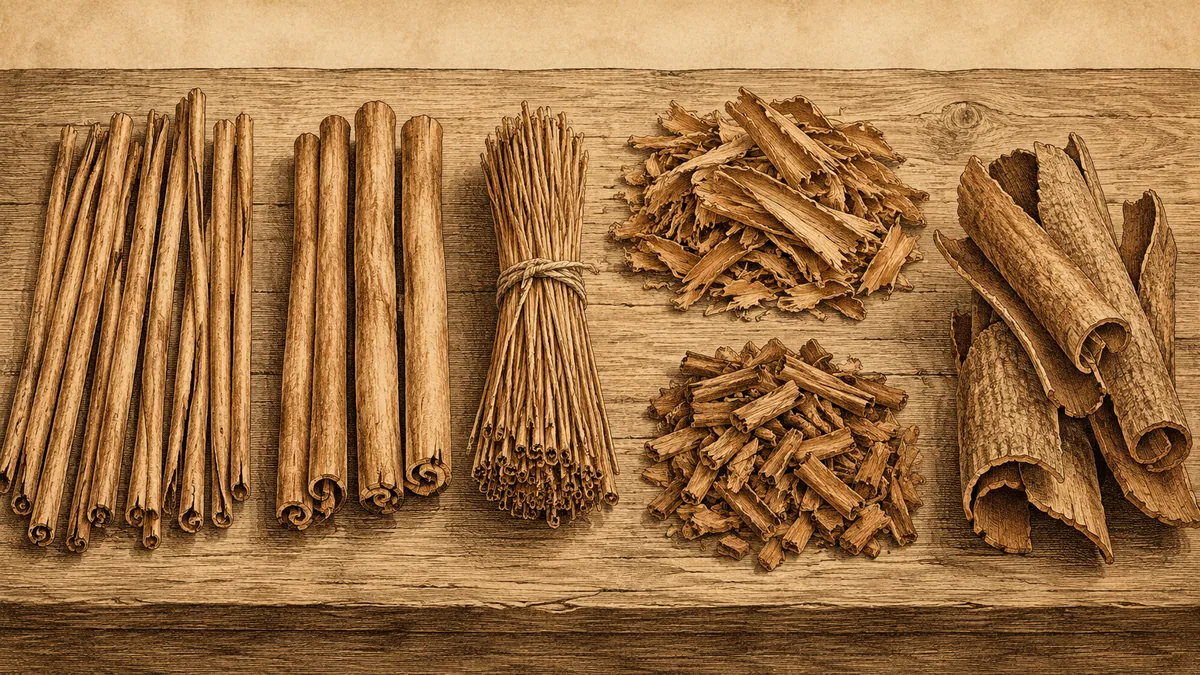
Ceylon cinnamon grading terms describe the thickness, appearance and form of the dried bark, and they can look confusing on a label. The main terms fall into three groups: grade names like Alba, Continental, Mexican and Hamburg, which rank quills from thinnest to thickest; code grades like C5 Special, C5 and C4, and the H grades H1 to H5, which are more precise versions of the same idea; and form terms like quills, quillings, featherings and chips, which describe the shape of the piece rather than its thickness. This guide explains each term in plain language.
If you have ever looked at a bag of Ceylon cinnamon and wondered what Alba or C5 means, this glossary is for you. It defines the common grading terms simply, so you can read a label with confidence. It builds on our pillar guide, the complete guide to Ceylon cinnamon grades.
The short answer
Ceylon cinnamon grading terms sort the bark by how thin and fine the quills are and by their form. Alba is the thinnest and finest grade, followed by Continental, Mexican and Hamburg as the quills get thicker; C and H codes are more exact grades based on quill diameter; and quills, quillings, featherings and chips describe the form of the piece. Thinner quills carry the higher grades, which is why Alba sits at the top.
Why cinnamon is graded
Ceylon cinnamon is graded so that buyers and sellers can describe quality consistently. The grade mostly reflects the thickness of the quill: the thinnest, smoothest quills are considered the finest, because they come from young, even shoots and have a delicate flavour and neat appearance. Thicker quills are still good cinnamon, but they sit lower in the grading scale. Grading also separates whole quills from the smaller pieces and offcuts, which have their own terms. Knowing the terms helps you match the grade to what you need, since you do not always need the top grade for everyday cooking.
Grade names: Alba to Hamburg
The traditional grade names rank quills from thinnest to thickest. Alba is the finest and thinnest grade, with a smooth, pale, delicate quill, and it is the most prized. Continental comes next, still fine but a little thicker than Alba. Mexican grades are thicker again, and Hamburg grades are the thickest of the main groups, with coarser, stronger quills. These names were shaped by the export markets the grades were historically sent to, but today they work simply as a scale from fine to coarse. Our guide to Continental grade Ceylon cinnamon looks at one of these in detail.
Code grades: C5, C4 and the H grades
Alongside the names, Ceylon cinnamon uses letter and number codes that describe the quill more precisely. The C codes, such as C5 Special, C5 and C4, are tied to quill diameter, with the numbers and the word “Special” marking finer, thinner quills. C5 Special is among the finest. The H grades, H1 to H5, are another coded system used for certain quill types, again based on diameter and quality, with H1 the finer end of that range. These codes do the same job as the names, sorting quills by thickness, but in a more exact, measured way. For one example, see our guide to C5 Special Ceylon cinnamon.
Form terms: quills, quillings, featherings and chips
A second set of terms describes the form of the cinnamon rather than its grade. A quill is a whole rolled stick of bark, the familiar cinnamon stick. Quillings are small broken pieces of quill, the fragments left over when quills are cut and handled. Featherings are thin inner bark and shavings, lighter offcuts that gather during processing. Chips are small pieces of bark, including outer bark, often used for grinding or extraction. These are not lower grades in the thickness sense but different products made from the same tree. Our glossary of featherings, quillings and chips covers these forms more fully.
How the terms fit together
It helps to see the terms as answering two different questions. The grade names and codes answer “how thin and fine is the quill?”, running from Alba and C5 Special at the fine end to Hamburg and the thicker codes at the coarse end. The form terms answer “what shape is the piece?”, separating whole quills from quillings, featherings and chips. A label might combine both, naming a grade and a form, such as Alba quills or cinnamon chips. Reading the two parts separately makes the label much easier to understand.
Where the grading terms come from
Ceylon cinnamon grading is not just informal trade language; it is backed by recognised standards. Sri Lanka, the home of true cinnamon, has long-established grading rules that define each grade by measurable features such as quill diameter, so a grade name means roughly the same thing from one seller to the next. This is why a term like C5 or Alba carries real meaning rather than being a loose description. When you see these terms on a reputable pack, they point back to this shared system, which is part of what makes Ceylon cinnamon a carefully sorted spice rather than a bag of mixed bark.
Reading a grade on a real label
On an actual pack, the grade often sits next to the species name and origin. You might see wording such as “Ceylon cinnamon, Cinnamomum verum, Alba grade, product of Sri Lanka”. Here the species and origin tell you it is true cinnamon, and the grade tells you how fine the quills are. If a label gives a grade but no species or origin, the grade alone still suggests a seller working within the Ceylon system, though it is best confirmed by the species name. A pack that gives neither a grade nor a species leaves you with the least information, which is worth keeping in mind when comparing products.
Cinnamon grading terms at a glance
| Term | Type | What it means |
|---|---|---|
| Alba | Grade name | Finest, thinnest quill |
| Continental | Grade name | Fine, slightly thicker than Alba |
| Mexican | Grade name | Thicker quill grade |
| Hamburg | Grade name | Thickest of the main grades |
| C5 Special, C5, C4 | Code grade | Graded by quill diameter, finer at C5 Special |
| H1 to H5 | Code grade | Coded grades by diameter and quality |
| Quill | Form | A whole rolled cinnamon stick |
| Quillings | Form | Small broken pieces of quill |
| Featherings | Form | Thin inner bark and shavings |
| Chips | Form | Small bark pieces for grinding |
Which grade should you choose?
The right grade depends on what you need. For a special dish where appearance and a delicate flavour matter, a fine grade such as Alba or C5 Special is worth it. For everyday cooking, simmering in syrups or making cinnamon tea, a mid grade works perfectly well and costs less, since the quill will be used for its flavour rather than shown off. If you are grinding your own cinnamon or making an infusion, quillings, featherings or chips can be a good-value choice because the form matters less once the bark is broken up. Matching the grade and form to the job saves money without losing quality where it counts.
Frequently asked questions
What is the best grade of Ceylon cinnamon?
Alba is generally considered the best grade of Ceylon cinnamon, as it has the thinnest, finest and smoothest quills. Code grades such as C5 Special are also at the fine end. “Best” here means the finest and most delicate, though a mid grade is often a more sensible choice for everyday cooking.
What does C5 mean on cinnamon?
C5 is a code grade tied to the diameter of the cinnamon quill, marking a fine, thin quill. C5 Special is finer still. The C codes sort Ceylon cinnamon by thickness in a precise, measured way, doing the same job as grade names like Alba and Continental.
Are featherings and chips lower quality?
Not exactly. Featherings and chips are different forms rather than lower grades. They are smaller pieces and offcuts of the same cinnamon, often used for grinding or infusion, where the shape of the piece matters less. They can be good value when you do not need whole quills.
Do higher grades taste better?
Finer grades such as Alba have a delicate, smooth flavour and a neat appearance, but a mid grade of true Ceylon cinnamon still tastes mild and sweet. The grade reflects thickness and appearance more than a simple better-or-worse flavour, so the right grade depends on the use.
Summary
Ceylon cinnamon grading terms become clear once you split them into two questions. Grade names (Alba, Continental, Mexican, Hamburg) and code grades (C5 Special, C5, C4 and H1 to H5) rank the quill by thickness, from fine to coarse, with Alba and C5 Special at the finest end. Form terms (quills, quillings, featherings and chips) describe the shape of the piece, from whole sticks to offcuts. Reading the grade and the form separately makes any label easy to understand, and matching both to the job lets you buy the right Ceylon cinnamon without overpaying.
This website provides educational information about Ceylon Cinnamon as a spice and food ingredient. It is not intended to provide medical advice or make health claims.
Leave a Reply