Tag: Alba grade

  • How Ceylon Cinnamon Is Officially Graded

    How Ceylon Cinnamon Is Officially Graded

    Ceylon cinnamon is officially graded by sorting the dried quills according to set rules for their diameter, appearance and quality, then labelling them with standard grade codes. The main grades run from the finest, Alba, through the Continental, Mexican and Hamburg families, with numbered sub-grades such as C5 or M5. Grading follows national standards in Sri Lanka, and quills are measured and inspected so that each grade means the same thing to every buyer.

    Behind every tin of Ceylon cinnamon labelled with a grade is a formal system of sorting and measurement. This guide explains how that official grading works, what the grade codes mean and who sets the rules, in plain terms. It builds on our pillar guide, the complete guide to Ceylon cinnamon grades.

    The short answer

    Official grading sorts dried Ceylon cinnamon quills by measured diameter, appearance and defects into named grades, following Sri Lankan national standards. Thinner, finer, cleaner quills reach higher grades, while thicker or more flawed ones fall into lower ones. Each grade has a code, such as Alba, C5 Special, C5, M5 or H1, and a definition that sets the limits for that grade. Because the rules are written down and the quills are measured against them, a grade name carries the same meaning from one supplier to another.

    What grading means

    Grading is the process of sorting a crop into quality classes so that buyers know what they are getting. For Ceylon cinnamon, grading takes the finished, dried quills and divides them into grades based on measurable features. It does not change the cinnamon itself: a grade simply describes where a particular quill fits on a scale from finest to coarsest. This matters because cinnamon is traded worldwide, and a shared grading system lets a buyer order a grade and receive bark that matches it, without inspecting every quill in person.

    What is measured

    Official grading rests on a few clear, measurable features of each quill. The most important is diameter: the thickness of the rolled quill, measured across its width. Finer, thinner quills are more prized and reach higher grades, while thicker quills fall into lower grades. Alongside diameter, graders look at appearance and colour, the evenness and neatness of the quill, and the presence of any defects such as roughness, breakage or blemishes. Together these decide the grade. The emphasis on diameter is why the finest grade, Alba, is defined by a very small quill diameter.

    The main grade families

    Ceylon cinnamon grades are organised into families, each with its own range of quill diameters. Alba is the finest and thinnest, the top of the scale. Below it, the Continental grades cover fine quills, the Mexican grades cover medium quills, and the Hamburg grades cover the thickest quills. Within these families, numbers mark sub-grades, so a label may read C5 Special, C5, C4, M5, M4 or H1, where the letter shows the family and the number relates to the diameter class. The result is a ladder of grades from Alba at the top down through the Hamburg range, each step allowing a slightly thicker quill.

    Grade familyCodeQuill character
    AlbaAlbaFinest and thinnest, top grade
    ContinentalC5 Special, C5, C4Fine, thin quills
    MexicanM5, M4Medium quills
    HamburgH1, H2, H3Thicker quills

    For a fuller description of what each grade name means, see our guide to cinnamon grading terms made simple.

    Who sets the standards

    The grading of Ceylon cinnamon is governed by official standards, most importantly the national standards of Sri Lanka. The Sri Lanka Standards Institution sets the rules for how cinnamon is classified, defining the grades and their requirements. There are also international standards, such as those issued by the International Organization for Standardization, which cover cinnamon quality and classification more broadly. These written standards are what make a grade official rather than a matter of opinion. Our guides to the SLS standard for Ceylon cinnamon and to ISO standards and cinnamon quality explain these bodies in more detail.

    How quills are sorted in practice

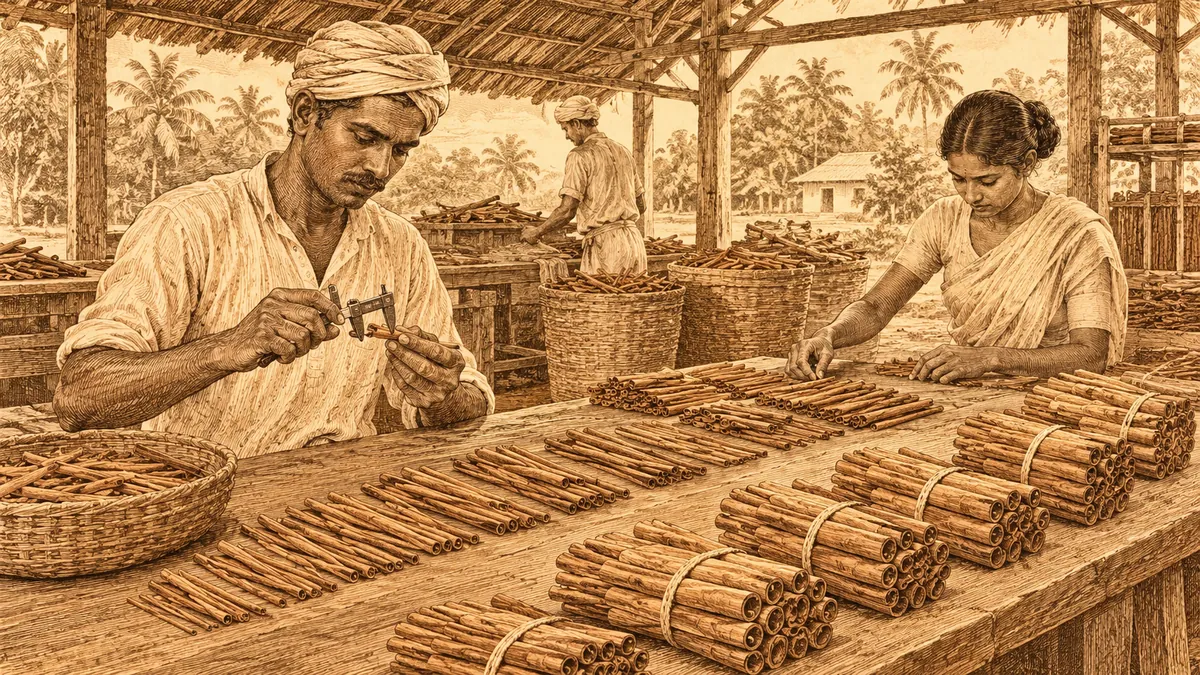
    In practice, grading happens after the cinnamon has been peeled, rolled and dried. Workers sort the finished quills, judging and measuring their diameter and checking their appearance, and group together the quills that meet each grade’s definition. Skilled graders can assess quills quickly by eye and feel, having learned the diameter classes through long experience, while measurement confirms the borderline cases. The sorted quills are then bundled by grade, ready to be labelled and traded. This sorting step turns a mixed batch of quills into clearly defined grades that the market can price and buy.

    Why official grading matters

    Official grading gives Ceylon cinnamon a common language of quality. For producers, it allows their cinnamon to be sold at a fair price that matches its grade, rewarding the care taken in peeling and rolling fine quills. For buyers, it provides confidence: ordering a named grade means receiving bark that meets a defined standard, whether the buyer is a spice importer, a manufacturer or a retailer. For the trade as a whole, it supports trust and consistency, since everyone works from the same definitions. In this way grading underpins the reputation of Ceylon cinnamon as a carefully classified, high-quality spice.

    Grading beyond whole quills

    Official grading covers more than the prime quills. During peeling and sorting, not every piece of bark forms a perfect quill, and these other forms are graded too. Featherings are the small, thin inner pieces of bark; quillings are broken fragments of quills; and chips are small pieces of bark trimmed away or left over. Each of these has its own place in the grading system and its own uses, generally in grinding and flavouring rather than sale as whole sticks. Sorting them properly means the whole crop is classified, with prime quills graded by diameter and the remaining material graded into these named classes. Our glossary of feathering, quilling and chips explains these forms in detail.

    Grading and price

    Grade and price are closely linked. Because higher grades such as Alba require the finest, thinnest quills, which are more limited and take more skill to produce, they command higher prices. Lower grades, with thicker quills, are more plentiful and cost less. This is why grade is one of the first things a serious buyer looks at, and why the grade on a label is a useful guide to both quality and cost. Grading, in other words, is not only about quality description but also about how the market values different classes of cinnamon.

    Summary

    Ceylon cinnamon is officially graded by sorting the dried quills according to written standards, mainly those of the Sri Lanka Standards Institution, based on measurable features above all the quill’s diameter, together with appearance and defects. The grades form a ladder from the finest, Alba, through the Continental, Mexican and Hamburg families, each marked by a code such as C5, M5 or H1. Grading takes place after peeling, rolling and drying, when workers sort and measure the quills and bundle them by grade. Because the rules are set down and applied consistently, a grade carries the same meaning for every buyer, which supports fair pricing, buyer confidence and the reputation of Ceylon cinnamon as a well-classified spice.

    Frequently asked questions

    How is Ceylon cinnamon officially graded?

    It is graded by sorting the dried quills according to set standards, mainly the quill’s diameter along with its appearance and any defects. Finer, thinner quills reach higher grades, and each grade has a code and a written definition under Sri Lankan national standards.

    What is the highest grade of Ceylon cinnamon?

    Alba is the highest and finest grade. It is defined by a very small quill diameter, meaning the thinnest, most delicate quills. Because such quills are limited and skilled to produce, Alba is the most prized and most costly grade.

    What do the grade codes like C5 or M5 mean?

    The letter shows the grade family, such as C for Continental or M for Mexican, and the number relates to the diameter class within that family. So C5 and M5 are specific sub-grades, each covering quills of a defined thickness.

    Who sets the grading standards for Ceylon cinnamon?

    The main authority is the Sri Lanka Standards Institution, which sets national standards defining the grades. International standards from the International Organization for Standardization also cover cinnamon quality and classification. These written rules make the grades official.

    Does the grade affect the price of cinnamon?

    Yes. Higher grades such as Alba, made from the finest, thinnest quills, are more limited and command higher prices, while lower grades with thicker quills cost less. Grade is therefore a useful guide to both quality and price.

    This website provides educational information about Ceylon Cinnamon as a spice and food ingredient. It is not intended to provide medical advice or make health claims.
  • Cinnamon Grading Terms Made Simple

    Cinnamon Grading Terms Made Simple

    Ceylon cinnamon grading terms describe the thickness, appearance and form of the dried bark, and they can look confusing on a label. The main terms fall into three groups: grade names like Alba, Continental, Mexican and Hamburg, which rank quills from thinnest to thickest; code grades like C5 Special, C5 and C4, and the H grades H1 to H5, which are more precise versions of the same idea; and form terms like quills, quillings, featherings and chips, which describe the shape of the piece rather than its thickness. This guide explains each term in plain language.

    If you have ever looked at a bag of Ceylon cinnamon and wondered what Alba or C5 means, this glossary is for you. It defines the common grading terms simply, so you can read a label with confidence. It builds on our pillar guide, the complete guide to Ceylon cinnamon grades.

    The short answer

    Ceylon cinnamon grading terms sort the bark by how thin and fine the quills are and by their form. Alba is the thinnest and finest grade, followed by Continental, Mexican and Hamburg as the quills get thicker; C and H codes are more exact grades based on quill diameter; and quills, quillings, featherings and chips describe the form of the piece. Thinner quills carry the higher grades, which is why Alba sits at the top.

    Why cinnamon is graded

    Ceylon cinnamon is graded so that buyers and sellers can describe quality consistently. The grade mostly reflects the thickness of the quill: the thinnest, smoothest quills are considered the finest, because they come from young, even shoots and have a delicate flavour and neat appearance. Thicker quills are still good cinnamon, but they sit lower in the grading scale. Grading also separates whole quills from the smaller pieces and offcuts, which have their own terms. Knowing the terms helps you match the grade to what you need, since you do not always need the top grade for everyday cooking.

    Grade names: Alba to Hamburg

    The traditional grade names rank quills from thinnest to thickest. Alba is the finest and thinnest grade, with a smooth, pale, delicate quill, and it is the most prized. Continental comes next, still fine but a little thicker than Alba. Mexican grades are thicker again, and Hamburg grades are the thickest of the main groups, with coarser, stronger quills. These names were shaped by the export markets the grades were historically sent to, but today they work simply as a scale from fine to coarse. Our guide to Continental grade Ceylon cinnamon looks at one of these in detail.

    Code grades: C5, C4 and the H grades

    Alongside the names, Ceylon cinnamon uses letter and number codes that describe the quill more precisely. The C codes, such as C5 Special, C5 and C4, are tied to quill diameter, with the numbers and the word “Special” marking finer, thinner quills. C5 Special is among the finest. The H grades, H1 to H5, are another coded system used for certain quill types, again based on diameter and quality, with H1 the finer end of that range. These codes do the same job as the names, sorting quills by thickness, but in a more exact, measured way. For one example, see our guide to C5 Special Ceylon cinnamon.

    Form terms: quills, quillings, featherings and chips

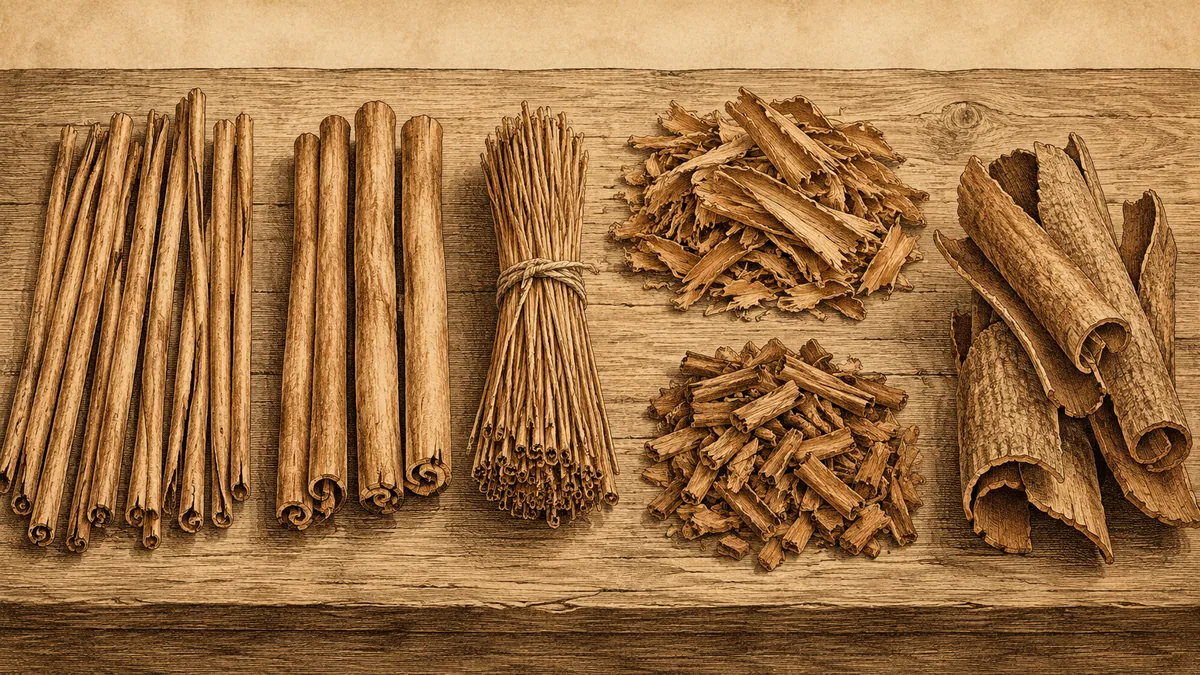
    A second set of terms describes the form of the cinnamon rather than its grade. A quill is a whole rolled stick of bark, the familiar cinnamon stick. Quillings are small broken pieces of quill, the fragments left over when quills are cut and handled. Featherings are thin inner bark and shavings, lighter offcuts that gather during processing. Chips are small pieces of bark, including outer bark, often used for grinding or extraction. These are not lower grades in the thickness sense but different products made from the same tree. Our glossary of featherings, quillings and chips covers these forms more fully.

    How the terms fit together

    It helps to see the terms as answering two different questions. The grade names and codes answer “how thin and fine is the quill?”, running from Alba and C5 Special at the fine end to Hamburg and the thicker codes at the coarse end. The form terms answer “what shape is the piece?”, separating whole quills from quillings, featherings and chips. A label might combine both, naming a grade and a form, such as Alba quills or cinnamon chips. Reading the two parts separately makes the label much easier to understand.

    Where the grading terms come from

    Ceylon cinnamon grading is not just informal trade language; it is backed by recognised standards. Sri Lanka, the home of true cinnamon, has long-established grading rules that define each grade by measurable features such as quill diameter, so a grade name means roughly the same thing from one seller to the next. This is why a term like C5 or Alba carries real meaning rather than being a loose description. When you see these terms on a reputable pack, they point back to this shared system, which is part of what makes Ceylon cinnamon a carefully sorted spice rather than a bag of mixed bark.

    Reading a grade on a real label

    On an actual pack, the grade often sits next to the species name and origin. You might see wording such as “Ceylon cinnamon, Cinnamomum verum, Alba grade, product of Sri Lanka”. Here the species and origin tell you it is true cinnamon, and the grade tells you how fine the quills are. If a label gives a grade but no species or origin, the grade alone still suggests a seller working within the Ceylon system, though it is best confirmed by the species name. A pack that gives neither a grade nor a species leaves you with the least information, which is worth keeping in mind when comparing products.

    Cinnamon grading terms at a glance

    TermTypeWhat it means
    AlbaGrade nameFinest, thinnest quill
    ContinentalGrade nameFine, slightly thicker than Alba
    MexicanGrade nameThicker quill grade
    HamburgGrade nameThickest of the main grades
    C5 Special, C5, C4Code gradeGraded by quill diameter, finer at C5 Special
    H1 to H5Code gradeCoded grades by diameter and quality
    QuillFormA whole rolled cinnamon stick
    QuillingsFormSmall broken pieces of quill
    FeatheringsFormThin inner bark and shavings
    ChipsFormSmall bark pieces for grinding

    Which grade should you choose?

    The right grade depends on what you need. For a special dish where appearance and a delicate flavour matter, a fine grade such as Alba or C5 Special is worth it. For everyday cooking, simmering in syrups or making cinnamon tea, a mid grade works perfectly well and costs less, since the quill will be used for its flavour rather than shown off. If you are grinding your own cinnamon or making an infusion, quillings, featherings or chips can be a good-value choice because the form matters less once the bark is broken up. Matching the grade and form to the job saves money without losing quality where it counts.

    Frequently asked questions

    What is the best grade of Ceylon cinnamon?

    Alba is generally considered the best grade of Ceylon cinnamon, as it has the thinnest, finest and smoothest quills. Code grades such as C5 Special are also at the fine end. “Best” here means the finest and most delicate, though a mid grade is often a more sensible choice for everyday cooking.

    What does C5 mean on cinnamon?

    C5 is a code grade tied to the diameter of the cinnamon quill, marking a fine, thin quill. C5 Special is finer still. The C codes sort Ceylon cinnamon by thickness in a precise, measured way, doing the same job as grade names like Alba and Continental.

    Are featherings and chips lower quality?

    Not exactly. Featherings and chips are different forms rather than lower grades. They are smaller pieces and offcuts of the same cinnamon, often used for grinding or infusion, where the shape of the piece matters less. They can be good value when you do not need whole quills.

    Do higher grades taste better?

    Finer grades such as Alba have a delicate, smooth flavour and a neat appearance, but a mid grade of true Ceylon cinnamon still tastes mild and sweet. The grade reflects thickness and appearance more than a simple better-or-worse flavour, so the right grade depends on the use.

    Summary

    Ceylon cinnamon grading terms become clear once you split them into two questions. Grade names (Alba, Continental, Mexican, Hamburg) and code grades (C5 Special, C5, C4 and H1 to H5) rank the quill by thickness, from fine to coarse, with Alba and C5 Special at the finest end. Form terms (quills, quillings, featherings and chips) describe the shape of the piece, from whole sticks to offcuts. Reading the grade and the form separately makes any label easy to understand, and matching both to the job lets you buy the right Ceylon cinnamon without overpaying.

    This website provides educational information about Ceylon Cinnamon as a spice and food ingredient. It is not intended to provide medical advice or make health claims.
  • What Is C5 Special Ceylon Cinnamon?

    What Is C5 Special Ceylon Cinnamon?

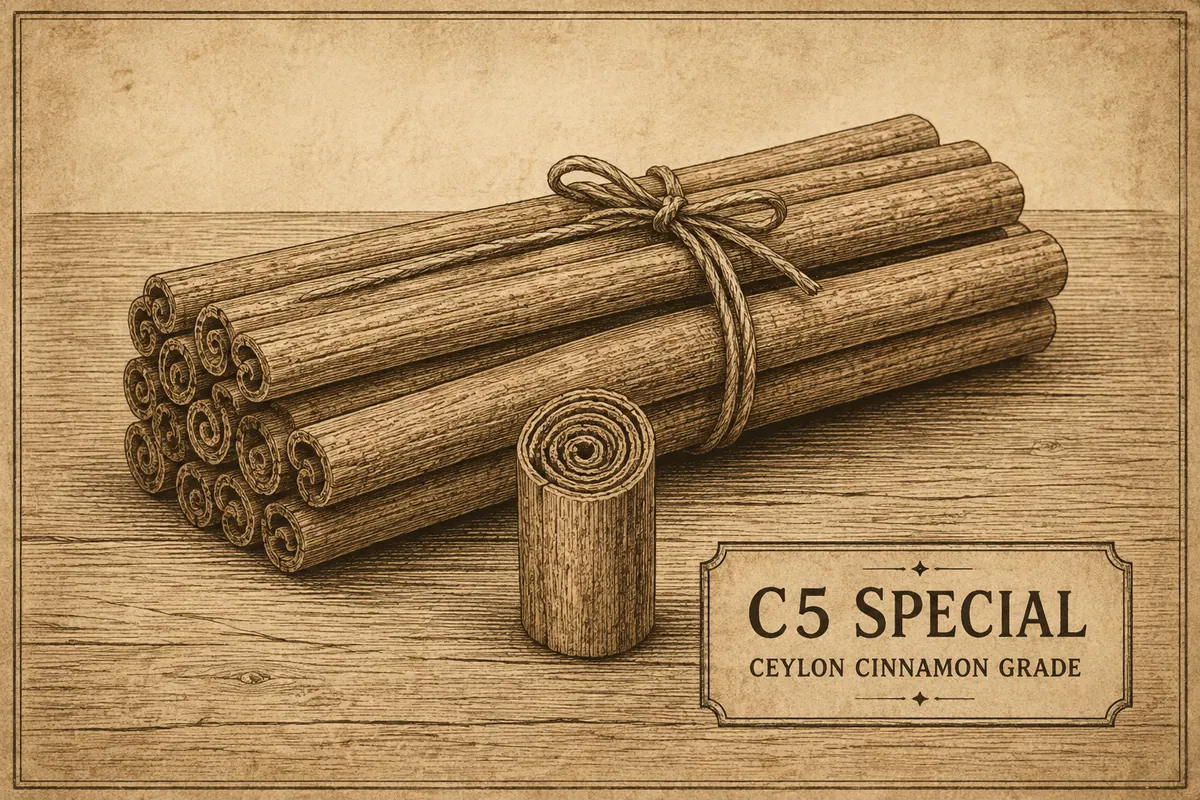
    C5 Special is a premium grade of Ceylon cinnamon, made up of fine, thin, evenly rolled quills of small diameter. In the Ceylon cinnamon grading system, “C” stands for Continental, and the number relates to the thickness of the quill: the smaller the number, the finer the quill. C5 Special sits near the top of the range, just below the very finest Alba grade, and is one of the most popular high-quality grades for everyday premium use.

    Grade codes like C5 Special can look puzzling on a label, but they follow a simple logic once you know the system. This guide explains what C5 Special means, how it fits among the other grades, and why it is so widely chosen. It builds on our full guide to Ceylon cinnamon grades.

    The short answer

    C5 Special is a high grade of Ceylon cinnamon quill, prized for its thin, fine, uniform sticks. The name comes from the Continental grading system, where quills are sorted by diameter and quality. C5 Special quills are slender and neat, giving a delicate flavour and an attractive appearance, which makes this grade a favourite with both home cooks and chefs who want fine quality without paying the very top Alba price.

    What does “C5 Special” mean?

    The label breaks down into two parts. The “C” stands for Continental, one of the traditional groupings used to sort Ceylon cinnamon quills for export. The number, here 5, relates to the diameter of the quill, with smaller numbers meaning thinner, finer quills. “Special” marks it as a select, higher-quality version within that band. So C5 Special describes a Continental-grade quill that is thin, fine and specially selected for quality.

    Why quill diameter matters

    In Ceylon cinnamon, thinner quills are generally finer. The most delicate bark, peeled and rolled with the greatest care, produces slender quills with a smooth surface and a gentle flavour. Thicker quills tend to come from coarser bark. Because grade is tied so closely to quill diameter, the width of the stick is one of the clearest signals of quality, a link set out in our guide to what a cinnamon quill is.

    Where C5 Special sits among the grades

    Ceylon cinnamon is graded from the very finest down to coarser quills and off-cuts. Alba is the finest and most expensive grade, made from the thinnest quills. Just below it come the top Continental grades, including C5 Special, followed by other Continental and Mexican grades, then thicker Hamburg grades, and finally broken pieces such as quillings and featherings. C5 Special therefore sits among the premium quill grades, close to the top of the range.

    Where C5 Special fits, from finest quills to coarser grades.
    GradeQuill characterRough position
    AlbaVery thin, finest barkTop grade
    C5 SpecialThin, fine, select quillsPremium
    C5 / C4Fine to medium quillsHigh to mid
    Mexican (M)Medium quillsMid
    Hamburg (H1 to H3)Thicker, coarser quillsLower
    Quillings / featheringsBroken pieces and shavingsOff-cuts

    The exact boundaries between grades are set by quality standards, as our guide to Ceylon cinnamon quality standards explains.

    C5 Special vs Alba

    Alba is the finest grade of all, made from the very thinnest quills, and it commands the highest price. C5 Special is a step below, with quills that are still thin and fine but a little larger in diameter than Alba. For most buyers, C5 Special offers an excellent balance: close to Alba in quality and appearance, but more affordable and more widely available. Alba is often reserved for gifts or special use, while C5 Special is a practical premium choice for regular cooking. The difference between the two is real but subtle, and for day-to-day use many people find C5 Special more than fine enough, saving the extra cost of Alba for occasions when only the very best will do.

    What C5 Special is good for

    Because its quills are fine and attractive, C5 Special suits any use where you want good-quality Ceylon cinnamon. The slender sticks look elegant in drinks and on a table, infuse cleanly into curries, rice, syrups and mulled drinks, and can be ground fresh for baking. It is a versatile, all-round premium grade rather than a specialist one, which is part of why it is so popular. The flavour is the classic delicate, sweet Ceylon profile, as covered in our pillar on Ceylon cinnamon grades.

    Is C5 Special worth choosing?

    For most people, C5 Special is a very sensible grade to buy. It gives the fine appearance and delicate flavour of top-quality Ceylon cinnamon at a more approachable price than Alba, and its neat, thin quills are pleasant to use. Unless you specifically want the absolute finest for a gift or display, C5 Special delivers premium quality for everyday cooking and drinks, which is exactly why it has become one of the most sought-after grades on the market.

    How C5 Special is sorted

    Grading Ceylon cinnamon is careful handwork. After the quills are peeled, rolled and dried, they are sorted by trained graders who judge each stick by its diameter, colour, smoothness and neatness. Quills that are thin, pale, even and well rolled are set aside for the higher grades, while thicker or rougher quills fall into lower ones, and broken pieces are separated out. C5 Special is one of the select bands within this sorting, so a quill in this grade has been judged fine enough to sit near the top of the range. This is why grade is such a reliable shorthand for quality: it reflects real, physical differences in the bark that a grader can see and feel.

    How to buy C5 Special with confidence

    When buying C5 Special, the grade code is only part of the picture. Look also for a clear statement that the product is Ceylon cinnamon or Cinnamomum verum from Sri Lanka, since the grade only has meaning for true cinnamon. Good C5 Special quills should look thin, pale and neatly rolled, feel light and brittle, and smell sweet and delicate. A reputable seller will state the grade and origin openly. Because grade names are not always policed as tightly as origin, pairing the C5 Special label with these simple checks helps make sure you are getting what the name promises.

    C5 Special in the wider grading picture

    It helps to remember that all these grades describe the same spice, true Ceylon cinnamon, sorted by the fineness of the quill rather than by flavour type. A lower grade is not fake or poor cinnamon; it is simply a thicker or less uniform quill, often perfectly good for grinding or long cooking. C5 Special earns its premium place by being among the finer, more attractive quills, which matters most when the sticks are on show or when you want the most delicate result. Choosing a grade is therefore about matching the quill to the use, and C5 Special is a grade that suits almost any use well.

    Frequently asked questions

    What is C5 Special Ceylon cinnamon?

    C5 Special is a premium grade of Ceylon cinnamon made from thin, fine, specially selected quills. In the Continental grading system, “C” means Continental and the number relates to quill diameter, with smaller numbers being finer. C5 Special sits just below the top Alba grade.

    Is C5 Special better than Alba?

    Alba is the finest grade, made from even thinner quills, and it is more expensive. C5 Special is a step below but still a high, premium grade. Many buyers prefer C5 Special as it offers close-to-Alba quality at a more affordable price.

    What does the C in C5 stand for?

    The “C” stands for Continental, a traditional grouping used to sort Ceylon cinnamon quills. The number relates to the diameter of the quill, with smaller numbers meaning thinner, finer sticks.

    Is C5 Special good for cooking?

    Yes. C5 Special is an excellent all-round grade for cooking and drinks. Its fine, thin quills infuse cleanly into liquids, look attractive in dishes and drinks, and can be ground fresh, all with the classic delicate Ceylon cinnamon flavour.

    Summary

    C5 Special is a premium grade of Ceylon cinnamon, made from thin, fine, evenly rolled quills. Its name comes from the Continental grading system, where “C” means Continental and the number reflects quill diameter, with smaller numbers being finer. C5 Special sits just below the top Alba grade, giving close-to-Alba quality and appearance at a more affordable price. Versatile, elegant and full of the classic delicate Ceylon flavour, it is one of the most popular high-quality grades, and a sensible choice for anyone wanting fine Ceylon cinnamon for everyday use without stepping all the way up to the top Alba price.

    This website provides educational information about Ceylon Cinnamon as a spice and food ingredient. It is not intended to provide medical advice or make health claims.
  • Ceylon Cinnamon Alba Grade Explained

    Ceylon Cinnamon Alba Grade Explained

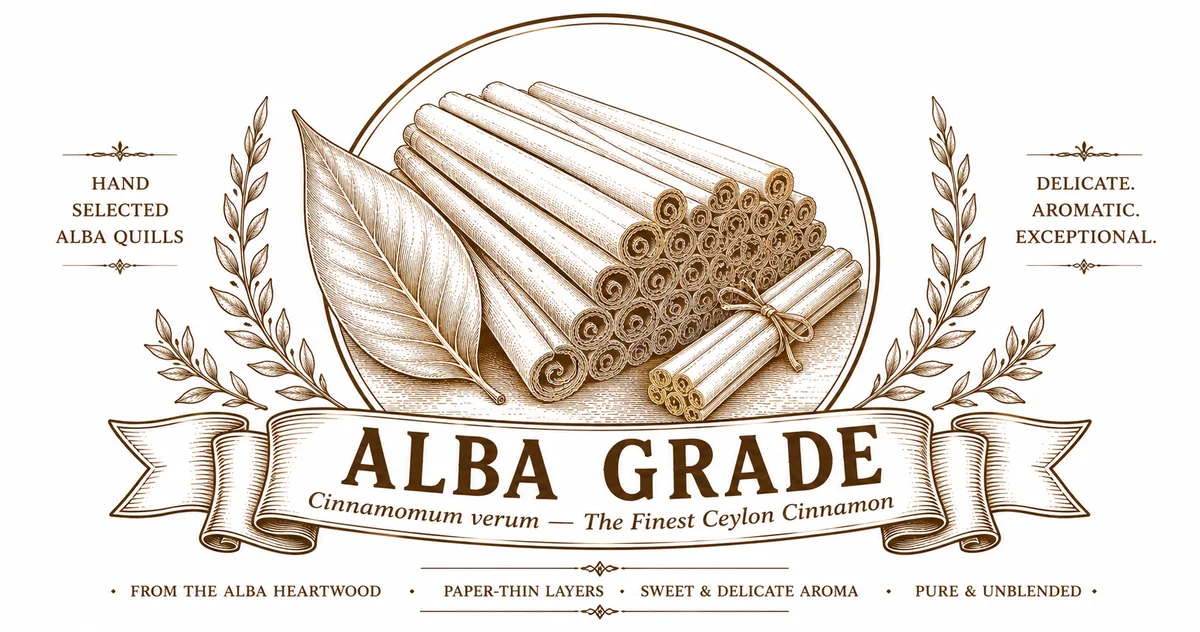
    Alba is the highest and most refined grade of Ceylon cinnamon. The name refers to the very thinnest, most delicate quills, those with the smallest diameter, which are prized for their pale colour, fine texture and sweet, mellow aroma. In the Ceylon cinnamon grading system, the thinner the quill, the higher the grade, and Alba sits right at the top.

    If you have seen “Alba” on a packet of cinnamon and wondered what it means, this guide explains it clearly: what the Alba grade is, how it fits into the wider grading system, why it commands the highest price, and whether it is the right choice for you. For the full overview of every grade, see our pillar guide on Ceylon cinnamon grades.

    What is Alba grade Ceylon cinnamon?

    Alba is the top grade of true Ceylon cinnamon (Cinnamomum verum), made from the thinnest quills produced during processing. Ceylon cinnamon quills are graded largely by their diameter: after the bark is peeled, dried and rolled into quills, they are sorted by thickness, and the finest, narrowest quills are classified as Alba. Because only a portion of any harvest yields quills thin enough to qualify, Alba is relatively scarce, which is part of why it is the most sought-after grade.

    How the grading system works

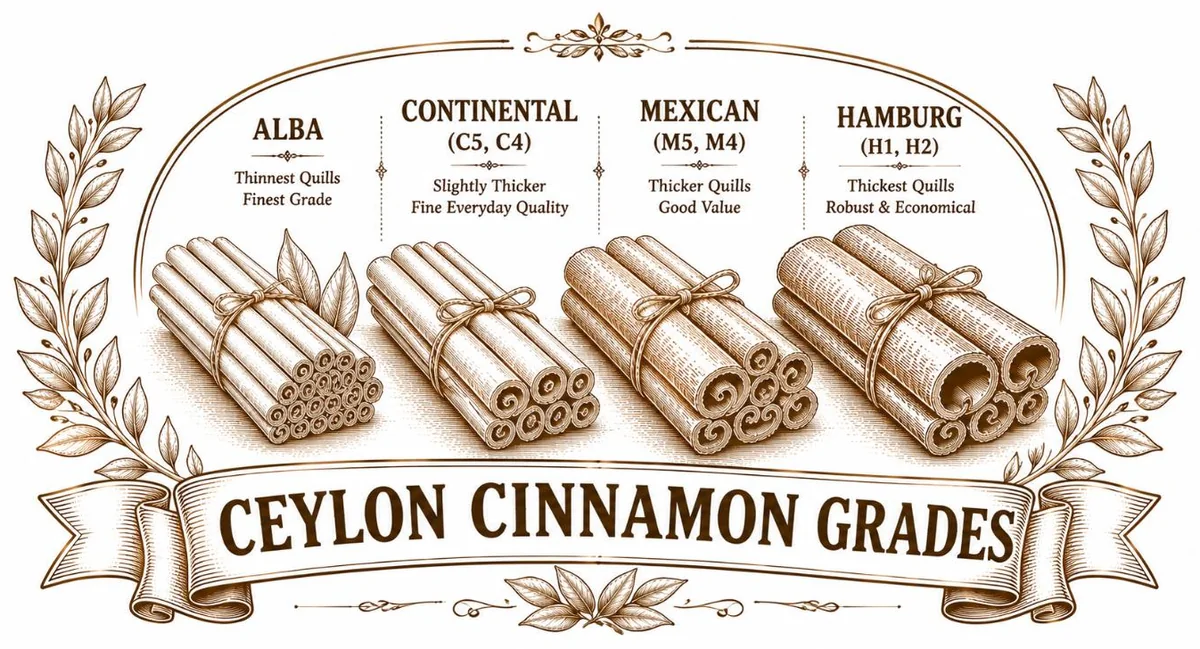
    Ceylon cinnamon grades are based on quill diameter, measured in millimetres, with smaller diameters earning higher grades. The main families of grades, from finest to coarsest, are broadly: Alba (the thinnest of all), then the Continental grades (such as C5 Special, C5 and C4), the Mexican grades (M5, M4) and the Hamburg grades (H1, H2). Each step down the ladder represents a slightly thicker quill. Alba typically has the smallest diameter of any grade, often cited at around 6 millimetres, which is why it feels so fine and papery. For the individual grades below Alba, see our guides to Continental grade and the other grade families linked from the grades pillar.

    Why quill diameter matters

    Diameter is used for grading because it closely reflects the quality of the bark and the skill of the peeler. The thinnest quills come from carefully selected, well-grown shoots and require the most expert hand-peeling to produce, as described in how Ceylon cinnamon is made. A thin quill also tends to have a more delicate structure and a smoother, more even surface. So while diameter is a physical measurement, it stands in for a whole set of quality attributes, fineness, appearance and craftsmanship, that buyers value.

    What makes Alba special

    Several qualities set Alba apart from the grades below it:

    Fine, papery texture

    Alba quills are exceptionally thin and delicate, closer to fine paper than to the harder bark of lower grades. They break and grind very easily, which makes them pleasant to work with in the kitchen.

    Pale, even colour

    Alba tends to have a light, uniform tan colour, reflecting the fine inner bark from which it is made. This pale appearance is one of the visual hallmarks people associate with premium Ceylon cinnamon.

    Delicate aroma and flavour

    Because it is made from the finest bark, Alba carries the sweet, gentle, complex aroma that Ceylon cinnamon is known for, without harshness. It is subtle rather than pungent, a quality that suits delicate dishes and beverages.

    Alba vs other Ceylon cinnamon grades

    A simplified comparison. All grades are true Ceylon cinnamon; they differ mainly in quill diameter.
    Grade familyRelative diameterCharacter
    AlbaThinnest / finestMost delicate, palest, premium
    Continental (C5, C4…)Slightly thickerFine, widely used, excellent quality
    Mexican (M5, M4)Thicker againGood everyday quality
    Hamburg (H1, H2)ThickestRobust, more economical

    It is worth stressing that every one of these grades is genuine Ceylon cinnamon from Cinnamomum verum. A lower grade is not lower quality in the sense of being a different, inferior species, it simply has a thicker quill. This is quite different from the distinction between Ceylon and cassia, which are different plants entirely, as explained in Ceylon cinnamon vs cassia.

    Why is Alba the most expensive grade?

    Alba costs more than other grades for a few connected reasons. First, it is scarce: only the finest quills from a harvest qualify, so there is simply less of it. Second, it demands the highest level of skill to peel and roll the very thin bark without tearing it, which is labour-intensive and time-consuming. Third, its fineness and appearance make it the grade most in demand for premium presentation. Together, scarcity, craftsmanship and demand push Alba to the top of the price range, a dynamic covered further in the Ceylon cinnamon buying guide.

    Is Alba worth it?

    Whether Alba is worth the premium depends on how you use cinnamon. For gifts, fine presentation, or delicate dishes and drinks where a subtle, refined flavour matters, Alba’s fineness is a genuine pleasure. For everyday cooking, baking or long-simmered dishes, a Continental or Mexican grade delivers the same true-cinnamon character at a lower price, and the difference in the finished dish may be modest. In other words, Alba is not “better cinnamon” in a way that transforms every recipe, it is the finest, most delicate expression of the same spice, and its value depends on whether that refinement matters for your particular use.

    How to use Alba cinnamon

    Because Alba is so fine and delicate, it shines where its subtlety can be appreciated: in lightly spiced desserts, warm milk and infusions, delicate baking, and beverages such as tea or coffee. Its thin quills grind smoothly for fresh powder and crumble easily into gentle infusions. In robust, heavily spiced dishes its finesse can be lost among stronger flavours, so many cooks reserve Alba for recipes where cinnamon is a star rather than a background note. For broader ideas, see our guide to the culinary uses of Ceylon cinnamon.

    How to buy genuine Alba

    When buying Alba, look for a label that names the grade and confirms the species and origin, genuine Alba should be described as Ceylon cinnamon, Cinnamomum verum, from Sri Lanka. The quills themselves should look very thin, pale and uniform, rolled into many fine layers. Be a little cautious of unusually cheap “Alba”, since the grade is naturally costly to produce; a price far below the norm may indicate mislabelling. Reputable suppliers are usually happy to state the grade clearly, and some provide details of origin and quality. Our guide to identifying authentic Ceylon cinnamon covers the visual checks in more detail.

    Common misunderstandings about Alba

    A few points often cause confusion. Alba is a grade, not a species or a place, it tells you about the quill’s fineness, not a different type of cinnamon. A higher grade does not mean the lower grades are “fake” or poor; they are all true Ceylon cinnamon. And grade is separate from freshness and storage: even the finest Alba will lose aroma if it is old or poorly kept, so buying from a source with good turnover and storing it well matters as much as the grade itself. Keeping these distinctions clear helps you shop with confidence rather than paying for a name alone.

    Summary

    Alba is the finest, highest grade of Ceylon cinnamon, made from the thinnest quills with the smallest diameter, often around 6 millimetres. It is prized for its pale, even colour, its exceptionally fine and papery texture, and its sweet, delicate aroma. It sits above the Continental, Mexican and Hamburg grade families, all of which are also genuine Cinnamomum verum but with progressively thicker quills. Alba is the most expensive grade because it is scarce, skill-intensive to produce and highly sought after. It is a lovely choice for delicate dishes, drinks and gifts, while lower grades offer the same true-cinnamon character at a friendlier price for everyday cooking.

    Frequently asked questions

    What does Alba mean in Ceylon cinnamon?

    Alba is the top grade of Ceylon cinnamon, made from the thinnest, finest quills. It refers to quill diameter, not a different species, it is still true Cinnamomum verum.

    Is Alba the best Ceylon cinnamon grade?

    Alba is the highest grade by fineness, with the smallest quill diameter and most delicate character. Whether it is “best” for you depends on your use; lower grades are the same species and excellent for everyday cooking.

    Why is Alba cinnamon so expensive?

    Because it is scarce, requires the most skilled hand-peeling of very thin bark, and is in high demand. Scarcity, craftsmanship and demand together make it the priciest grade.

    Is a lower grade of Ceylon cinnamon worse quality?

    Not in terms of authenticity. Lower grades such as Continental or Hamburg are all genuine Ceylon cinnamon; they simply have thicker quills. They offer the same true-cinnamon flavour at a lower price.

    This website provides educational information about Ceylon Cinnamon as a spice and food ingredient. It is not intended to provide medical advice or make health claims.

  • Complete Guide to Ceylon Cinnamon Grades

    Complete Guide to Ceylon Cinnamon Grades

    Ceylon cinnamon is graded mainly by the diameter and appearance of its quills, from the very fine, pale Alba grade through Continental, Mexican and Hamburg categories, each with coded sub-grades such as C5, M5 and H1. Thinner, lighter, more tightly rolled quills are considered higher grade. Alongside whole quills, the harvest also yields quillings, featherings, chips and powder. This guide decodes every grade so you know exactly what you are buying.

    Grading can look baffling on a spice label, Alba, C5 Special, M4, H2, but the system is logical once you understand that it is largely about quill diameter and neatness. Grades describe appearance and size, not a different species: every grade below is still true Ceylon cinnamon (Cinnamomum verum). The internationally recognised reference for cinnamon specifications is the ISO 6539 standard.

    How Ceylon cinnamon is graded

    After the bark is peeled, rolled and dried, a process described in how Ceylon cinnamon is made, the finished quills are sorted by hand. The main criteria are the diameter of the quill, its colour, how tightly and cleanly it is rolled, and the absence of cracks or blemishes. In general, the finer and paler the quill, the higher the grade and the more delicate the flavour. Thicker quills are darker, more robust in taste and more affordable.

    The four main grade families

    Approximate quill diameters by grade. Figures vary between exporters; ranges are indicative.
    Grade familyTypical diameterCharacter
    Alba (finest)about 6 mm or lessPalest, sweetest, most delicate; a small fraction of the harvest
    Continental (C)about 10, 13 mmLight brown, well rolled; a popular everyday premium grade
    Mexican (M)about 14, 16 mmWarmer amber tone, more rustic roll, punchier character
    Hamburg (H)about 17, 19 mm and upThicker, darker, boldest flavour; often used in bulk

    The names Continental, Mexican and Hamburg are traditional market categories, historically linked to the regions that favoured each thickness. They do not mean the cinnamon was grown in Mexico or Germany, it is all Sri Lankan.

    The coded sub-grades (C, M and H numbers)

    Within the main families you will see codes that further specify diameter. Smaller numbers usually indicate finer quills. Indicative ranges include:

    • Alba, the finest of all, roughly 6 mm or under.
    • C5 Special, a premium Continental quill, about 7, 9 mm.
    • C5, about 10, 12 mm; C4, about 13, 14 mm.
    • M5 / M4 (Mexican), roughly 16, 20 mm.
    • H1 / H2 / H3 (Hamburg), roughly 17 mm and thicker.

    Because exporters and standards differ slightly, treat these numbers as a practical guide rather than absolute cut-offs. What stays constant is the principle: lower number and family closer to Alba means finer, paler and more delicate.

    Quills, quillings, featherings and chips

    Not everything from the harvest becomes a perfect long quill. The trade recognises several forms:

    • Quills, the classic rolled sticks, typically sold in lengths up to around a metre before being cut. These are the premium form.
    • Quillings, small broken pieces of quill, often under 200 mm. They carry the same flavour at a lower price and are ideal for grinding or infusing.
    • Featherings, thin, feathery inner-bark shavings and small curls left over from making quills. Economical and aromatic.
    • Chips, small cut pieces of bark, sometimes including outer bark, generally the most affordable form and often used for extracting oil or for bulk infusions.

    Ground cinnamon and powder

    Ceylon cinnamon powder is made by grinding quills, quillings or featherings. Powder made from higher grades will be paler and more fragrant. Because ground cinnamon loses aroma faster than whole quills and cannot be inspected for authenticity by eye, buying reputable, clearly labelled Ceylon powder, or grinding your own from quills, is the safest way to be sure of quality. Our identification guide explains why powder demands extra care.

    Which grade should you buy?

    For most home cooks, the “best” grade is the one that fits the job and budget:

    • Alba or C5 Special, for gifting, delicate desserts, drinks and anywhere the cinnamon flavour is the star.
    • C5 / C4 (Continental), excellent all-rounders product premium quality at a sensible price.
    • Mexican / Hamburg, great value for everyday baking, mulling, long simmering and grinding your own powder, where a bolder flavour is welcome.

    Remember that a “lower” grade is not lower quality cinnamon, it is simply a thicker quill with a more robust flavour. The buying guide pairs grades with uses and budgets in more detail.

    Where the grade names come from

    The traditional grade names reflect the historic export trade rather than geography. Continental, Mexican and Hamburg were market categories associated with the regions and buyers that favoured particular quill thicknesses, for example, thinner quills for certain European markets and thicker ones for others. Over time these names became standardised descriptions of diameter. Alba, from the Latin for “white,” refers to the palest, finest quills. Knowing this helps explain why a “Mexican” grade is still entirely Sri Lankan cinnamon.

    How grade affects flavour and price

    Diameter is closely linked to both taste and cost. Finer quills such as Alba come from the youngest, most tender bark and tend to be the sweetest and most delicate, but they are scarce and labour-intensive to produce, so they command the highest prices. Thicker quills carry a more robust, woody flavour and are more plentiful, making them better value for everyday cooking. None of this changes authenticity, a thick Hamburg quill is just as genuinely Cinnamomum verum as a fine Alba.

    Grades and the ISO standard

    Internationally, cinnamon specifications are described by the ISO 6539 standard, which sets out characteristics such as dimensions and quality parameters for cinnamon quills. Sri Lankan grading builds on this framework, sorting quills by diameter and appearance into the familiar Alba, C, M and H categories. When buying, the practical takeaway is that a clearly stated grade, alongside the species and origin, is a sign of a well-organised, transparent supplier.

    A quick buyer’s cheat-sheet

    • Want the finest, most delicate quills? Choose Alba or C5 Special.
    • Want the best balance of quality and price? Continental C5 or C4.
    • Cooking in volume or grinding your own powder? Mexican, Hamburg, or quillings and featherings.
    • Buying powder? Favour a trusted, clearly labelled Ceylon source, since grade cannot be judged by eye once ground.

    Do grades change how you cook with it?

    In practice, the grade you choose can subtly shape a dish. Finer grades like Alba dissolve their delicate flavour quickly and are lovely in drinks, dustings and gentle desserts where you want fragrance without any harsh edge. Thicker Hamburg-style quills, with their more robust, woody character, hold up well in long-simmered curries, stocks and mulled drinks where a sturdier flavour is welcome and the quill is removed before serving. Because all grades are the same species, you can move between them freely; think of grade as a way to fine-tune intensity and elegance rather than as a quality hierarchy. Our culinary guide shows where each shines.

    Are thicker grades worse quality?

    This is a common misunderstanding. A thicker Hamburg quill is not spoiled, stale or adulterated cinnamon, it is simply a larger-diameter roll from more mature bark, with a bolder, woodier flavour. It comes from the same Cinnamomum verum plant, grown and hand-peeled in the same way as Alba. The grade tells you about size and finesse, not integrity. For a busy kitchen that gets through cinnamon quickly, a thicker grade or quillings can be the smarter, more economical choice while still being completely genuine Ceylon cinnamon.

    Reading grades on a label

    When shopping, you may see grade codes printed alongside the species and origin, for example “Ceylon Cinnamon (Cinnamomum verum), Alba, Sri Lanka.” A clearly stated grade is a good sign of a careful, transparent supplier. If a product simply says “cinnamon sticks” with no species, origin or grade, you cannot assume it is Ceylon at all; it may well be cassia. Combining grade information with the authenticity checks in our identification guide gives you the fullest picture of what you are buying.

    Summary

    Ceylon cinnamon grades describe the size and appearance of the quills, not different plants. Alba is the finest and palest, followed by Continental (C), Mexican (M) and Hamburg (H) families, each with numbered sub-grades tied to diameter. Broken and offcut forms, quillings, featherings and chips, offer the same flavour more affordably, and powder is milled from these grades. Choose finer grades for delicate, showcase uses and thicker grades for everyday, robust cooking. Whatever the grade, genuine Ceylon cinnamon remains thin-barked, pale and low in coumarin.

    Frequently asked questions

    What is the best grade of Ceylon cinnamon?

    Alba is the finest and most delicate, but “best” depends on use. Continental grades offer premium quality at better value, while thicker grades are ideal for everyday baking and grinding.

    What does Alba cinnamon mean?

    Alba is the top grade of Ceylon cinnamon: the thinnest, palest and sweetest quills, roughly 6 mm or less in diameter, and only a small share of each harvest.

    Are quillings lower quality than quills?

    No. Quillings are simply broken pieces of quill. They have the same flavour and are excellent value for grinding or infusing.

    Do the grade numbers mean different quality?

    They mainly indicate quill diameter. Finer grades are more delicate; thicker grades are bolder. All are genuine Ceylon cinnamon.

    This website provides educational information about Ceylon Cinnamon as a spice and food ingredient. It is not intended to provide medical advice or make health claims.