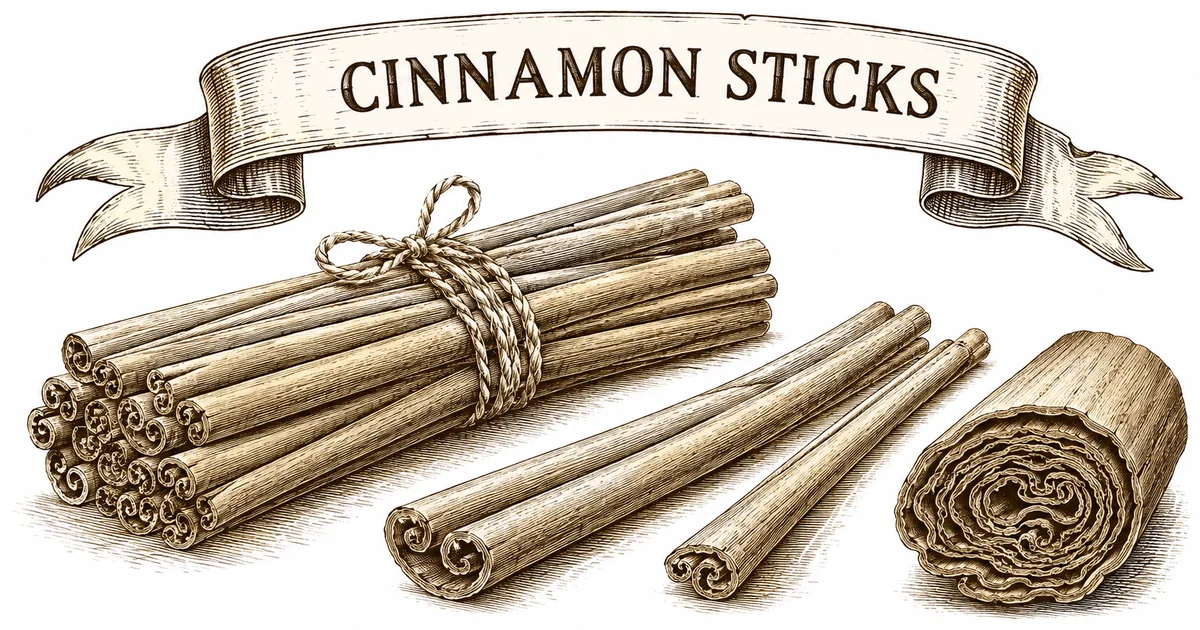
Cinnamon sticks, also called quills, are simply lengths of dried cinnamon bark that have curled into a roll as they dry. In true Ceylon cinnamon they are made of many thin, papery layers rolled tightly together, which is why genuine Ceylon sticks are pale, brittle and easily crumbled, unlike the hard, thick single curl of a cassia stick. They are one of the most versatile and long-lasting ways to buy and use cinnamon.
This guide covers everything you need to know about cinnamon sticks: what they are, how “sticks” and “quills” differ, how Ceylon and cassia sticks compare, the sizes and grades you will see, how to use them, and how they compare with ground cinnamon. For the wider context of forms and quality, see our pillar guide on Ceylon cinnamon grades.
What is a cinnamon stick?
A cinnamon stick is a piece of dried cinnamon bark that has rolled into a tube or scroll as it dried. When cinnamon is harvested, the thin inner bark is peeled from the shoots and left to dry; as it loses moisture it naturally curls, forming the familiar stick shape. In true Ceylon cinnamon, several thin layers of bark are nested and rolled together, so the finished stick is made of many delicate sheets rather than one thick piece.
Cinnamon sticks vs cinnamon quills: are they the same?
In everyday use, “cinnamon stick” and “cinnamon quill” mean the same thing, a rolled length of dried cinnamon bark. “Quill” is the more traditional term used in the cinnamon trade, especially for Ceylon cinnamon, while “stick” is the common everyday word. So if you see Ceylon cinnamon sold as “quills,” these are simply cinnamon sticks by another name. The word quill nicely captures the way the fine Ceylon bark is rolled, much like a rolled scroll.
Ceylon cinnamon sticks vs cassia sticks
Not all cinnamon sticks are alike, and the difference is easiest to see in whole-stick form.
| Feature | Ceylon cinnamon sticks | Cassia sticks |
|---|---|---|
| Structure | Many thin layers rolled together | One thick, hard layer |
| Texture | Thin, brittle, easy to crumble | Hard and woody |
| Colour | Pale tan | Darker reddish-brown |
| Aroma | Sweet, delicate, complex | Strong and pungent |
Because the structure of the stick is so hard to fake, whole sticks are one of the best ways to tell true Ceylon cinnamon from cassia, as explained in our guide to identifying authentic Ceylon cinnamon.
Sizes and grades of cinnamon sticks
Ceylon cinnamon sticks come in a range of lengths and thicknesses, and their quality is described by a grading system. Finer, thinner quills such as the delicate Alba grade are the most prized, while thicker grades are coarser. Sticks are also cut to different lengths for different markets and uses. Knowing the grade helps you judge quality and value, which is set out in our pillar guide to Ceylon cinnamon grades. For everyday cooking, a mid-range grade is usually perfectly good; the very finest grades are prized as much for their appearance and delicacy as for flavour.
How to use cinnamon sticks
Cinnamon sticks are wonderfully versatile, and they shine wherever you want to infuse flavour slowly and cleanly.
Infusing liquids
Drop a stick into simmering milk, cream, syrup, tea, mulled drinks, stews or rice dishes to release a gentle, even cinnamon flavour, then remove it before serving. This is one of the best ways to use sticks, and it avoids any powdery texture.
Grinding your own powder
Because whole sticks keep their aroma far longer than pre-ground cinnamon, many cooks grind sticks fresh as needed for a brighter flavour. Ceylon sticks are brittle and grind easily.
Slow-cooked and savoury dishes
Whole sticks are ideal for curries, pilaus, tagines and braises, where they can cook for a long time and be lifted out at the end. More ideas are covered in our guide to the culinary uses of Ceylon cinnamon.
Cinnamon sticks vs ground cinnamon
Both forms are useful, and choosing between them depends on the job. Whole sticks are best for infusing liquids, for long-cooked dishes, and for keeping cinnamon fresh, because their small surface area means they hold their aromatic oils for a long time. Ground cinnamon is more convenient for baking and for dishes where you want the flavour dispersed evenly through a batter or mix, but it loses its aroma more quickly once ground. A practical approach many cooks take is to keep whole sticks for infusing and long cooking, and a small, fresh jar of powder for baking, grinding more from sticks when needed. The trade-offs are part of buying well, as discussed in our Ceylon cinnamon buying guide.
Can you reuse cinnamon sticks?
Yes, up to a point. A cinnamon stick used to infuse a liquid can often be rinsed, dried and used once or twice more, though each use gives a milder flavour as its aromatic oils are gradually spent. A good test is aroma: if a rinsed, dried stick still smells sweet and fragrant when you snap or scrape it, it still has flavour to give; if it smells faint, it is spent. Reusing sticks is a nice way to get extra value from good-quality Ceylon cinnamon.
How to store cinnamon sticks
Cinnamon sticks are among the longest-lasting forms of the spice, but they still need protecting. Keep them in an airtight container in a cool, dark, dry place, away from heat, light and moisture. Stored this way, whole Ceylon cinnamon sticks stay fragrant for a few years, considerably longer than ground cinnamon. Full storage guidance is set out in our guide to how to store Ceylon cinnamon properly.
Buying good cinnamon sticks
When buying cinnamon sticks, the same principles apply as for any cinnamon: look for the botanical name Cinnamomum verum and a Sri Lankan origin if you want true Ceylon cinnamon, and favour sticks that are pale, thin and layered rather than hard, dark and single-walled. Being able to see whole sticks is an advantage, because their structure reveals so much about authenticity and quality. Whether you buy small quantities for everyday cooking or larger amounts of quills, choosing genuine, well-made sticks sets you up for the best flavour.
Summary
Cinnamon sticks, or quills, are lengths of dried cinnamon bark that curl as they dry. In true Ceylon cinnamon they are made of many thin, papery layers, making them pale, brittle and easy to crumble, in contrast to the hard, thick single curl of cassia. “Stick” and “quill” mean the same thing, with quill the traditional trade term. Sticks come in various grades and sizes, from delicate Alba to coarser grades, and they excel at infusing liquids, flavouring slow-cooked dishes and being ground fresh for a brighter powder. They keep their aroma far longer than ground cinnamon, can often be reused once or twice, and store best in an airtight container somewhere cool, dark and dry. For genuine flavour, choose pale, layered sticks of Cinnamomum verum from Sri Lanka.
Frequently asked questions
Are cinnamon sticks and quills the same thing?
Yes. Both terms describe a rolled length of dried cinnamon bark. “Quill” is the traditional trade term, especially for Ceylon cinnamon, while “stick” is the everyday word.
How can I tell a Ceylon cinnamon stick from a cassia stick?
A Ceylon stick is pale, thin and made of many soft layers that crumble easily, while a cassia stick is dark, thick, hard and formed of a single woody curl. The layered structure is the clearest sign.
Can you reuse a cinnamon stick?
Often once or twice. After infusing, rinse and dry the stick; if it still smells sweet when snapped or scraped it has flavour left, though each use is milder. Once it smells faint, it is spent.
Do cinnamon sticks last longer than ground cinnamon?
Yes. Whole sticks have far less surface area exposed to air, so they keep their aroma for a few years when stored airtight, cool and dark, whereas ground cinnamon is best used within about six to twelve months.
This website provides educational information about Ceylon Cinnamon as a spice and food ingredient. It is not intended to provide medical advice or make health claims.
Leave a Reply