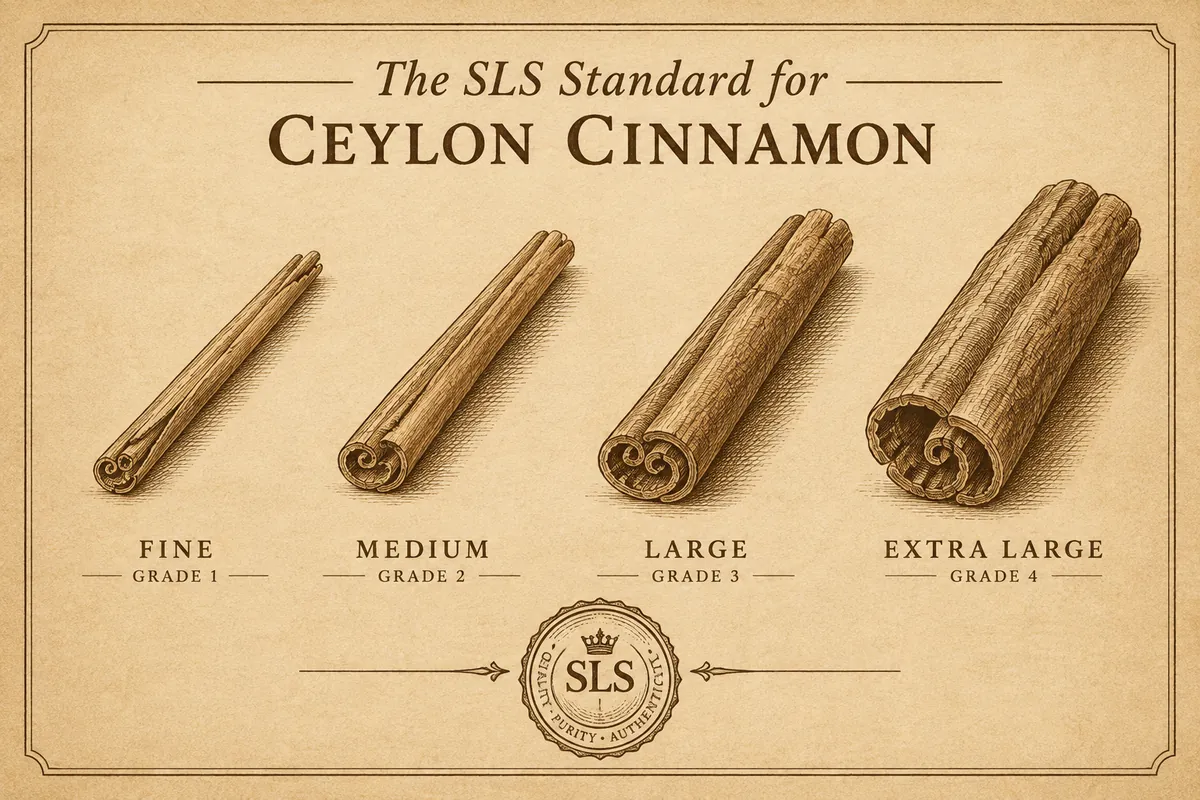
The SLS standard for Ceylon cinnamon is the national quality standard set by the Sri Lanka Standards Institution, published as SLS 81. It defines how true Ceylon cinnamon should be graded, sorted and presented, setting out the recognised grades, their sizes and the quality requirements a batch must meet. In short, SLS 81 is the official rulebook that tells buyers and sellers what genuine, properly graded Ceylon cinnamon should look like.
When people ask what makes one batch of cinnamon officially higher grade than another, the answer often traces back to this standard. This guide explains what the SLS standard is, what it covers and why it matters. It builds on our pillar guide to Ceylon cinnamon grades.
The short answer
SLS 81 is the Sri Lanka Standard for Ceylon cinnamon, issued by the Sri Lanka Standards Institution, which sets out the official grading system and quality requirements for the spice. It groups cinnamon quills into recognised grades, defines their sizes, and lays down quality rules covering things like moisture and cleanliness. It gives the whole industry a common language for describing quality.
What is the Sri Lanka Standards Institution?
The Sri Lanka Standards Institution, often shortened to SLSI, is the national standards body of Sri Lanka. It develops and publishes standards for a wide range of products, and its standards carry the prefix SLS. For a spice as important to Sri Lanka as cinnamon, having an official national standard matters a great deal, because it protects the reputation of the country’s most famous export and gives buyers around the world confidence in what they are getting.
What SLS 81 covers
SLS 81 is the specific standard for Ceylon cinnamon. While the fine detail sits in the official document, the standard broadly deals with several areas.
Grades
The heart of the standard is the grading system. It defines the recognised grades of Ceylon cinnamon quills and organises them into the main groups that the trade uses, so that a grade name means the same thing from one seller to the next.
Size and appearance
The standard ties grades to measurable features such as the diameter of the quills. Finer, thinner quills fall into the higher grades, and the standard sets out how these sizes map onto grade names, giving an objective basis for sorting.
Quality requirements
Beyond size, the standard addresses quality factors such as moisture content, cleanliness and freedom from foreign matter. These rules help ensure that cinnamon sold as a given grade is not only the right size but also clean, dry and sound.
The main Ceylon cinnamon grade groups
Under the grading system, Ceylon cinnamon quills are sorted into a set of well known groups, from the finest to the coarser. These are the categories the standard and the trade share.
| Grade group | General character |
|---|---|
| Alba | The finest, thinnest quills |
| Continental | Fine quills, a step below Alba |
| Mexican | Medium quills |
| Hamburg | The thickest, coarsest quills |
Within these groups there are further sub-grades, often written with letters and numbers, that describe the exact size band. Our guide to C5 Special Ceylon cinnamon looks at one of these fine sub-grades in detail.
Why the SLS standard matters
A standard like SLS 81 does several useful jobs at once. It gives sellers and buyers a shared vocabulary, so that a grade name carries a clear, agreed meaning rather than being a marketing label. It supports fair trade, because a buyer ordering a particular grade knows what they should receive. And it protects the good name of Ceylon cinnamon as a whole, since a recognised national standard signals that the spice is produced to a defined level of quality. This is closely tied to the wider system of Ceylon cinnamon quality standards.
How SLS 81 relates to international standards
The SLS standard is Sri Lanka’s national standard, but Ceylon cinnamon is also traded around the world, where international standards and buyer specifications come into play as well. In practice the national grading system and international expectations line up closely, since the grade names used in SLS 81 are the same ones understood in export markets. For a buyer, the key point is that the grading language is consistent: an Alba quill or a Continental quill means broadly the same fine, defined product wherever it is sold. This shared understanding is part of what makes the grading section of a Ceylon cinnamon buying guide so useful.
What the standard means for everyday buyers
Most people buying cinnamon for the kitchen will never read SLS 81 itself, and they do not need to. What matters is that the standard exists in the background, shaping how the cinnamon on the shelf was graded and described. When a product is labelled with a recognised grade such as Alba or Continental, that name has meaning because of the standard behind it. For the shopper, the practical takeaways are simple: look for true Ceylon cinnamon or Cinnamomum verum, ideally from Sri Lanka, and treat a clearly stated grade as a sign that the seller is working within a recognised system.
How cinnamon is checked against the standard
A standard is only as good as the checking behind it. In practice, cinnamon is sorted and inspected against the grade definitions as it is prepared for sale and export. Graders look at the quills, measure their size, and judge them against the requirements for each grade, setting aside pieces that do not fit. Quality factors such as dryness and cleanliness are assessed as well, so that a batch labelled with a particular grade genuinely matches it. Reputable producers and exporters work to these definitions as a matter of course, and formal certification and testing add a further layer of assurance for buyers who need it. The result is that the grade written on a pack is backed by real sorting and inspection rather than being an empty label.
The standard evolves over time
Like most national standards, the Ceylon cinnamon standard is not fixed forever. It is reviewed and revised periodically to keep pace with the needs of the industry and its buyers, which is why you will see it referred to with a year, as in later revisions of SLS 81. Each revision keeps the core purpose intact, a clear grading system and defined quality requirements, while updating the detail. For everyday purposes the important thing is not the exact revision year but the fact that a current, recognised national standard sits behind the grading of Ceylon cinnamon, giving the system stability and credibility.
Standards, trust and the Ceylon name
Ultimately, the SLS standard is about trust. Cinnamon has been central to Sri Lanka for centuries, and protecting the quality and reputation of the spice is a national concern. By setting out clear, official rules for grading and quality, SLS 81 helps make sure that the name Ceylon cinnamon continues to stand for something real. It is one of the quiet pieces of infrastructure that keeps the world’s finest cinnamon living up to its reputation.
Frequently asked questions
What is the SLS standard for Ceylon cinnamon?
It is the national quality standard for Ceylon cinnamon set by the Sri Lanka Standards Institution, published as SLS 81. It defines the recognised grades of Ceylon cinnamon, ties them to sizes such as quill diameter, and sets quality requirements covering factors like moisture and cleanliness.
What does SLS 81 stand for?
SLS is the prefix used for Sri Lanka Standards, issued by the Sri Lanka Standards Institution, and 81 is the number of the particular standard that applies to cinnamon. So SLS 81 is simply the Sri Lanka Standard for Ceylon cinnamon, updated in later revisions over time.
Does the SLS standard set the cinnamon grades?
Yes. The grading system is central to the standard. It defines the main grade groups, Alba, Continental, Mexican and Hamburg, along with their sub-grades, and links them to measurable features such as quill size, so grade names have a consistent meaning.
Do I need to know SLS 81 to buy good cinnamon?
No. As a shopper you do not need to read the standard. It works in the background to give grade names meaning. Simply look for true Ceylon cinnamon or Cinnamomum verum, ideally from Sri Lanka, and treat a clearly stated grade as a good sign.
Summary
The SLS standard for Ceylon cinnamon is SLS 81, the national quality standard set by the Sri Lanka Standards Institution. It defines the recognised grades of Ceylon cinnamon, from the fine Alba quills down to the thicker Hamburg group, ties those grades to measurable sizes, and lays out quality requirements such as moisture and cleanliness. For the trade it provides a shared, dependable language for quality, and for the ordinary buyer it works quietly in the background, giving grade names real meaning and helping the name Ceylon cinnamon continue to stand for the finest true cinnamon.
This website provides educational information about Ceylon Cinnamon as a spice and food ingredient. It is not intended to provide medical advice or make health claims.
Leave a Reply