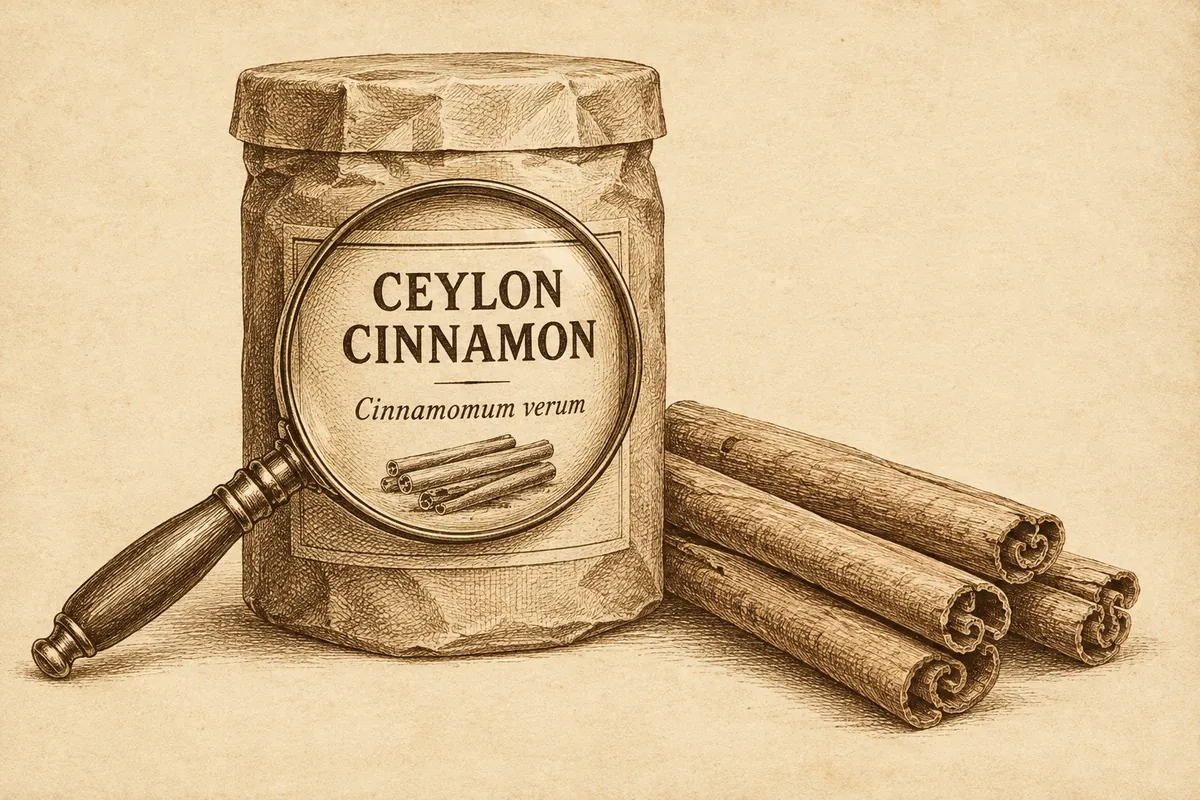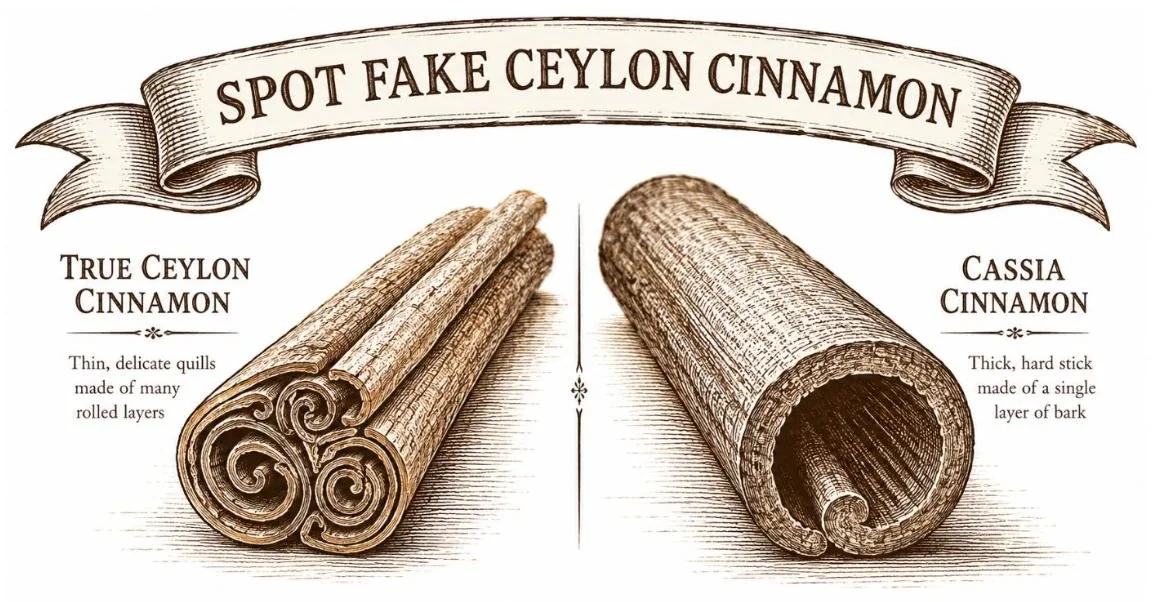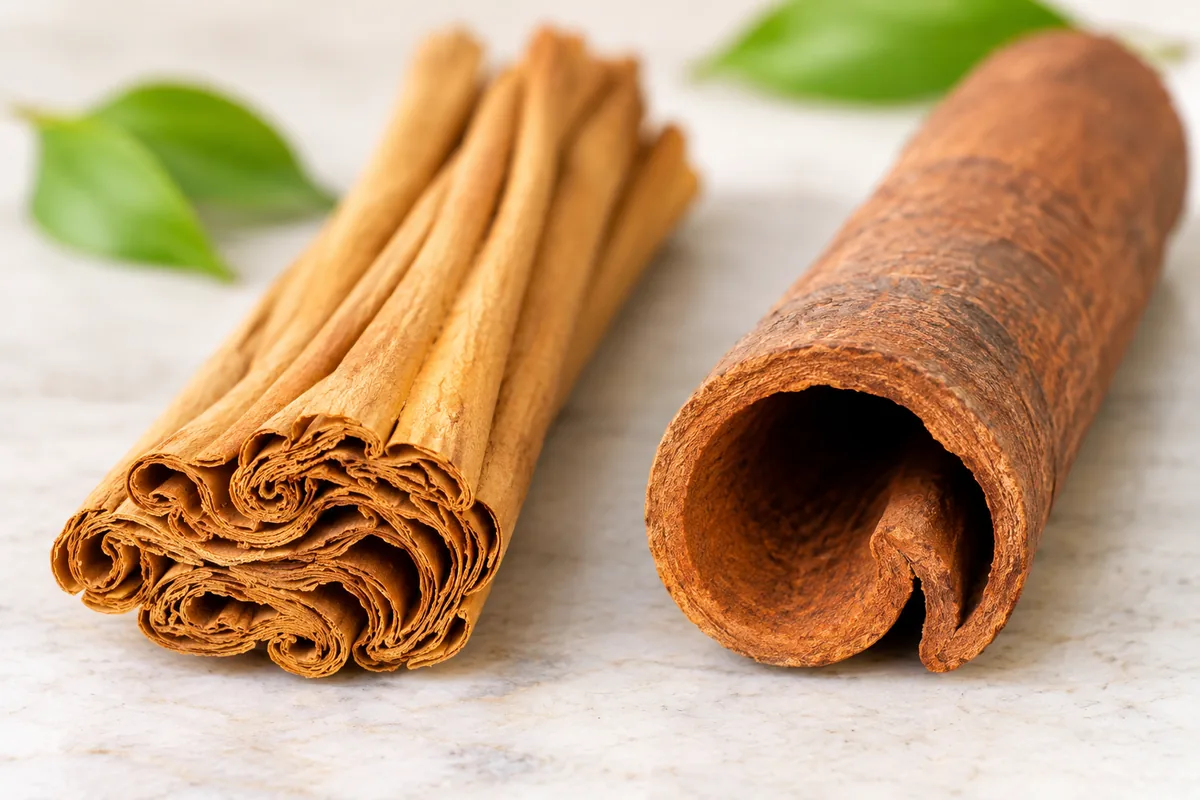
You can tell real Ceylon cinnamon from cheaper cassia by a few clear visual clues. True Ceylon cinnamon, Cinnamomum verum, forms thin, pale tan quills made of many fine layers rolled tightly together, like a cigar or a rolled newspaper, and it is soft and crumbly enough to snap easily. Cassia, by contrast, is usually a single thick, hard curl of dark reddish-brown bark with a hollow centre. Looking at the colour, the thickness, the number of layers and the way the bark is rolled gives you a quick and reliable way to recognise genuine Ceylon cinnamon by sight, before you even taste or smell it.
Knowing what real Ceylon cinnamon looks like is one of the most useful skills for a buyer. This guide sets out the visual clues that reveal it, so you can recognise the genuine article at a glance. It builds on our pillar guide to how to identify authentic Ceylon cinnamon.
The short answer
Real Ceylon cinnamon is thin, pale tan and made of many fine layers rolled tightly together, soft enough to crumble, while cassia is thick, hard, dark and usually a single curl. The quickest visual checks are colour, which is lighter for Ceylon; thickness, which is thin for Ceylon; and structure, which shows many delicate layers in a Ceylon quill like a rolled cigar. If a cinnamon stick is dark, thick, hard and hollow with one heavy curl, it is almost certainly cassia. If it is pale, thin, brittle and packed with fine layers, it is Ceylon.
Clue one: colour
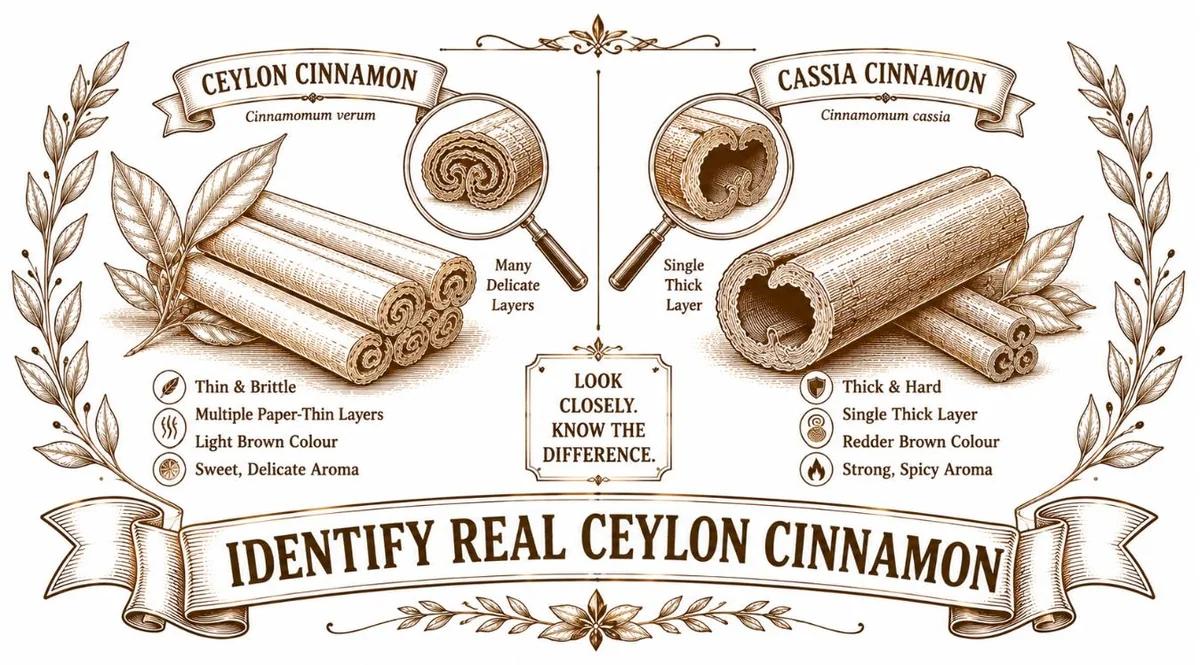
The first visual clue is colour. Real Ceylon cinnamon is a light, warm tan or pale brown, sometimes almost buff. Cassia is darker, a deeper reddish-brown or rusty colour. The difference is clear when the two are placed side by side: the Ceylon quill looks noticeably paler and softer in tone, while the cassia looks dark and heavy. Colour alone is not a complete test, since lighting and age can shift the shade a little, but a pale tan colour is a strong first sign of genuine Ceylon cinnamon, and a dark reddish-brown is a sign of cassia.
| Visual clue | Real Ceylon cinnamon | Cassia |
|---|---|---|
| Colour | Pale tan, light brown | Dark reddish-brown |
| Thickness | Thin bark | Thick, heavy bark |
| Layers | Many fine layers | One or few thick layers |
| Roll shape | Tight, like a cigar | Single curl, hollow |
| Texture | Soft, crumbly, brittle | Hard, woody |
Clue two: thickness of the bark
The thickness of the bark is one of the clearest clues. Real Ceylon cinnamon is made from very thin bark, so the walls of the quill are delicate and papery. Cassia is made from thick, coarse bark, so its sticks feel heavy and the walls are noticeably thicker and harder. If you look at the end of a stick, a Ceylon quill shows a thin, fine wall, while a cassia stick shows a thick, woody one. This difference in thickness is also why Ceylon cinnamon is so much easier to crumble and grind than the tough, hard cassia.
Clue three: the layers and roll
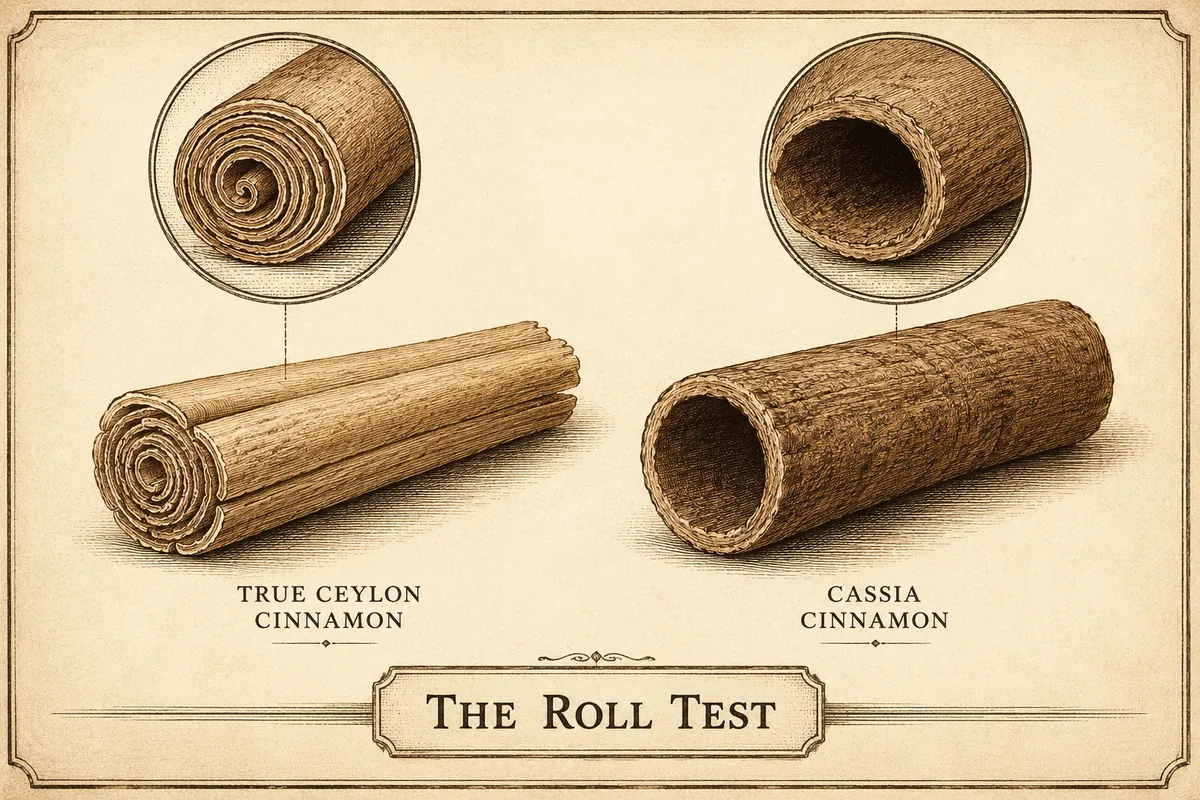
Perhaps the most telling visual clue is the structure of the roll. When you look at the end of a real Ceylon cinnamon quill, you see many thin layers of bark rolled tightly together, like a rolled-up newspaper or a cigar. This multi-layered roll is a signature of true cinnamon. A cassia stick, by contrast, is usually a single thick curl of bark, often rolling inward from both sides or forming one hard tube, with a hollow centre rather than many fine layers. Counting the layers at the end of a stick is one of the surest ways to tell the two apart. Our guide to the roll test for telling Ceylon from cassia looks at this in detail.
Clue four: texture and brittleness
Texture is both a visual and a physical clue. Real Ceylon cinnamon looks and feels soft, almost flaky, and its thin, layered quills are brittle, snapping and crumbling easily between the fingers. This is why Ceylon cinnamon can be ground at home without special equipment. Cassia looks and feels hard and woody, and its thick sticks resist breaking, needing real force to snap. So if a stick crumbles softly into fine layered pieces, that points to Ceylon, while a stick that stays hard and stubborn points to cassia. The brittle, flaky look of Ceylon is part of what makes it recognisable.
Clue five: shape and length
Real Ceylon cinnamon quills are often longer and more uniform, rolled into neat, slender tubes, and in the trade they are cut to standard lengths. Cassia sticks tend to be shorter, thicker and more irregular, often a single heavy curl. While shape varies by seller and grade, a neat, slender, tightly rolled quill is typical of Ceylon, and a short, chunky, hard curl is typical of cassia. Combined with colour and layering, the overall shape adds to the picture. None of these clues works perfectly alone, but together they give a reliable visual impression of which cinnamon you are looking at.
What about ground cinnamon?
Visual clues are easiest with whole sticks, because powder hides the structure that gives cinnamon away. Ground Ceylon cinnamon tends to be a lighter tan colour, while ground cassia is often darker and more reddish, but this is far less reliable than examining a quill. For powder, the label and source matter much more than appearance, since colour alone can be misleading. Where you can, buying whole quills lets you use the visual clues described here. Our guide to how to tell if cinnamon powder is Ceylon covers the powder question more fully.
Putting the clues together
No single visual clue is foolproof, but together they are very reliable. A genuine Ceylon cinnamon quill is pale tan, thin-walled, made of many fine layers rolled tightly like a cigar, soft and brittle, and often long and slender. A cassia stick is dark reddish-brown, thick, hard and woody, usually a single curl with a hollow centre. When several clues point the same way, you can be confident. If in doubt, combine the look of the cinnamon with a check of the label for Cinnamomum verum and Sri Lankan origin. Reading labels well is covered in our guide to reading cinnamon labels correctly.
Summary
Real Ceylon cinnamon can be recognised by sight through a handful of clear visual clues. It is pale tan rather than dark reddish-brown, thin-walled rather than thick, and made of many fine layers rolled tightly together like a cigar rather than a single hard curl. It is soft, flaky and brittle, crumbling easily, where cassia is hard and woody. Its quills are often long, slender and neat. Taken together, these clues of colour, thickness, layering, texture and shape give a quick and reliable way to tell true Ceylon cinnamon, Cinnamomum verum from Sri Lanka, from the cheaper cassia often sold simply as cinnamon. Visual checks work best on whole sticks; for powder, the label and source matter more. When the look of the cinnamon and the label agree, you can be confident you have the genuine article.
Frequently asked questions
How can I tell real Ceylon cinnamon by sight?
Look for thin, pale tan quills made of many fine layers rolled tightly like a cigar, soft enough to crumble. Cassia is thick, hard, dark reddish-brown and usually a single curl with a hollow centre. Colour, thickness and layering are the clearest visual clues.
What colour is real Ceylon cinnamon?
Real Ceylon cinnamon is a light, warm tan or pale brown, sometimes almost buff. Cassia is darker, a deeper reddish-brown. The Ceylon quill looks noticeably paler and softer in tone when placed next to a dark cassia stick, though colour alone is not a complete test.
How does the roll of Ceylon cinnamon differ from cassia?
A real Ceylon cinnamon quill is made of many thin layers rolled tightly together, like a rolled newspaper or cigar. Cassia is usually a single thick curl of bark with a hollow centre. Counting the fine layers at the end of a stick is one of the surest visual tests.
Is Ceylon cinnamon softer than cassia?
Yes. Real Ceylon cinnamon is thin, soft and brittle, crumbling and snapping easily, which is why it can be ground at home. Cassia is thick, hard and woody, and resists breaking. The soft, flaky texture of Ceylon is one of its recognisable features.
Can I use visual clues on ground cinnamon?
Less reliably. Powder hides the structure that gives cinnamon away. Ground Ceylon tends to be a lighter tan and cassia darker, but colour alone can mislead. For powder, the label and source matter more than appearance, so buying whole quills is better for visual checks.
This website provides educational information about Ceylon Cinnamon as a spice and food ingredient. It is not intended to provide medical advice or make health claims.