Tag: Authentic cinnamon

  • What Is the Ceylon Cinnamon Geographical Indication?

    What Is the Ceylon Cinnamon Geographical Indication?

    A Geographical Indication, or GI, is an official label that ties a product to a specific place of origin and protects its name. The Ceylon Cinnamon Geographical Indication identifies true cinnamon, Cinnamomum verum, grown and prepared in Sri Lanka, confirming that cinnamon sold as Ceylon cinnamon genuinely comes from there. It protects the name from misuse, supports the farmers and peelers who produce it, and gives buyers a trusted mark of authentic origin.

    Ceylon cinnamon is tied so closely to Sri Lanka that its origin has become part of its identity, and a Geographical Indication puts that link into law. This guide explains what the Ceylon Cinnamon GI is, how a GI works, and why it matters for authenticity and for the people who grow the spice. It builds on our pillar guide to Sri Lankan cinnamon farming.

    The short answer

    The Ceylon Cinnamon Geographical Indication is an official origin mark that recognises true cinnamon from Sri Lanka and protects the name from being used on cinnamon from elsewhere. Like a GI for Champagne or Parmigiano Reggiano, it says that a product with this name must come from a defined place and meet defined standards. For Ceylon cinnamon, that place is Sri Lanka, and the product is bark from Cinnamomum verum prepared in the traditional way. The GI helps buyers trust the name and helps producers protect the reputation and value of their spice.

    What a geographical indication is

    A geographical indication is a sign used on products that have a specific geographical origin and qualities or a reputation due to that origin. Well-known examples include Champagne, which must come from the Champagne region of France, and Parmigiano Reggiano cheese from its defined area of Italy. The idea is that some products are inseparable from where they are made, because the place, its conditions and its traditions shape the product. A GI protects the name so that only genuine products from that place can use it, which guards both the consumer and the producer. Ceylon cinnamon fits this idea closely, since its character comes from Sri Lanka’s land, climate and craft.

    The Ceylon Cinnamon GI

    Ceylon cinnamon has been recognised with a Geographical Indication that links the name to Sri Lanka as its country of origin. This was a notable step for the country, as Ceylon cinnamon is one of its most famous products and one that has long been copied or confused with cheaper cassia. Under the GI, cinnamon marketed as Ceylon cinnamon is expected to be genuine true cinnamon from Sri Lanka, produced to defined standards of quality and origin. The GI works alongside the national grading and quality rules, such as those described in our guide to the SLS standard for Ceylon cinnamon, giving the spice both a quality framework and an origin protection.

    Why the GI matters for authenticity

    The main value of the GI is authenticity. Because true Ceylon cinnamon is more costly than cassia and other cinnamon-like barks, the name has long been attractive to imitate, and cinnamon from other countries has sometimes been sold under the Ceylon name. A Geographical Indication makes that misuse harder, because the name is legally tied to genuine Sri Lankan origin. For buyers, this means the Ceylon name carries more weight, and for Sri Lanka, it protects a reputation built over centuries. The GI supports the same goal as careful label-reading, which our guide to reading cinnamon labels correctly explains from the shopper’s side.

    AspectWhat the Ceylon Cinnamon GI does
    OriginTies the name to Sri Lanka as the source
    ProductIdentifies true cinnamon, Cinnamomum verum
    Name protectionLimits use of the name to genuine products
    Quality linkWorks with national grading and standards
    Who it helpsBuyers seeking authenticity and local producers

    Why the GI matters for farmers and sustainability

    Beyond authenticity, the GI matters for the people who grow and prepare cinnamon. Much of Sri Lanka’s cinnamon comes from smallholder farms and skilled peeling families, and protecting the Ceylon name helps protect the value of their work. When the name cannot be freely used by cheaper substitutes, genuine producers can command a fairer price, which supports rural livelihoods across the cinnamon-growing south. This connects to wider efforts around fair and sustainable cinnamon, including those discussed in our guide to fair trade and Ceylon cinnamon. In this way the GI is not only a legal mark but also a tool for sustaining a traditional craft and the communities behind it.

    How a GI is used and enforced

    A geographical indication is registered with the relevant authorities and then used on qualifying products, often with a recognised logo or wording that shows the protected origin. Producers whose cinnamon meets the origin and quality conditions may use the indication, while others may not legally use the protected name for similar products. Enforcement depends on the legal systems where the GI is recognised, and protection can extend to other countries through registration there. For a spice traded worldwide, recognition in major markets is especially important, since it guards the Ceylon name where much of the cinnamon is sold.

    The GI and the Ceylon name

    The Ceylon Cinnamon GI reinforces something the name has always implied: that this cinnamon belongs to Sri Lanka. The word Ceylon is the island’s historical name, and it has long been a byword for fine cinnamon, as our guide to why it is called Ceylon cinnamon explains. The GI turns that long association into a protected right, ensuring that the name points to genuine origin rather than being a loose description anyone can borrow. In doing so, it strengthens the bond between the spice, its name and its homeland.

    What the GI means for a shopper

    For an everyday buyer, the GI is a reason to trust the Ceylon name a little more, but it works best alongside the usual checks. A protected origin mark means that genuine Ceylon cinnamon can be identified and that misuse of the name is discouraged, yet a shopper still benefits from reading the label for the species name, Cinnamomum verum, and a clear statement of Sri Lankan origin. Where a product carries both a trustworthy origin indication and clear labelling, the buyer has good reason to believe it is authentic. The GI, in other words, strengthens the value of the Ceylon name without removing the sense of checking what is on the packet, and the two together give the clearest picture of authenticity.

    Summary

    A Geographical Indication is an official mark that ties a product to a specific place and protects its name, and the Ceylon Cinnamon GI applies this to true cinnamon, Cinnamomum verum, from Sri Lanka. It confirms that cinnamon sold under the Ceylon name genuinely comes from the island and meets defined standards, making misuse of the name harder and giving buyers a trusted sign of authentic origin. Beyond protecting consumers, the GI helps the smallholder farmers and peeling families who produce the spice by defending the value of their work, supporting rural livelihoods and a traditional craft. Working alongside national grading and quality rules, the Ceylon Cinnamon GI turns the long association between the spice and its homeland into a protected right, reinforcing that genuine Ceylon cinnamon comes from Sri Lanka.

    Frequently asked questions

    What is the Ceylon Cinnamon Geographical Indication?

    It is an official origin mark that recognises true cinnamon, Cinnamomum verum, from Sri Lanka and protects the Ceylon cinnamon name. It confirms that cinnamon sold under that name genuinely comes from Sri Lanka and meets defined standards of quality and origin.

    What does a geographical indication mean?

    A geographical indication is a sign used on products whose qualities or reputation come from a specific place of origin. Examples include Champagne and Parmigiano Reggiano. It protects the name so that only genuine products from that place can use it.

    Why does Ceylon cinnamon have a GI?

    Because true Ceylon cinnamon is closely tied to Sri Lanka and is often imitated by cheaper cassia or cinnamon from other countries. The GI protects the name, guards authenticity, and supports the farmers and peelers who produce genuine Ceylon cinnamon.

    How does the GI protect buyers?

    It legally ties the Ceylon cinnamon name to genuine Sri Lankan origin, making it harder for other products to be sold under that name. This gives buyers more confidence that cinnamon labelled as Ceylon cinnamon is authentic true cinnamon from Sri Lanka.

    Does the GI help cinnamon farmers?

    Yes. By protecting the value of the Ceylon name, the GI helps genuine producers, many of them smallholder farmers and peeling families, earn a fairer price for their work. This supports rural livelihoods and the traditional craft of making true cinnamon.

    This website provides educational information about Ceylon Cinnamon as a spice and food ingredient. It is not intended to provide medical advice or make health claims.
  • What Is ‘True Cinnamon’ and Why Does It Matter?

    What Is ‘True Cinnamon’ and Why Does It Matter?

    “True cinnamon” is the common name for Ceylon cinnamon, the spice made from the dried inner bark of Cinnamomum verum, a tree native to Sri Lanka. It is called true cinnamon to set it apart from cassia, a group of related but different barks that are also sold as “cinnamon”. The distinction matters because the two differ in flavour, bark structure and botanical species, so knowing which one you have affects how your food tastes and what you are really buying. This guide explains what true cinnamon means and why the term is worth knowing.

    The phrase “true cinnamon” appears on labels, in recipes and in shops, but it is not always explained. This guide sets out what it means, where it comes from and why the difference is worth caring about, in plain terms. It builds on our pillar guide, what is true Ceylon cinnamon.

    The short answer

    True cinnamon is Ceylon cinnamon, the spice from Cinnamomum verum, grown in Sri Lanka, and the term exists to distinguish it from cassia, the cheaper, more common bark often sold simply as “cinnamon”. It matters because true cinnamon is milder and sweeter, has a thin, layered bark, and is a distinct botanical species, so the name tells you what you are actually getting.

    Where the term comes from

    The word “cinnamon” is used in everyday speech for several different barks from the Cinnamomum family of trees. Only one of them, Cinnamomum verum, is the original spice that the name historically referred to. The Latin word verum itself means “true”, so the botanical name already carries the idea. Over time, as cheaper cassia barks spread through world trade and were also called cinnamon, the term “true cinnamon” came into use to point clearly to the original Ceylon spice rather than its substitutes.

    So “true cinnamon” is not a marketing invention but a way of naming the specific spice that the word cinnamon first described. For more on the species name, see our guide to what Cinnamomum verum means.

    True cinnamon versus cassia

    The reason the term exists is the difference between true cinnamon and cassia. True cinnamon, Cinnamomum verum, comes from Sri Lanka and has a thin, papery bark made of many fine layers rolled into delicate quills. Its flavour is mild, sweet and lightly citrus. Cassia is a group of other species, such as Cinnamomum cassia from China and Cinnamomum burmannii from Indonesia, with a thick, hard single-layer bark and a stronger, hotter, more pungent flavour. Both are real spices, but they are not the same thing. Our full comparison covers this in detail: Ceylon cinnamon versus cassia.

    Because cassia is cheaper and more widely produced, much of the ground “cinnamon” on supermarket shelves is actually cassia. That is exactly why the term true cinnamon is useful: it names the original spice clearly, so you are not left guessing which bark is in the jar.

    Why the difference matters

    Knowing whether you have true cinnamon or cassia matters for a few practical reasons. The first is flavour. True cinnamon is gentle and sweet, which suits delicate desserts, custards and milk-based dishes, while cassia is bolder and better for a strong cinnamon hit in heavier bakes. Using one where you expected the other changes how a dish tastes.

    The second is simply knowing what you are buying. True cinnamon is a distinct, named spice with its own origin and character, and it usually costs more than cassia because it is more labour intensive to produce. When a product says true cinnamon or names Cinnamomum verum, you can be confident you are getting the Ceylon spice rather than a cheaper substitute sold under the same everyday name. For telling them apart yourself, see our guide on how to identify authentic Ceylon cinnamon.

    A little history behind the name

    True cinnamon has a long history that helps explain why it earned its name. For centuries, the thin, fragrant bark of Cinnamomum verum from Sri Lanka was one of the most sought-after spices in the world, carried along ancient trade routes and valued across the Mediterranean and beyond. Because it was rare and precious, it was the cinnamon that people knew and wrote about. As trade grew, cheaper cassia barks from other parts of Asia entered the market under the same broad name, and the two became blurred in everyday use. Calling the Sri Lankan spice “true cinnamon” was a way of keeping the original, historically prized spice distinct from the newer substitutes. The term carries that heritage with it, pointing back to the spice that first made cinnamon famous.

    Where you will see the term

    You are most likely to meet the phrase “true cinnamon” on product packaging, in recipes and in guides about spices. On packaging, it is often paired with “Ceylon cinnamon” and the species name to reassure buyers they are getting Cinnamomum verum. In recipes, a cook may specify true cinnamon when the gentle, sweet flavour matters to the dish. In spice guides and articles, the term is used to draw the clear line between true cinnamon and cassia. Seeing the phrase is usually a sign that the writer or seller wants to be precise about which spice they mean, rather than leaving it to the catch-all word cinnamon.

    How to spot true cinnamon

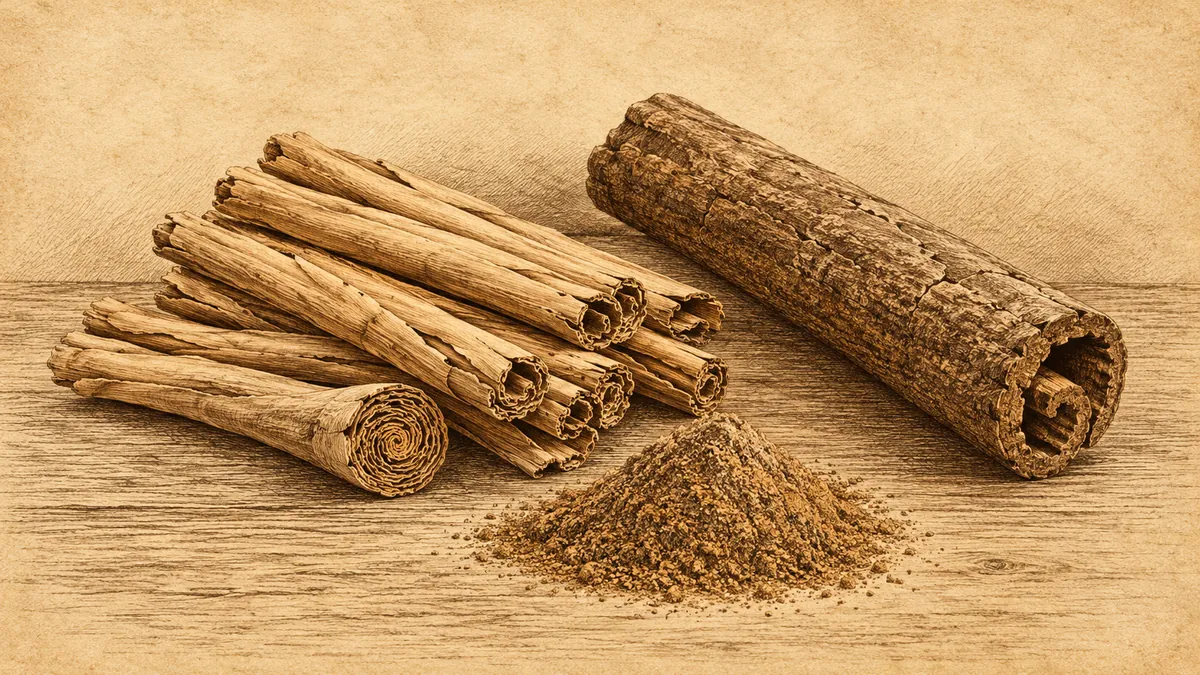
    You can recognise true cinnamon in a few ways. On a label, look for the words “Ceylon cinnamon” or “true cinnamon” and the species name Cinnamomum verum (or the older Cinnamomum zeylanicum), along with a Sri Lankan origin. By eye, a true cinnamon quill is thin and brittle, made of many layers rolled tightly together like a packed cigar, and it snaps and crumbles easily. A cassia stick is a thick, hard single curl that is much tougher to break. In powder form the two are hard to tell apart, which is why the label matters most for ground cinnamon.

    True cinnamon at a glance

    PointTrue cinnamonCassia
    Also calledCeylon cinnamonChinese, Indonesian, Saigon cinnamon
    SpeciesCinnamomum verumCinnamomum cassia and others
    OriginSri LankaChina, Indonesia, Vietnam
    BarkThin, layered, brittleThick, hard, single layer
    FlavourMild, sweet, delicateBold, hot, pungent
    Typical priceHigherLower

    Does “true cinnamon” mean better cinnamon?

    True cinnamon is not automatically better than cassia for every use, so the term is about identity rather than a simple ranking. True cinnamon is prized for its delicate, sweet flavour and fine quills, and it is the original spice, but cassia has its place where a strong, hot cinnamon flavour is wanted. What the term true cinnamon really tells you is which spice you are dealing with, so you can choose the right one for the dish and know what you are paying for. Thinking of it as a clear label rather than a quality badge is the most useful way to use the term.

    Frequently asked questions

    What does “true cinnamon” mean?

    True cinnamon means Ceylon cinnamon, the spice made from the dried inner bark of Cinnamomum verum, a tree native to Sri Lanka. The term distinguishes it from cassia, a group of related but different barks that are also commonly sold as cinnamon.

    Is true cinnamon the same as Ceylon cinnamon?

    Yes. True cinnamon and Ceylon cinnamon are two names for the same spice, made from Cinnamomum verum and grown in Sri Lanka. “Ceylon” is the historic name for the island, and “true cinnamon” marks it out from cassia.

    Why does it matter if cinnamon is true or cassia?

    It matters because the two differ in flavour, bark and species. True cinnamon is milder and sweeter and suits delicate dishes, while cassia is bolder and hotter. Knowing which you have affects how your food tastes and tells you what you are actually buying.

    Is all cinnamon true cinnamon?

    No. Much of the cinnamon sold, especially ground cinnamon in supermarkets, is cassia rather than true cinnamon. Only cinnamon from Cinnamomum verum is true cinnamon, so check the label for the species name or a Ceylon origin.

    Summary

    True cinnamon is the common name for Ceylon cinnamon, the spice from Cinnamomum verum, grown in Sri Lanka. The term exists to tell it apart from cassia, a group of cheaper, more common barks also sold as cinnamon. The difference matters because true cinnamon is milder and sweeter, has a thin, layered bark and is a distinct species, so the name tells you which spice you really have. It is best understood as a clear label of identity rather than a simple mark of quality, helping you choose the right cinnamon and know what you are buying.

    This website provides educational information about Ceylon Cinnamon as a spice and food ingredient. It is not intended to provide medical advice or make health claims.
  • What to Look for on a Ceylon Cinnamon Label

    What to Look for on a Ceylon Cinnamon Label

    When you buy Ceylon cinnamon, the label is the first thing you can actually check. True Ceylon cinnamon, Cinnamomum verum, comes from Sri Lanka, and a good label will usually say so in plain words: the species or botanical name, the country of origin, and often a grade such as Alba or C5. A label that only says “cinnamon”, with no species and no origin, gives you very little to go on. This guide walks through the details worth looking for on a Ceylon cinnamon label before you buy.

    Shopping for true cinnamon can be confusing because the word “cinnamon” on its own covers several different barks. This buying guide looks, point by point, at what a Ceylon cinnamon label should tell you and which words are a good sign. It builds on our pillar Ceylon cinnamon buying guide.

    The short answer

    On a Ceylon cinnamon label, look for the species name Cinnamomum verum (or Cinnamomum zeylanicum), the country of origin Sri Lanka, and a grade such as Alba, C5 or C4. Helpful extras include the form (quills, sticks or ground), packaging and harvest or batch details, and any recognised certification. A label that names the species and the origin, rather than just “cinnamon”, is the clearest starting sign that you are buying true Ceylon cinnamon.

    Why the label matters

    In many shops, “cinnamon” with no further detail is cassia, a related but different bark that comes mostly from China, Indonesia and Vietnam. True Ceylon cinnamon is a separate species with a milder, sweeter flavour and a thin, papery bark. Because the two are sold under the same everyday name, the label is often the only way to tell them apart before you open the pack. For the full flavour and bark differences, see our guide to Ceylon cinnamon versus cassia.

    A clear, detailed label is itself a quality signal. Sellers who take care to name the species, the origin and the grade are usually confident about what they are selling. A vague label is not proof of a problem, but it does leave you guessing.

    The species or botanical name

    The single most useful thing on the label is the botanical name. True Ceylon cinnamon is Cinnamomum verum, which was once called Cinnamomum zeylanicum, so either name points to the real thing. Cassia barks carry different species names, such as Cinnamomum cassia, Cinnamomum burmannii or Cinnamomum loureiroi.

    If the label prints Cinnamomum verum or Cinnamomum zeylanicum, that is a strong sign. If it prints one of the cassia species names, you are looking at cassia, whatever the front of the pack says. If there is no species name at all, treat the product as unconfirmed until you can check further.

    The country of origin

    True Ceylon cinnamon is grown in Sri Lanka, and most of the world’s supply still comes from there. A label that reads “Product of Sri Lanka” or “Origin: Sri Lanka” lines up with genuine Ceylon cinnamon. “Ceylon” is the historic name for the island, so “Ceylon cinnamon” and “Sri Lankan cinnamon” mean the same thing.

    Be careful with wording such as “packed in” or “distributed by”, which tells you where the pack was filled or handled, not where the bark was grown. The origin you want is the country where the cinnamon itself was produced. Our guide to reading cinnamon labels correctly goes deeper into this kind of wording.

    The grade

    Ceylon cinnamon is sorted into grades, and many good labels print the grade on the pack. Grades such as Alba, C5 Special, C5, C4 and the Continental and Mexican groups describe the thickness and appearance of the quills, with the thinnest and most delicate quills carrying the highest grades. Alba is the finest and thinnest.

    A grade on the label is a sign that the seller is working within the recognised Ceylon cinnamon system. You do not always need the top grade: for everyday cooking a mid grade is often a sensible choice. The point is that a named grade shows the product has been sorted to a standard rather than simply bagged.

    The form: quills, sticks or ground

    The label should make clear what form you are buying. True Ceylon cinnamon quills are made of many thin layers rolled together, so they look like a tightly packed cigar and snap easily. Cassia sticks are usually a single thick, hard curl. If you are buying sticks, “Ceylon cinnamon quills” is a better sign than an unnamed “cinnamon stick”.

    Ground cinnamon is harder to judge by eye once it is powder, which makes the species name and origin on the label even more important. If you want to tell the two forms apart in your own kitchen, our guide on how to identify authentic Ceylon cinnamon sets out the simple checks.

    Certifications and standards

    Some Ceylon cinnamon packs carry certification marks or references to a standard. The Sri Lanka Standards Institution sets the SLS standard for Ceylon cinnamon, and there are organic, fair trade and geographical indication schemes as well. A certification is not required for the cinnamon to be genuine, but a recognised mark adds confidence, especially when buying online. Our guide to the SLS standard for Ceylon cinnamon explains what that particular standard covers.

    Read certification wording closely. A phrase such as “certified organic” refers to how the cinnamon was grown, not to the species. Organic cassia is still cassia. Origin and species remain the details that tell you whether the bark is true Ceylon cinnamon.

    Harvest, batch and packaging details

    Smaller sellers often print a harvest date, a batch number or a best-before date. These help you judge freshness, since cinnamon slowly loses aroma over time once ground. Whole quills keep their aroma longer than powder, so a packaging date matters more for ground cinnamon. Good packaging is a resealable pouch or a sealed jar that keeps out air and light.

    None of these details confirm the species on their own, but together they show a careful seller. A pack with the species, the origin, a grade and a clear date is giving you a full picture.

    What a Ceylon cinnamon label should tell you

    Label detailGood sign for Ceylon cinnamonReason to check further
    Species nameCinnamomum verum or Cinnamomum zeylanicumA cassia species, or no species at all
    Country of originProduct of Sri LankaOnly “packed in” wording, or no origin
    GradeAlba, C5, C4 or another named gradeNo grade given
    FormCeylon cinnamon quills, sticks or groundUnnamed “cinnamon stick”
    CertificationSLS, organic, fair trade or GI markClaims with no species named
    FreshnessHarvest, batch or best-before dateNo date, loose or open packaging

    Putting it together at the shelf

    A quick way to read a label is to work down from the most telling detail. First look for the species: Cinnamomum verum or Cinnamomum zeylanicum is what you want. Next check the origin for Sri Lanka. Then look for a grade such as Alba or C5, confirm the form, and finally glance at any certification and the packaging date. If the first two details are present and clear, you are almost certainly holding true Ceylon cinnamon. If they are missing, it is worth asking the seller or reading more before you buy.

    Frequently asked questions

    What should a Ceylon cinnamon label say?

    A good Ceylon cinnamon label gives the species name Cinnamomum verum (or the older Cinnamomum zeylanicum), the country of origin Sri Lanka, and usually a grade such as Alba or C5. Helpful extras are the form, any certification and a harvest or best-before date.

    Does “Ceylon cinnamon” on the label guarantee it is real?

    The name alone is a good start but is strongest when backed by the species name and a Sri Lankan origin. A label that says “Ceylon cinnamon”, names Cinnamomum verum and states “Product of Sri Lanka” is giving you the full picture.

    If a label only says “cinnamon”, what does that mean?

    A plain “cinnamon” label with no species and no origin is most often cassia, since cassia is the common cinnamon in many shops. It is not confirmation either way, so look for the species name or ask the seller before assuming it is true Ceylon cinnamon.

    Does organic or fair trade mean it is Ceylon cinnamon?

    No. Organic and fair trade describe how the cinnamon was grown and traded, not which species it is. Cassia can also be organic. Always check the species name and origin alongside any such certification.

    Summary

    The label is your best tool when buying Ceylon cinnamon. The details that matter most are the species name, Cinnamomum verum or Cinnamomum zeylanicum, and the country of origin, Sri Lanka. A named grade such as Alba or C5, a clear form, a recognised certification and a freshness date all add confidence. A label that names the species and the origin is the clearest sign of true Ceylon cinnamon, while a bare “cinnamon” label with neither detail is worth a second look before you buy.

    This website provides educational information about Ceylon Cinnamon as a spice and food ingredient. It is not intended to provide medical advice or make health claims.

  • The Roll Test: Telling Ceylon From Cassia

    The Roll Test: Telling Ceylon From Cassia

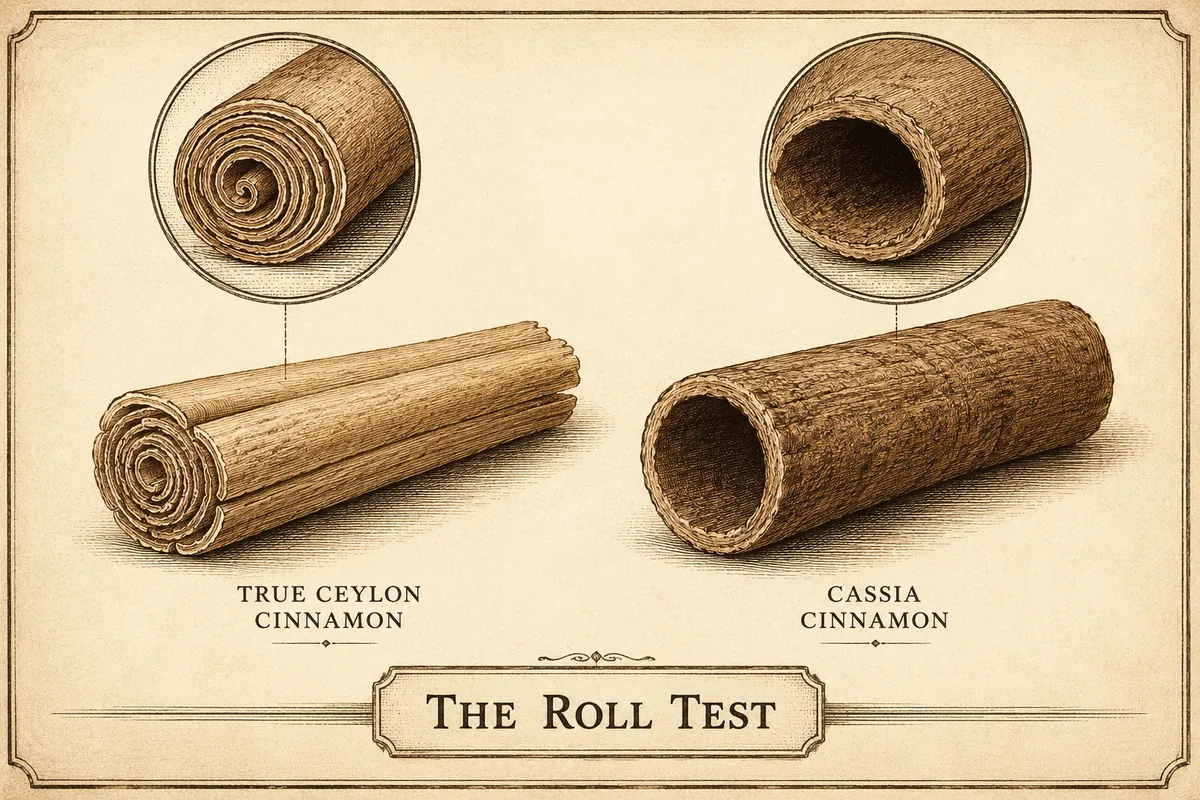
    The roll test is a quick, simple way to tell true Ceylon cinnamon from cassia just by looking at the shape of the stick. A Ceylon cinnamon quill is made of many thin, soft layers of bark rolled tightly together, so its cut end looks like a little scroll or a rolled-up cigar. A cassia stick, by contrast, is a single thick, hard layer that curls into one hollow tube. Look at how the bark rolls, and you can usually tell the two apart at a glance.

    This test is one of the easiest checks any shopper can do, and it needs no special tools. This guide explains how the roll test works, why the two barks roll so differently, and how to use it alongside other simple checks. It builds on our pillar guide on how to identify real Ceylon cinnamon.

    The short answer

    Look at the end of the stick: many thin layers rolled up like a scroll means Ceylon cinnamon, while a single thick curl means cassia. True Ceylon cinnamon is made from delicate inner bark layered and rolled by hand, giving a multi-layered quill. Cassia is a thick, tough bark that curls once. This difference in the roll is one of the clearest visual clues to which spice you are holding. It is the kind of detail you only need to see once to remember: after your first side-by-side comparison, the scrolled Ceylon quill and the single-curl cassia stick become instantly recognisable, and you will spot the difference almost without thinking whenever you handle a cinnamon stick.

    Why the two barks roll differently

    The reason comes down to the bark itself. True Ceylon cinnamon uses only the thin, papery inner bark of the tree, and several fine strips are layered inside one another and rolled together to build a quill. This produces the signature look of many soft, tight layers, a little like a rolled scroll. Cassia uses a much thicker, harder bark, and a single piece curls into one solid tube. So the roll test is really a test of bark thickness and structure, a difference explained further in our guide to what a cinnamon quill is.

    How to do the roll test

    The test is simple and takes seconds. Pick up the stick and look closely at its cut end and its overall shape.

    Look at the end

    The clearest sign is the cross-section at the end of the stick. If you see many thin layers curled up together, like the rings of a tiny scroll, it is Ceylon cinnamon. If you see one thick layer forming a single hollow tube, it is cassia.

    Look at the whole stick

    Ceylon quills are usually pale tan, slender and light, and they often have that rolled, papery, layered look along their length. Cassia sticks are darker reddish brown, thicker, heavier and harder, curling in a single tight roll. The overall shape backs up what you see at the end.

    Feel and snap

    You can add a touch test. Ceylon cinnamon is brittle and crumbly, and a quill snaps easily into pieces because the thin layers break readily. Cassia is hard and woody and resists snapping. If the stick shatters lightly in your fingers, that points to Ceylon; if it is tough and solid, that points to cassia. This links closely to the checks in our guide on how to spot fake Ceylon cinnamon.

    Roll test results at a glance

    What the roll test shows for Ceylon cinnamon and cassia.
    FeatureCeylon cinnamonCassia
    Roll shapeMany thin layers, like a scrollSingle thick curl
    BarkThin, papery inner barkThick, hard bark
    ColourPale tan brownDarker reddish brown
    WeightLightHeavier
    SnapBrittle, crumbles easilyHard, resists breaking

    Why the roll test is so useful

    The roll test is popular because anyone can do it, anywhere, with no equipment. In a shop, at home or in the kitchen, a quick look at the end of the stick gives a strong hint about which cinnamon you have. It is not a laboratory test, and edge cases exist, but for whole sticks it is one of the fastest and most reliable visual checks. Because cassia is often sold simply as “cinnamon”, this simple habit of looking at the roll can save you from mistaking one for the other, a theme at the heart of our guide to Ceylon cinnamon vs cassia.

    When the roll test does not help

    The roll test only works on whole sticks. Once cinnamon is ground into powder, the roll is gone, and you cannot use this method; there you have to rely on colour, smell and, above all, the label. Very short or broken pieces can also be harder to read. In these cases, checking that the product is clearly labelled as Ceylon cinnamon or Cinnamomum verum, ideally from Sri Lanka, is the surest guide. For whole quills, though, the roll test remains a quick and handy first check.

    The roll test in the shop and the kitchen

    One of the best things about the roll test is where you can use it. In a shop, you can hold a jar or packet of whole quills up to the light and look at the ends of the sticks before you buy, choosing the ones with the fine, scrolled, many-layered look. At home, it is a quick way to check what you already have in the cupboard: pull out a stick, look at the end, and you will usually know at once whether it is Ceylon or cassia. It is also a lovely thing to show children or guests, since the difference between a soft, rolled Ceylon scroll and a hard cassia tube is easy to see once it is pointed out. A small habit like this quietly builds your confidence as a buyer.

    Combining the roll test with other checks

    The roll test is strongest when used alongside a couple of other simple signs. Colour is a good partner: true Ceylon cinnamon tends to be a pale, warm tan, while cassia is a darker reddish brown. Aroma helps too, as Ceylon has a soft, sweet, delicate smell, whereas cassia is sharper and more pungent. And the label is the final word, since only true cinnamon should carry the name Ceylon cinnamon or Cinnamomum verum. Put together, the roll, the colour, the smell and the label give a clear, confident picture, which is exactly the layered approach set out in our pillar guide on how to identify real Ceylon cinnamon.

    Frequently asked questions

    What is the roll test for cinnamon?

    It is a simple visual check that tells Ceylon cinnamon from cassia by the shape of the stick. Ceylon cinnamon has many thin layers rolled together like a scroll, while cassia is a single thick curl. Looking at the rolled end of the stick reveals which one it is.

    How can you tell Ceylon cinnamon from cassia by looking?

    Look at the end of the stick and its overall form. Many fine layers, a pale colour and a light, brittle feel point to Ceylon cinnamon. A single thick curl, a darker colour and a hard, heavy feel point to cassia.

    Does the roll test work on ground cinnamon?

    No. The roll test only works on whole sticks, because it relies on seeing how the bark is rolled. For ground cinnamon you must rely on colour, aroma and the label, checking for Ceylon cinnamon or Cinnamomum verum from Sri Lanka.

    Is the roll test always accurate?

    It is a strong, quick guide for whole sticks, but not a laboratory test. Most Ceylon and cassia sticks are easy to tell apart by their roll, though broken or unusual pieces can be harder to read. Pairing the roll test with colour, smell and the label gives the most confidence.

    Summary

    The roll test is a fast, no-tools way to tell true Ceylon cinnamon from cassia. Ceylon cinnamon is made from thin inner bark rolled into many soft layers, so its end looks like a little scroll, and the stick is pale, light and brittle. Cassia is a single thick, hard curl, darker and heavier. By looking at the rolled end of a whole stick, and adding a gentle snap test, you can usually tell the two apart in seconds. The method does not work on powder, where the label is your best guide, but for whole quills the roll test is one of the simplest and most useful checks there is. Once you have made it a habit, telling true Ceylon cinnamon from cassia becomes second nature every time you shop or cook.

    This website provides educational information about Ceylon Cinnamon as a spice and food ingredient. It is not intended to provide medical advice or make health claims.
  • Where to Buy Authentic Ceylon Cinnamon

    Where to Buy Authentic Ceylon Cinnamon

    The safest places to buy authentic Ceylon cinnamon (Cinnamomum verum) are specialist spice merchants, reputable online sellers that clearly state the species and Sri Lankan origin, and shops that sell whole quills you can inspect. Wherever you buy, the single most reliable rule is the same: look for the words Cinnamomum verum and an origin of Sri Lanka on the label, and treat anything simply sold as “cinnamon” with caution.

    This guide is not about pointing you to one shop. It is about teaching you how to recognise a trustworthy source anywhere in the world, so you can buy genuine Ceylon cinnamon with confidence rather than accidentally ending up with cheaper cassia. For the wider picture of choosing well, see our pillar guide, the Ceylon cinnamon buying guide.

    Where can you buy authentic Ceylon cinnamon?

    Ceylon cinnamon is sold through several kinds of outlets, each with strengths and trade-offs. Knowing what to expect from each helps you shop wisely.

    Specialist spice shops

    Dedicated spice merchants are often the best starting point. They tend to know their products, label species and origin clearly, and stock genuine Ceylon cinnamon rather than generic “cinnamon”. Because spices are their whole business, they are more likely to be able to answer questions about grade, harvest and source.

    Reputable online retailers

    Buying online opens up a much wider choice, including sellers who ship directly from Sri Lanka. The trade-off is that you cannot handle the product before buying, so you must rely on the listing. Favour sellers who state Cinnamomum verum, name Sri Lanka as the origin, show clear photographs of thin, layered quills, and describe the grade. Vague listings that only say “cinnamon” are best avoided.

    Supermarkets and general grocers

    Mainstream supermarkets usually sell cassia under the plain name “cinnamon”, though some now carry a clearly labelled Ceylon line as well. If you shop here, read the label carefully: the presence of the botanical name and a Sri Lankan origin is what separates true Ceylon cinnamon from the cassia sitting beside it. The reasons these two are so often confused are explained in our guide to Ceylon cinnamon vs cassia.

    Farmers’ markets and direct trade

    Some markets, delis and direct-trade sellers offer Ceylon cinnamon sourced from specific growers. These can be excellent, especially when the seller can tell you where the spice comes from. As always, confirm the species and origin rather than relying on the word “authentic” alone.

    What to look for in any seller

    Regardless of where you shop, the same signals separate a trustworthy source from a doubtful one.

    The botanical name is stated

    A reliable seller of true cinnamon will proudly display Cinnamomum verum (sometimes written Cinnamomum zeylanicum). If the species is missing and the product is simply “cinnamon”, assume it may be cassia until proven otherwise.

    The origin is Sri Lanka

    Genuine Ceylon cinnamon comes overwhelmingly from Sri Lanka. A clear country of origin, paired with the correct species, is a strong sign of authenticity. The farming tradition behind that origin is described in our guide to Sri Lankan cinnamon farming.

    Whole quills you can inspect

    Where possible, buy whole quills rather than powder, because their structure is hard to fake. True Ceylon quills are thin, pale and made of many soft layers rolled together, in contrast to the hard single curl of cassia. Being able to see or photograph the quills gives you a way to verify quality yourself, using the checks in our guide to how to spot fake Ceylon cinnamon.

    Transparent grade information

    Good sellers describe the grade of their cinnamon, from the delicate Alba to coarser grades, rather than leaving it unspecified. Understanding what these grades mean helps you judge whether the price is fair, as set out in our complete guide to Ceylon cinnamon grades.

    Whole quills or ground powder: which to buy

    Where you buy is closely tied to what form you buy. Each has its place.

    Choosing between whole quills and ground cinnamon when buying.
    FormBest forThings to watch
    Whole quillsVerifying authenticity; longer shelf lifeNeeds grinding for some recipes
    Ground powderConvenience and everyday bakingHarder to verify; can be adulterated

    Because ground cinnamon hides the tell-tale layered structure, it is easier to pass off cassia or fillers as Ceylon powder. If you are buying powder, it matters even more that the seller is reputable and that the label names the species and origin.

    Buying Ceylon cinnamon online safely

    Online is where most people now shop, so it deserves a closer look. Before you buy, check that the listing names Cinnamomum verum and Sri Lanka, shows real photographs rather than generic stock images, describes the grade, and comes from a seller with a track record of honest descriptions. Be wary of listings where the price is far lower than comparable Ceylon cinnamon, as unusually cheap “Ceylon” is a classic warning sign that the product may actually be cassia. When a listing is vague, ask the seller directly about species and origin before ordering.

    Why price is part of the picture

    True Ceylon cinnamon is more labour-intensive to harvest and hand-peel than cassia, so it almost always costs more. A realistic, somewhat higher price is normal and even reassuring; a suspiciously low price on something labelled “Ceylon” is a reason to look more closely. That said, a high price alone does not guarantee authenticity, so always combine the price signal with the species, origin and structural checks. The relationship between cost and quality is covered further in our Ceylon cinnamon buying guide.

    Questions worth asking before you buy

    Whether you are standing at a market stall or reading an online listing, a few simple questions quickly reveal how trustworthy a source is. Ask what the species is and expect to hear Cinnamomum verum. Ask where it is from and expect Sri Lanka. Ask about the grade and expect a specific answer rather than a shrug. A seller who can answer these clearly and consistently is far more likely to be product the real thing than one who deals only in the vague word “cinnamon”.

    Avoiding the most common mistakes

    Most disappointments come from a handful of avoidable errors. Buying purely on the word “cinnamon” without checking the species is the biggest one, because that word covers both true cinnamon and cassia. Assuming that “organic” or “premium” automatically means Ceylon is another, since those terms say nothing about the botanical species. Finally, chasing the lowest possible price often leads straight to cassia. Slowing down to read the label and verify the source is what separates a confident purchase from a lucky guess, and it builds naturally on knowing how to identify authentic Ceylon cinnamon.

    Summary

    You can buy authentic Ceylon cinnamon from specialist spice shops, reputable online sellers, some supermarkets, and direct-trade markets, but the outlet matters less than the checks you apply. Everywhere, the decisive signals are the same: the label names Cinnamomum verum, the origin is Sri Lanka, whole quills are thin and layered, the grade is stated, and the price is realistic rather than suspiciously cheap. Favour whole quills when you can, be extra careful with powder, ask sellers direct questions about species and origin, and don’t let words like “premium” or “organic” stand in for proof of authenticity. Apply these habits and you can shop with confidence wherever you are.

    Frequently asked questions

    Where is the best place to buy Ceylon cinnamon?

    Specialist spice merchants and reputable online sellers that clearly state Cinnamomum verum and a Sri Lankan origin are usually the most reliable. Being able to see whole quills, in person or in clear photos, is a further advantage.

    Can you buy real Ceylon cinnamon in supermarkets?

    Sometimes. Most supermarket “cinnamon” is cassia, but some stores now stock a clearly labelled Ceylon line. Check for the botanical name and a Sri Lankan origin to tell the two apart on the shelf.

    Is it safe to buy Ceylon cinnamon online?

    Yes, if you choose carefully. Favour listings that name Cinnamomum verum and Sri Lanka, show genuine photos of thin layered quills, describe the grade, and come from sellers with honest descriptions. Treat unusually cheap “Ceylon” cinnamon with caution.

    How do I know a seller’s Ceylon cinnamon is genuine?

    Ask about the species, origin and grade. A trustworthy seller will confirm Cinnamomum verum, name Sri Lanka, and give a specific grade. Whole quills you can inspect provide extra reassurance.

    This website provides educational information about Ceylon Cinnamon as a spice and food ingredient. It is not intended to provide medical advice or make health claims.
  • How to Spot Fake Ceylon Cinnamon

    How to Spot Fake Ceylon Cinnamon

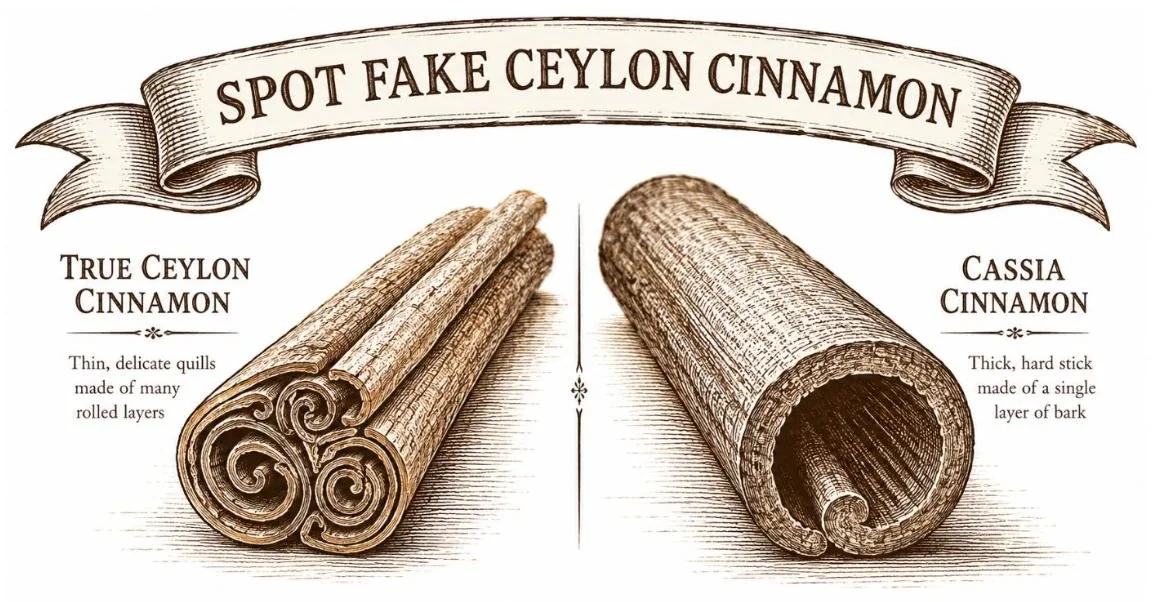
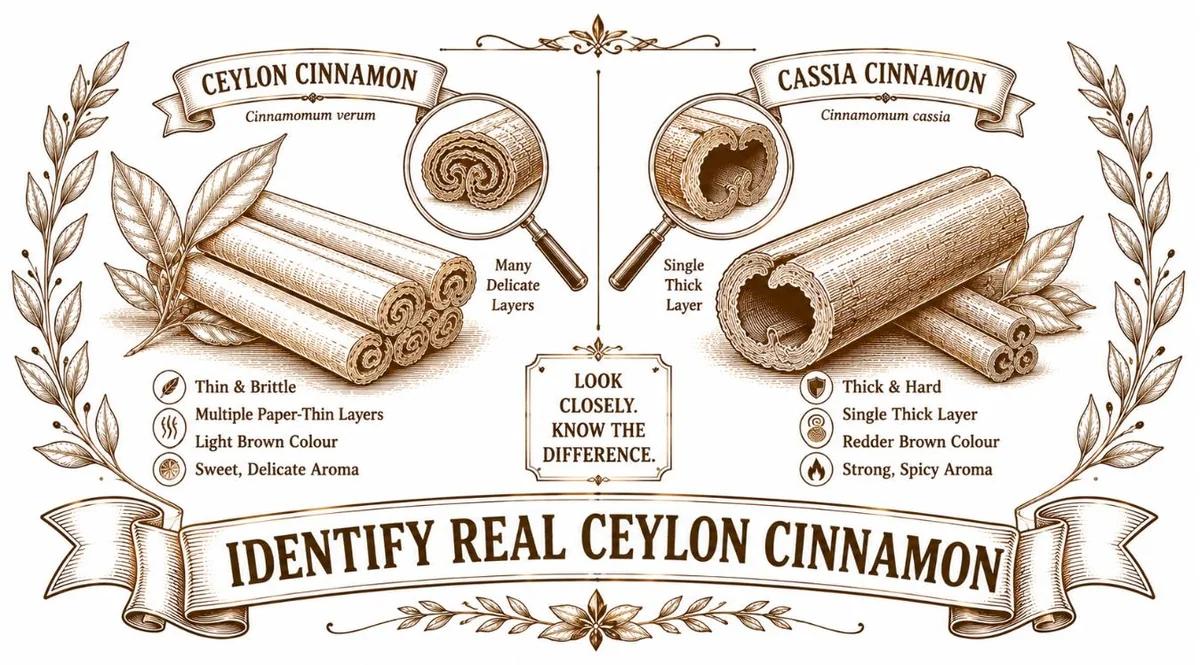
    The easiest way to spot fake Ceylon cinnamon is to look at the shape and feel of the stick: true Ceylon cinnamon (Cinnamomum verum) forms thin, brittle quills made of many soft, papery layers rolled tightly together, while the “fake” cinnamon sold in most supermarkets is usually cassia, a single, thick, hard, hollow curl of dark reddish-brown bark. In powder form the clues are subtler, but colour, aroma and taste still give it away.

    Most “fake” Ceylon cinnamon is not a deliberate forgery so much as a case of mistaken identity: cheaper cassia bark sold under the single word “cinnamon”. This guide shows you exactly what to look for, whether you are holding a stick, a jar of powder, or reading a label, so you can tell genuine Cinnamomum verum from the imposters. For the full picture, see our pillar guide on how to identify authentic Ceylon cinnamon.

    What does “fake” Ceylon cinnamon actually mean?

    “Fake” Ceylon cinnamon usually means cassia cinnamon being passed off, knowingly or not, as true Ceylon cinnamon. Cassia comes from several related trees (such as Cinnamomum cassia and Cinnamomum burmannii) grown mainly in China, Indonesia and Vietnam. It is a genuine spice in its own right and perfectly legal to sell, but it is coarser, cheaper and chemically different from true Ceylon cinnamon, which comes almost entirely from Sri Lanka. The confusion arises because in many countries both barks are simply labelled “cinnamon”. The full botanical contrast is set out in our guide to Ceylon cinnamon vs cassia.

    Less commonly, “fake” can also mean powder that has been bulked out with fillers, or old, stale stock sold as premium spice. The checks below help with all of these cases.

    How to spot fake cinnamon sticks (quills)

    Whole sticks are the easiest form to judge, because the physical structure of the bark is very hard to fake.

    Look at the layers

    Break or look at the end of the stick. True Ceylon cinnamon is made of many thin layers rolled up like a fine cigar or a rolled newspaper, so the cross-section looks like the rings of a tightly wound scroll. Cassia is typically a single thick layer curled into a hard tube, often with a hollow centre and only one or two curls. If you see one thick, woody wall instead of many delicate layers, you are almost certainly holding cassia.

    Check the thickness and hardness

    Genuine Ceylon quills are thin and brittle, you can usually snap them easily by hand or even crumble them between your fingers. Cassia bark is thick, hard and woody; it resists breaking and often needs a grinder. If a “cinnamon” stick feels like a piece of tough bark that won’t yield, that hardness is a strong sign it is cassia.

    Judge the colour

    True Ceylon cinnamon is a light tan or pale golden-brown. Cassia is a noticeably darker, reddish or chocolate brown. Colour alone is not proof, because lighting and age vary, but a very dark, uniform stick leans strongly toward cassia.

    Smell and taste

    Ceylon cinnamon has a delicate, sweet, warm and complex aroma with citrus and floral notes. Cassia smells and tastes stronger, harsher and more “spicy-hot”, with a pungent bite. If the flavour is aggressive and one-dimensional rather than subtle and layered, it is likely cassia. The finer flavour of Ceylon cinnamon is one reason it is prized in cooking, as covered in our guide to culinary uses of Ceylon cinnamon.

    Quick comparison: Ceylon vs cassia sticks

    At-a-glance signs for telling true Ceylon cinnamon from cassia sticks.
    FeatureTrue Ceylon cinnamonCassia (often sold as “cinnamon”)
    LayersMany thin, papery layers rolled upSingle thick, hard layer
    TextureThin and brittle, snaps easilyThick, hard and woody
    ColourLight tan / pale brownDark reddish or chocolate brown
    AromaSweet, delicate, complexStrong, harsh, pungent
    ShapeSolid, tightly filled quillOften a single hollow curl

    How to spot fake cinnamon powder

    Powder is harder to judge because grinding removes the tell-tale layered structure. Still, several clues remain.

    Colour of the powder

    Ceylon cinnamon powder is a lighter tan-brown, while cassia powder tends to be a darker reddish-brown. If you have known-genuine Ceylon powder to compare against, the difference is often visible side by side.

    Aroma and flavour

    As with sticks, Ceylon powder smells mild, sweet and layered, whereas cassia is sharper and more intense. A cheap “cinnamon” that overwhelms a dish with a hot, biting note is more likely cassia.

    Be alert to fillers

    Very cheap ground “cinnamon” is occasionally bulked out with other ground plant material or starches. You cannot reliably detect this by eye, which is why the source and packaging matter so much. Buying whole quills and grinding them yourself removes most of this risk, a strategy discussed in our Ceylon cinnamon buying guide.

    Read the label carefully

    Labels are one of the most reliable tools you have, if you know what to look for.

    Look for the botanical name

    Genuine Ceylon cinnamon lists Cinnamomum verum (sometimes written Cinnamomum zeylanicum) on the packaging. If the label only says “cinnamon” with no species, or names Cinnamomum cassia or Cinnamomum burmannii, you are not looking at true Ceylon cinnamon. The word “verum” literally means “true”, and it is the clearest label-level signal there is.

    Check the country of origin

    True Ceylon cinnamon comes overwhelmingly from Sri Lanka (historically called Ceylon). Cassia is grown mainly in China, Indonesia and Vietnam. An origin of Sri Lanka, combined with the Cinnamomum verum name, is a strong pair of signals. The farming tradition behind this origin is described in our guide to Sri Lankan cinnamon farming.

    Be sceptical of vague marketing

    Terms like “premium”, “true” or “gourmet” on the front of a pack mean nothing on their own. Turn the packet over and read the ingredients and botanical name. If a product markets itself as Ceylon cinnamon but hides or omits the species and origin, treat that as a warning sign.

    Why price is a clue (but not proof)

    True Ceylon cinnamon is more labour-intensive to harvest and process than cassia, so it almost always costs more. If a product is branded “Ceylon” but priced the same as ordinary bulk cinnamon, be cautious, the price may be too good to be true. That said, a high price alone does not guarantee authenticity, so always combine the price signal with the structural, sensory and label checks above. Why genuine Ceylon cinnamon commands a premium is tied to how it is grown and peeled, covered in how Ceylon cinnamon is made.

    Understanding grades helps too

    Even among genuine Ceylon cinnamon there are different grades, from the delicate Alba quills to coarser grades. Knowing the grading system helps you judge whether a premium price is justified and whether the product matches its description, rather than being over-sold. Our complete guide to Ceylon cinnamon grades explains what the grade names mean and how quality is classified.

    A simple three-step authenticity check

    If you want a quick routine to apply in a shop or kitchen, use these three steps in order.

    Step 1: Read the label

    Look for Cinnamomum verum (or zeylanicum) and an origin of Sri Lanka. No species named usually means cassia.

    Step 2: Inspect the stick

    If you can see whole quills, check for many thin layers, a light tan colour, and a stick that feels thin and brittle rather than hard and woody.

    Step 3: Smell and taste

    Genuine Ceylon cinnamon is sweet, mild and complex. A harsh, hot, one-note “cinnamon” flavour points to cassia.

    Summary

    Spotting fake Ceylon cinnamon comes down to a handful of reliable signals. Most “fakes” are simply cassia sold under the generic name “cinnamon”, so the key is to distinguish the two. Whole sticks are easiest: true Ceylon cinnamon forms thin, brittle quills of many papery layers in a pale tan colour, while cassia is a hard, thick, dark, often hollow curl. In powder form, rely on colour, a mild sweet aroma, and, above all, the label, which should name Cinnamomum verum and an origin of Sri Lanka. Combine the physical checks, the sensory checks and the label together, use price as a supporting clue, and you can buy true Ceylon cinnamon with confidence.

    Frequently asked questions

    How can I tell if my cinnamon is real Ceylon cinnamon?

    Check the stick and the label. True Ceylon cinnamon forms thin, brittle quills of many rolled layers in a light tan colour, and its packaging names Cinnamomum verum with an origin of Sri Lanka. Hard, dark, single-layer sticks are usually cassia.

    Is supermarket cinnamon fake?

    Not fake, but usually cassia rather than true Ceylon cinnamon. Most inexpensive “cinnamon” is genuine cassia bark, which is a real spice but botanically different from Cinnamomum verum. Check the label for the species and origin to be sure.

    Does colour tell you if cinnamon is fake?

    Colour is a useful clue but not proof. Ceylon cinnamon is usually a lighter tan, while cassia is darker and more reddish. Because lighting and age affect colour, combine it with the layered-stick test and the label check.

    Why is real Ceylon cinnamon more expensive?

    Because it is harvested and hand-peeled with more care and comes mainly from Sri Lanka, its production is more labour-intensive than cassia. A “Ceylon” product priced like ordinary bulk cinnamon should be treated with caution.

    This website provides educational information about Ceylon Cinnamon as a spice and food ingredient. It is not intended to provide medical advice or make health claims.

  • How to Identify Authentic Ceylon Cinnamon

    How to Identify Authentic Ceylon Cinnamon

    You can identify authentic Ceylon cinnamon by its light tan colour, its thin bark rolled into many nested layers, its brittle texture that crumbles easily, its sweet and delicate aroma, and a label that names Cinnamomum verum and Sri Lanka. Cassia, the common substitute, is dark, thick, hard and single-curled. A few simple checks at home will tell the two apart with confidence.

    Because both true cinnamon and cassia are often sold simply as “cinnamon,” telling them apart is a practical skill worth having. This guide gives you clear visual, textural and aroma tests, plus label-reading tips. For the underlying differences, see Ceylon cinnamon vs cassia.

    The quick 5-point check

    Five fast ways to distinguish Ceylon cinnamon from cassia.
    CheckCeylon cinnamonCassia
    ColourLight tan / goldenDark reddish-brown
    Bark & rollThin, many layers, like a rolled cigarThick, single hollow curl
    TextureBrittle, crumbles by handHard, difficult to snap
    AromaSweet, delicate, fragrantStrong, hot, pungent
    LabelSays Cinnamomum verum / Ceylon / Sri LankaOften just “cinnamon,” or names cassia

    1. Look at the colour

    Genuine Ceylon cinnamon is a pale, warm tan, sometimes almost golden. Cassia is noticeably darker and redder. Colour alone is not definitive, but combined with the other checks it is a strong first clue, and it applies to powder too, where Ceylon tends to be lighter brown and cassia a deeper rusty red.

    2. Examine the roll and bark thickness

    This is the most reliable visual test. Look at the end of the stick. A Ceylon quill is made of many thin layers of fine bark rolled tightly together, so the cross-section looks like a coiled newspaper or cigar. Cassia is a single thick curl, often hollow in the middle, formed from one hard layer of bark. If you see one solid tube, it is almost certainly cassia.

    3. Test the texture

    Ceylon cinnamon’s thin bark is brittle. Press or snap a quill and it tends to crack and crumble into flaky layers, you can often break it with your fingers. Cassia is hard and woody, difficult to snap by hand, and usually needs a sturdy grinder. This “snap test” is quick and telling.

    4. Smell the aroma

    Ceylon cinnamon has a sweet, warm, fragrant aroma with subtle floral and citrus notes. Cassia smells stronger and hotter, more one-dimensional and sometimes slightly harsh. With a little practice the difference in the nose is easy to recognise, and it carries through into the flavour of finished dishes, as discussed in culinary uses of Ceylon cinnamon.

    5. Read the label carefully

    Authentic Ceylon cinnamon will usually state one or more of the following: Cinnamomum verum (or the older Cinnamomum zeylanicum), “true cinnamon,” “Ceylon cinnamon,” and Sri Lanka as the country of origin. Be cautious of jars labelled simply “cinnamon” with no species or origin, these are usually cassia. Watch too for the assumption that “organic” means Ceylon: organic refers to how it was grown, not to the species, so an organic product can still be cassia.

    Identifying Ceylon cinnamon powder

    Powder is harder to judge because you cannot inspect the quill. Rely on colour (Ceylon is a lighter brown), aroma (sweeter and more delicate), and above all a trustworthy, clearly labelled source that names the species and origin. When in doubt, buy whole quills you can inspect and grind them yourself.

    Common ways cinnamon is mislabelled

    Most mislabelling is not deliberate fraud but the loose use of the word “cinnamon” for what is really cassia. Because cassia dominates the mass market, shoppers often pay Ceylon prices for cassia, or assume the harsher cassia flavour is what cinnamon is “supposed” to taste like. Knowing the checks above protects you, and pairs naturally with the advice in our buying guide.

    Identifying by taste

    If you are able to taste a small amount, the difference is clear. Ceylon cinnamon is mild, sweet and mellow, dissolving into a gentle warmth with subtle floral notes. Cassia delivers a sharper, hotter, more astringent hit that lingers and can slightly dry the mouth. Once you have tasted them side by side, the flavour test becomes one of the easiest ways to tell them apart, and it explains why the two behave so differently in the recipes covered in our culinary guide.

    Informal tests and their limits

    You may come across “home tests” for cinnamon online, such as judging by how a powder behaves in liquid. Treat these with caution: they are unreliable and can be affected by grind size, additives and freshness. The dependable checks remain the physical ones, colour, the multi-layered roll, brittleness and aroma, combined with honest labelling. There is no substitute for inspecting a whole quill and reading what the packaging actually states.

    Buying online safely

    When you cannot handle the product before buying, labelling and seller transparency become your main tools. Look for listings that clearly state Cinnamomum verum, name Sri Lanka as the origin, specify a grade, and show clear photographs of the quills’ layered ends. Be wary of listings that rely on vague health language instead of concrete product detail, or that price “cinnamon” suspiciously low. These same principles underpin our buying guide.

    Why labels can be misleading

    In many markets the word “cinnamon” can legally cover both true cinnamon and cassia, so a jar can be entirely accurate in calling cassia “cinnamon” while telling you nothing about the species. Country-of-origin labelling adds another layer: origin tells you where a product was packed or grown but not necessarily which species it is. The only reliable confirmation is an explicit botanical name plus a Sri Lankan origin, everything else is a clue rather than proof.

    What about the “curl” direction?

    People sometimes ask whether the way a stick curls reveals its type. The reliable structural clue is not the direction of the curl but the number of layers: Ceylon cinnamon is built from many thin sheets of inner bark rolled tightly together, so it looks layered like a rolled newspaper, while cassia forms one thick, hard curl that is often hollow. Focus on that layered cross-section rather than on which way the ends turn. Combined with colour, brittleness and aroma, the layered structure is the most dependable visual test of all.

    Putting the checks together

    No single test is foolproof on its own, but together the checks are decisive. Imagine picking up an unlabelled stick: if it is pale tan, made of many thin layers rolled like a cigar, crumbles when you press it, and smells sweetly fragrant, you can be confident it is Ceylon cinnamon. If it is dark and reddish, a single hard curl, difficult to snap, and smells hot and sharp, it is cassia. The more of these signals point the same way, the more certain you can be. Whole quills are always easier to judge than powder, which is why buying sticks and grinding your own is the surest route to authenticity.

    Why identification is worth the effort

    Learning these checks pays off in three ways. You avoid paying a premium for cassia sold loosely as “cinnamon”; you get the delicate flavour that recipes calling for true cinnamon actually intend; and you can enjoy the naturally low coumarin content of Ceylon cinnamon when you use the spice often. Pair this identification know-how with the practical advice in our buying guide and the background in what is true Ceylon cinnamon, and you will rarely be fooled again.

    Summary

    To identify authentic Ceylon cinnamon, look for a pale tan colour, thin bark rolled into many nested layers, a brittle texture that crumbles easily, and a sweet, delicate aroma, then confirm with a label naming Cinnamomum verum and Sri Lanka. Cassia, by contrast, is dark, thick, hard, single-curled and pungent. For powder, trust colour, aroma and a reputable labelled source, or grind your own from quills. A handful of simple checks is all it takes to be sure you have the real thing.

    Frequently asked questions

    How can I tell if my cinnamon is Ceylon or cassia?

    Check the roll: Ceylon has many thin layers like a cigar and crumbles easily, while cassia is a single hard, thick curl. Ceylon is also paler and sweeter smelling.

    Does “organic” mean it is Ceylon cinnamon?

    No. Organic describes how the plant was grown, not the species. Organic cinnamon can still be cassia, so check for Cinnamomum verum and Sri Lanka on the label.

    Can I identify Ceylon cinnamon powder?

    It is harder. Ceylon powder is usually lighter brown with a sweeter, more delicate aroma, but the safest approach is a clearly labelled trusted source or grinding your own quills.

    Is lighter-coloured cinnamon always Ceylon?

    Colour is a useful clue but not proof on its own. Combine it with the bark structure, texture, aroma and label checks for confidence.

    This website provides educational information about Ceylon Cinnamon as a spice and food ingredient. It is not intended to provide medical advice or make health claims.