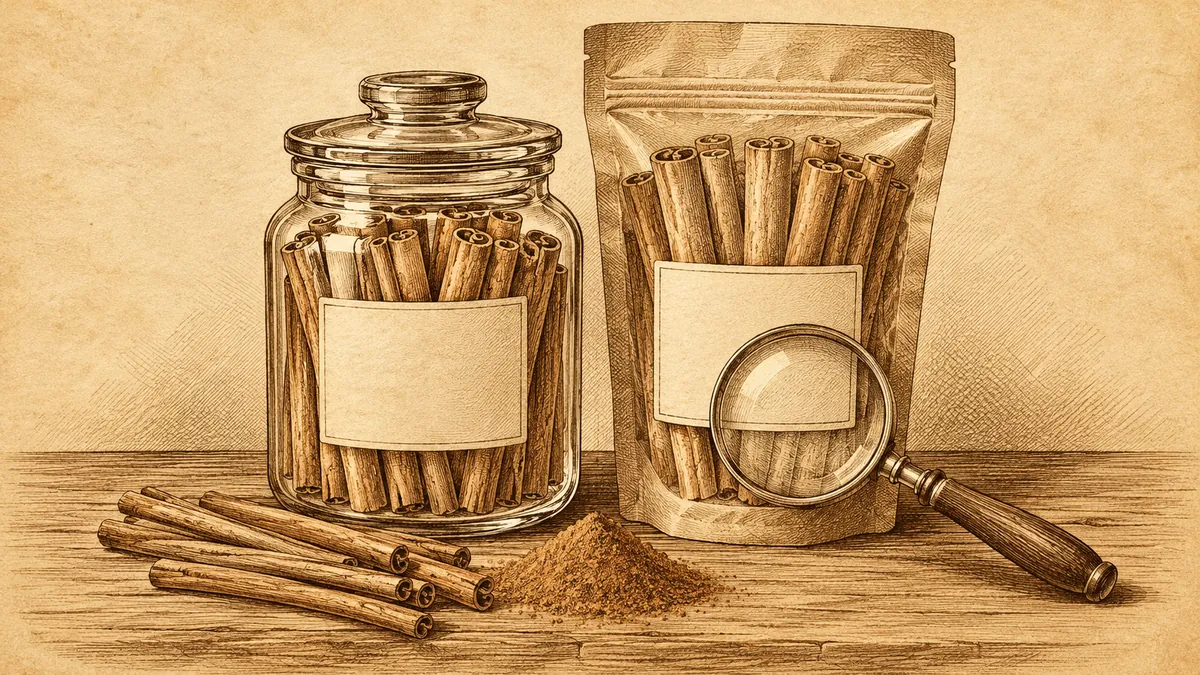
When you buy Ceylon cinnamon, the label is the first thing you can actually check. True Ceylon cinnamon, Cinnamomum verum, comes from Sri Lanka, and a good label will usually say so in plain words: the species or botanical name, the country of origin, and often a grade such as Alba or C5. A label that only says “cinnamon”, with no species and no origin, gives you very little to go on. This guide walks through the details worth looking for on a Ceylon cinnamon label before you buy.
Shopping for true cinnamon can be confusing because the word “cinnamon” on its own covers several different barks. This buying guide looks, point by point, at what a Ceylon cinnamon label should tell you and which words are a good sign. It builds on our pillar Ceylon cinnamon buying guide.
The short answer
On a Ceylon cinnamon label, look for the species name Cinnamomum verum (or Cinnamomum zeylanicum), the country of origin Sri Lanka, and a grade such as Alba, C5 or C4. Helpful extras include the form (quills, sticks or ground), packaging and harvest or batch details, and any recognised certification. A label that names the species and the origin, rather than just “cinnamon”, is the clearest starting sign that you are buying true Ceylon cinnamon.
Why the label matters
In many shops, “cinnamon” with no further detail is cassia, a related but different bark that comes mostly from China, Indonesia and Vietnam. True Ceylon cinnamon is a separate species with a milder, sweeter flavour and a thin, papery bark. Because the two are sold under the same everyday name, the label is often the only way to tell them apart before you open the pack. For the full flavour and bark differences, see our guide to Ceylon cinnamon versus cassia.
A clear, detailed label is itself a quality signal. Sellers who take care to name the species, the origin and the grade are usually confident about what they are selling. A vague label is not proof of a problem, but it does leave you guessing.
The species or botanical name
The single most useful thing on the label is the botanical name. True Ceylon cinnamon is Cinnamomum verum, which was once called Cinnamomum zeylanicum, so either name points to the real thing. Cassia barks carry different species names, such as Cinnamomum cassia, Cinnamomum burmannii or Cinnamomum loureiroi.
If the label prints Cinnamomum verum or Cinnamomum zeylanicum, that is a strong sign. If it prints one of the cassia species names, you are looking at cassia, whatever the front of the pack says. If there is no species name at all, treat the product as unconfirmed until you can check further.
The country of origin
True Ceylon cinnamon is grown in Sri Lanka, and most of the world’s supply still comes from there. A label that reads “Product of Sri Lanka” or “Origin: Sri Lanka” lines up with genuine Ceylon cinnamon. “Ceylon” is the historic name for the island, so “Ceylon cinnamon” and “Sri Lankan cinnamon” mean the same thing.
Be careful with wording such as “packed in” or “distributed by”, which tells you where the pack was filled or handled, not where the bark was grown. The origin you want is the country where the cinnamon itself was produced. Our guide to reading cinnamon labels correctly goes deeper into this kind of wording.
The grade
Ceylon cinnamon is sorted into grades, and many good labels print the grade on the pack. Grades such as Alba, C5 Special, C5, C4 and the Continental and Mexican groups describe the thickness and appearance of the quills, with the thinnest and most delicate quills carrying the highest grades. Alba is the finest and thinnest.
A grade on the label is a sign that the seller is working within the recognised Ceylon cinnamon system. You do not always need the top grade: for everyday cooking a mid grade is often a sensible choice. The point is that a named grade shows the product has been sorted to a standard rather than simply bagged.
The form: quills, sticks or ground
The label should make clear what form you are buying. True Ceylon cinnamon quills are made of many thin layers rolled together, so they look like a tightly packed cigar and snap easily. Cassia sticks are usually a single thick, hard curl. If you are buying sticks, “Ceylon cinnamon quills” is a better sign than an unnamed “cinnamon stick”.
Ground cinnamon is harder to judge by eye once it is powder, which makes the species name and origin on the label even more important. If you want to tell the two forms apart in your own kitchen, our guide on how to identify authentic Ceylon cinnamon sets out the simple checks.
Certifications and standards
Some Ceylon cinnamon packs carry certification marks or references to a standard. The Sri Lanka Standards Institution sets the SLS standard for Ceylon cinnamon, and there are organic, fair trade and geographical indication schemes as well. A certification is not required for the cinnamon to be genuine, but a recognised mark adds confidence, especially when buying online. Our guide to the SLS standard for Ceylon cinnamon explains what that particular standard covers.
Read certification wording closely. A phrase such as “certified organic” refers to how the cinnamon was grown, not to the species. Organic cassia is still cassia. Origin and species remain the details that tell you whether the bark is true Ceylon cinnamon.
Harvest, batch and packaging details
Smaller sellers often print a harvest date, a batch number or a best-before date. These help you judge freshness, since cinnamon slowly loses aroma over time once ground. Whole quills keep their aroma longer than powder, so a packaging date matters more for ground cinnamon. Good packaging is a resealable pouch or a sealed jar that keeps out air and light.
None of these details confirm the species on their own, but together they show a careful seller. A pack with the species, the origin, a grade and a clear date is giving you a full picture.
What a Ceylon cinnamon label should tell you
| Label detail | Good sign for Ceylon cinnamon | Reason to check further |
|---|---|---|
| Species name | Cinnamomum verum or Cinnamomum zeylanicum | A cassia species, or no species at all |
| Country of origin | Product of Sri Lanka | Only “packed in” wording, or no origin |
| Grade | Alba, C5, C4 or another named grade | No grade given |
| Form | Ceylon cinnamon quills, sticks or ground | Unnamed “cinnamon stick” |
| Certification | SLS, organic, fair trade or GI mark | Claims with no species named |
| Freshness | Harvest, batch or best-before date | No date, loose or open packaging |
Putting it together at the shelf
A quick way to read a label is to work down from the most telling detail. First look for the species: Cinnamomum verum or Cinnamomum zeylanicum is what you want. Next check the origin for Sri Lanka. Then look for a grade such as Alba or C5, confirm the form, and finally glance at any certification and the packaging date. If the first two details are present and clear, you are almost certainly holding true Ceylon cinnamon. If they are missing, it is worth asking the seller or reading more before you buy.
Frequently asked questions
What should a Ceylon cinnamon label say?
A good Ceylon cinnamon label gives the species name Cinnamomum verum (or the older Cinnamomum zeylanicum), the country of origin Sri Lanka, and usually a grade such as Alba or C5. Helpful extras are the form, any certification and a harvest or best-before date.
Does “Ceylon cinnamon” on the label guarantee it is real?
The name alone is a good start but is strongest when backed by the species name and a Sri Lankan origin. A label that says “Ceylon cinnamon”, names Cinnamomum verum and states “Product of Sri Lanka” is giving you the full picture.
If a label only says “cinnamon”, what does that mean?
A plain “cinnamon” label with no species and no origin is most often cassia, since cassia is the common cinnamon in many shops. It is not confirmation either way, so look for the species name or ask the seller before assuming it is true Ceylon cinnamon.
Does organic or fair trade mean it is Ceylon cinnamon?
No. Organic and fair trade describe how the cinnamon was grown and traded, not which species it is. Cassia can also be organic. Always check the species name and origin alongside any such certification.
Summary
The label is your best tool when buying Ceylon cinnamon. The details that matter most are the species name, Cinnamomum verum or Cinnamomum zeylanicum, and the country of origin, Sri Lanka. A named grade such as Alba or C5, a clear form, a recognised certification and a freshness date all add confidence. A label that names the species and the origin is the clearest sign of true Ceylon cinnamon, while a bare “cinnamon” label with neither detail is worth a second look before you buy.
This website provides educational information about Ceylon Cinnamon as a spice and food ingredient. It is not intended to provide medical advice or make health claims.
Leave a Reply