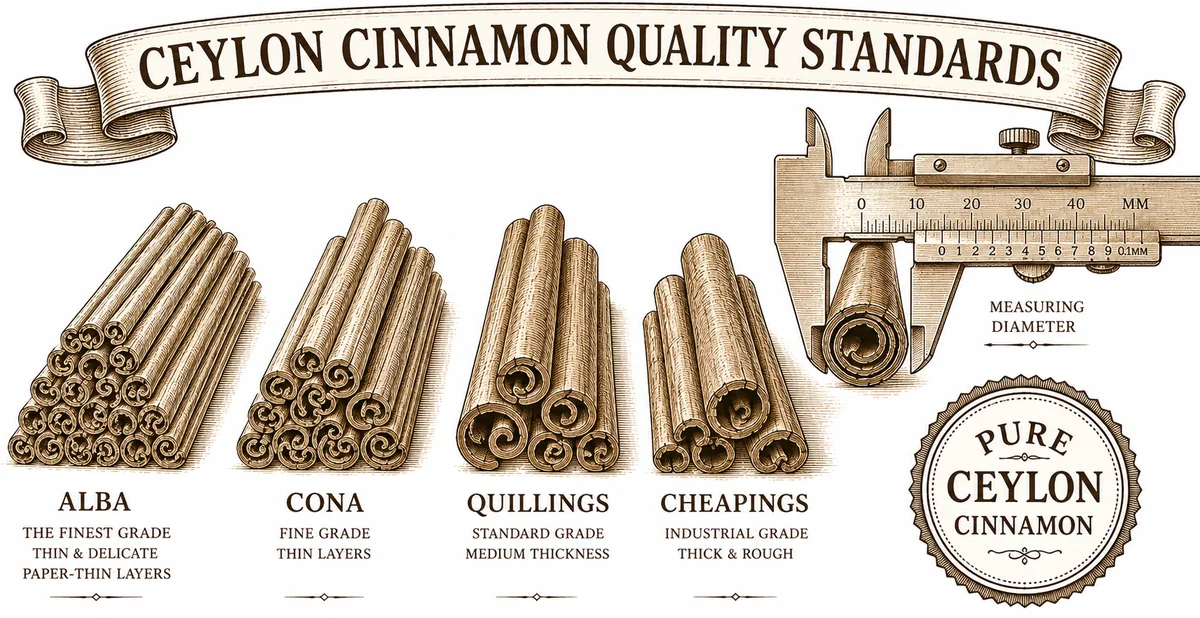
Ceylon cinnamon quality standards are the grading rules, national specifications and certification marks used to define, measure and guarantee the quality of true Ceylon cinnamon (Cinnamomum verum). They cover everything from the thickness and appearance of the quills to moisture, cleanliness and origin, and they are what allow buyers around the world to trust that a product labelled “Ceylon cinnamon” really meets a recognised level of quality.
This guide explains, in plain terms, how Ceylon cinnamon quality is defined and protected: the grading system, the Sri Lankan and international standards involved, the “Pure Ceylon Cinnamon” mark, and what these standards mean for you as a buyer. For the practical side of choosing well, it pairs closely with our pillar Ceylon cinnamon buying guide.
What are Ceylon cinnamon quality standards?
Quality standards for Ceylon cinnamon are agreed rules that describe what good cinnamon should be, and how to measure it, so that buyers and sellers share a common definition of quality. Rather than leaving “quality” as a vague idea, standards set out measurable characteristics, such as the grade of the quills, their moisture content, and freedom from foreign matter, that a batch of cinnamon must meet. This turns quality into something that can be checked and certified rather than simply claimed, which matters greatly in an international spice trade where buyers may never see the crop growing.
Grading: the foundation of cinnamon quality
The most familiar quality system is the grading of the quills themselves. Ceylon cinnamon is sorted into grades based mainly on the diameter and appearance of the sticks, from the fine, thin Alba grade through to coarser grades, along with categories such as quillings, featherings and chips. Finer, thinner, cleaner quills command the highest grades. This grading language is the everyday backbone of cinnamon quality, and it is explained fully in our pillar guide to Ceylon cinnamon grades. Understanding the grade of a product tells you a great deal about its quality and helps you judge whether a price is fair.
National and international standards
Beyond grading, formal standards set out detailed specifications for cinnamon as a traded commodity.
Sri Lankan standards
As the home of true cinnamon, Sri Lanka maintains national standards for cinnamon through its standards body. These Sri Lanka Standards (often referred to as SLS) specifications describe the requirements for different grades and the limits for things like moisture and impurities, giving the industry an agreed benchmark. Because Sri Lanka is the origin of genuine Ceylon cinnamon, its standards carry particular weight.
International standards
Cinnamon is also covered by international standards, such as those published by the International Organization for Standardization (ISO), which set out specifications and test methods used across the global spice trade. These help ensure that cinnamon traded between countries meets consistent, internationally recognised requirements.
Food-safety standards
On top of quality grading, cinnamon sold as food must meet general food-safety requirements in the markets where it is sold, covering hygiene and safe handling. These sit alongside quality standards rather than replacing them.
What quality standards actually measure
Different standards look at different attributes, but several characteristics come up repeatedly.
| Attribute | Why it matters |
|---|---|
| Grade (quill diameter and appearance) | The core measure of stick quality |
| Moisture content | Too much moisture risks spoilage and mould |
| Cleanliness and foreign matter | Ensures the product is free of debris |
| Aroma and colour | Indicators of freshness and authenticity |
| Origin and species | Confirms it is genuine Ceylon cinnamon |
Together these give a rounded picture of quality, from how the cinnamon looks and smells to how clean, dry and authentic it is.
The “Pure Ceylon Cinnamon” certification mark
To protect the identity and reputation of genuine Ceylon cinnamon, a dedicated certification mark exists to identify authentic Sri Lankan cinnamon that meets defined requirements. A mark of this kind acts as a signal of both origin and quality, helping buyers distinguish true Ceylon cinnamon from cassia sold under the generic name “cinnamon”. Certification and origin protection are closely tied to authenticity, which is why knowing how to identify authentic Ceylon cinnamon is such a useful companion skill: standards and marks work best when buyers also know what genuine cinnamon looks, feels and smells like.
Why quality standards matter to buyers
For an ordinary shopper, these standards may seem distant, but they underpin the trust you place in a product. Standards and certification mean that “Ceylon cinnamon” is not just a marketing phrase but a defined, checkable claim. They give reputable sellers a framework to demonstrate quality and origin, and they give you a reason to trust clear labelling. When you look for the species Cinnamomum verum, a Sri Lankan origin, a stated grade, or a recognised certification, you are effectively relying on this standards system, a practical approach set out in our guide to where to buy authentic Ceylon cinnamon. Standards also matter because they help keep genuine Ceylon cinnamon distinct from cassia, a distinction explained in Ceylon cinnamon vs cassia.
Standards versus marketing claims
It is worth remembering that a recognised standard or grade is more meaningful than a vague marketing word. Terms like “premium,” “gourmet” or “finest” are not defined standards and can be used freely, whereas a stated grade, a Sri Lankan origin, the species name, or a genuine certification mark point to something measurable. When judging cinnamon, it pays to look past adjectives to these concrete signals of quality, which is a recurring theme in our Ceylon cinnamon buying guide.
Summary
Ceylon cinnamon quality standards are the grading rules, national and international specifications, food-safety requirements and certification marks that together define and protect the quality of true Ceylon cinnamon. Grading by quill diameter and appearance is the everyday foundation, while Sri Lankan (SLS) and international (ISO) standards set detailed specifications for attributes such as moisture, cleanliness, aroma and origin. A dedicated “Pure Ceylon Cinnamon” certification mark signals authentic, origin-verified cinnamon. For buyers, these standards turn quality from a vague claim into something measurable and trustworthy: by looking for the species Cinnamomum verum, a Sri Lankan origin, a clear grade and recognised certification, you are drawing on the whole standards system to choose genuine, high-quality Ceylon cinnamon with confidence.
Frequently asked questions
What are Ceylon cinnamon quality standards?
They are the grading rules, national and international specifications, food-safety requirements and certification marks that define and measure the quality of true Ceylon cinnamon, covering things like grade, moisture, cleanliness and origin.
What is the SLS standard for cinnamon?
SLS refers to Sri Lanka Standards, the national specifications maintained by Sri Lanka’s standards body. They set out requirements for cinnamon grades and limits for attributes such as moisture and impurities, giving the industry an agreed benchmark.
Is there a certification mark for genuine Ceylon cinnamon?
Yes. A dedicated “Pure Ceylon Cinnamon” certification mark exists to identify authentic Sri Lankan cinnamon that meets defined requirements, helping buyers distinguish true Ceylon cinnamon from cassia.
How do quality standards help me as a buyer?
They turn “Ceylon cinnamon” into a defined, checkable claim rather than a marketing phrase. Looking for the species, a Sri Lankan origin, a stated grade and recognised certification lets you rely on the standards system to choose genuine, quality cinnamon.
This website provides educational information about Ceylon Cinnamon as a spice and food ingredient. It is not intended to provide medical advice or make health claims.