Tag: Fake cinnamon

  • How to Spot Fake Ceylon Cinnamon

    How to Spot Fake Ceylon Cinnamon

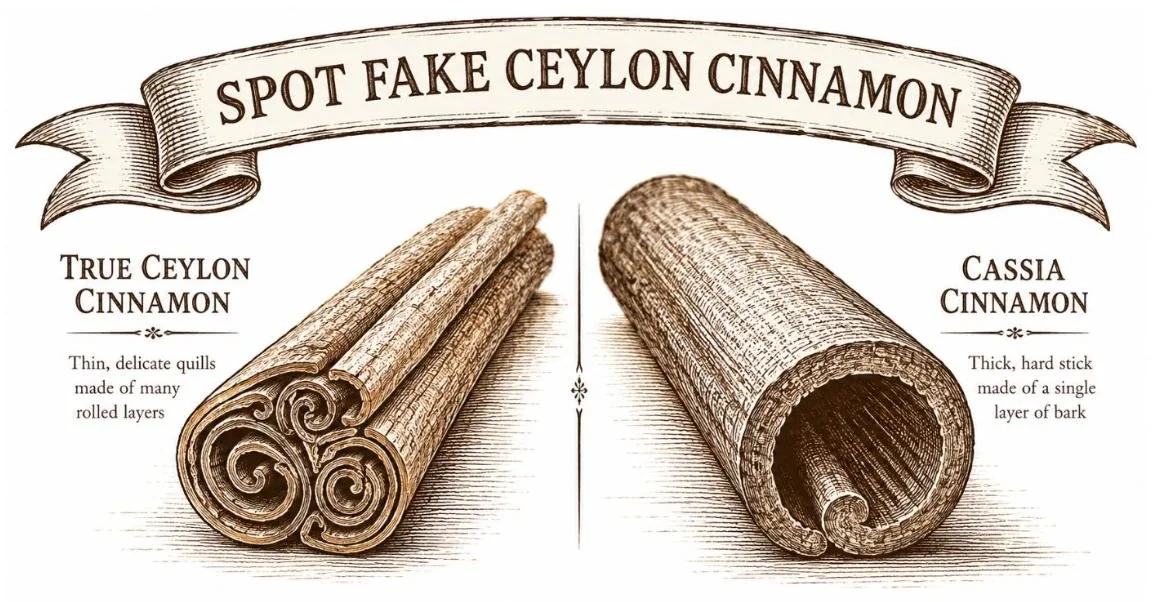
    The easiest way to spot fake Ceylon cinnamon is to look at the shape and feel of the stick: true Ceylon cinnamon (Cinnamomum verum) forms thin, brittle quills made of many soft, papery layers rolled tightly together, while the “fake” cinnamon sold in most supermarkets is usually cassia, a single, thick, hard, hollow curl of dark reddish-brown bark. In powder form the clues are subtler, but colour, aroma and taste still give it away.

    Most “fake” Ceylon cinnamon is not a deliberate forgery so much as a case of mistaken identity: cheaper cassia bark sold under the single word “cinnamon”. This guide shows you exactly what to look for, whether you are holding a stick, a jar of powder, or reading a label, so you can tell genuine Cinnamomum verum from the imposters. For the full picture, see our pillar guide on how to identify authentic Ceylon cinnamon.

    What does “fake” Ceylon cinnamon actually mean?

    “Fake” Ceylon cinnamon usually means cassia cinnamon being passed off, knowingly or not, as true Ceylon cinnamon. Cassia comes from several related trees (such as Cinnamomum cassia and Cinnamomum burmannii) grown mainly in China, Indonesia and Vietnam. It is a genuine spice in its own right and perfectly legal to sell, but it is coarser, cheaper and chemically different from true Ceylon cinnamon, which comes almost entirely from Sri Lanka. The confusion arises because in many countries both barks are simply labelled “cinnamon”. The full botanical contrast is set out in our guide to Ceylon cinnamon vs cassia.

    Less commonly, “fake” can also mean powder that has been bulked out with fillers, or old, stale stock sold as premium spice. The checks below help with all of these cases.

    How to spot fake cinnamon sticks (quills)

    Whole sticks are the easiest form to judge, because the physical structure of the bark is very hard to fake.

    Look at the layers

    Break or look at the end of the stick. True Ceylon cinnamon is made of many thin layers rolled up like a fine cigar or a rolled newspaper, so the cross-section looks like the rings of a tightly wound scroll. Cassia is typically a single thick layer curled into a hard tube, often with a hollow centre and only one or two curls. If you see one thick, woody wall instead of many delicate layers, you are almost certainly holding cassia.

    Check the thickness and hardness

    Genuine Ceylon quills are thin and brittle, you can usually snap them easily by hand or even crumble them between your fingers. Cassia bark is thick, hard and woody; it resists breaking and often needs a grinder. If a “cinnamon” stick feels like a piece of tough bark that won’t yield, that hardness is a strong sign it is cassia.

    Judge the colour

    True Ceylon cinnamon is a light tan or pale golden-brown. Cassia is a noticeably darker, reddish or chocolate brown. Colour alone is not proof, because lighting and age vary, but a very dark, uniform stick leans strongly toward cassia.

    Smell and taste

    Ceylon cinnamon has a delicate, sweet, warm and complex aroma with citrus and floral notes. Cassia smells and tastes stronger, harsher and more “spicy-hot”, with a pungent bite. If the flavour is aggressive and one-dimensional rather than subtle and layered, it is likely cassia. The finer flavour of Ceylon cinnamon is one reason it is prized in cooking, as covered in our guide to culinary uses of Ceylon cinnamon.

    Quick comparison: Ceylon vs cassia sticks

    At-a-glance signs for telling true Ceylon cinnamon from cassia sticks.
    FeatureTrue Ceylon cinnamonCassia (often sold as “cinnamon”)
    LayersMany thin, papery layers rolled upSingle thick, hard layer
    TextureThin and brittle, snaps easilyThick, hard and woody
    ColourLight tan / pale brownDark reddish or chocolate brown
    AromaSweet, delicate, complexStrong, harsh, pungent
    ShapeSolid, tightly filled quillOften a single hollow curl

    How to spot fake cinnamon powder

    Powder is harder to judge because grinding removes the tell-tale layered structure. Still, several clues remain.

    Colour of the powder

    Ceylon cinnamon powder is a lighter tan-brown, while cassia powder tends to be a darker reddish-brown. If you have known-genuine Ceylon powder to compare against, the difference is often visible side by side.

    Aroma and flavour

    As with sticks, Ceylon powder smells mild, sweet and layered, whereas cassia is sharper and more intense. A cheap “cinnamon” that overwhelms a dish with a hot, biting note is more likely cassia.

    Be alert to fillers

    Very cheap ground “cinnamon” is occasionally bulked out with other ground plant material or starches. You cannot reliably detect this by eye, which is why the source and packaging matter so much. Buying whole quills and grinding them yourself removes most of this risk, a strategy discussed in our Ceylon cinnamon buying guide.

    Read the label carefully

    Labels are one of the most reliable tools you have, if you know what to look for.

    Look for the botanical name

    Genuine Ceylon cinnamon lists Cinnamomum verum (sometimes written Cinnamomum zeylanicum) on the packaging. If the label only says “cinnamon” with no species, or names Cinnamomum cassia or Cinnamomum burmannii, you are not looking at true Ceylon cinnamon. The word “verum” literally means “true”, and it is the clearest label-level signal there is.

    Check the country of origin

    True Ceylon cinnamon comes overwhelmingly from Sri Lanka (historically called Ceylon). Cassia is grown mainly in China, Indonesia and Vietnam. An origin of Sri Lanka, combined with the Cinnamomum verum name, is a strong pair of signals. The farming tradition behind this origin is described in our guide to Sri Lankan cinnamon farming.

    Be sceptical of vague marketing

    Terms like “premium”, “true” or “gourmet” on the front of a pack mean nothing on their own. Turn the packet over and read the ingredients and botanical name. If a product markets itself as Ceylon cinnamon but hides or omits the species and origin, treat that as a warning sign.

    Why price is a clue (but not proof)

    True Ceylon cinnamon is more labour-intensive to harvest and process than cassia, so it almost always costs more. If a product is branded “Ceylon” but priced the same as ordinary bulk cinnamon, be cautious, the price may be too good to be true. That said, a high price alone does not guarantee authenticity, so always combine the price signal with the structural, sensory and label checks above. Why genuine Ceylon cinnamon commands a premium is tied to how it is grown and peeled, covered in how Ceylon cinnamon is made.

    Understanding grades helps too

    Even among genuine Ceylon cinnamon there are different grades, from the delicate Alba quills to coarser grades. Knowing the grading system helps you judge whether a premium price is justified and whether the product matches its description, rather than being over-sold. Our complete guide to Ceylon cinnamon grades explains what the grade names mean and how quality is classified.

    A simple three-step authenticity check

    If you want a quick routine to apply in a shop or kitchen, use these three steps in order.

    Step 1: Read the label

    Look for Cinnamomum verum (or zeylanicum) and an origin of Sri Lanka. No species named usually means cassia.

    Step 2: Inspect the stick

    If you can see whole quills, check for many thin layers, a light tan colour, and a stick that feels thin and brittle rather than hard and woody.

    Step 3: Smell and taste

    Genuine Ceylon cinnamon is sweet, mild and complex. A harsh, hot, one-note “cinnamon” flavour points to cassia.

    Summary

    Spotting fake Ceylon cinnamon comes down to a handful of reliable signals. Most “fakes” are simply cassia sold under the generic name “cinnamon”, so the key is to distinguish the two. Whole sticks are easiest: true Ceylon cinnamon forms thin, brittle quills of many papery layers in a pale tan colour, while cassia is a hard, thick, dark, often hollow curl. In powder form, rely on colour, a mild sweet aroma, and, above all, the label, which should name Cinnamomum verum and an origin of Sri Lanka. Combine the physical checks, the sensory checks and the label together, use price as a supporting clue, and you can buy true Ceylon cinnamon with confidence.

    Frequently asked questions

    How can I tell if my cinnamon is real Ceylon cinnamon?

    Check the stick and the label. True Ceylon cinnamon forms thin, brittle quills of many rolled layers in a light tan colour, and its packaging names Cinnamomum verum with an origin of Sri Lanka. Hard, dark, single-layer sticks are usually cassia.

    Is supermarket cinnamon fake?

    Not fake, but usually cassia rather than true Ceylon cinnamon. Most inexpensive “cinnamon” is genuine cassia bark, which is a real spice but botanically different from Cinnamomum verum. Check the label for the species and origin to be sure.

    Does colour tell you if cinnamon is fake?

    Colour is a useful clue but not proof. Ceylon cinnamon is usually a lighter tan, while cassia is darker and more reddish. Because lighting and age affect colour, combine it with the layered-stick test and the label check.

    Why is real Ceylon cinnamon more expensive?

    Because it is harvested and hand-peeled with more care and comes mainly from Sri Lanka, its production is more labour-intensive than cassia. A “Ceylon” product priced like ordinary bulk cinnamon should be treated with caution.

    This website provides educational information about Ceylon Cinnamon as a spice and food ingredient. It is not intended to provide medical advice or make health claims.
  • How to Identify Authentic Ceylon Cinnamon

    How to Identify Authentic Ceylon Cinnamon

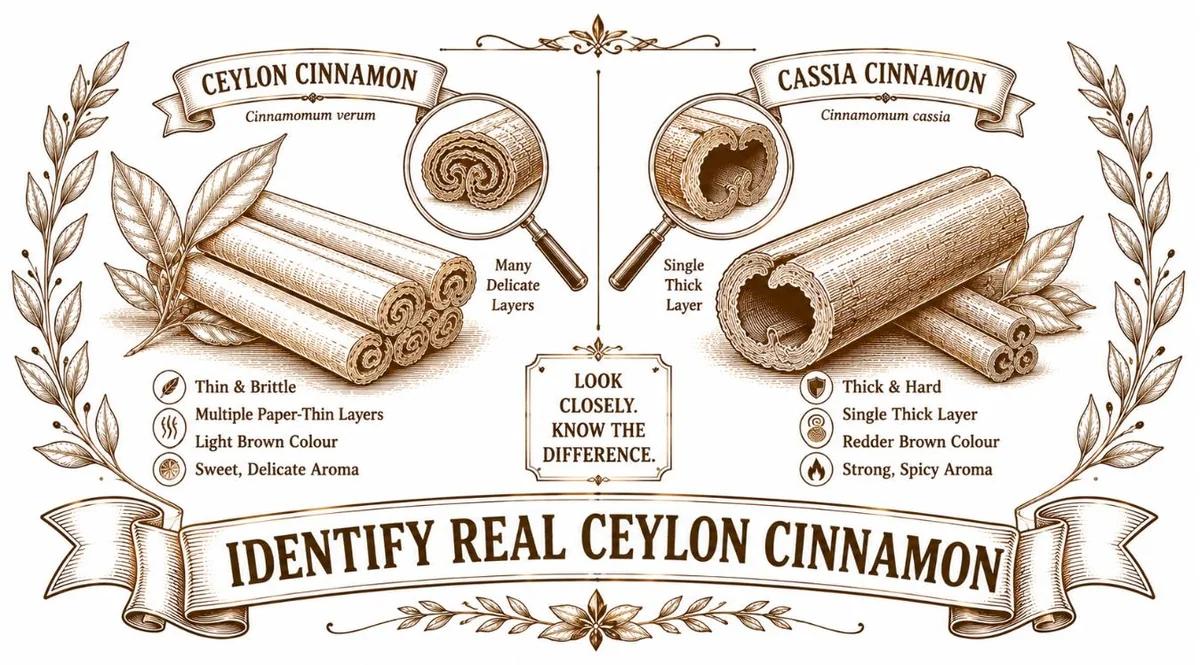
    You can identify authentic Ceylon cinnamon by its light tan colour, its thin bark rolled into many nested layers, its brittle texture that crumbles easily, its sweet and delicate aroma, and a label that names Cinnamomum verum and Sri Lanka. Cassia, the common substitute, is dark, thick, hard and single-curled. A few simple checks at home will tell the two apart with confidence.

    Because both true cinnamon and cassia are often sold simply as “cinnamon,” telling them apart is a practical skill worth having. This guide gives you clear visual, textural and aroma tests, plus label-reading tips. For the underlying differences, see Ceylon cinnamon vs cassia.

    The quick 5-point check

    Five fast ways to distinguish Ceylon cinnamon from cassia.
    CheckCeylon cinnamonCassia
    ColourLight tan / goldenDark reddish-brown
    Bark & rollThin, many layers, like a rolled cigarThick, single hollow curl
    TextureBrittle, crumbles by handHard, difficult to snap
    AromaSweet, delicate, fragrantStrong, hot, pungent
    LabelSays Cinnamomum verum / Ceylon / Sri LankaOften just “cinnamon,” or names cassia

    1. Look at the colour

    Genuine Ceylon cinnamon is a pale, warm tan, sometimes almost golden. Cassia is noticeably darker and redder. Colour alone is not definitive, but combined with the other checks it is a strong first clue, and it applies to powder too, where Ceylon tends to be lighter brown and cassia a deeper rusty red.

    2. Examine the roll and bark thickness

    This is the most reliable visual test. Look at the end of the stick. A Ceylon quill is made of many thin layers of fine bark rolled tightly together, so the cross-section looks like a coiled newspaper or cigar. Cassia is a single thick curl, often hollow in the middle, formed from one hard layer of bark. If you see one solid tube, it is almost certainly cassia.

    3. Test the texture

    Ceylon cinnamon’s thin bark is brittle. Press or snap a quill and it tends to crack and crumble into flaky layers, you can often break it with your fingers. Cassia is hard and woody, difficult to snap by hand, and usually needs a sturdy grinder. This “snap test” is quick and telling.

    4. Smell the aroma

    Ceylon cinnamon has a sweet, warm, fragrant aroma with subtle floral and citrus notes. Cassia smells stronger and hotter, more one-dimensional and sometimes slightly harsh. With a little practice the difference in the nose is easy to recognise, and it carries through into the flavour of finished dishes, as discussed in culinary uses of Ceylon cinnamon.

    5. Read the label carefully

    Authentic Ceylon cinnamon will usually state one or more of the following: Cinnamomum verum (or the older Cinnamomum zeylanicum), “true cinnamon,” “Ceylon cinnamon,” and Sri Lanka as the country of origin. Be cautious of jars labelled simply “cinnamon” with no species or origin, these are usually cassia. Watch too for the assumption that “organic” means Ceylon: organic refers to how it was grown, not to the species, so an organic product can still be cassia.

    Identifying Ceylon cinnamon powder

    Powder is harder to judge because you cannot inspect the quill. Rely on colour (Ceylon is a lighter brown), aroma (sweeter and more delicate), and above all a trustworthy, clearly labelled source that names the species and origin. When in doubt, buy whole quills you can inspect and grind them yourself.

    Common ways cinnamon is mislabelled

    Most mislabelling is not deliberate fraud but the loose use of the word “cinnamon” for what is really cassia. Because cassia dominates the mass market, shoppers often pay Ceylon prices for cassia, or assume the harsher cassia flavour is what cinnamon is “supposed” to taste like. Knowing the checks above protects you, and pairs naturally with the advice in our buying guide.

    Identifying by taste

    If you are able to taste a small amount, the difference is clear. Ceylon cinnamon is mild, sweet and mellow, dissolving into a gentle warmth with subtle floral notes. Cassia delivers a sharper, hotter, more astringent hit that lingers and can slightly dry the mouth. Once you have tasted them side by side, the flavour test becomes one of the easiest ways to tell them apart, and it explains why the two behave so differently in the recipes covered in our culinary guide.

    Informal tests and their limits

    You may come across “home tests” for cinnamon online, such as judging by how a powder behaves in liquid. Treat these with caution: they are unreliable and can be affected by grind size, additives and freshness. The dependable checks remain the physical ones, colour, the multi-layered roll, brittleness and aroma, combined with honest labelling. There is no substitute for inspecting a whole quill and reading what the packaging actually states.

    Buying online safely

    When you cannot handle the product before buying, labelling and seller transparency become your main tools. Look for listings that clearly state Cinnamomum verum, name Sri Lanka as the origin, specify a grade, and show clear photographs of the quills’ layered ends. Be wary of listings that rely on vague health language instead of concrete product detail, or that price “cinnamon” suspiciously low. These same principles underpin our buying guide.

    Why labels can be misleading

    In many markets the word “cinnamon” can legally cover both true cinnamon and cassia, so a jar can be entirely accurate in calling cassia “cinnamon” while telling you nothing about the species. Country-of-origin labelling adds another layer: origin tells you where a product was packed or grown but not necessarily which species it is. The only reliable confirmation is an explicit botanical name plus a Sri Lankan origin, everything else is a clue rather than proof.

    What about the “curl” direction?

    People sometimes ask whether the way a stick curls reveals its type. The reliable structural clue is not the direction of the curl but the number of layers: Ceylon cinnamon is built from many thin sheets of inner bark rolled tightly together, so it looks layered like a rolled newspaper, while cassia forms one thick, hard curl that is often hollow. Focus on that layered cross-section rather than on which way the ends turn. Combined with colour, brittleness and aroma, the layered structure is the most dependable visual test of all.

    Putting the checks together

    No single test is foolproof on its own, but together the checks are decisive. Imagine picking up an unlabelled stick: if it is pale tan, made of many thin layers rolled like a cigar, crumbles when you press it, and smells sweetly fragrant, you can be confident it is Ceylon cinnamon. If it is dark and reddish, a single hard curl, difficult to snap, and smells hot and sharp, it is cassia. The more of these signals point the same way, the more certain you can be. Whole quills are always easier to judge than powder, which is why buying sticks and grinding your own is the surest route to authenticity.

    Why identification is worth the effort

    Learning these checks pays off in three ways. You avoid paying a premium for cassia sold loosely as “cinnamon”; you get the delicate flavour that recipes calling for true cinnamon actually intend; and you can enjoy the naturally low coumarin content of Ceylon cinnamon when you use the spice often. Pair this identification know-how with the practical advice in our buying guide and the background in what is true Ceylon cinnamon, and you will rarely be fooled again.

    Summary

    To identify authentic Ceylon cinnamon, look for a pale tan colour, thin bark rolled into many nested layers, a brittle texture that crumbles easily, and a sweet, delicate aroma, then confirm with a label naming Cinnamomum verum and Sri Lanka. Cassia, by contrast, is dark, thick, hard, single-curled and pungent. For powder, trust colour, aroma and a reputable labelled source, or grind your own from quills. A handful of simple checks is all it takes to be sure you have the real thing.

    Frequently asked questions

    How can I tell if my cinnamon is Ceylon or cassia?

    Check the roll: Ceylon has many thin layers like a cigar and crumbles easily, while cassia is a single hard, thick curl. Ceylon is also paler and sweeter smelling.

    Does “organic” mean it is Ceylon cinnamon?

    No. Organic describes how the plant was grown, not the species. Organic cinnamon can still be cassia, so check for Cinnamomum verum and Sri Lanka on the label.

    Can I identify Ceylon cinnamon powder?

    It is harder. Ceylon powder is usually lighter brown with a sweeter, more delicate aroma, but the safest approach is a clearly labelled trusted source or grinding your own quills.

    Is lighter-coloured cinnamon always Ceylon?

    Colour is a useful clue but not proof on its own. Combine it with the bark structure, texture, aroma and label checks for confidence.

    This website provides educational information about Ceylon Cinnamon as a spice and food ingredient. It is not intended to provide medical advice or make health claims.