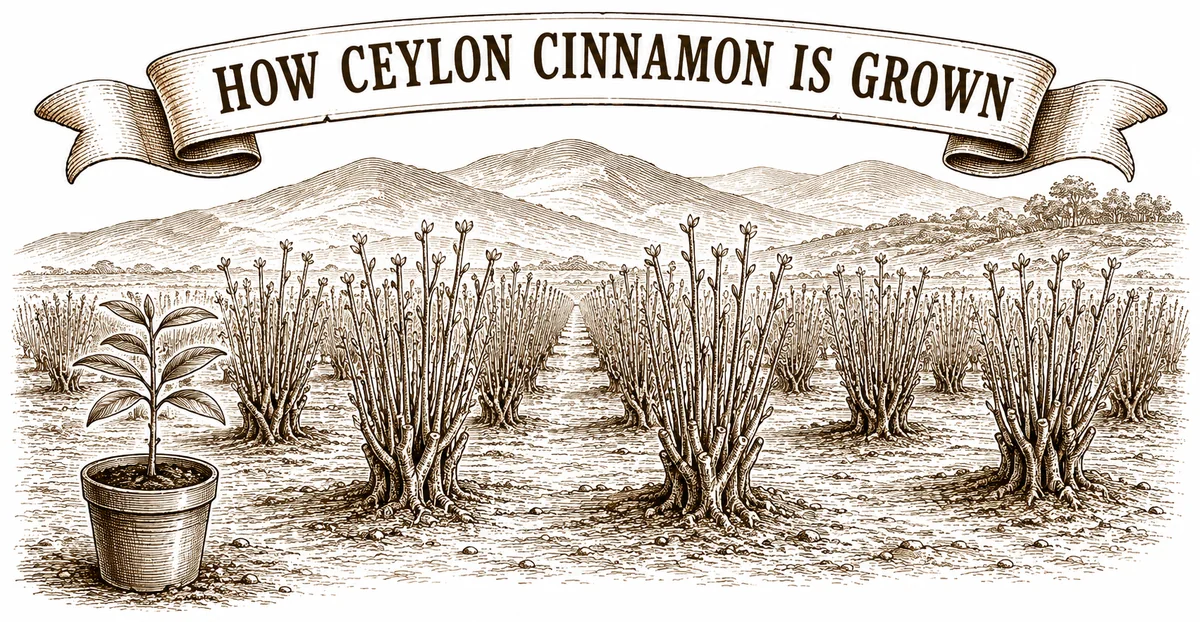
Ceylon cinnamon is grown from young plants raised in nurseries and set out in warm, humid, low-country gardens in Sri Lanka, where the trees are cut back low and encouraged to send up many slender shoots rather than grow into tall trees. Those shoots, not the trunk, are what eventually become cinnamon, so growing the crop is really about managing a dense thicket of young stems year after year.
This guide explains how true Ceylon cinnamon (Cinnamomum verum) is grown from the ground up: how the plants are propagated, where and how they are planted, the conditions they need, and how a cinnamon garden is managed through its long productive life. For the wider picture of cultivation in Sri Lanka, see our pillar guide on Sri Lankan cinnamon farming.
What does it mean to “grow” Ceylon cinnamon?
Growing Ceylon cinnamon means cultivating Cinnamomum verum as a coppiced bush rather than a full-sized tree, so that it continually produces the slender shoots whose bark becomes the spice. Left alone, the plant would grow into a tree many metres tall, but growers keep it low and multi-stemmed by cutting it back. Each harvest removes mature shoots and stimulates fresh ones, so a single well-managed plant keeps producing for many years. Understanding the spice itself helps here, as explained in our guide to what is true Ceylon cinnamon.
Where Ceylon cinnamon grows best
Ceylon cinnamon thrives in the warm, humid lowlands of Sri Lanka, particularly the wet zone near the south-western coast. A few conditions matter most.
Climate
The plant favours a hot, humid tropical climate with generous, fairly evenly spread rainfall and steady warmth through the year. Consistent moisture keeps the plants growing actively, which supports the frequent flushes of new shoots that growers rely on.
Soil
Cinnamon does well in well-drained sandy or loamy soils. Sandy coastal soils are traditionally associated with fine, fragrant cinnamon, while waterlogged ground is unsuitable because the roots dislike sitting in water. Good drainage combined with steady rainfall is the ideal balance.
Elevation
The crop is mainly a low-country one, grown from near sea level up into the lower hills. These warm elevations suit its growth and are part of why the coastal districts of the south-west became the heartland of Ceylon cinnamon.
How Ceylon cinnamon plants are propagated
New cinnamon plants are started before they ever reach the garden, usually in a nursery.
From seed
Cinnamon can be grown from seed, collected from ripe fruits and sown fresh, since the seeds lose viability quickly if stored. Seedlings are raised in nursery beds or bags until they are strong enough to transplant.
From cuttings and division
Growers also propagate cinnamon vegetatively, for example from cuttings or by dividing rooted material, which can help reproduce plants with desirable qualities. Whichever method is used, the aim is a healthy young plant with a good root system ready for planting out.
Planting out a cinnamon garden
Once seedlings are established, they are transplanted into the field, traditionally at the start of a rainy period so the young plants settle in with plenty of moisture. They are set out in rows at spacings that allow each plant room to form a clump of shoots while keeping the garden dense enough to be productive. In the early months the young plants are weeded and tended while they establish their roots and begin to grow. This early cultivation is the foundation of the garden’s later productivity, and it flows naturally into the harvesting cycle described in our guide to how Ceylon cinnamon is harvested.
Coppicing: the key to growing cinnamon
The single most important growing technique is coppicing, cutting the young plant back close to the ground once it is established. Instead of one main stem growing tall, the cut plant responds by sending up a cluster of new shoots from the base. These multiple slender shoots are exactly what the grower wants, because straight, thin stems yield the finest bark. From then on, the plant is managed as a low, many-stemmed bush, with shoots harvested and new ones continually replacing them. This regenerative cycle is why a cinnamon garden can keep producing for decades from the same rootstock.
How long before a cinnamon plant can be harvested?
A newly planted cinnamon garden needs a few years before the first harvest. The young plants must grow, be coppiced, and produce shoots of the right size and maturity, which typically takes around two to three years from planting before worthwhile harvesting begins. After that first cutting, the plant is in production, and shoots can be taken repeatedly as they reach the right stage. The judgement of when a shoot is ready, straight, evenly coloured and of suitable thickness, is central to both growing and harvesting, and shapes the quality of the finished spice, as our guide to how Ceylon cinnamon is made explains.
Caring for a growing cinnamon garden
A productive garden needs ongoing attention rather than being left to itself.
Weeding and soil care
Young plants especially need to be kept clear of competing weeds, and the soil is looked after to keep it fertile and well drained. Healthy soil supports the steady flush of shoots the crop depends on.
Managing shade and spacing
Growers manage how much light the plants receive and keep the spacing of shoots in balance, removing weak or crowded stems so that strong, straight shoots can develop. This shaping of the bush is part of the everyday craft of cinnamon growing.
Protecting the plants
Like any crop, cinnamon can face pests and diseases, and growers watch for these and manage them to keep the garden vigorous. A well-tended garden produces cleaner, more uniform shoots and therefore better cinnamon.
Ceylon cinnamon growing at a glance
| Stage | What happens |
|---|---|
| Propagation | Plants raised from fresh seed or cuttings in a nursery |
| Planting | Seedlings transplanted to warm, humid, well-drained land |
| Establishment | Young plants weeded and tended for the first years |
| Coppicing | Plants cut back low to force many slender shoots |
| Production | Shoots harvested repeatedly; new shoots regrow for decades |
Why the way cinnamon is grown matters
Every choice in the garden echoes through to the finished spice. Suitable climate and soil, careful propagation, correct spacing, and above all skilful coppicing all lead to straight, even, healthy shoots that peel into fine, fragrant quills. Poorly grown or neglected plants produce crooked, uneven stems that yield lower-grade bark. In other words, growing Ceylon cinnamon well is the first and most fundamental step in producing a premium spice, long before any peeling begins. It is also why genuine Ceylon cinnamon, grown this way in its traditional home, is so closely tied to Sri Lanka, a connection covered throughout our guide to Sri Lankan cinnamon farming.
Summary
Ceylon cinnamon is grown by cultivating Cinnamomum verum as a low, coppiced bush in the warm, humid, well-drained lowlands of Sri Lanka. Plants are raised from fresh seed or cuttings in a nursery, transplanted into the field during a rainy period, and tended as they establish. The defining technique is coppicing: cutting the young plant back so it sends up many slender shoots, which are the source of the spice. After roughly two to three years the first shoots are ready, and thereafter the same plants keep producing for decades as shoots are harvested and continually regrow. Good climate, soil, spacing and care all combine to produce the straight, even shoots that make fine cinnamon, making the way the crop is grown the true foundation of its quality.
Frequently asked questions
How is Ceylon cinnamon grown?
It is grown by cultivating the Cinnamomum verum plant as a low, multi-stemmed bush in warm, humid, well-drained land in Sri Lanka, then cutting it back (coppicing) so it produces many slender shoots whose bark becomes cinnamon.
What conditions does cinnamon need to grow?
Ceylon cinnamon prefers a hot, humid tropical climate with steady rainfall, warm low-country elevations, and well-drained sandy or loamy soil. Waterlogged ground is unsuitable because the roots dislike sitting in water.
How long does it take to grow cinnamon before harvest?
A new garden usually needs around two to three years from planting before the first worthwhile harvest, once the plants have grown, been coppiced and produced shoots of suitable size. After that the plant stays in production for many years.
Is cinnamon grown as a tree or a bush?
Although the plant would naturally become a tree, growers keep it as a low, coppiced bush. Cutting it back forces a cluster of slender shoots, which are far more useful for producing fine bark than a single tall trunk.
This website provides educational information about Ceylon Cinnamon as a spice and food ingredient. It is not intended to provide medical advice or make health claims.
Leave a Reply