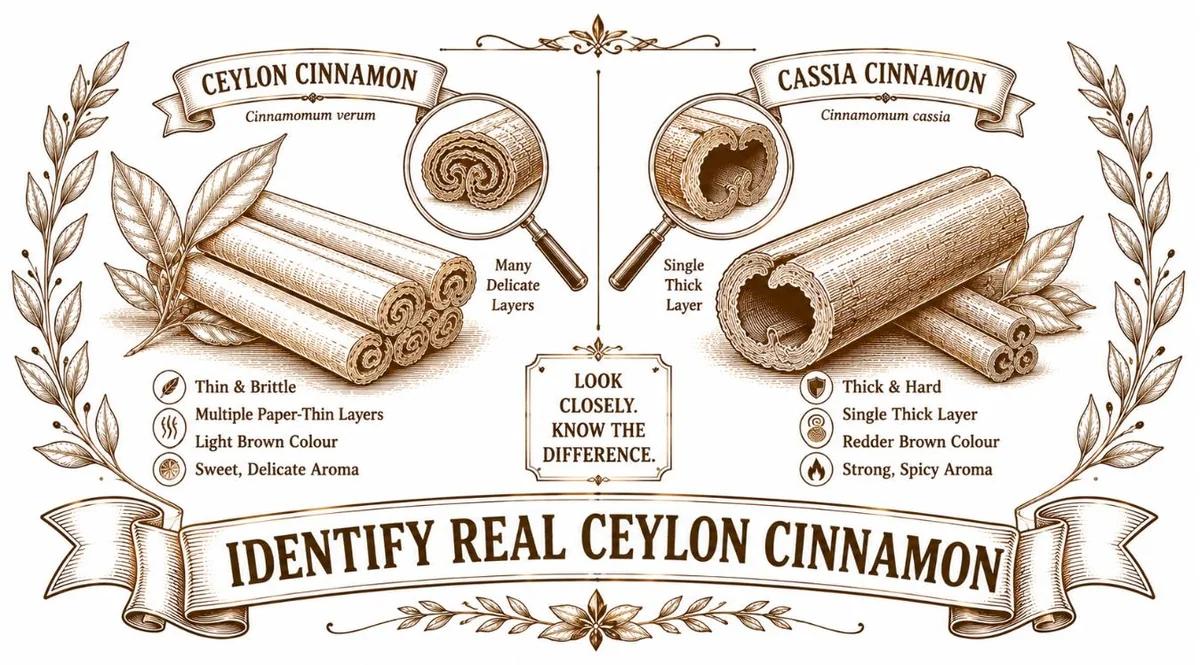
You can identify authentic Ceylon cinnamon by its light tan colour, its thin bark rolled into many nested layers, its brittle texture that crumbles easily, its sweet and delicate aroma, and a label that names Cinnamomum verum and Sri Lanka. Cassia, the common substitute, is dark, thick, hard and single-curled. A few simple checks at home will tell the two apart with confidence.
Because both true cinnamon and cassia are often sold simply as “cinnamon,” telling them apart is a practical skill worth having. This guide gives you clear visual, textural and aroma tests, plus label-reading tips. For the underlying differences, see Ceylon cinnamon vs cassia.
The quick 5-point check
| Check | Ceylon cinnamon | Cassia |
|---|---|---|
| Colour | Light tan / golden | Dark reddish-brown |
| Bark & roll | Thin, many layers, like a rolled cigar | Thick, single hollow curl |
| Texture | Brittle, crumbles by hand | Hard, difficult to snap |
| Aroma | Sweet, delicate, fragrant | Strong, hot, pungent |
| Label | Says Cinnamomum verum / Ceylon / Sri Lanka | Often just “cinnamon,” or names cassia |
1. Look at the colour
Genuine Ceylon cinnamon is a pale, warm tan, sometimes almost golden. Cassia is noticeably darker and redder. Colour alone is not definitive, but combined with the other checks it is a strong first clue, and it applies to powder too, where Ceylon tends to be lighter brown and cassia a deeper rusty red.
2. Examine the roll and bark thickness
This is the most reliable visual test. Look at the end of the stick. A Ceylon quill is made of many thin layers of fine bark rolled tightly together, so the cross-section looks like a coiled newspaper or cigar. Cassia is a single thick curl, often hollow in the middle, formed from one hard layer of bark. If you see one solid tube, it is almost certainly cassia.
3. Test the texture
Ceylon cinnamon’s thin bark is brittle. Press or snap a quill and it tends to crack and crumble into flaky layers, you can often break it with your fingers. Cassia is hard and woody, difficult to snap by hand, and usually needs a sturdy grinder. This “snap test” is quick and telling.
4. Smell the aroma
Ceylon cinnamon has a sweet, warm, fragrant aroma with subtle floral and citrus notes. Cassia smells stronger and hotter, more one-dimensional and sometimes slightly harsh. With a little practice the difference in the nose is easy to recognise, and it carries through into the flavour of finished dishes, as discussed in culinary uses of Ceylon cinnamon.
5. Read the label carefully
Authentic Ceylon cinnamon will usually state one or more of the following: Cinnamomum verum (or the older Cinnamomum zeylanicum), “true cinnamon,” “Ceylon cinnamon,” and Sri Lanka as the country of origin. Be cautious of jars labelled simply “cinnamon” with no species or origin, these are usually cassia. Watch too for the assumption that “organic” means Ceylon: organic refers to how it was grown, not to the species, so an organic product can still be cassia.
Identifying Ceylon cinnamon powder
Powder is harder to judge because you cannot inspect the quill. Rely on colour (Ceylon is a lighter brown), aroma (sweeter and more delicate), and above all a trustworthy, clearly labelled source that names the species and origin. When in doubt, buy whole quills you can inspect and grind them yourself.
Common ways cinnamon is mislabelled
Most mislabelling is not deliberate fraud but the loose use of the word “cinnamon” for what is really cassia. Because cassia dominates the mass market, shoppers often pay Ceylon prices for cassia, or assume the harsher cassia flavour is what cinnamon is “supposed” to taste like. Knowing the checks above protects you, and pairs naturally with the advice in our buying guide.
Identifying by taste
If you are able to taste a small amount, the difference is clear. Ceylon cinnamon is mild, sweet and mellow, dissolving into a gentle warmth with subtle floral notes. Cassia delivers a sharper, hotter, more astringent hit that lingers and can slightly dry the mouth. Once you have tasted them side by side, the flavour test becomes one of the easiest ways to tell them apart, and it explains why the two behave so differently in the recipes covered in our culinary guide.
Informal tests and their limits
You may come across “home tests” for cinnamon online, such as judging by how a powder behaves in liquid. Treat these with caution: they are unreliable and can be affected by grind size, additives and freshness. The dependable checks remain the physical ones, colour, the multi-layered roll, brittleness and aroma, combined with honest labelling. There is no substitute for inspecting a whole quill and reading what the packaging actually states.
Buying online safely
When you cannot handle the product before buying, labelling and seller transparency become your main tools. Look for listings that clearly state Cinnamomum verum, name Sri Lanka as the origin, specify a grade, and show clear photographs of the quills’ layered ends. Be wary of listings that rely on vague health language instead of concrete product detail, or that price “cinnamon” suspiciously low. These same principles underpin our buying guide.
Why labels can be misleading
In many markets the word “cinnamon” can legally cover both true cinnamon and cassia, so a jar can be entirely accurate in calling cassia “cinnamon” while telling you nothing about the species. Country-of-origin labelling adds another layer: origin tells you where a product was packed or grown but not necessarily which species it is. The only reliable confirmation is an explicit botanical name plus a Sri Lankan origin, everything else is a clue rather than proof.
What about the “curl” direction?
People sometimes ask whether the way a stick curls reveals its type. The reliable structural clue is not the direction of the curl but the number of layers: Ceylon cinnamon is built from many thin sheets of inner bark rolled tightly together, so it looks layered like a rolled newspaper, while cassia forms one thick, hard curl that is often hollow. Focus on that layered cross-section rather than on which way the ends turn. Combined with colour, brittleness and aroma, the layered structure is the most dependable visual test of all.
Putting the checks together
No single test is foolproof on its own, but together the checks are decisive. Imagine picking up an unlabelled stick: if it is pale tan, made of many thin layers rolled like a cigar, crumbles when you press it, and smells sweetly fragrant, you can be confident it is Ceylon cinnamon. If it is dark and reddish, a single hard curl, difficult to snap, and smells hot and sharp, it is cassia. The more of these signals point the same way, the more certain you can be. Whole quills are always easier to judge than powder, which is why buying sticks and grinding your own is the surest route to authenticity.
Why identification is worth the effort
Learning these checks pays off in three ways. You avoid paying a premium for cassia sold loosely as “cinnamon”; you get the delicate flavour that recipes calling for true cinnamon actually intend; and you can enjoy the naturally low coumarin content of Ceylon cinnamon when you use the spice often. Pair this identification know-how with the practical advice in our buying guide and the background in what is true Ceylon cinnamon, and you will rarely be fooled again.
Summary
To identify authentic Ceylon cinnamon, look for a pale tan colour, thin bark rolled into many nested layers, a brittle texture that crumbles easily, and a sweet, delicate aroma, then confirm with a label naming Cinnamomum verum and Sri Lanka. Cassia, by contrast, is dark, thick, hard, single-curled and pungent. For powder, trust colour, aroma and a reputable labelled source, or grind your own from quills. A handful of simple checks is all it takes to be sure you have the real thing.
Frequently asked questions
How can I tell if my cinnamon is Ceylon or cassia?
Check the roll: Ceylon has many thin layers like a cigar and crumbles easily, while cassia is a single hard, thick curl. Ceylon is also paler and sweeter smelling.
Does “organic” mean it is Ceylon cinnamon?
No. Organic describes how the plant was grown, not the species. Organic cinnamon can still be cassia, so check for Cinnamomum verum and Sri Lanka on the label.
Can I identify Ceylon cinnamon powder?
It is harder. Ceylon powder is usually lighter brown with a sweeter, more delicate aroma, but the safest approach is a clearly labelled trusted source or grinding your own quills.
Is lighter-coloured cinnamon always Ceylon?
Colour is a useful clue but not proof on its own. Combine it with the bark structure, texture, aroma and label checks for confidence.
This website provides educational information about Ceylon Cinnamon as a spice and food ingredient. It is not intended to provide medical advice or make health claims.
Leave a Reply