Tag: Ceylon cinnamon

  • Cinnamon Sticks: Everything You Need to Know

    Cinnamon Sticks: Everything You Need to Know

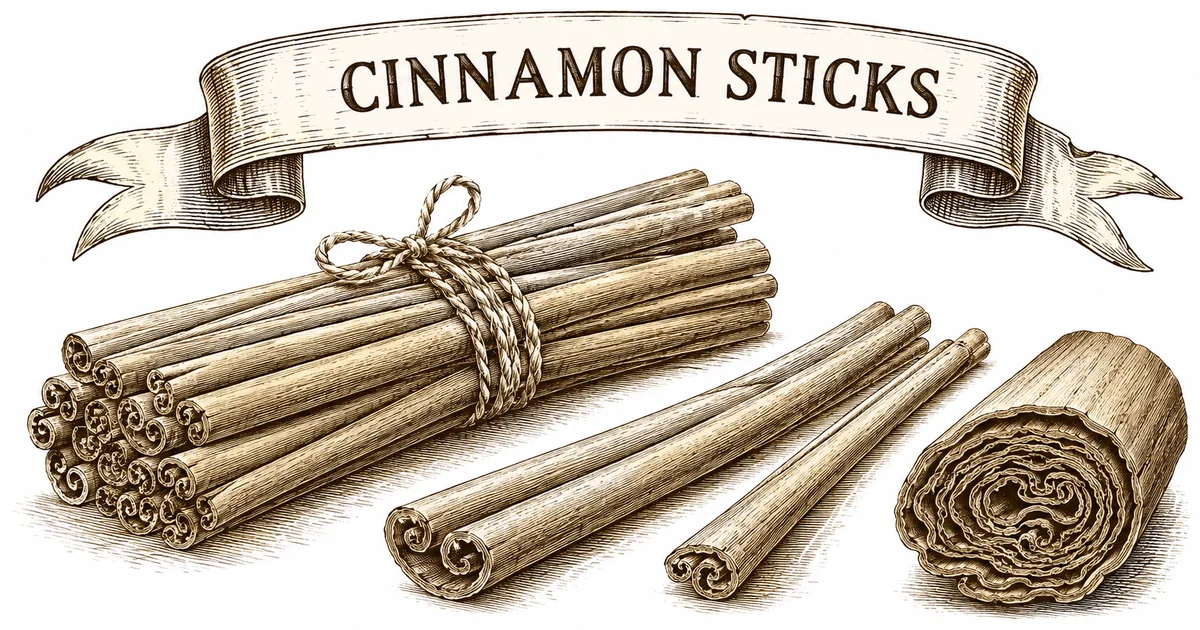
    Cinnamon sticks, also called quills, are simply lengths of dried cinnamon bark that have curled into a roll as they dry. In true Ceylon cinnamon they are made of many thin, papery layers rolled tightly together, which is why genuine Ceylon sticks are pale, brittle and easily crumbled, unlike the hard, thick single curl of a cassia stick. They are one of the most versatile and long-lasting ways to buy and use cinnamon.

    This guide covers everything you need to know about cinnamon sticks: what they are, how “sticks” and “quills” differ, how Ceylon and cassia sticks compare, the sizes and grades you will see, how to use them, and how they compare with ground cinnamon. For the wider context of forms and quality, see our pillar guide on Ceylon cinnamon grades.

    What is a cinnamon stick?

    A cinnamon stick is a piece of dried cinnamon bark that has rolled into a tube or scroll as it dried. When cinnamon is harvested, the thin inner bark is peeled from the shoots and left to dry; as it loses moisture it naturally curls, forming the familiar stick shape. In true Ceylon cinnamon, several thin layers of bark are nested and rolled together, so the finished stick is made of many delicate sheets rather than one thick piece.

    Cinnamon sticks vs cinnamon quills: are they the same?

    In everyday use, “cinnamon stick” and “cinnamon quill” mean the same thing, a rolled length of dried cinnamon bark. “Quill” is the more traditional term used in the cinnamon trade, especially for Ceylon cinnamon, while “stick” is the common everyday word. So if you see Ceylon cinnamon sold as “quills,” these are simply cinnamon sticks by another name. The word quill nicely captures the way the fine Ceylon bark is rolled, much like a rolled scroll.

    Ceylon cinnamon sticks vs cassia sticks

    Not all cinnamon sticks are alike, and the difference is easiest to see in whole-stick form.

    How true Ceylon cinnamon sticks compare with cassia sticks.
    FeatureCeylon cinnamon sticksCassia sticks
    StructureMany thin layers rolled togetherOne thick, hard layer
    TextureThin, brittle, easy to crumbleHard and woody
    ColourPale tanDarker reddish-brown
    AromaSweet, delicate, complexStrong and pungent

    Because the structure of the stick is so hard to fake, whole sticks are one of the best ways to tell true Ceylon cinnamon from cassia, as explained in our guide to identifying authentic Ceylon cinnamon.

    Sizes and grades of cinnamon sticks

    Ceylon cinnamon sticks come in a range of lengths and thicknesses, and their quality is described by a grading system. Finer, thinner quills such as the delicate Alba grade are the most prized, while thicker grades are coarser. Sticks are also cut to different lengths for different markets and uses. Knowing the grade helps you judge quality and value, which is set out in our pillar guide to Ceylon cinnamon grades. For everyday cooking, a mid-range grade is usually perfectly good; the very finest grades are prized as much for their appearance and delicacy as for flavour.

    How to use cinnamon sticks

    Cinnamon sticks are wonderfully versatile, and they shine wherever you want to infuse flavour slowly and cleanly.

    Infusing liquids

    Drop a stick into simmering milk, cream, syrup, tea, mulled drinks, stews or rice dishes to release a gentle, even cinnamon flavour, then remove it before serving. This is one of the best ways to use sticks, and it avoids any powdery texture.

    Grinding your own powder

    Because whole sticks keep their aroma far longer than pre-ground cinnamon, many cooks grind sticks fresh as needed for a brighter flavour. Ceylon sticks are brittle and grind easily.

    Slow-cooked and savoury dishes

    Whole sticks are ideal for curries, pilaus, tagines and braises, where they can cook for a long time and be lifted out at the end. More ideas are covered in our guide to the culinary uses of Ceylon cinnamon.

    Cinnamon sticks vs ground cinnamon

    Both forms are useful, and choosing between them depends on the job. Whole sticks are best for infusing liquids, for long-cooked dishes, and for keeping cinnamon fresh, because their small surface area means they hold their aromatic oils for a long time. Ground cinnamon is more convenient for baking and for dishes where you want the flavour dispersed evenly through a batter or mix, but it loses its aroma more quickly once ground. A practical approach many cooks take is to keep whole sticks for infusing and long cooking, and a small, fresh jar of powder for baking, grinding more from sticks when needed. The trade-offs are part of buying well, as discussed in our Ceylon cinnamon buying guide.

    Can you reuse cinnamon sticks?

    Yes, up to a point. A cinnamon stick used to infuse a liquid can often be rinsed, dried and used once or twice more, though each use gives a milder flavour as its aromatic oils are gradually spent. A good test is aroma: if a rinsed, dried stick still smells sweet and fragrant when you snap or scrape it, it still has flavour to give; if it smells faint, it is spent. Reusing sticks is a nice way to get extra value from good-quality Ceylon cinnamon.

    How to store cinnamon sticks

    Cinnamon sticks are among the longest-lasting forms of the spice, but they still need protecting. Keep them in an airtight container in a cool, dark, dry place, away from heat, light and moisture. Stored this way, whole Ceylon cinnamon sticks stay fragrant for a few years, considerably longer than ground cinnamon. Full storage guidance is set out in our guide to how to store Ceylon cinnamon properly.

    Buying good cinnamon sticks

    When buying cinnamon sticks, the same principles apply as for any cinnamon: look for the botanical name Cinnamomum verum and a Sri Lankan origin if you want true Ceylon cinnamon, and favour sticks that are pale, thin and layered rather than hard, dark and single-walled. Being able to see whole sticks is an advantage, because their structure reveals so much about authenticity and quality. Whether you buy small quantities for everyday cooking or larger amounts of quills, choosing genuine, well-made sticks sets you up for the best flavour.

    Summary

    Cinnamon sticks, or quills, are lengths of dried cinnamon bark that curl as they dry. In true Ceylon cinnamon they are made of many thin, papery layers, making them pale, brittle and easy to crumble, in contrast to the hard, thick single curl of cassia. “Stick” and “quill” mean the same thing, with quill the traditional trade term. Sticks come in various grades and sizes, from delicate Alba to coarser grades, and they excel at infusing liquids, flavouring slow-cooked dishes and being ground fresh for a brighter powder. They keep their aroma far longer than ground cinnamon, can often be reused once or twice, and store best in an airtight container somewhere cool, dark and dry. For genuine flavour, choose pale, layered sticks of Cinnamomum verum from Sri Lanka.

    Frequently asked questions

    Are cinnamon sticks and quills the same thing?

    Yes. Both terms describe a rolled length of dried cinnamon bark. “Quill” is the traditional trade term, especially for Ceylon cinnamon, while “stick” is the everyday word.

    How can I tell a Ceylon cinnamon stick from a cassia stick?

    A Ceylon stick is pale, thin and made of many soft layers that crumble easily, while a cassia stick is dark, thick, hard and formed of a single woody curl. The layered structure is the clearest sign.

    Can you reuse a cinnamon stick?

    Often once or twice. After infusing, rinse and dry the stick; if it still smells sweet when snapped or scraped it has flavour left, though each use is milder. Once it smells faint, it is spent.

    Do cinnamon sticks last longer than ground cinnamon?

    Yes. Whole sticks have far less surface area exposed to air, so they keep their aroma for a few years when stored airtight, cool and dark, whereas ground cinnamon is best used within about six to twelve months.

    This website provides educational information about Ceylon Cinnamon as a spice and food ingredient. It is not intended to provide medical advice or make health claims.
  • What Is Cinnamaldehyde?

    What Is Cinnamaldehyde?

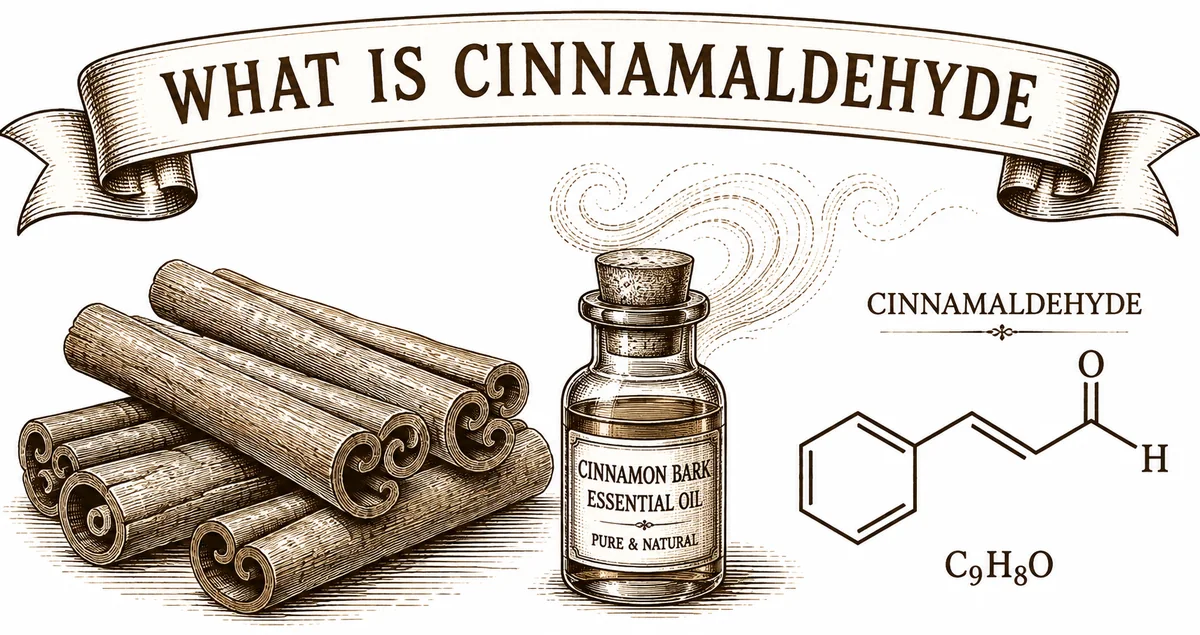
    Cinnamaldehyde is the naturally occurring organic compound that gives cinnamon its characteristic warm, sweet, spicy aroma and flavour, it is the main component of the essential oil in cinnamon bark. When you smell or taste cinnamon, cinnamaldehyde is the molecule most responsible for that unmistakable scent, and true Ceylon cinnamon (Cinnamomum verum) owes much of its fragrance to it.

    This guide gives a clear, non-technical explanation of what cinnamaldehyde is, where it comes from in the plant, why it matters for aroma and flavour, and how it relates to other compounds found in cinnamon. It is an educational look at the chemistry of a spice, not health advice. For the bigger picture of the spice itself, see our pillar guide on what is true Ceylon cinnamon.

    What is cinnamaldehyde, simply put?

    Cinnamaldehyde is an aromatic organic compound (an aldehyde) that occurs naturally in cinnamon and is the principal substance responsible for cinnamon’s smell and taste. In plain terms, it is the “cinnamon molecule”, the ingredient in the plant’s own chemistry that our noses and tongues register as cinnamon. It is found mainly in the bark, concentrated in the essential oil, and it is what makes cinnamon instantly recognisable among spices.

    Where does cinnamaldehyde come from in the plant?

    Cinnamaldehyde is produced by the cinnamon tree itself and is concentrated in the bark, which is the part harvested to make the spice.

    In the bark oil

    The inner bark of Cinnamomum verum contains a fragrant essential oil, and cinnamaldehyde is typically the largest single component of that oil. This is why the bark, once peeled, rolled and dried into quills, carries such a strong, sweet aroma, the process is described in our guide to how Ceylon cinnamon is made.

    Bark versus leaf

    Different parts of the plant have different chemistry. The bark oil is rich in cinnamaldehyde, which gives the familiar sweet cinnamon scent, whereas the leaf oil contains more of a different compound called eugenol, giving it a more clove-like character. This is why cinnamon bark and cinnamon leaf products can smell noticeably different.

    Why cinnamaldehyde matters for aroma and flavour

    The reason cinnamaldehyde is so important is simple: it is the main driver of cinnamon’s sensory identity. Its presence and concentration shape how sweet, warm and intense a cinnamon smells and tastes. A cinnamon rich in well-preserved aromatic oils will smell vivid and sweet, while one whose oils have faded will smell flat. This is why aroma is such a good test of freshness and quality, a theme in our guide to identifying authentic Ceylon cinnamon, and why storing cinnamon well to protect those volatile oils makes such a difference to cooking.

    Cinnamaldehyde in cooking

    Because cinnamaldehyde is a volatile aromatic compound, it behaves in characteristic ways in the kitchen. It is released as fragrance when cinnamon is warmed, which is why simmering a quill in milk or syrup, or baking with cinnamon, fills a room with scent. Gentle heat helps carry the aroma, while very prolonged high heat can drive off some of the delicate top notes. Understanding that cinnamon’s flavour lives largely in these aromatic oils helps explain why fresh, well-stored cinnamon performs so much better in recipes, as covered in our guide to the culinary uses of Ceylon cinnamon.

    Cinnamaldehyde and other cinnamon compounds

    Cinnamon is not a single chemical but a natural mixture, and cinnamaldehyde sits alongside other naturally occurring compounds.

    Some naturally occurring compounds associated with cinnamon and what they contribute.
    CompoundMainly found inSensory role
    CinnamaldehydeBark oilThe characteristic sweet, warm cinnamon aroma
    EugenolLeaf oilA clove-like, spicy note
    CoumarinCassia more than CeylonA compound found in much smaller amounts in Ceylon cinnamon

    The balance of these compounds differs between true Ceylon cinnamon and cassia. One well-known difference is coumarin, which is present in much lower amounts in Ceylon cinnamon than in cassia, a distinction discussed in our guide to Ceylon cinnamon vs cassia. Cinnamaldehyde, by contrast, is central to the aroma of both, though the overall flavour profiles still differ.

    Is cinnamaldehyde natural or artificial?

    Cinnamaldehyde is a naturally occurring compound made by the cinnamon plant, and it is the substance responsible for cinnamon’s natural scent. It can also be produced synthetically for use as a flavouring and fragrance ingredient in the wider food and cosmetics industries, but in true Ceylon cinnamon the cinnamaldehyde you encounter is the plant’s own. When you use genuine cinnamon bark or freshly ground cinnamon, its aroma comes from this naturally present compound rather than any additive.

    What researchers study about cinnamaldehyde

    As the defining compound of a globally important spice, cinnamaldehyde is of interest to scientists who study flavour, fragrance and plant chemistry. Researchers analyse its concentration to characterise different cinnamon types and grades, to understand aroma, and to assess quality in the spice trade. In this educational context, cinnamaldehyde is simply the best-known molecule in cinnamon’s natural make-up. This article does not make any health claims about cinnamaldehyde or cinnamon; it describes the compound’s role in aroma, flavour and plant chemistry only.

    Summary

    Cinnamaldehyde is the naturally occurring aromatic compound that gives cinnamon its signature warm, sweet, spicy character. Produced by the cinnamon tree and concentrated in the bark’s essential oil, it is the largest single component of that oil and the molecule most responsible for how cinnamon smells and tastes. Bark oil is rich in cinnamaldehyde, while leaf oil leans more towards eugenol, and the balance of these and other compounds, including the coumarin that is much lower in Ceylon cinnamon than in cassia, helps define each cinnamon’s flavour. Because cinnamaldehyde is volatile, protecting cinnamon’s oils through good storage keeps its aroma vivid. In short, cinnamaldehyde is the heart of cinnamon’s fragrance, and understanding it explains much about why fresh, genuine Ceylon cinnamon smells and tastes so good.

    Frequently asked questions

    What is cinnamaldehyde?

    Cinnamaldehyde is the naturally occurring organic compound that gives cinnamon its characteristic warm, sweet aroma and flavour. It is the main component of the essential oil found in cinnamon bark.

    Where is cinnamaldehyde found in cinnamon?

    It is concentrated in the bark, within the essential oil, and is typically the largest single component of that oil. Cinnamon leaf oil, by contrast, contains more eugenol and less cinnamaldehyde.

    Is cinnamaldehyde natural?

    Yes. In true Ceylon cinnamon, cinnamaldehyde is produced naturally by the plant and is responsible for its scent. A synthetic version also exists for industrial flavour and fragrance use, but genuine cinnamon’s aroma comes from the natural compound.

    Does cinnamaldehyde affect cinnamon’s flavour?

    Very much so. As the main aromatic compound, cinnamaldehyde largely determines how sweet, warm and intense a cinnamon smells and tastes, which is why fresh, well-stored cinnamon with well-preserved oils performs best in cooking.

    This website provides educational information about Ceylon Cinnamon as a spice and food ingredient. It is not intended to provide medical advice or make health claims.
  • Is Ceylon Cinnamon Sustainable?

    Is Ceylon Cinnamon Sustainable?

    Ceylon cinnamon is widely regarded as one of the more sustainable spices, because the plant is grown as a coppiced bush that regrows after each harvest, is largely tended and processed by hand with little heavy machinery, and supports the livelihoods of many smallholder farming families in Sri Lanka. Rather than being cut down, cinnamon plants are pruned and keep producing for decades, so a well-managed garden is a renewable, long-lived crop.

    This guide looks honestly at what makes true Ceylon cinnamon (Cinnamomum verum) a comparatively low-impact spice: how the growing method conserves the plants, the role of the people who produce it, and the environmental and social factors that shape its sustainability. For the wider context of how it is cultivated, see our pillar guide on Sri Lankan cinnamon farming.

    What does “sustainable” mean for Ceylon cinnamon?

    Sustainability here means producing cinnamon in a way that can continue for the long term without exhausting the land, harming the environment, or leaving the people who grow it worse off. For Ceylon cinnamon, that comes down to three linked things: the growing method that renews itself, the mostly manual, low-input way it is processed, and the many farming families whose livelihoods depend on it. No crop is perfectly impact-free, but cinnamon’s traditional cultivation has several features that make it relatively gentle on both land and people.

    Why the growing method is renewable

    The single biggest reason Ceylon cinnamon is considered sustainable is coppicing, the practice of cutting the plant back low so it sends up fresh shoots instead of being felled.

    The plant is not cut down

    Because only the young shoots are harvested and the rootstock stays in the ground, a single cinnamon plant keeps regrowing and producing for many years, often decades. There is no need to clear and replant with every harvest, which protects the soil and avoids the disturbance that comes with replanting. This regenerative cycle is described in our guide to how Ceylon cinnamon is grown.

    Continuous, low-waste harvesting

    Harvesting takes the shoots and leaves the plant to recover, and even the off-cuts are put to use: trimmed leaves and smaller material are often distilled for cinnamon leaf oil rather than discarded. This makes good use of the whole plant, as touched on in our guide to how Ceylon cinnamon is harvested.

    A low-input, hand-made craft

    Ceylon cinnamon is unusual among modern crops in how little heavy industry it involves. The shoots are cut, peeled, rolled and dried largely by hand, using simple tools and skilled human labour rather than energy-hungry machinery. Drying is often done in the open air or in simple sheds. This hand-made approach, covered in our guide to how Ceylon cinnamon is made, keeps the energy footprint of production low compared with heavily mechanised agriculture, and it is a large part of why genuine Ceylon cinnamon is both labour-intensive and comparatively low-impact.

    The people behind the spice

    Sustainability is not only about the environment; it is also about the people who make a crop possible.

    Smallholder farming families

    Much of Sri Lanka’s cinnamon is grown by smallholder families and processed by skilled peelers, often as knowledge passed down through generations. The crop provides income and employment across rural communities, so a healthy cinnamon industry supports many livelihoods.

    Skilled, valued labour

    Because peeling cinnamon is a craft that takes years to master, the people who do it hold genuine skill. Supporting fair prices and good conditions for growers and peelers is central to keeping the industry sustainable in a human sense, not just an environmental one. Choosing quality, traceable cinnamon is one way consumers connect to this, a theme in our Ceylon cinnamon buying guide.

    Environmental strengths at a glance

    Features that make Ceylon cinnamon a comparatively low-impact spice.
    FeatureWhy it helps
    CoppicingPlants regrow; no felling or frequent replanting
    Long plant lifeSame rootstock produces for decades
    Hand processingLow machinery and energy use
    Whole-plant useOff-cuts distilled into leaf oil, less waste
    Perennial coverEstablished gardens help protect the soil

    Honest limits and challenges

    A fair look at sustainability also acknowledges the challenges. Like any agriculture, cinnamon farming can face pressures around land use, pests and diseases, fair pricing, and the demands placed on farmers and peelers. Prices paid to growers, market fluctuations, and the hard physical nature of peeling all affect whether the livelihoods behind the spice are truly sustainable over time. Environmental outcomes also depend on how individual gardens are managed. In other words, cinnamon has strong natural advantages, but realising them depends on good practice on the ground and fair treatment of the people involved, rather than being automatic.

    How consumers can support sustainable cinnamon

    Buyers have a real, if modest, role to play. Choosing genuine Ceylon cinnamon, looking for clear origin information, and favouring sellers who are transparent about sourcing all help reward good practice. Buying quality cinnamon and using it well, rather than wasting it, also respects the labour and resources behind it. Knowing how to recognise the real thing supports this, as set out in our guide to identifying authentic Ceylon cinnamon. While no single purchase transforms an industry, consistent demand for authentic, responsibly produced cinnamon encourages the practices that keep it sustainable.

    Summary

    Ceylon cinnamon is considered a relatively sustainable spice for several connected reasons: it is grown as a coppiced bush that regrows rather than being cut down, so the same plants produce for decades; it is largely tended and processed by hand with little heavy machinery, keeping energy use low; the whole plant is used, with off-cuts distilled into oil; and it supports the livelihoods of many smallholder farming families in Sri Lanka. These are genuine strengths, though sustainability is never automatic, it depends on good land management, fair prices and decent conditions for growers and peelers. For consumers, choosing authentic, transparently sourced Ceylon cinnamon and using it well is a simple way to support the practices that keep this ancient crop renewable.

    Frequently asked questions

    Is Ceylon cinnamon environmentally sustainable?

    It has strong sustainability credentials: the plant is coppiced rather than felled, regrows for decades, is processed largely by hand with little machinery, and makes use of the whole plant. Actual impact still depends on how each garden is managed.

    Why is coppicing important for sustainability?

    Coppicing means cutting the plant back so it regrows new shoots instead of being cut down. This lets the same rootstock produce for many years without replanting, protecting the soil and reducing disturbance.

    Does buying Ceylon cinnamon support farmers?

    Much Ceylon cinnamon is grown and peeled by smallholder families and skilled workers in Sri Lanka. Choosing genuine, transparently sourced cinnamon helps reward fair, responsible production and the livelihoods behind it.

    Is Ceylon cinnamon a low-impact spice?

    Comparatively, yes. Its renewable growing method, hand-based processing and whole-plant use give it a lower footprint than many heavily mechanised crops, though no agriculture is entirely without impact.

    This website provides educational information about Ceylon Cinnamon as a spice and food ingredient. It is not intended to provide medical advice or make health claims.
  • How to Store Ceylon Cinnamon Properly

    How to Store Ceylon Cinnamon Properly

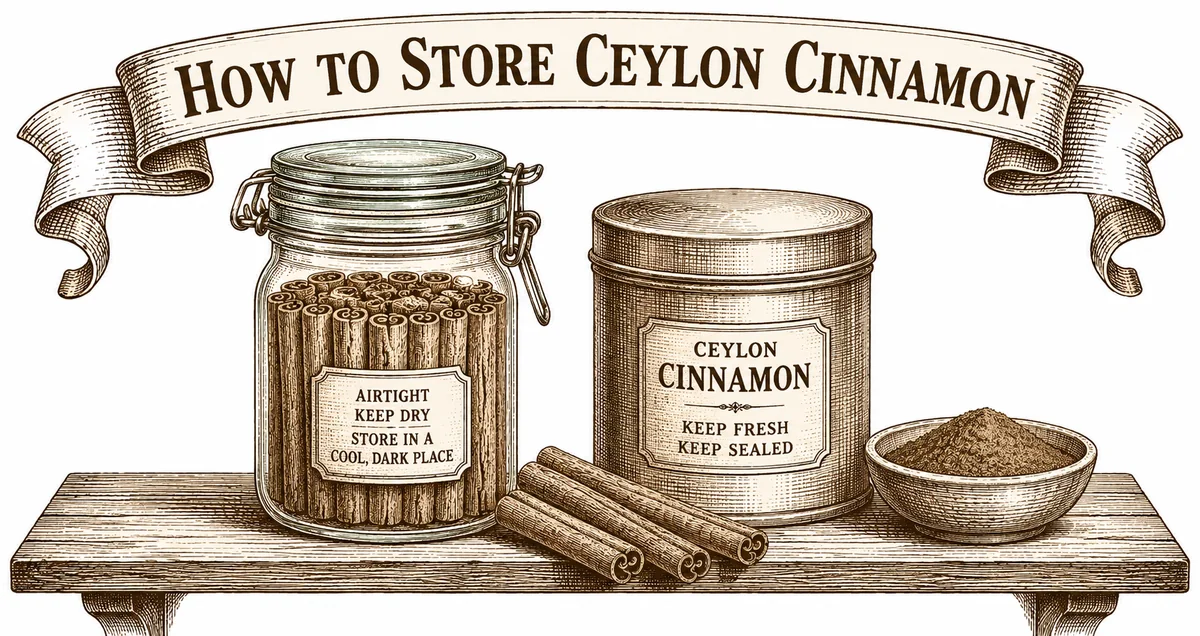
    The best way to store Ceylon cinnamon is in an airtight container kept in a cool, dark, dry place away from heat, light and moisture, ideally as whole quills rather than powder, since whole cinnamon keeps its aroma far longer. Stored well, whole Ceylon cinnamon quills stay flavourful for a few years, while ground cinnamon is at its best within about six months to a year.

    This guide explains exactly how to keep true Ceylon cinnamon (Cinnamomum verum) fresh: the conditions that spoil it, the best containers and locations, how long each form lasts, and simple habits that protect its delicate flavour. Good storage is the natural companion to buying well, so it pairs closely with our pillar Ceylon cinnamon buying guide.

    Why does storage matter for Ceylon cinnamon?

    Ceylon cinnamon owes its sweet, delicate flavour to naturally occurring aromatic oils, and those oils gradually escape and fade over time, a process that heat, light, air and moisture all speed up. Because true Ceylon cinnamon is prized for its subtle, complex aroma, protecting those volatile oils is the whole point of good storage. Poor storage doesn’t usually make cinnamon unsafe, but it does leave it dull, flat and far less fragrant than it should be, which matters most when you are cooking with a spice chosen for its finesse, as covered in our guide to culinary uses of Ceylon cinnamon.

    The four enemies of fresh cinnamon

    Keeping cinnamon fresh is mostly about shielding it from four things.

    Air

    Exposure to air lets the aromatic oils evaporate and oxidise, so an airtight container is the single most important safeguard. Every time a jar is opened some aroma is lost, so a well-sealed container that is not opened more than necessary keeps cinnamon lively for longer.

    Heat

    Warmth drives off the volatile oils faster, which is why a spot right next to the oven or hob is one of the worst places to keep cinnamon. A cool cupboard is far kinder to its flavour.

    Light

    Direct light, especially sunlight, degrades both colour and aroma over time. Storing cinnamon in a dark cupboard or an opaque container protects it.

    Moisture

    Damp is particularly harmful: moisture can cause clumping in powder and, in bad cases, mould. Always use a dry spoon in the jar and keep cinnamon well away from steam and humidity.

    The best way to store Ceylon cinnamon

    Putting those principles together gives a simple, reliable method.

    Use an airtight container

    Transfer cinnamon into a clean, dry, airtight jar or tin with a tight-fitting lid. Glass jars with good seals and opaque tins both work well; the key is that air and moisture cannot get in.

    Keep it cool, dark and dry

    Store the container in a cool, dark, dry cupboard, away from the oven, hob, kettle, dishwasher and any sunny windowsill. A pantry or an interior cupboard is ideal.

    Favour whole quills

    Wherever possible, store cinnamon as whole quills and grind only what you need. Whole cinnamon has far less surface area exposed to air, so it holds its aroma much longer than powder. The differences between forms and grades are covered in our guide to Ceylon cinnamon grades.

    How long does Ceylon cinnamon last?

    Shelf life depends mainly on the form and how well it is stored.

    Approximate flavour life of well-stored Ceylon cinnamon.
    FormBest flavour withinNotes
    Whole quills (sticks)Around 2, 3 yearsKeep longest; grind as needed
    Ground cinnamonAround 6, 12 monthsFades faster once ground
    Cinnamon in a blendUse by the blend’s dateOther spices may fade first

    These are guides to flavour, not safety. Dried cinnamon rarely “goes off” in a way that is unsafe if kept dry, but past these windows it simply tastes weaker. If in doubt, the aroma test below is the best judge.

    How to tell if your cinnamon is still good

    The simplest check is your nose. Fresh Ceylon cinnamon smells sweet, warm and fragrant; tired cinnamon smells faint or of almost nothing. With whole quills, snapping a piece or lightly scraping the surface releases fresh aroma; if little scent comes through, the cinnamon has faded. For powder, a quick sniff tells you a lot, a lively, sweet smell means it is still good, while a flat or dusty smell means it is past its best. Faded cinnamon is not harmful, but you may need to use more of it, or replace it, to get the flavour you want. Recognising genuine quality in the first place helps too, as set out in our guide to identifying authentic Ceylon cinnamon.

    Storing whole quills vs ground cinnamon

    The two forms have slightly different needs. Whole quills are forgiving: kept airtight, cool and dark, they stay aromatic for years, and grinding a small amount fresh gives a noticeably brighter flavour. Ground cinnamon is more delicate because its large surface area lets aroma escape quickly, so it benefits from an especially well-sealed container, storage in smaller quantities, and being used within a year. If you buy powder, buying amounts you will realistically use in that time avoids waste. This is one reason many keen cooks prefer to buy quills and grind as needed, a strategy discussed in our Ceylon cinnamon buying guide.

    Common storage mistakes to avoid

    A few everyday habits quietly shorten cinnamon’s life. Keeping the jar on a rack right beside the cooker exposes it to constant heat; storing it in a clear jar on a sunny counter subjects it to light; dipping a wet spoon into powder introduces moisture; and leaving a container loosely closed lets aroma drift away. Avoiding these, a sealed container in a cool, dark, dry cupboard, opened only when needed and used with a dry spoon, is really all it takes to keep Ceylon cinnamon at its fragrant best.

    Can you refrigerate or freeze Ceylon cinnamon?

    For everyday purposes, cinnamon does not need refrigeration or freezing; a cool, dark, dry cupboard is ideal and avoids the risk of condensation that a fridge or freezer can introduce. If you keep a large quantity of whole quills for the long term, an airtight container in a cool cupboard is usually enough. The most important thing is to protect cinnamon from moisture and temperature swings, so if a container is ever moved between cold and warm places, letting it come back to room temperature before opening helps prevent condensation inside.

    Summary

    Storing Ceylon cinnamon well is simple: keep it in an airtight container in a cool, dark, dry cupboard, away from heat, light and moisture, and favour whole quills over powder. Stored this way, whole quills stay fragrant for around two to three years, while ground cinnamon is best used within six to twelve months. Protect it from the four enemies, air, heat, light and moisture, use a dry spoon, and open the container only when you need it. When in doubt, trust your nose: sweet and fragrant means fresh, faint means faded. Faded cinnamon is not unsafe, just less flavourful, so good storage is really about preserving the delicate aroma that makes true Ceylon cinnamon special.

    Frequently asked questions

    How should I store Ceylon cinnamon?

    Keep it in an airtight container in a cool, dark, dry cupboard, away from heat, light and moisture. Whole quills store best; grind only what you need, and always use a dry spoon with powder.

    How long does Ceylon cinnamon last?

    Well-stored whole quills stay fragrant for around two to three years, while ground cinnamon is at its best within about six to twelve months. These are guides to flavour rather than safety, since dry cinnamon rarely becomes unsafe.

    Does Ceylon cinnamon go off?

    Kept dry, cinnamon rarely spoils in an unsafe way; instead it gradually loses aroma and tastes weaker. If it has been exposed to moisture and shows clumping or any sign of mould, discard it.

    Should I keep cinnamon in the fridge?

    No, a cool, dark, dry cupboard is better. Fridges and freezers can introduce condensation and moisture, which harm cinnamon. If a container is moved from cold to warm, let it reach room temperature before opening.

    This website provides educational information about Ceylon Cinnamon as a spice and food ingredient. It is not intended to provide medical advice or make health claims.
  • How Ceylon Cinnamon Is Grown

    How Ceylon Cinnamon Is Grown

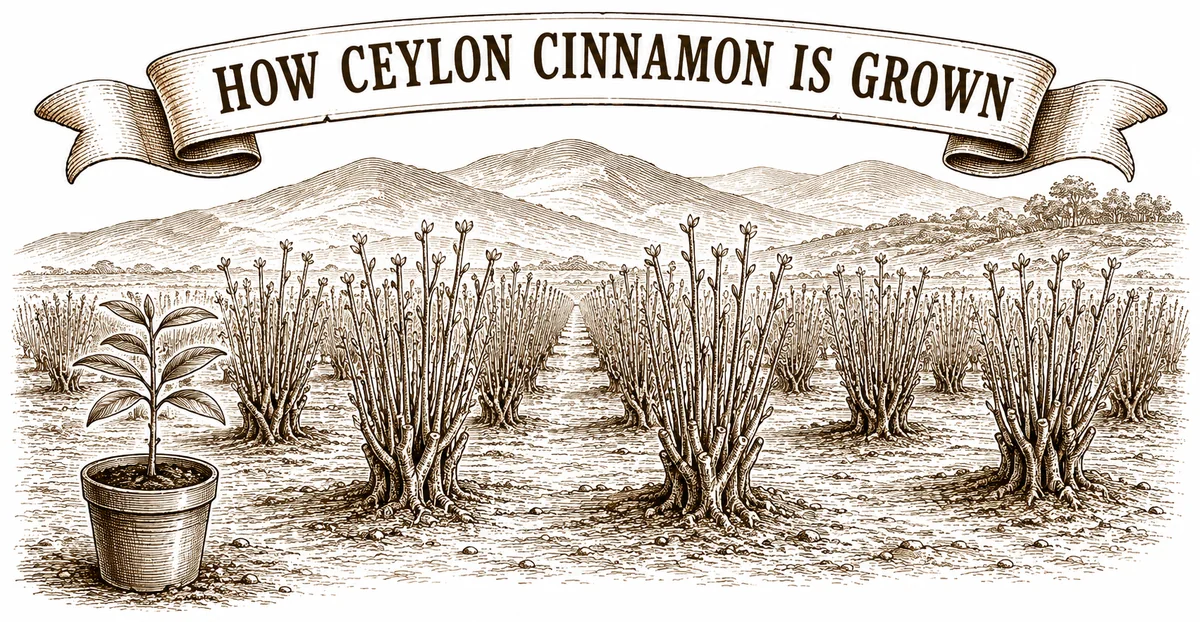
    Ceylon cinnamon is grown from young plants raised in nurseries and set out in warm, humid, low-country gardens in Sri Lanka, where the trees are cut back low and encouraged to send up many slender shoots rather than grow into tall trees. Those shoots, not the trunk, are what eventually become cinnamon, so growing the crop is really about managing a dense thicket of young stems year after year.

    This guide explains how true Ceylon cinnamon (Cinnamomum verum) is grown from the ground up: how the plants are propagated, where and how they are planted, the conditions they need, and how a cinnamon garden is managed through its long productive life. For the wider picture of cultivation in Sri Lanka, see our pillar guide on Sri Lankan cinnamon farming.

    What does it mean to “grow” Ceylon cinnamon?

    Growing Ceylon cinnamon means cultivating Cinnamomum verum as a coppiced bush rather than a full-sized tree, so that it continually produces the slender shoots whose bark becomes the spice. Left alone, the plant would grow into a tree many metres tall, but growers keep it low and multi-stemmed by cutting it back. Each harvest removes mature shoots and stimulates fresh ones, so a single well-managed plant keeps producing for many years. Understanding the spice itself helps here, as explained in our guide to what is true Ceylon cinnamon.

    Where Ceylon cinnamon grows best

    Ceylon cinnamon thrives in the warm, humid lowlands of Sri Lanka, particularly the wet zone near the south-western coast. A few conditions matter most.

    Climate

    The plant favours a hot, humid tropical climate with generous, fairly evenly spread rainfall and steady warmth through the year. Consistent moisture keeps the plants growing actively, which supports the frequent flushes of new shoots that growers rely on.

    Soil

    Cinnamon does well in well-drained sandy or loamy soils. Sandy coastal soils are traditionally associated with fine, fragrant cinnamon, while waterlogged ground is unsuitable because the roots dislike sitting in water. Good drainage combined with steady rainfall is the ideal balance.

    Elevation

    The crop is mainly a low-country one, grown from near sea level up into the lower hills. These warm elevations suit its growth and are part of why the coastal districts of the south-west became the heartland of Ceylon cinnamon.

    How Ceylon cinnamon plants are propagated

    New cinnamon plants are started before they ever reach the garden, usually in a nursery.

    From seed

    Cinnamon can be grown from seed, collected from ripe fruits and sown fresh, since the seeds lose viability quickly if stored. Seedlings are raised in nursery beds or bags until they are strong enough to transplant.

    From cuttings and division

    Growers also propagate cinnamon vegetatively, for example from cuttings or by dividing rooted material, which can help reproduce plants with desirable qualities. Whichever method is used, the aim is a healthy young plant with a good root system ready for planting out.

    Planting out a cinnamon garden

    Once seedlings are established, they are transplanted into the field, traditionally at the start of a rainy period so the young plants settle in with plenty of moisture. They are set out in rows at spacings that allow each plant room to form a clump of shoots while keeping the garden dense enough to be productive. In the early months the young plants are weeded and tended while they establish their roots and begin to grow. This early cultivation is the foundation of the garden’s later productivity, and it flows naturally into the harvesting cycle described in our guide to how Ceylon cinnamon is harvested.

    Coppicing: the key to growing cinnamon

    The single most important growing technique is coppicing, cutting the young plant back close to the ground once it is established. Instead of one main stem growing tall, the cut plant responds by sending up a cluster of new shoots from the base. These multiple slender shoots are exactly what the grower wants, because straight, thin stems yield the finest bark. From then on, the plant is managed as a low, many-stemmed bush, with shoots harvested and new ones continually replacing them. This regenerative cycle is why a cinnamon garden can keep producing for decades from the same rootstock.

    How long before a cinnamon plant can be harvested?

    A newly planted cinnamon garden needs a few years before the first harvest. The young plants must grow, be coppiced, and produce shoots of the right size and maturity, which typically takes around two to three years from planting before worthwhile harvesting begins. After that first cutting, the plant is in production, and shoots can be taken repeatedly as they reach the right stage. The judgement of when a shoot is ready, straight, evenly coloured and of suitable thickness, is central to both growing and harvesting, and shapes the quality of the finished spice, as our guide to how Ceylon cinnamon is made explains.

    Caring for a growing cinnamon garden

    A productive garden needs ongoing attention rather than being left to itself.

    Weeding and soil care

    Young plants especially need to be kept clear of competing weeds, and the soil is looked after to keep it fertile and well drained. Healthy soil supports the steady flush of shoots the crop depends on.

    Managing shade and spacing

    Growers manage how much light the plants receive and keep the spacing of shoots in balance, removing weak or crowded stems so that strong, straight shoots can develop. This shaping of the bush is part of the everyday craft of cinnamon growing.

    Protecting the plants

    Like any crop, cinnamon can face pests and diseases, and growers watch for these and manage them to keep the garden vigorous. A well-tended garden produces cleaner, more uniform shoots and therefore better cinnamon.

    Ceylon cinnamon growing at a glance

    A simplified overview of how Ceylon cinnamon is grown.
    StageWhat happens
    PropagationPlants raised from fresh seed or cuttings in a nursery
    PlantingSeedlings transplanted to warm, humid, well-drained land
    EstablishmentYoung plants weeded and tended for the first years
    CoppicingPlants cut back low to force many slender shoots
    ProductionShoots harvested repeatedly; new shoots regrow for decades

    Why the way cinnamon is grown matters

    Every choice in the garden echoes through to the finished spice. Suitable climate and soil, careful propagation, correct spacing, and above all skilful coppicing all lead to straight, even, healthy shoots that peel into fine, fragrant quills. Poorly grown or neglected plants produce crooked, uneven stems that yield lower-grade bark. In other words, growing Ceylon cinnamon well is the first and most fundamental step in producing a premium spice, long before any peeling begins. It is also why genuine Ceylon cinnamon, grown this way in its traditional home, is so closely tied to Sri Lanka, a connection covered throughout our guide to Sri Lankan cinnamon farming.

    Summary

    Ceylon cinnamon is grown by cultivating Cinnamomum verum as a low, coppiced bush in the warm, humid, well-drained lowlands of Sri Lanka. Plants are raised from fresh seed or cuttings in a nursery, transplanted into the field during a rainy period, and tended as they establish. The defining technique is coppicing: cutting the young plant back so it sends up many slender shoots, which are the source of the spice. After roughly two to three years the first shoots are ready, and thereafter the same plants keep producing for decades as shoots are harvested and continually regrow. Good climate, soil, spacing and care all combine to produce the straight, even shoots that make fine cinnamon, making the way the crop is grown the true foundation of its quality.

    Frequently asked questions

    How is Ceylon cinnamon grown?

    It is grown by cultivating the Cinnamomum verum plant as a low, multi-stemmed bush in warm, humid, well-drained land in Sri Lanka, then cutting it back (coppicing) so it produces many slender shoots whose bark becomes cinnamon.

    What conditions does cinnamon need to grow?

    Ceylon cinnamon prefers a hot, humid tropical climate with steady rainfall, warm low-country elevations, and well-drained sandy or loamy soil. Waterlogged ground is unsuitable because the roots dislike sitting in water.

    How long does it take to grow cinnamon before harvest?

    A new garden usually needs around two to three years from planting before the first worthwhile harvest, once the plants have grown, been coppiced and produced shoots of suitable size. After that the plant stays in production for many years.

    Is cinnamon grown as a tree or a bush?

    Although the plant would naturally become a tree, growers keep it as a low, coppiced bush. Cutting it back forces a cluster of slender shoots, which are far more useful for producing fine bark than a single tall trunk.

    This website provides educational information about Ceylon Cinnamon as a spice and food ingredient. It is not intended to provide medical advice or make health claims.

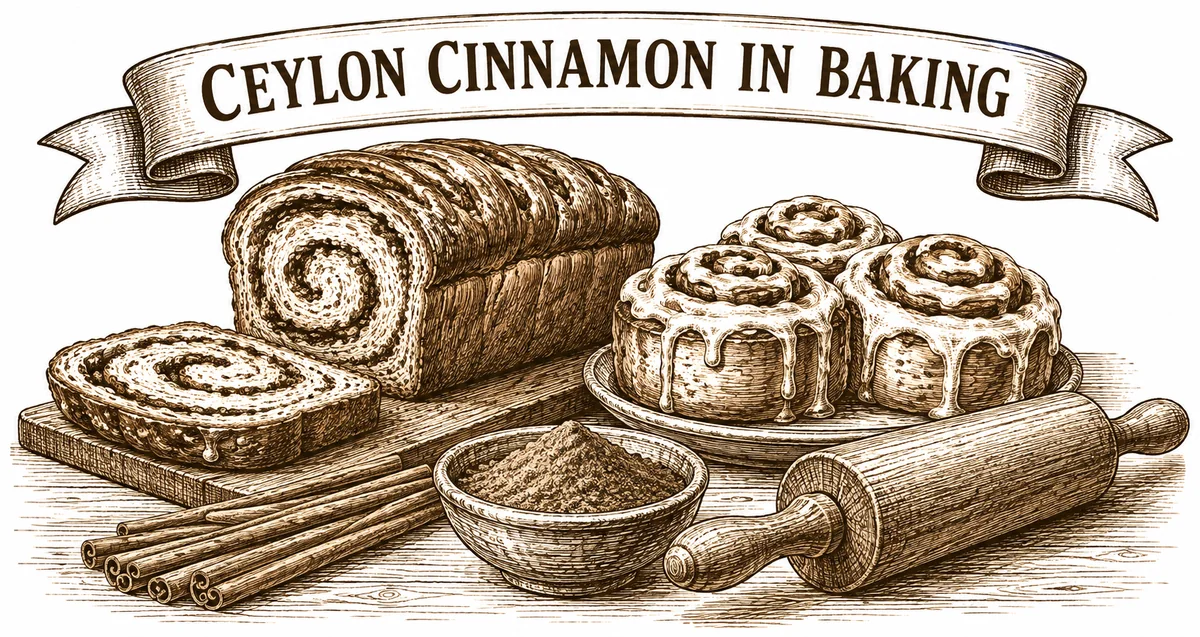
  • How to Use Ceylon Cinnamon in Baking

    How to Use Ceylon Cinnamon in Baking

    Ceylon cinnamon is prized in baking for its delicate, sweet, mildly citrusy flavour, which blends smoothly into cakes, breads, pastries and biscuits without the harsh bite of cassia. Because true Ceylon cinnamon (Cinnamomum verum) is finer and less overpowering, you can often use it a little more generously, letting its warm aroma lift a bake rather than dominate it.

    This guide walks through how to get the best from Ceylon cinnamon in the kitchen: when to use powder versus quills, how to add it at the right moment, which classic bakes it suits, and simple habits that keep its flavour fresh. For the wider view of cooking with this spice, see our pillar guide on the culinary uses of Ceylon cinnamon.

    Why use Ceylon cinnamon in baking?

    Ceylon cinnamon suits baking because its flavour is gentle, sweet and complex rather than sharp and hot. Cassia, the cinnamon most people know from supermarket shelves, is stronger and more pungent, which can overwhelm subtle bakes. Ceylon cinnamon’s softer profile lets it sit in harmony with butter, vanilla, fruit and sugar, adding warmth and fragrance without taking over. This is one reason many bakers who try true Ceylon cinnamon find their cakes and pastries taste rounder and more refined. The differences between the two are explained in our guide to Ceylon cinnamon vs cassia.

    Powder or quills: which to use in baking?

    Both forms have a place in the baker’s kitchen, and choosing well makes a real difference.

    Ground cinnamon for even flavour

    For most baking, ground Ceylon cinnamon is the natural choice. It disperses evenly through batters, doughs and fillings, so every bite carries the same gentle warmth. Powder is ideal for cakes, cookies, muffins, cinnamon rolls and spiced breads, where you want the flavour woven throughout.

    Whole quills for infusing

    Whole quills shine when you want to infuse a liquid rather than season a batter. Simmering a quill in milk, cream, syrup or a fruit compote draws out the aroma slowly and cleanly, which you can then use as the base of a custard, rice pudding, poached fruit or a soaking syrup. Grinding your own powder from fresh quills also gives a brighter flavour than pre-ground cinnamon that has sat for months. The distinctions between forms and grades are covered in our complete guide to Ceylon cinnamon grades.

    When to add cinnamon in a recipe

    Timing affects how the flavour comes through in the finished bake.

    Mixed into dry ingredients

    For cakes, biscuits and breads, the simplest approach is to whisk ground cinnamon into the flour and other dry ingredients before combining with the wet. This ensures it is evenly distributed and avoids clumping.

    Blended into fillings and swirls

    For cinnamon rolls, swirl breads and pastries, cinnamon is usually mixed with sugar and sometimes butter to form a filling or paste that is spread and rolled through the dough. Here a slightly more generous hand works well, because the cinnamon is concentrated in ribbons rather than spread through the whole crumb.

    Infused into liquids first

    For custards, syrups and puddings, add a quill to the warming liquid and let it steep, then remove it before finishing the recipe. This gives a smooth, even cinnamon note without any powdery texture.

    How much Ceylon cinnamon to use

    Because Ceylon cinnamon is milder than cassia, you can generally be a little more generous, though taste always guides the amount. A rough starting point for a standard cake or batch of cookies is around one to two teaspoons of ground Ceylon cinnamon, adjusted up or down to preference. It is easy to add more next time, so when trying a new recipe it is sensible to start moderate, taste the batter where safe to do so, and build up. The gentle flavour means Ceylon cinnamon rewards experimentation without the risk of a single spoonful overpowering the whole bake.

    Classic bakes that suit Ceylon cinnamon

    Ceylon cinnamon flatters a wide range of baked goods.

    Popular bakes and how Ceylon cinnamon is typically used in each.
    BakeHow cinnamon is used
    Cinnamon rollsMixed with sugar and butter as a swirl filling
    Spiced cakes and loavesWhisked into the dry ingredients
    Cookies and biscuitsBlended into the dough; dusted on top
    Fruit pies and crumblesTossed with the fruit and sugar
    Custards and rice puddingsInfused as a whole quill in the milk

    Cinnamon also pairs beautifully with common baking partners such as vanilla, nutmeg, cardamom, apple, pear, chocolate and citrus, so it slots naturally into festive and everyday recipes alike.

    Cinnamon and sugar: a baking staple

    One of the simplest and most useful preparations is cinnamon sugar: ground Ceylon cinnamon stirred into caster or granulated sugar. It can be sprinkled over buns, toast, doughnuts, pastries and cookies before or after baking, or folded into swirl fillings. Because Ceylon cinnamon is so fragrant, a homemade cinnamon sugar using fresh, good-quality cinnamon tastes noticeably livelier than a jar that has been open for a long time. Making a small batch as you need it keeps the aroma at its best.

    Getting the freshest flavour

    The flavour of any cinnamon fades over time as its aromatic oils gradually escape. To keep bakes tasting their best, store Ceylon cinnamon in an airtight container away from heat, light and moisture, and buy in amounts you will use within a reasonable period. Whole quills keep their flavour longer than powder, so grinding small quantities as needed is a good habit for keen bakers. If a jar of ground cinnamon has lost its punch, you may simply need to use a little more, or replace it. Good storage is part of buying well, a theme covered in our Ceylon cinnamon buying guide.

    A few simple tips for better results

    Small adjustments can noticeably improve how cinnamon comes through in your baking. Whisking the powder thoroughly into dry ingredients prevents streaks and clumps. Toasting whole quills briefly before grinding can deepen their aroma. Tasting fillings and batters where it is safe to do so lets you fine-tune the amount to your liking. And choosing genuine Ceylon cinnamon in the first place sets the ceiling on flavour, which is why it helps to know how to identify authentic Ceylon cinnamon before you bake.

    Summary

    Ceylon cinnamon is a baker’s friend because its sweet, delicate, complex flavour improves cakes, cookies, breads, pastries and puddings without overpowering them. Use ground cinnamon for even flavour through batters and doughs, and whole quills for infusing milk, syrups and custards. Whisk powder into dry ingredients, build cinnamon-sugar fillings for swirls, and infuse quills into warming liquids for smooth results. Because it is milder than cassia, you can often be a little more generous, adjusting to taste. Keep it fresh with airtight storage, grind small amounts from quills when you can, and start with authentic Ceylon cinnamon to give every bake the finest possible warmth and aroma.

    Frequently asked questions

    Is Ceylon cinnamon good for baking?

    Yes. Its delicate, sweet and complex flavour blends smoothly into cakes, breads, cookies and pastries without the harsh, hot bite of cassia, making it especially suited to subtle bakes.

    How much Ceylon cinnamon should I use in a cake?

    A common starting point is around one to two teaspoons of ground Ceylon cinnamon for a standard cake, adjusted to taste. Because it is milder than cassia, you can often use a little more without it becoming overpowering.

    Should I use cinnamon powder or sticks for baking?

    Use ground cinnamon for even flavour through batters, doughs and fillings, and whole quills for infusing liquids such as milk, cream or syrup. Grinding your own powder from fresh quills gives a brighter taste.

    When should I add cinnamon in a baking recipe?

    Whisk ground cinnamon into the dry ingredients for even distribution, blend it with sugar and butter for swirl fillings, or infuse a whole quill into warming liquids for custards and puddings, removing it before finishing.

    This website provides educational information about Ceylon Cinnamon as a spice and food ingredient. It is not intended to provide medical advice or make health claims.
  • Where to Buy Authentic Ceylon Cinnamon

    Where to Buy Authentic Ceylon Cinnamon

    The safest places to buy authentic Ceylon cinnamon (Cinnamomum verum) are specialist spice merchants, reputable online sellers that clearly state the species and Sri Lankan origin, and shops that sell whole quills you can inspect. Wherever you buy, the single most reliable rule is the same: look for the words Cinnamomum verum and an origin of Sri Lanka on the label, and treat anything simply sold as “cinnamon” with caution.

    This guide is not about pointing you to one shop. It is about teaching you how to recognise a trustworthy source anywhere in the world, so you can buy genuine Ceylon cinnamon with confidence rather than accidentally ending up with cheaper cassia. For the wider picture of choosing well, see our pillar guide, the Ceylon cinnamon buying guide.

    Where can you buy authentic Ceylon cinnamon?

    Ceylon cinnamon is sold through several kinds of outlets, each with strengths and trade-offs. Knowing what to expect from each helps you shop wisely.

    Specialist spice shops

    Dedicated spice merchants are often the best starting point. They tend to know their products, label species and origin clearly, and stock genuine Ceylon cinnamon rather than generic “cinnamon”. Because spices are their whole business, they are more likely to be able to answer questions about grade, harvest and source.

    Reputable online retailers

    Buying online opens up a much wider choice, including sellers who ship directly from Sri Lanka. The trade-off is that you cannot handle the product before buying, so you must rely on the listing. Favour sellers who state Cinnamomum verum, name Sri Lanka as the origin, show clear photographs of thin, layered quills, and describe the grade. Vague listings that only say “cinnamon” are best avoided.

    Supermarkets and general grocers

    Mainstream supermarkets usually sell cassia under the plain name “cinnamon”, though some now carry a clearly labelled Ceylon line as well. If you shop here, read the label carefully: the presence of the botanical name and a Sri Lankan origin is what separates true Ceylon cinnamon from the cassia sitting beside it. The reasons these two are so often confused are explained in our guide to Ceylon cinnamon vs cassia.

    Farmers’ markets and direct trade

    Some markets, delis and direct-trade sellers offer Ceylon cinnamon sourced from specific growers. These can be excellent, especially when the seller can tell you where the spice comes from. As always, confirm the species and origin rather than relying on the word “authentic” alone.

    What to look for in any seller

    Regardless of where you shop, the same signals separate a trustworthy source from a doubtful one.

    The botanical name is stated

    A reliable seller of true cinnamon will proudly display Cinnamomum verum (sometimes written Cinnamomum zeylanicum). If the species is missing and the product is simply “cinnamon”, assume it may be cassia until proven otherwise.

    The origin is Sri Lanka

    Genuine Ceylon cinnamon comes overwhelmingly from Sri Lanka. A clear country of origin, paired with the correct species, is a strong sign of authenticity. The farming tradition behind that origin is described in our guide to Sri Lankan cinnamon farming.

    Whole quills you can inspect

    Where possible, buy whole quills rather than powder, because their structure is hard to fake. True Ceylon quills are thin, pale and made of many soft layers rolled together, in contrast to the hard single curl of cassia. Being able to see or photograph the quills gives you a way to verify quality yourself, using the checks in our guide to how to spot fake Ceylon cinnamon.

    Transparent grade information

    Good sellers describe the grade of their cinnamon, from the delicate Alba to coarser grades, rather than leaving it unspecified. Understanding what these grades mean helps you judge whether the price is fair, as set out in our complete guide to Ceylon cinnamon grades.

    Whole quills or ground powder: which to buy

    Where you buy is closely tied to what form you buy. Each has its place.

    Choosing between whole quills and ground cinnamon when buying.
    FormBest forThings to watch
    Whole quillsVerifying authenticity; longer shelf lifeNeeds grinding for some recipes
    Ground powderConvenience and everyday bakingHarder to verify; can be adulterated

    Because ground cinnamon hides the tell-tale layered structure, it is easier to pass off cassia or fillers as Ceylon powder. If you are buying powder, it matters even more that the seller is reputable and that the label names the species and origin.

    Buying Ceylon cinnamon online safely

    Online is where most people now shop, so it deserves a closer look. Before you buy, check that the listing names Cinnamomum verum and Sri Lanka, shows real photographs rather than generic stock images, describes the grade, and comes from a seller with a track record of honest descriptions. Be wary of listings where the price is far lower than comparable Ceylon cinnamon, as unusually cheap “Ceylon” is a classic warning sign that the product may actually be cassia. When a listing is vague, ask the seller directly about species and origin before ordering.

    Why price is part of the picture

    True Ceylon cinnamon is more labour-intensive to harvest and hand-peel than cassia, so it almost always costs more. A realistic, somewhat higher price is normal and even reassuring; a suspiciously low price on something labelled “Ceylon” is a reason to look more closely. That said, a high price alone does not guarantee authenticity, so always combine the price signal with the species, origin and structural checks. The relationship between cost and quality is covered further in our Ceylon cinnamon buying guide.

    Questions worth asking before you buy

    Whether you are standing at a market stall or reading an online listing, a few simple questions quickly reveal how trustworthy a source is. Ask what the species is and expect to hear Cinnamomum verum. Ask where it is from and expect Sri Lanka. Ask about the grade and expect a specific answer rather than a shrug. A seller who can answer these clearly and consistently is far more likely to be product the real thing than one who deals only in the vague word “cinnamon”.

    Avoiding the most common mistakes

    Most disappointments come from a handful of avoidable errors. Buying purely on the word “cinnamon” without checking the species is the biggest one, because that word covers both true cinnamon and cassia. Assuming that “organic” or “premium” automatically means Ceylon is another, since those terms say nothing about the botanical species. Finally, chasing the lowest possible price often leads straight to cassia. Slowing down to read the label and verify the source is what separates a confident purchase from a lucky guess, and it builds naturally on knowing how to identify authentic Ceylon cinnamon.

    Summary

    You can buy authentic Ceylon cinnamon from specialist spice shops, reputable online sellers, some supermarkets, and direct-trade markets, but the outlet matters less than the checks you apply. Everywhere, the decisive signals are the same: the label names Cinnamomum verum, the origin is Sri Lanka, whole quills are thin and layered, the grade is stated, and the price is realistic rather than suspiciously cheap. Favour whole quills when you can, be extra careful with powder, ask sellers direct questions about species and origin, and don’t let words like “premium” or “organic” stand in for proof of authenticity. Apply these habits and you can shop with confidence wherever you are.

    Frequently asked questions

    Where is the best place to buy Ceylon cinnamon?

    Specialist spice merchants and reputable online sellers that clearly state Cinnamomum verum and a Sri Lankan origin are usually the most reliable. Being able to see whole quills, in person or in clear photos, is a further advantage.

    Can you buy real Ceylon cinnamon in supermarkets?

    Sometimes. Most supermarket “cinnamon” is cassia, but some stores now stock a clearly labelled Ceylon line. Check for the botanical name and a Sri Lankan origin to tell the two apart on the shelf.

    Is it safe to buy Ceylon cinnamon online?

    Yes, if you choose carefully. Favour listings that name Cinnamomum verum and Sri Lanka, show genuine photos of thin layered quills, describe the grade, and come from sellers with honest descriptions. Treat unusually cheap “Ceylon” cinnamon with caution.

    How do I know a seller’s Ceylon cinnamon is genuine?

    Ask about the species, origin and grade. A trustworthy seller will confirm Cinnamomum verum, name Sri Lanka, and give a specific grade. Whole quills you can inspect provide extra reassurance.

    This website provides educational information about Ceylon Cinnamon as a spice and food ingredient. It is not intended to provide medical advice or make health claims.

  • How to Spot Fake Ceylon Cinnamon

    How to Spot Fake Ceylon Cinnamon

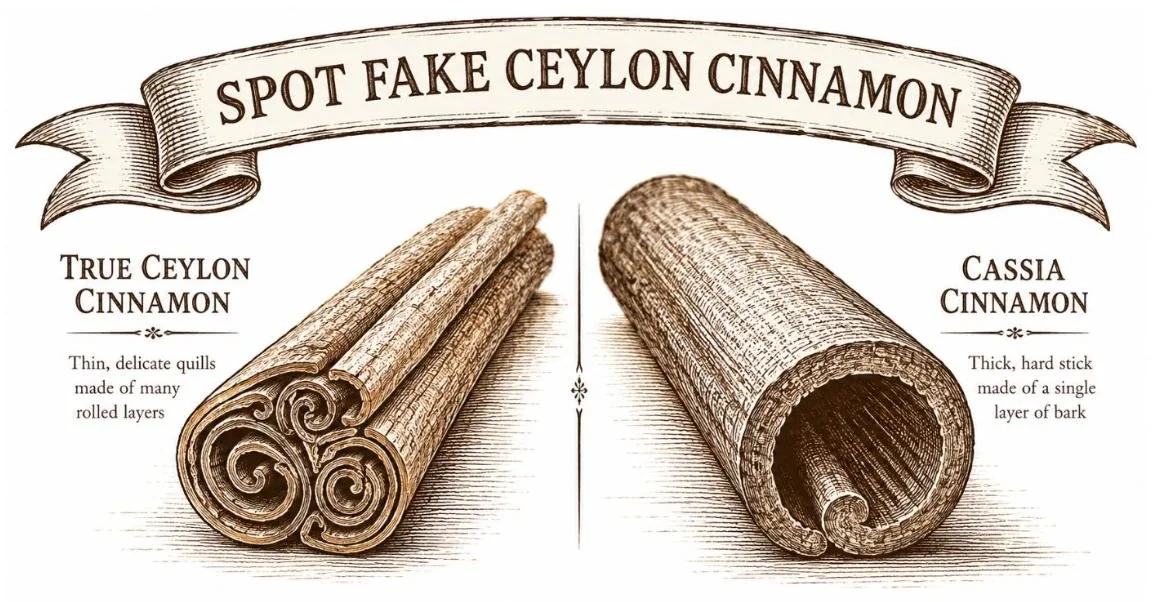
    The easiest way to spot fake Ceylon cinnamon is to look at the shape and feel of the stick: true Ceylon cinnamon (Cinnamomum verum) forms thin, brittle quills made of many soft, papery layers rolled tightly together, while the “fake” cinnamon sold in most supermarkets is usually cassia, a single, thick, hard, hollow curl of dark reddish-brown bark. In powder form the clues are subtler, but colour, aroma and taste still give it away.

    Most “fake” Ceylon cinnamon is not a deliberate forgery so much as a case of mistaken identity: cheaper cassia bark sold under the single word “cinnamon”. This guide shows you exactly what to look for, whether you are holding a stick, a jar of powder, or reading a label, so you can tell genuine Cinnamomum verum from the imposters. For the full picture, see our pillar guide on how to identify authentic Ceylon cinnamon.

    What does “fake” Ceylon cinnamon actually mean?

    “Fake” Ceylon cinnamon usually means cassia cinnamon being passed off, knowingly or not, as true Ceylon cinnamon. Cassia comes from several related trees (such as Cinnamomum cassia and Cinnamomum burmannii) grown mainly in China, Indonesia and Vietnam. It is a genuine spice in its own right and perfectly legal to sell, but it is coarser, cheaper and chemically different from true Ceylon cinnamon, which comes almost entirely from Sri Lanka. The confusion arises because in many countries both barks are simply labelled “cinnamon”. The full botanical contrast is set out in our guide to Ceylon cinnamon vs cassia.

    Less commonly, “fake” can also mean powder that has been bulked out with fillers, or old, stale stock sold as premium spice. The checks below help with all of these cases.

    How to spot fake cinnamon sticks (quills)

    Whole sticks are the easiest form to judge, because the physical structure of the bark is very hard to fake.

    Look at the layers

    Break or look at the end of the stick. True Ceylon cinnamon is made of many thin layers rolled up like a fine cigar or a rolled newspaper, so the cross-section looks like the rings of a tightly wound scroll. Cassia is typically a single thick layer curled into a hard tube, often with a hollow centre and only one or two curls. If you see one thick, woody wall instead of many delicate layers, you are almost certainly holding cassia.

    Check the thickness and hardness

    Genuine Ceylon quills are thin and brittle, you can usually snap them easily by hand or even crumble them between your fingers. Cassia bark is thick, hard and woody; it resists breaking and often needs a grinder. If a “cinnamon” stick feels like a piece of tough bark that won’t yield, that hardness is a strong sign it is cassia.

    Judge the colour

    True Ceylon cinnamon is a light tan or pale golden-brown. Cassia is a noticeably darker, reddish or chocolate brown. Colour alone is not proof, because lighting and age vary, but a very dark, uniform stick leans strongly toward cassia.

    Smell and taste

    Ceylon cinnamon has a delicate, sweet, warm and complex aroma with citrus and floral notes. Cassia smells and tastes stronger, harsher and more “spicy-hot”, with a pungent bite. If the flavour is aggressive and one-dimensional rather than subtle and layered, it is likely cassia. The finer flavour of Ceylon cinnamon is one reason it is prized in cooking, as covered in our guide to culinary uses of Ceylon cinnamon.

    Quick comparison: Ceylon vs cassia sticks

    At-a-glance signs for telling true Ceylon cinnamon from cassia sticks.
    FeatureTrue Ceylon cinnamonCassia (often sold as “cinnamon”)
    LayersMany thin, papery layers rolled upSingle thick, hard layer
    TextureThin and brittle, snaps easilyThick, hard and woody
    ColourLight tan / pale brownDark reddish or chocolate brown
    AromaSweet, delicate, complexStrong, harsh, pungent
    ShapeSolid, tightly filled quillOften a single hollow curl

    How to spot fake cinnamon powder

    Powder is harder to judge because grinding removes the tell-tale layered structure. Still, several clues remain.

    Colour of the powder

    Ceylon cinnamon powder is a lighter tan-brown, while cassia powder tends to be a darker reddish-brown. If you have known-genuine Ceylon powder to compare against, the difference is often visible side by side.

    Aroma and flavour

    As with sticks, Ceylon powder smells mild, sweet and layered, whereas cassia is sharper and more intense. A cheap “cinnamon” that overwhelms a dish with a hot, biting note is more likely cassia.

    Be alert to fillers

    Very cheap ground “cinnamon” is occasionally bulked out with other ground plant material or starches. You cannot reliably detect this by eye, which is why the source and packaging matter so much. Buying whole quills and grinding them yourself removes most of this risk, a strategy discussed in our Ceylon cinnamon buying guide.

    Read the label carefully

    Labels are one of the most reliable tools you have, if you know what to look for.

    Look for the botanical name

    Genuine Ceylon cinnamon lists Cinnamomum verum (sometimes written Cinnamomum zeylanicum) on the packaging. If the label only says “cinnamon” with no species, or names Cinnamomum cassia or Cinnamomum burmannii, you are not looking at true Ceylon cinnamon. The word “verum” literally means “true”, and it is the clearest label-level signal there is.

    Check the country of origin

    True Ceylon cinnamon comes overwhelmingly from Sri Lanka (historically called Ceylon). Cassia is grown mainly in China, Indonesia and Vietnam. An origin of Sri Lanka, combined with the Cinnamomum verum name, is a strong pair of signals. The farming tradition behind this origin is described in our guide to Sri Lankan cinnamon farming.

    Be sceptical of vague marketing

    Terms like “premium”, “true” or “gourmet” on the front of a pack mean nothing on their own. Turn the packet over and read the ingredients and botanical name. If a product markets itself as Ceylon cinnamon but hides or omits the species and origin, treat that as a warning sign.

    Why price is a clue (but not proof)

    True Ceylon cinnamon is more labour-intensive to harvest and process than cassia, so it almost always costs more. If a product is branded “Ceylon” but priced the same as ordinary bulk cinnamon, be cautious, the price may be too good to be true. That said, a high price alone does not guarantee authenticity, so always combine the price signal with the structural, sensory and label checks above. Why genuine Ceylon cinnamon commands a premium is tied to how it is grown and peeled, covered in how Ceylon cinnamon is made.

    Understanding grades helps too

    Even among genuine Ceylon cinnamon there are different grades, from the delicate Alba quills to coarser grades. Knowing the grading system helps you judge whether a premium price is justified and whether the product matches its description, rather than being over-sold. Our complete guide to Ceylon cinnamon grades explains what the grade names mean and how quality is classified.

    A simple three-step authenticity check

    If you want a quick routine to apply in a shop or kitchen, use these three steps in order.

    Step 1: Read the label

    Look for Cinnamomum verum (or zeylanicum) and an origin of Sri Lanka. No species named usually means cassia.

    Step 2: Inspect the stick

    If you can see whole quills, check for many thin layers, a light tan colour, and a stick that feels thin and brittle rather than hard and woody.

    Step 3: Smell and taste

    Genuine Ceylon cinnamon is sweet, mild and complex. A harsh, hot, one-note “cinnamon” flavour points to cassia.

    Summary

    Spotting fake Ceylon cinnamon comes down to a handful of reliable signals. Most “fakes” are simply cassia sold under the generic name “cinnamon”, so the key is to distinguish the two. Whole sticks are easiest: true Ceylon cinnamon forms thin, brittle quills of many papery layers in a pale tan colour, while cassia is a hard, thick, dark, often hollow curl. In powder form, rely on colour, a mild sweet aroma, and, above all, the label, which should name Cinnamomum verum and an origin of Sri Lanka. Combine the physical checks, the sensory checks and the label together, use price as a supporting clue, and you can buy true Ceylon cinnamon with confidence.

    Frequently asked questions

    How can I tell if my cinnamon is real Ceylon cinnamon?

    Check the stick and the label. True Ceylon cinnamon forms thin, brittle quills of many rolled layers in a light tan colour, and its packaging names Cinnamomum verum with an origin of Sri Lanka. Hard, dark, single-layer sticks are usually cassia.

    Is supermarket cinnamon fake?

    Not fake, but usually cassia rather than true Ceylon cinnamon. Most inexpensive “cinnamon” is genuine cassia bark, which is a real spice but botanically different from Cinnamomum verum. Check the label for the species and origin to be sure.

    Does colour tell you if cinnamon is fake?

    Colour is a useful clue but not proof. Ceylon cinnamon is usually a lighter tan, while cassia is darker and more reddish. Because lighting and age affect colour, combine it with the layered-stick test and the label check.

    Why is real Ceylon cinnamon more expensive?

    Because it is harvested and hand-peeled with more care and comes mainly from Sri Lanka, its production is more labour-intensive than cassia. A “Ceylon” product priced like ordinary bulk cinnamon should be treated with caution.

    This website provides educational information about Ceylon Cinnamon as a spice and food ingredient. It is not intended to provide medical advice or make health claims.

  • The Ancient History of Cinnamon Trade

    The Ancient History of Cinnamon Trade

    For most of recorded history, cinnamon was one of the world’s most prized and mysterious spices, carried thousands of miles from Sri Lanka to the ancient Mediterranean, where its true origin was hidden for centuries behind deliberate secrecy and fantastical stories. The ancient cinnamon trade is a tale of long sea routes, guarded monopolies, and a spice so valued it was fit for temples, kings and the dead.

    This guide traces cinnamon’s journey through the ancient world: where it really came from, how it reached Egypt, Greece and Rome, why traders worked so hard to conceal its source, and what made it so extraordinarily useful. For the wider story of the spice across the ages, see our pillar guide on the history of Ceylon cinnamon.

    Where did ancient cinnamon really come from?

    The finest cinnamon of antiquity was the bark of Cinnamomum verum, native to the island of Sri Lanka, known for much of history as Ceylon. From there, and from nearby parts of South and Southeast Asia, cinnamon travelled westward along a web of maritime and overland routes long before Europeans had any idea where the island lay. To understand what this spice actually is, see our guide to what is true Ceylon cinnamon. The people who bought cinnamon in ancient Egyptian or Roman markets rarely knew its origin; they simply knew it arrived from “the East” at great cost.

    Cinnamon in the ancient world

    References to cinnamon appear across many ancient cultures, a sign of how far and how early it travelled.

    Ancient Egypt

    Cinnamon and its relative cassia were valued in ancient Egypt, where aromatic spices were used in perfumes, ceremonial oils and embalming. Fragrant imported spices were luxury goods, associated with ritual and status, and their presence in Egypt shows that trade links reaching toward Asia existed thousands of years ago.

    The Hebrew scriptures

    Cinnamon is named among the precious aromatics of the ancient Near East, appearing in early texts as an ingredient in sacred anointing oils and as a symbol of luxury and fragrance. Such mentions place cinnamon firmly among the most treasured trade goods of the age.

    Greece and Rome

    Greek and Roman writers, including the historian Herodotus and later the naturalist Pliny the Elder, wrote about cinnamon with a mixture of fascination and confusion. It was burned as incense, blended into perfumes, and used to flavour and scent. The Romans in particular prized it highly, and Pliny famously grumbled about the enormous prices commanded by the spice after passing through many hands.

    The secret of cinnamon’s origin

    One of the most striking features of the ancient cinnamon trade is that the people who controlled it deliberately hid where the spice came from. Arab and other intermediary traders acted as middlemen between the distant source and the Mediterranean markets, and it was in their interest to keep buyers ignorant. If Greek and Roman merchants had known the true origin, they might have tried to bypass the middlemen and trade directly, collapsing a highly profitable monopoly.

    Tales to guard a monopoly

    To protect their advantage, traders spread fantastical stories about how cinnamon was obtained. Herodotus recorded a famous legend that great birds carried cinnamon sticks to their nests on high cliffs, and that people had to trick the birds to retrieve it. Other tales placed cinnamon in dangerous, faraway lands guarded by fearsome creatures. These stories were almost certainly invented, or at least encouraged, to make the spice seem rare, dangerous to gather, and therefore worth its extraordinary price, while concealing the humble reality of bark peeled from a tree.

    Why was cinnamon so useful?

    Several forces combined to make cinnamon one of antiquity’s costliest goods.

    Enormous distance

    Cinnamon crossed oceans and deserts, passing through many traders, ports and taxes on its long journey west. Every stage added cost, so by the time it reached a Roman market its price had multiplied many times over.

    Controlled supply and secrecy

    Because middlemen guarded the source and the routes, supply was tightly controlled. Scarcity, real and manufactured, kept prices high, and the aura of mystery only added to cinnamon’s prestige.

    Prestige and ritual

    Cinnamon was not an everyday seasoning for most people but a luxury reserved for the wealthy, for temples and for special occasions. Its use in perfumes, sacred rites and funerary practices gave it a symbolic value well beyond its weight, making it a fitting gift for gods and rulers alike.

    The routes cinnamon travelled

    Ancient cinnamon reached the Mediterranean by a combination of sea and land. Maritime traders moved goods across the Indian Ocean, using seasonal monsoon winds to sail between South Asia and the ports of Arabia and the Red Sea. From there, overland caravans and further sea legs carried the spice onward to the great trading cities of the ancient world. This long relay of ships, ports and caravans is why cinnamon was so expensive and why its ultimate source could stay hidden for so long, no single trader needed to know the whole chain from tree to market.

    Ceylon at the heart of the story

    Although ancient buyers did not know it, the island of Ceylon sat near the origin of the finest cinnamon. Over time, its reputation as the home of superb cinnamon became so strong that the spice and the island grew inseparable in name, a connection covered in our guide to Sri Lankan cinnamon farming. The distinction between this true cinnamon and the coarser cassia often sold elsewhere is a very old one, and it still matters today, as explained in Ceylon cinnamon vs cassia.

    Cinnamon and cassia in the ancient trade

    Ancient writers often mentioned “cinnamon” and “cassia” side by side, and the two were not always clearly separated in the markets of antiquity. Both were aromatic barks from related trees carried along the same eastern routes, but they differed in fineness and price, with the more delicate true cinnamon generally the more prized. This ancient blurring of the two is the distant ancestor of a confusion that still exists on supermarket shelves today, where cassia is frequently sold simply as “cinnamon”. The enduring distinction between the two barks, one fine and layered, the other hard and coarse, is set out in our guide to Ceylon cinnamon vs cassia. Understanding it helps make sense of why the ancient sources sometimes seem to describe several different spices under overlapping names.

    How the secret finally unravelled

    No monopoly built on secrecy lasts forever. As centuries passed, knowledge of the eastern sea routes spread, and the fanciful stories lost their power. Eventually the true geography of the spice became known in the West, setting the stage for later eras when European powers sought to control the cinnamon lands directly. That dramatic later chapter, of colonial competition over Ceylon’s cinnamon, belongs to the broader history of Ceylon cinnamon, but its roots lie in these ancient centuries when cinnamon was already worth crossing the world for.

    What the ancient trade tells us

    The story of ancient cinnamon is really a story about value, distance and information. A simple piece of tree bark became one of the most sought-after substances on earth because it was rare in the West, difficult to trace, and wrapped in mystery. The traders who moved it understood that controlling knowledge was as profitable as controlling the goods themselves. Seen this way, cinnamon is not just a spice but a window into how the ancient world traded, competed and imagined the lands beyond its horizon.

    Summary

    In antiquity, cinnamon was a treasure. The best of it was the bark of Cinnamomum verum from the region around Ceylon, carried west across the Indian Ocean and Arabian routes to Egypt, Greece and Rome, where it was used in perfumes, incense, sacred oils and funerary rites. Middlemen guarded its origin fiercely, inventing tales of cinnamon-carrying birds and dangerous distant lands to keep buyers in the dark and prices high. Distance, controlled supply and prestige combined to make cinnamon one of the ancient world’s most useful goods, a reputation that would eventually draw empires to the island where the finest cinnamon grew.

    Frequently asked questions

    Where did cinnamon come from in ancient times?

    The finest ancient cinnamon was the bark of Cinnamomum verum from the region around Sri Lanka (Ceylon). It travelled west through many traders, so buyers in Egypt, Greece and Rome rarely knew its true source.

    Why did ancient traders hide where cinnamon came from?

    To protect a highly profitable monopoly. If buyers had known the true origin, they might have traded directly and bypassed the middlemen, so traders spread fantastical stories to conceal the source and keep prices high.

    What was the myth of the cinnamon birds?

    The historian Herodotus recorded a legend that giant birds carried cinnamon to cliff-top nests, from which people had to retrieve it by trickery. It was almost certainly invented to make cinnamon seem rare and dangerous to gather.

    Why was cinnamon so expensive in the ancient world?

    Because of vast trade distances, many middlemen and taxes, deliberately controlled supply, and its prestige in perfume, ritual and funerary use. Together these pushed cinnamon’s price far above its humble origin as tree bark.

    This website provides educational information about Ceylon Cinnamon as a spice and food ingredient. It is not intended to provide medical advice or make health claims.

  • How Ceylon Cinnamon Is Harvested

    How Ceylon Cinnamon Is Harvested

    Ceylon cinnamon is harvested by cutting the slender young shoots of the Cinnamomum verum tree, usually two or three times a year, and then peeling the thin inner bark by hand within hours of cutting. Timing matters: harvesting is concentrated in the wetter months, when the sap is flowing and the bark separates cleanly from the wood, which is what makes the delicate hand-peeling possible.

    If you have ever wondered how a spice as fine as true Ceylon cinnamon actually leaves the tree, this guide walks through the harvest step by step: when it happens, which stems are chosen, how they are cut, and what happens in the key hours immediately afterwards. Harvesting is only the first stage of a longer craft, so for the complete journey see our pillar guide on how Ceylon cinnamon is made.

    What does “harvesting” mean for Ceylon cinnamon?

    Harvesting Ceylon cinnamon means cutting the young bark-bearing shoots from the tree, not felling the tree itself. The prized spice is the tree’s thin inner bark, so a harvest is really a careful pruning: harvesters remove the straight, pencil-to-thumb-thick stems that have grown since the last cutting, leaving the rootstock in the ground to send up fresh shoots for next time. This is why a single cinnamon plant can be harvested again and again for decades. The growing side of this story, how those shoots are raised in the first place, is covered in our guide to Sri Lankan cinnamon farming.

    When is Ceylon cinnamon harvested?

    Ceylon cinnamon is typically harvested two to three times a year, with the main harvests falling in the wetter seasons. There are two connected reasons for this timing.

    The bark peels more easily when sap is flowing

    During and just after rain, the tree is actively growing and moisture sits between the bark and the wood. This makes the bark slip away cleanly when a skilled peeler works it, which is essential for producing the fine, unbroken layers that Ceylon cinnamon is known for. In drier spells the bark clings to the wood and tears, wasting the crop.

    The shoots have reached the right maturity

    Harvest is also governed by the age and thickness of the stems. Shoots are usually ready when they are roughly two to three years old, straight, and about one to two centimetres thick, with bark that has turned an even brown. Harvesters read the plant rather than the calendar alone, cutting when the stems are mature enough to yield good bark but still young enough to be supple.

    How harvesters choose which stems to cut

    Not every stem is taken. A good harvester selects shoots that are straight, smooth, and free of side branches, knots or blemishes, because these produce the longest, cleanest quills. Twisted or branched stems are harder to peel and give broken, uneven bark. The colour and feel of the bark are important cues: an even, mid-brown stem with bark that gives slightly under a thumbnail is usually at its peak. Poorer stems may be left to mature further or used for lower grades, a distinction explained in our guide to Ceylon cinnamon grades.

    How the shoots are cut

    The chosen stems are cut low, close to the base of the plant, with a sharp knife or billhook. Cutting near the base encourages the rootstock to throw up a cluster of new shoots, a technique known as coppicing, so the plant renews itself for the next harvest. The cut stems are then trimmed of their leaves and side twigs and gathered into bundles. The leaves and off-cuts are not wasted; smaller material and trimmings are often set aside for distillation into cinnamon leaf oil rather than discarded.

    Why speed matters after cutting

    Once a stem is cut, the clock starts. The bark separates most easily while the shoot is still fresh and full of moisture, so harvested bundles are carried quickly to a nearby peeling shed and worked the same day, ideally within hours. If the stems dry out, the bark hardens and grips the wood, making clean peeling far more difficult. This tight link between cutting and peeling is one reason Ceylon cinnamon is still largely a small-scale, hand-crafted harvest carried out close to where the trees grow, rather than a heavily mechanised one.

    From harvested stem to peeling: the immediate next steps

    Although this guide focuses on the harvest, it helps to see where the cut stems go next, because harvesting and early processing flow into one another on the same day.

    Rubbing and scraping

    The rough outer bark is first scraped and rubbed to loosen it, exposing the smooth inner bark beneath. This preparation makes the delicate peeling that follows much cleaner.

    Peeling the inner bark

    Using specialised knives, the peeler carefully lifts the thin inner bark away in long strips. This is the skilled heart of the whole process, and the quality of the finished spice depends heavily on the peeler’s touch.

    Forming and drying the quills

    The fresh strips are then rolled and nested into the familiar quills and left to dry, gradually curling and tightening as they lose moisture. The full detail of these stages lives in the pillar guide on how Ceylon cinnamon is made.

    Ceylon cinnamon harvesting at a glance

    A simplified overview of the Ceylon cinnamon harvest.
    StageWhat happens
    TimingTwo to three times a year, mainly in wetter months
    SelectionStraight, smooth shoots about 2, 3 years old chosen
    CuttingStems cut low to encourage new shoots (coppicing)
    BundlingLeaves trimmed; stems bundled and moved quickly
    Same-day peelingBark rubbed, peeled and rolled while still fresh

    Why the harvest is done by hand

    Ceylon cinnamon’s harvest resists mechanisation for a simple reason: the value lies in thin, intact bark, and only a trained human hand can select the right stems and peel them without shredding the delicate layers. Machines can grind and pack, but the judgement of choosing a stem and the dexterity of peeling it remain human skills passed down through generations. This craftsmanship is part of why genuine Ceylon cinnamon commands a premium and why its quills look so different from the hard, thick curls of cassia, a contrast we look at in our guide to identifying authentic Ceylon cinnamon.

    Does harvesting damage the cinnamon tree?

    Because harvesting takes only the young shoots and leaves the established rootstock untouched, it does not kill the plant. In fact, cutting the stems low stimulates the base to send up a fresh flush of shoots, much as pruning encourages new growth in a hedge. A well-managed cinnamon plant can therefore be harvested repeatedly for many years, sometimes for decades, from the same rootstock. This regenerative rhythm is part of what makes Ceylon cinnamon a comparatively low-impact, renewable crop: the same plants keep producing, so there is no need to clear and replant with every harvest. The ongoing cycle of cutting and regrowth is a defining feature of how these gardens are managed over the long term.

    How harvesting shapes the final quality

    Every decision made at harvest echoes through to the jar on your shelf. Cutting at the right moisture level, choosing clean straight stems, and peeling promptly all lead to fine, evenly coloured, tightly rolled quills. Rushed or poorly timed harvesting, by contrast, tends to produce thicker, broken or blemished bark that is downgraded. In other words, the harvest is not a mechanical first step but a quality-defining one, setting the ceiling for how good the finished spice can be.

    Summary

    Harvesting Ceylon cinnamon is a careful, hand-led process rather than a simple cut-and-collect. The tree’s young shoots are cut low, usually two or three times a year and mainly in the wetter months when the bark separates cleanly, and only straight, smooth, suitably mature stems are chosen. Because the bark peels best while fresh, cut stems are moved quickly to be rubbed, peeled and rolled the same day. Cutting near the base lets the plant regrow for future harvests, making Ceylon cinnamon a renewable, sustainable crop. Above all, the skill applied at harvest largely determines the fineness and grade of the cinnamon that eventually reaches your kitchen.

    Frequently asked questions

    How often is Ceylon cinnamon harvested?

    Usually two to three times a year, concentrated in the wetter seasons when the bark separates most easily. The exact timing depends on rainfall and on how quickly the shoots mature.

    Is the whole cinnamon tree cut down to harvest it?

    No. Only the young shoots are cut, low near the base, while the rootstock stays in the ground and sends up fresh shoots. This coppicing lets the same plant be harvested for many years.

    Why is Ceylon cinnamon harvested in the rainy season?

    Because moving sap and moisture between the bark and wood let the bark peel away cleanly. Peeling in dry conditions causes the bark to tear, spoiling the fine layers.

    Why must the bark be peeled so soon after cutting?

    Fresh stems still hold the moisture that lets the inner bark lift away smoothly. If they dry out, the bark hardens and grips the wood, making clean peeling much harder.

    This website provides educational information about Ceylon Cinnamon as a spice and food ingredient. It is not intended to provide medical advice or make health claims.