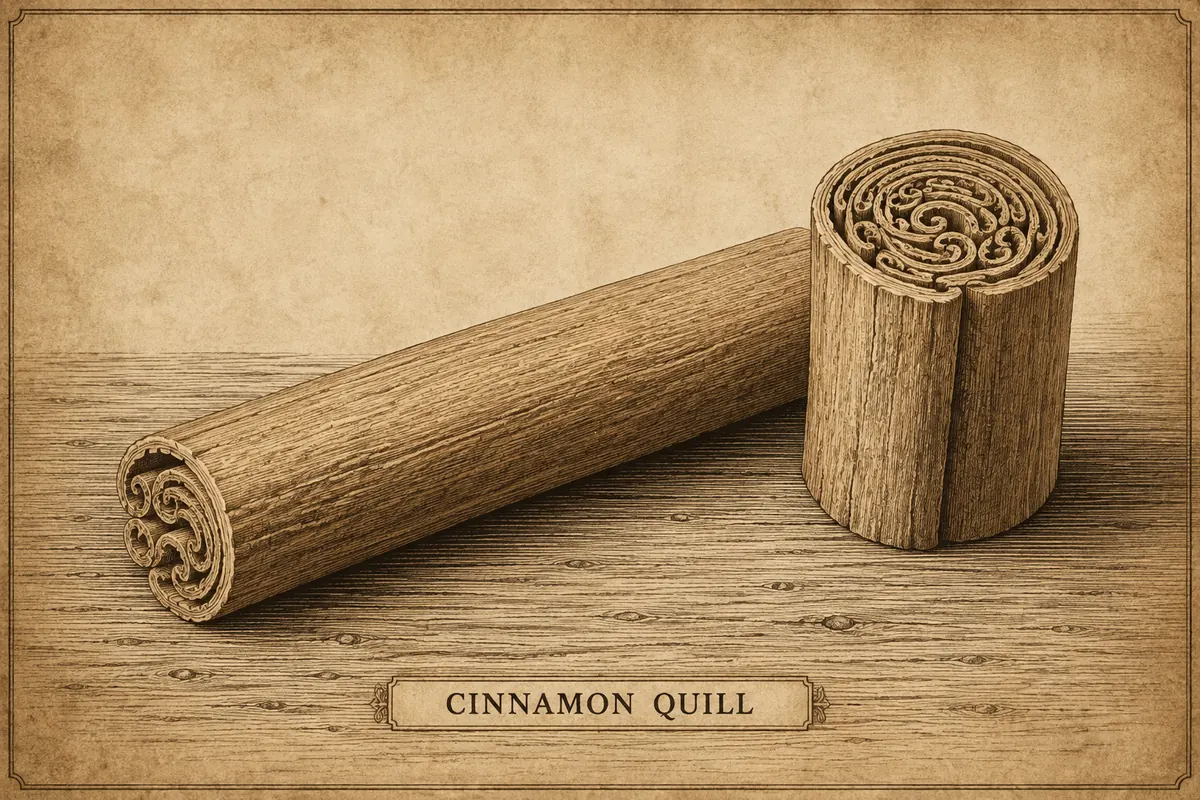
A cinnamon quill is a stick of dried cinnamon bark that has curled into a hollow tube as it dries. In true Ceylon cinnamon, a quill is made from many thin, soft layers of inner bark rolled together by hand into a single neat roll. The word “quill” comes from the same root as a writing quill and a reed, because the rolled bark looks like a hollow tube or pen.
“Quill” is the traditional name for what many people simply call a cinnamon stick, and it is the word used in the cinnamon trade. This guide explains exactly what a quill is, where the name comes from, how quills are formed, and how they relate to grades. It builds on our guide to Ceylon cinnamon grades.
The short answer
A cinnamon quill is a rolled tube of dried cinnamon bark, the classic form of the whole spice. For Ceylon cinnamon, peelers take the thin inner bark, layer several pieces together and roll them into a long, slender quill that dries into a firm stick. The result is the familiar pale, papery, multi-layered roll that sets true cinnamon apart from the thick, hard single curl of cassia.
Where does the word “quill” come from?
The word “quill” originally meant a hollow reed or the hollow shaft of a feather, the kind once cut into a pen. Because a roll of cinnamon bark forms a similar hollow tube, the same word came to be used for it. So a cinnamon quill is named for its shape: a neat, hollow roll. The term has been part of the spice trade for a long time and remains the correct name for a whole rolled cinnamon stick today.
How a cinnamon quill is formed
A quill does not simply grow on the tree; it is made through skilled handwork. After the outer bark is scraped away, the peeler lifts off the thin inner bark in strips. Several of these strips are then layered inside one another and rolled together into a long tube. As the roll dries, it tightens and firms into a solid quill. This craft is at the heart of how the spice is produced, as our guide to how Ceylon cinnamon is made explains in full.
Why Ceylon quills have many layers
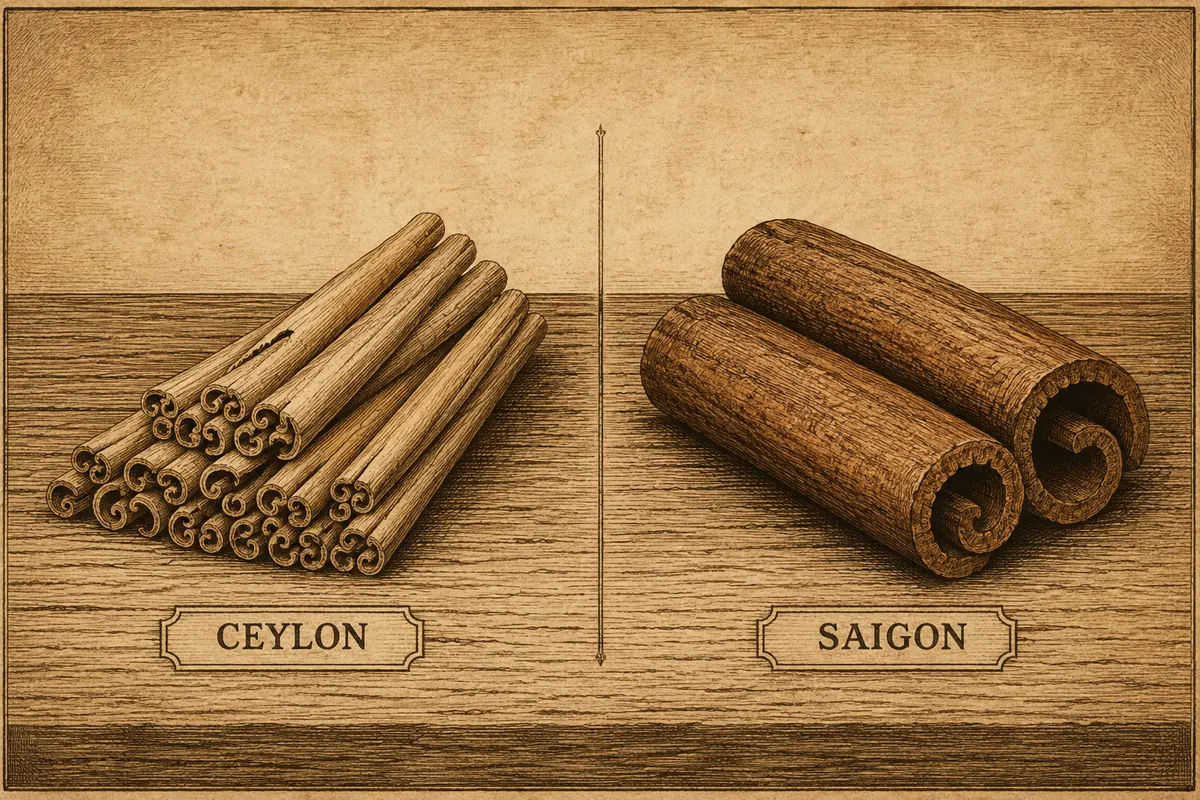
The layered structure is a signature of true Ceylon cinnamon. Because its inner bark is so thin and delicate, several pieces are combined to make one quill, giving the cross-section its distinctive look of many soft, rolled-up layers, a little like a rolled cigar or a tiny scroll. Cassia, by contrast, has thick bark that curls into a single hard layer. This difference is one of the easiest ways to tell the two apart.
Cinnamon quill vs cinnamon stick
“Quill” and “stick” describe the same thing. Quill is the traditional trade term for a rolled length of cinnamon bark, while “stick” is the everyday word most shoppers use. There is no difference in the product; a cinnamon stick is a cinnamon quill. You will see “quill” more often on specialist and export packaging, and “stick” more often in supermarkets and recipes. Our guide to cinnamon sticks covers the same form in everyday terms.
Quill sizes and lengths
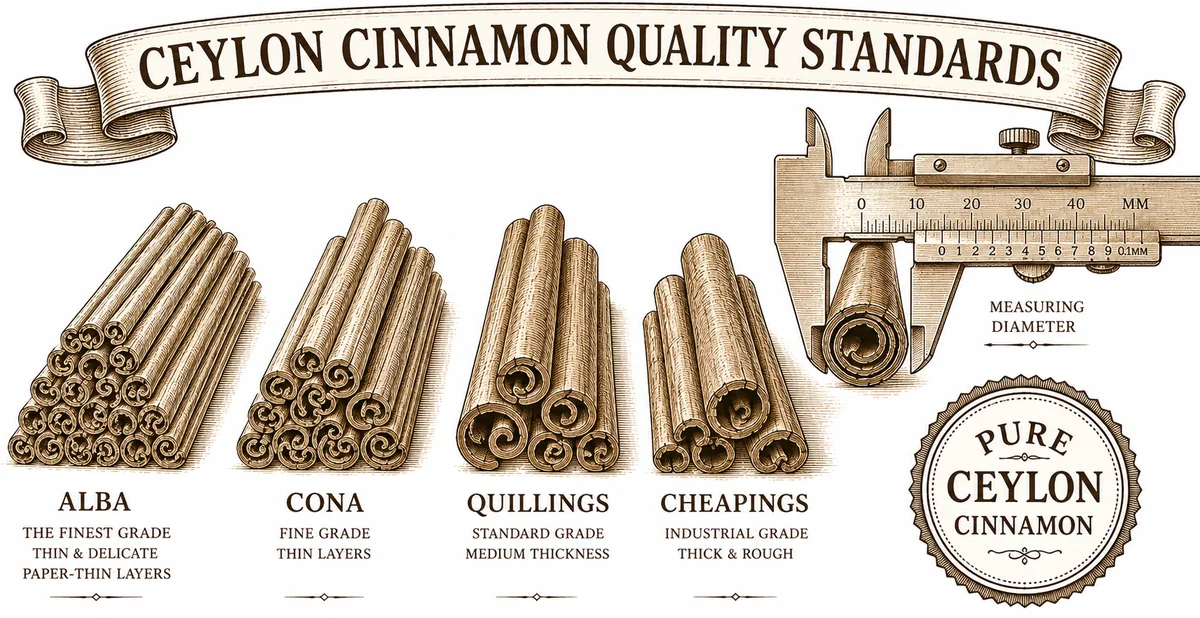
Quills are usually sold cut to a standard length, commonly around 8 to 10 centimetres for retail, though export quills can be much longer before cutting. Their diameter and neatness feed into how they are graded: fine, slender, evenly rolled quills of pale bark are prized, while thicker or broken pieces are graded lower. The finest grades are made from the thinnest, most tightly rolled quills, which is why a well-made quill is a mark of careful peeling and good bark rather than just a pretty shape. The look of the quill is therefore closely tied to quality, a link set out in our guide to Ceylon cinnamon grades.
Quills and related forms at a glance
| Term | What it means |
|---|---|
| Quill | A whole rolled tube of dried cinnamon bark |
| Stick | The everyday word for a quill |
| Quillings | Small broken pieces of quill |
| Featherings | Thin inner bark shavings and small curls |
| Chips | Cut pieces of bark, often for grinding or infusing |
| Ground | Quills milled into powder |
These terms are all part of the cinnamon vocabulary, and several appear in our glossary of Ceylon cinnamon terms.
Why the quill form matters
The quill is not just how cinnamon looks; it is a practical and useful form. Whole quills keep their aroma far longer than powder, because less of the bark is exposed to air. They can be dropped whole into curries, rice, drinks and syrups to infuse flavour, then lifted out. And their multi-layered structure is a quick visual test of authenticity, since only true Ceylon cinnamon rolls into those thin, soft layers. In short, the quill is both the traditional shape of the spice and a sign of what it is. For anyone learning about Ceylon cinnamon, understanding the quill is a natural starting point, since so much of the spice’s quality, history and identity is wrapped up in that simple rolled tube of bark.
A short history of the cinnamon quill
The rolled quill is not a modern invention. For centuries, cinnamon was traded across the world in this form, because rolling the bark made it easier to dry, bundle, pack and ship without it crumbling. The neat tubes could be tied together, graded by eye, and carried great distances while holding their aroma. So the quill is partly a practical answer to an old problem: how to move a delicate spice safely from a small island to distant markets. The shape we still buy today carries that long trading history inside it.
How to store and use quills
Because a quill exposes little of its bark to the air, it keeps its flavour well. Stored whole in an airtight jar, away from heat, light and damp, Ceylon cinnamon quills stay fragrant for a long time, often a couple of years. In the kitchen they are used whole: a quill is added to a simmering pot, a warm drink or a syrup, left to infuse its gentle sweetness, then removed before serving. When you want ground cinnamon, a brittle Ceylon quill can be snapped and milled fresh, which gives a brighter flavour than powder that has been sitting open. In this way the quill is both a storage form and a cooking tool.
Spotting a good quill
A fine Ceylon quill is pale tan, slender and light, with a smooth surface and a clear pattern of thin rolled layers at the cut ends. It should feel brittle rather than hard, snapping cleanly, and smell sweet and delicate. A very dark, thick, heavy stick that curls in a single hard layer and smells sharp is a cassia quill rather than true cinnamon. Learning to read these signs in the quill itself is one of the simplest ways to judge what you are buying before you even taste it.
Frequently asked questions
What is a cinnamon quill?
A cinnamon quill is a stick of dried cinnamon bark that has rolled into a hollow tube. In Ceylon cinnamon, it is made by layering and rolling several pieces of thin inner bark by hand, which then dry into a firm, pale, multi-layered roll.
Is a cinnamon quill the same as a cinnamon stick?
Yes. “Quill” is the traditional trade name and “stick” is the everyday word, but they mean the same thing: a whole rolled length of cinnamon bark.
Why is it called a quill?
Because the rolled bark forms a hollow tube, like a reed or the shaft of a feather quill once used as a pen. The name describes the shape of the rolled cinnamon.
Why do Ceylon cinnamon quills have layers?
Because the inner bark of true cinnamon is very thin, so several pieces are rolled together to make one quill. This gives the cross-section its distinctive many-layered look, which cassia, with its single thick layer, does not have.
Summary
A cinnamon quill is the classic rolled tube of dried cinnamon bark, named after the hollow reed or feather pen it resembles. In true Ceylon cinnamon, a quill is made by hand from many thin layers of inner bark rolled together, giving the pale, papery, multi-layered look that marks it out from cassia. “Quill” and “stick” mean the same thing, with quill being the traditional trade term. The quill form keeps cinnamon fresh, makes it easy to infuse and remove, and offers a quick test of authenticity, which is why it remains the signature shape of the spice.
This website provides educational information about Ceylon Cinnamon as a spice and food ingredient. It is not intended to provide medical advice or make health claims.