Tag: Ceylon cinnamon

  • Complete Guide to Ceylon Cinnamon Grades

    Complete Guide to Ceylon Cinnamon Grades

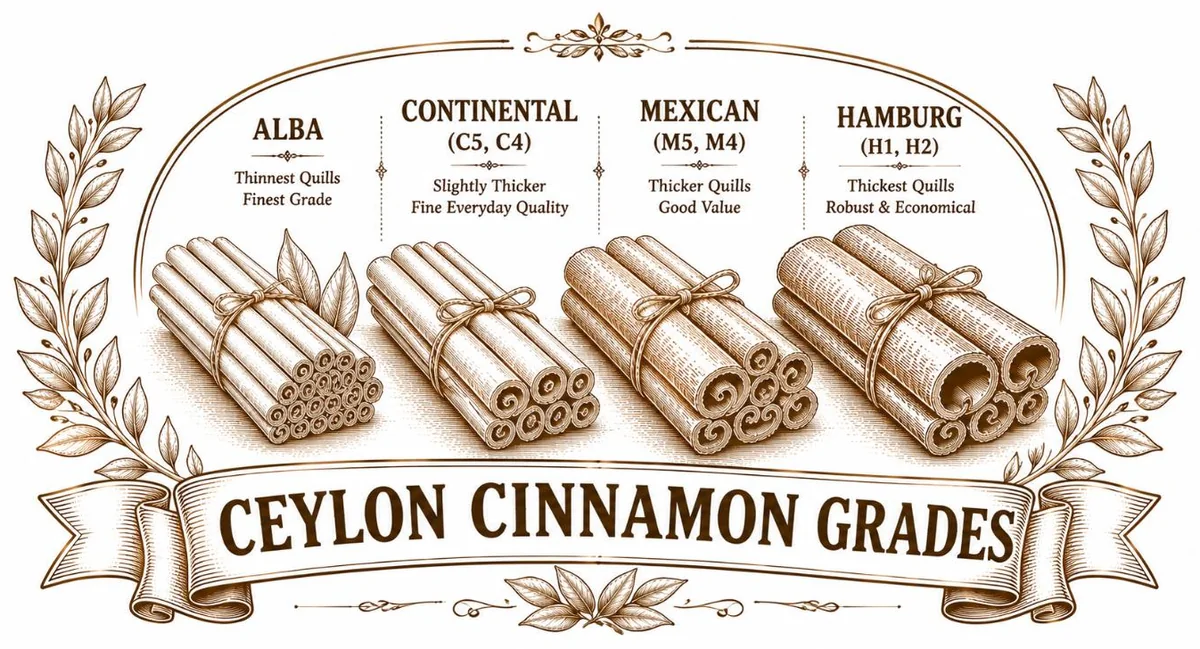
    Ceylon cinnamon is graded mainly by the diameter and appearance of its quills, from the very fine, pale Alba grade through Continental, Mexican and Hamburg categories, each with coded sub-grades such as C5, M5 and H1. Thinner, lighter, more tightly rolled quills are considered higher grade. Alongside whole quills, the harvest also yields quillings, featherings, chips and powder. This guide decodes every grade so you know exactly what you are buying.

    Grading can look baffling on a spice label, Alba, C5 Special, M4, H2, but the system is logical once you understand that it is largely about quill diameter and neatness. Grades describe appearance and size, not a different species: every grade below is still true Ceylon cinnamon (Cinnamomum verum). The internationally recognised reference for cinnamon specifications is the ISO 6539 standard.

    How Ceylon cinnamon is graded

    After the bark is peeled, rolled and dried, a process described in how Ceylon cinnamon is made, the finished quills are sorted by hand. The main criteria are the diameter of the quill, its colour, how tightly and cleanly it is rolled, and the absence of cracks or blemishes. In general, the finer and paler the quill, the higher the grade and the more delicate the flavour. Thicker quills are darker, more robust in taste and more affordable.

    The four main grade families

    Approximate quill diameters by grade. Figures vary between exporters; ranges are indicative.
    Grade familyTypical diameterCharacter
    Alba (finest)about 6 mm or lessPalest, sweetest, most delicate; a small fraction of the harvest
    Continental (C)about 10, 13 mmLight brown, well rolled; a popular everyday premium grade
    Mexican (M)about 14, 16 mmWarmer amber tone, more rustic roll, punchier character
    Hamburg (H)about 17, 19 mm and upThicker, darker, boldest flavour; often used in bulk

    The names Continental, Mexican and Hamburg are traditional market categories, historically linked to the regions that favoured each thickness. They do not mean the cinnamon was grown in Mexico or Germany, it is all Sri Lankan.

    The coded sub-grades (C, M and H numbers)

    Within the main families you will see codes that further specify diameter. Smaller numbers usually indicate finer quills. Indicative ranges include:

    • Alba, the finest of all, roughly 6 mm or under.
    • C5 Special, a premium Continental quill, about 7, 9 mm.
    • C5, about 10, 12 mm; C4, about 13, 14 mm.
    • M5 / M4 (Mexican), roughly 16, 20 mm.
    • H1 / H2 / H3 (Hamburg), roughly 17 mm and thicker.

    Because exporters and standards differ slightly, treat these numbers as a practical guide rather than absolute cut-offs. What stays constant is the principle: lower number and family closer to Alba means finer, paler and more delicate.

    Quills, quillings, featherings and chips

    Not everything from the harvest becomes a perfect long quill. The trade recognises several forms:

    • Quills, the classic rolled sticks, typically sold in lengths up to around a metre before being cut. These are the premium form.
    • Quillings, small broken pieces of quill, often under 200 mm. They carry the same flavour at a lower price and are ideal for grinding or infusing.
    • Featherings, thin, feathery inner-bark shavings and small curls left over from making quills. Economical and aromatic.
    • Chips, small cut pieces of bark, sometimes including outer bark, generally the most affordable form and often used for extracting oil or for bulk infusions.

    Ground cinnamon and powder

    Ceylon cinnamon powder is made by grinding quills, quillings or featherings. Powder made from higher grades will be paler and more fragrant. Because ground cinnamon loses aroma faster than whole quills and cannot be inspected for authenticity by eye, buying reputable, clearly labelled Ceylon powder, or grinding your own from quills, is the safest way to be sure of quality. Our identification guide explains why powder demands extra care.

    Which grade should you buy?

    For most home cooks, the “best” grade is the one that fits the job and budget:

    • Alba or C5 Special, for gifting, delicate desserts, drinks and anywhere the cinnamon flavour is the star.
    • C5 / C4 (Continental), excellent all-rounders product premium quality at a sensible price.
    • Mexican / Hamburg, great value for everyday baking, mulling, long simmering and grinding your own powder, where a bolder flavour is welcome.

    Remember that a “lower” grade is not lower quality cinnamon, it is simply a thicker quill with a more robust flavour. The buying guide pairs grades with uses and budgets in more detail.

    Where the grade names come from

    The traditional grade names reflect the historic export trade rather than geography. Continental, Mexican and Hamburg were market categories associated with the regions and buyers that favoured particular quill thicknesses, for example, thinner quills for certain European markets and thicker ones for others. Over time these names became standardised descriptions of diameter. Alba, from the Latin for “white,” refers to the palest, finest quills. Knowing this helps explain why a “Mexican” grade is still entirely Sri Lankan cinnamon.

    How grade affects flavour and price

    Diameter is closely linked to both taste and cost. Finer quills such as Alba come from the youngest, most tender bark and tend to be the sweetest and most delicate, but they are scarce and labour-intensive to produce, so they command the highest prices. Thicker quills carry a more robust, woody flavour and are more plentiful, making them better value for everyday cooking. None of this changes authenticity, a thick Hamburg quill is just as genuinely Cinnamomum verum as a fine Alba.

    Grades and the ISO standard

    Internationally, cinnamon specifications are described by the ISO 6539 standard, which sets out characteristics such as dimensions and quality parameters for cinnamon quills. Sri Lankan grading builds on this framework, sorting quills by diameter and appearance into the familiar Alba, C, M and H categories. When buying, the practical takeaway is that a clearly stated grade, alongside the species and origin, is a sign of a well-organised, transparent supplier.

    A quick buyer’s cheat-sheet

    • Want the finest, most delicate quills? Choose Alba or C5 Special.
    • Want the best balance of quality and price? Continental C5 or C4.
    • Cooking in volume or grinding your own powder? Mexican, Hamburg, or quillings and featherings.
    • Buying powder? Favour a trusted, clearly labelled Ceylon source, since grade cannot be judged by eye once ground.

    Do grades change how you cook with it?

    In practice, the grade you choose can subtly shape a dish. Finer grades like Alba dissolve their delicate flavour quickly and are lovely in drinks, dustings and gentle desserts where you want fragrance without any harsh edge. Thicker Hamburg-style quills, with their more robust, woody character, hold up well in long-simmered curries, stocks and mulled drinks where a sturdier flavour is welcome and the quill is removed before serving. Because all grades are the same species, you can move between them freely; think of grade as a way to fine-tune intensity and elegance rather than as a quality hierarchy. Our culinary guide shows where each shines.

    Are thicker grades worse quality?

    This is a common misunderstanding. A thicker Hamburg quill is not spoiled, stale or adulterated cinnamon, it is simply a larger-diameter roll from more mature bark, with a bolder, woodier flavour. It comes from the same Cinnamomum verum plant, grown and hand-peeled in the same way as Alba. The grade tells you about size and finesse, not integrity. For a busy kitchen that gets through cinnamon quickly, a thicker grade or quillings can be the smarter, more economical choice while still being completely genuine Ceylon cinnamon.

    Reading grades on a label

    When shopping, you may see grade codes printed alongside the species and origin, for example “Ceylon Cinnamon (Cinnamomum verum), Alba, Sri Lanka.” A clearly stated grade is a good sign of a careful, transparent supplier. If a product simply says “cinnamon sticks” with no species, origin or grade, you cannot assume it is Ceylon at all; it may well be cassia. Combining grade information with the authenticity checks in our identification guide gives you the fullest picture of what you are buying.

    Summary

    Ceylon cinnamon grades describe the size and appearance of the quills, not different plants. Alba is the finest and palest, followed by Continental (C), Mexican (M) and Hamburg (H) families, each with numbered sub-grades tied to diameter. Broken and offcut forms, quillings, featherings and chips, offer the same flavour more affordably, and powder is milled from these grades. Choose finer grades for delicate, showcase uses and thicker grades for everyday, robust cooking. Whatever the grade, genuine Ceylon cinnamon remains thin-barked, pale and low in coumarin.

    Frequently asked questions

    What is the best grade of Ceylon cinnamon?

    Alba is the finest and most delicate, but “best” depends on use. Continental grades offer premium quality at better value, while thicker grades are ideal for everyday baking and grinding.

    What does Alba cinnamon mean?

    Alba is the top grade of Ceylon cinnamon: the thinnest, palest and sweetest quills, roughly 6 mm or less in diameter, and only a small share of each harvest.

    Are quillings lower quality than quills?

    No. Quillings are simply broken pieces of quill. They have the same flavour and are excellent value for grinding or infusing.

    Do the grade numbers mean different quality?

    They mainly indicate quill diameter. Finer grades are more delicate; thicker grades are bolder. All are genuine Ceylon cinnamon.

    This website provides educational information about Ceylon Cinnamon as a spice and food ingredient. It is not intended to provide medical advice or make health claims.
  • Ceylon Cinnamon vs Cassia Cinnamon

    Ceylon Cinnamon vs Cassia Cinnamon

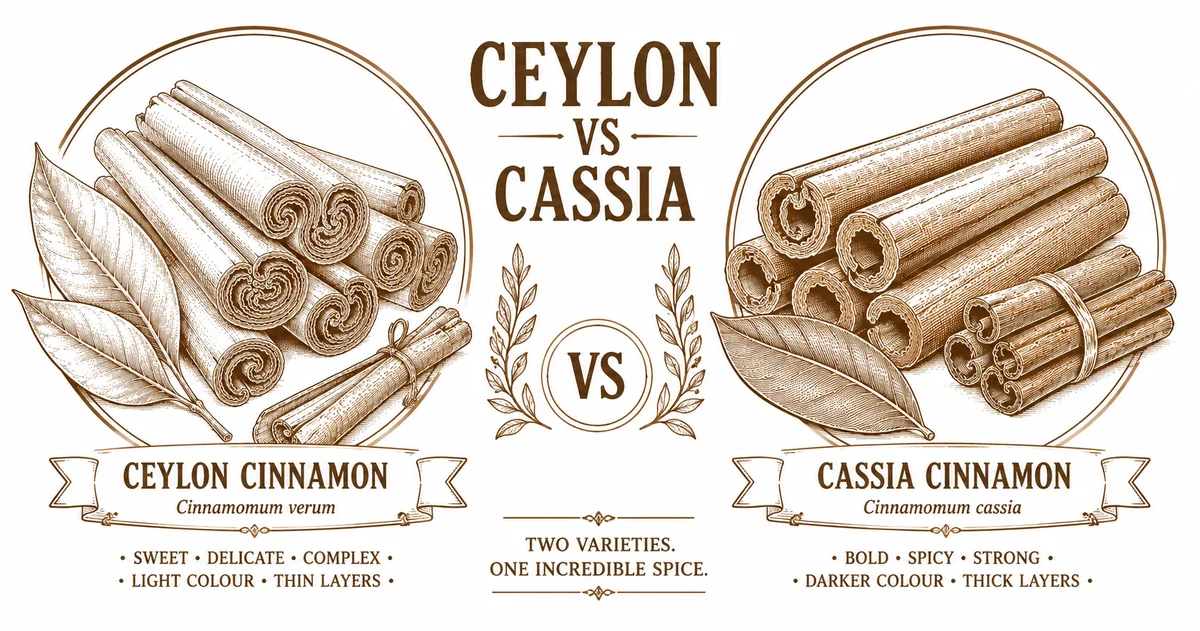
    Ceylon cinnamon is the bark of Cinnamomum verum from Sri Lanka; cassia is the bark of several other Cinnamomum species grown mainly in China, Indonesia and Vietnam. The two look, feel and taste different, and cassia contains far more of the naturally occurring compound coumarin. Ceylon is thin, pale and delicately sweet; cassia is thick, dark and boldly pungent. Knowing which is which changes how you shop and cook.

    Most people never realise there are two very different products sold under the single word “cinnamon.” This guide sets them side by side, botany, origin, appearance, flavour, bark structure, coumarin and culinary use, so you can tell them apart with confidence. For the fundamentals of true cinnamon itself, start with what is true Ceylon cinnamon.

    Quick comparison table

    Ceylon cinnamon vs cassia, the essential differences.
    FeatureCeylon cinnamonCassia cinnamon
    Botanical sourceCinnamomum verum (syn. zeylanicum)C. cassia, C. burmannii, C. loureiroi
    Main originSri LankaChina, Indonesia, Vietnam
    Bark thicknessThin and paperyThick and hard
    Quill shapeMany fine layers rolled togetherSingle thick curl, often hollow
    ColourLight tan / golden brownDark reddish-brown
    TextureBrittle, crumbles easilyHard, snaps or needs a grinder
    Aroma & flavourDelicate, sweet, complexStrong, hot, pungent
    Coumarin contentOnly trace amountsConsiderably higher
    Typical priceHigher (premium)Lower (commodity)

    Botanical differences

    Both belong to the genus Cinnamomum in the laurel family, but they are different species. True cinnamon is a single species, Cinnamomum verum. “Cassia” is a commercial grouping of several species: C. cassia (Chinese cassia), C. burmannii (Indonesian or Korintje cassia) and C. loureiroi (Saigon or Vietnamese cassia). Because they are botanically distinct, their bark develops a different structure and a different balance of aromatic compounds.

    Origin differences

    Ceylon cinnamon is overwhelmingly a product of Sri Lanka, where it has been cultivated and hand-processed for centuries; its name is now protected in the EU as a Geographical Indication tied to the island. Cassia is grown across East and South-East Asia and is produced on a far larger industrial scale, which is a major reason it is cheaper and more widely available. The historical reasons behind Sri Lanka’s association with cinnamon are covered in our history of Ceylon cinnamon.

    Appearance: how to tell them apart by sight

    Place the two side by side and the differences are obvious. A Ceylon quill is light tan and built from many thin layers of soft inner bark rolled tightly together, so the end looks like a coiled cigar. It is fragile and flakes apart easily. A cassia stick is dark reddish-brown, made of a single thick, woody layer curled into a hollow tube, and is hard enough that most people cannot snap it by hand. These cues are the heart of our guide to identifying authentic Ceylon cinnamon.

    Bark structure

    The structural contrast comes from which part of the bark is used and how it is prepared. Ceylon cinnamon uses only the delicate inner bark, scraped free of the outer layers and rolled while pliable into multi-layered quills. Cassia is made from thicker bark that includes more of the woody outer layers, which is why it is harder, less refined in flavour, and forms that characteristic single curl. Understanding this is easier once you have read how Ceylon cinnamon is made.

    Flavour differences

    Ceylon cinnamon tastes sweet, mellow and layered, with soft floral and citrus notes. It flavours a dish without dominating it. Cassia is stronger, hotter and more astringent, with a punchy, almost spicy-sweet bite that carries well through robust bakes and heavily spiced dishes. Neither is “better” in the abstract, they simply suit different purposes, which we look at in the culinary uses of Ceylon cinnamon.

    The coumarin difference

    One of the most discussed differences is coumarin, a naturally occurring aromatic compound present in the bark. Cassia contains substantially more coumarin than Ceylon cinnamon, which carries only trace amounts. Food-safety authorities such as the European Food Safety Authority have established a tolerable daily intake for coumarin, and this is one reason some consumers who use cinnamon frequently, or in large quantities, choose Ceylon. This is a compositional, food-ingredient distinction rather than a health claim.

    Culinary differences: which should you use?

    As a rule of thumb, reach for Ceylon cinnamon where its subtlety can shine, delicate custards and rice puddings, milk and cream dishes, fine pastry, fragrant Sri Lankan and South Indian curries, and drinks where you do not want harshness. Choose cassia where you want a bold, unmistakable cinnamon punch that stands up to sugar and strong flavours, such as cinnamon rolls, robust spice blends and long-cooked stews. Many cooks keep both. If you are buying Ceylon for the first time, our buying guide explains what to look for.

    Why do people confuse Ceylon cinnamon and cassia?

    The confusion is largely a labelling issue. In many countries, both can legally be sold simply as “cinnamon,” with no species named on the jar. Because cassia is cheaper and more plentiful, it makes up the majority of the mass market, so most shoppers have only ever encountered cassia and assume it is the standard. Only when the label specifies Cinnamomum verum, “true cinnamon” or “Ceylon cinnamon,” and names Sri Lanka as the origin, can you be confident you are getting the real thing.

    The different types of cassia

    “Cassia” is not one thing but a family of species, and they vary in their own right:

    • Chinese cassia (C. cassia), the classic cassia, dark and strong, widely used across Asia.
    • Indonesian / Korintje cassia (C. burmannii), the most common cinnamon in North American supermarkets, sweetly pungent.
    • Saigon / Vietnamese cassia (C. loureiroi), the boldest and most intensely flavoured, prized by some bakers for its punch.

    All three are still cassia, thicker-barked, higher in coumarin and more forceful than Ceylon cinnamon. If a premium-priced “cinnamon” names one of these species or simply says “cinnamon,” it is cassia, not true cinnamon.

    Price and availability

    Cassia’s lower price is a direct result of how it is produced: it grows across large areas of Asia, is farmed on an industrial scale, and its thicker bark is easier to harvest and does not require the delicate hand-peeling that Ceylon cinnamon demands. Ceylon cinnamon, grown in a smaller region and processed by skilled peelers as described in how Ceylon cinnamon is made, is naturally scarcer and dearer. This is why cassia dominates supermarket shelves worldwide while true cinnamon is more often found in specialist shops and from dedicated suppliers.

    How to choose between them in practice

    A simple way to decide: if the cinnamon flavour is the star of the dish, a custard, a spiced latte, a delicate cake, a fragrant curry, reach for Ceylon. If cinnamon is a supporting note that needs to punch through sugar, chocolate or strong spices, cassia does the job cheaply. Serious cooks often keep a jar of each: Ceylon for finesse and everyday enjoyment, cassia for occasions that call for a bold hit. Whichever you choose, checking the label for the species and origin, as covered in our identification guide, ensures you know exactly what you are getting.

    Beyond flavour: everyday considerations

    For most households the choice comes down to three practical factors: flavour, frequency of use and budget. If you cook with cinnamon only occasionally and want maximum punch for minimum cost, cassia is perfectly serviceable. If you use cinnamon often, value a refined taste, or simply prefer the very low coumarin content of true cinnamon, Ceylon rewards the modest extra outlay. Neither choice is wrong; they suit different priorities. What matters is knowing which one you are buying, so that the decision is yours to make rather than the supermarket’s to make for you.

    A note on other “cinnamon” products

    The Ceylon-versus-cassia distinction also applies to processed products. Cinnamon powder, cinnamon tea, cinnamon-flavoured baked goods and cinnamon oil can be made from either type, and the label rarely says which. If the species matters to you, look for products that specifically state Ceylon cinnamon or Cinnamomum verum, and treat unlabelled “cinnamon” products as most likely cassia-based. The identification guide and buying guide both help you navigate these products with confidence.

    Summary

    Ceylon cinnamon and cassia are related but genuinely different spices. Ceylon, Cinnamomum verum from Sri Lanka, is thin, pale, brittle, delicately sweet and very low in coumarin. Cassia is thick, dark, hard, boldly pungent and much higher in coumarin, produced cheaply across Asia. Tell them apart by colour, bark structure and texture, and choose between them by the dish: Ceylon for finesse, cassia for punch. When a label does not name the species or origin, it is usually cassia.

    Frequently asked questions

    Is cassia cinnamon bad for you?

    Cassia is a widely used culinary spice. It simply contains more coumarin than Ceylon cinnamon, which is why some people who use cinnamon heavily prefer Ceylon. This is an ingredient-composition point, not medical advice.

    Can I substitute cassia for Ceylon cinnamon?

    Yes, but expect a stronger, hotter flavour from cassia, so you may want to use a little less. For delicate dishes, Ceylon’s subtlety is hard to replace.

    Which cinnamon is in my supermarket?

    Unless the label specifically says Ceylon cinnamon or Cinnamomum verum, it is almost certainly cassia.

    Is Ceylon cinnamon worth the extra cost?

    For its refined flavour, pale delicate quills and low coumarin, many cooks find it well worth it, especially for baking and drinks where the flavour is front and centre.

    This website provides educational information about Ceylon Cinnamon as a spice and food ingredient. It is not intended to provide medical advice or make health claims.

  • What Is True Ceylon Cinnamon?

    What Is True Ceylon Cinnamon?

    True Ceylon Cinnamon is the dried inner bark of Cinnamomum verum, an evergreen tree native to Sri Lanka. Often called “true cinnamon,” it is harvested by hand, rolled into thin, brittle, multi-layered quills, and prized for its delicate, sweet, complex aroma and its naturally low coumarin content. It is the spice that gave cinnamon its name, and it is quite different from the thicker, harsher cassia that fills most supermarket shelves.

    If you have only ever cooked with the cinnamon sold in ordinary grocery jars, there is a good chance you have never tasted genuine Ceylon cinnamon at all. This guide explains exactly what true Ceylon cinnamon is, where it comes from, what it looks, smells and tastes like, and why it holds such a special place in the world of spices.

    The scientific name: Cinnamomum verum

    Botanically, true cinnamon is Cinnamomum verum, the Latin word verum literally means “true.” You may also see it written as Cinnamomum zeylanicum, an older synonym that references Zeylan, or Ceylon, the historical name for Sri Lanka. Both names point to the same plant. It belongs to the laurel family, Lauraceae, which also includes bay laurel and avocado.

    The commercial spice is not the whole bark of the tree but the thin inner bark, carefully separated from the outer bark and dried until it curls. This distinction matters: the quality of Ceylon cinnamon comes directly from how skilfully that fragile inner layer is peeled and rolled, a craft explained in our guide to how Ceylon cinnamon is made.

    Where does Ceylon cinnamon come from?

    Authentic Ceylon cinnamon comes from Sri Lanka, the island nation off the southern tip of India. Sri Lanka produces the overwhelming majority of the world’s true cinnamon, most of it grown in the wet, humid south-west of the country around the districts of Galle, Matara and Ratnapura. The combination of tropical climate, sandy loam soils and generations of accumulated peeling skill is difficult to replicate elsewhere, which is why the island remains the benchmark for quality.

    The link between the spice and its homeland is now formally recognised. In February 2022, “Ceylon Cinnamon” became Sri Lanka’s first product to be granted a Protected Geographical Indication (PGI) in the European Union, legally tying the name to cinnamon produced on the island. You can read more about the plant’s roots in our guides to Sri Lankan cinnamon farming and the history of Ceylon cinnamon.

    True cinnamon vs cassia: the key difference

    The single most important thing to understand about cinnamon is that not all of it is the same. “Cinnamon” is really an umbrella term for the bark of several related Cinnamomum species. In practice they fall into two camps:

    • True cinnamon, Cinnamomum verum, grown mainly in Sri Lanka. This is Ceylon cinnamon.
    • Cassia cinnamon, a group of species such as Cinnamomum cassia (Chinese), C. burmannii (Indonesian/Korintje) and C. loureiroi (Saigon/Vietnamese), grown across East and South-East Asia. Most inexpensive supermarket cinnamon is cassia.

    The two differ in appearance, flavour, bark structure and in their content of coumarin, a naturally occurring compound found in far higher levels in cassia than in Ceylon cinnamon. We compare them in detail in Ceylon cinnamon vs cassia, but the table below captures the essentials.

    True Ceylon cinnamon compared with cassia at a glance.
    FeatureCeylon cinnamonCassia
    Botanical sourceCinnamomum verumSeveral species (e.g. C. cassia)
    Main originSri LankaChina, Indonesia, Vietnam
    Quill structureThin, brittle, many nested layersThick, hard, hollow single curl
    ColourLight tan to golden brownDark reddish-brown
    Aroma & flavourDelicate, sweet, layeredStrong, hot, pungent
    Coumarin contentOnly trace amountsConsiderably higher

    What does Ceylon cinnamon look like?

    Appearance is one of the easiest ways to recognise true cinnamon. A genuine Ceylon quill is thin and papery, rolled from many fine layers of inner bark, so a cross-section looks a little like a tightly wound cigar or a rolled newspaper. The colour is a light, warm tan, sometimes described as pale golden, rather than the dark reddish-brown of cassia. Because the bark is so fine, the quills are fragile and crumble easily between your fingers.

    Cassia, by contrast, is made from thicker, harder bark that forms a single hollow tube and is much more difficult to break by hand. These visual and textural clues are the foundation of our guide to identifying authentic Ceylon cinnamon.

    What does Ceylon cinnamon smell and taste like?

    The aroma of Ceylon cinnamon is sweet, warm and delicate, with gentle floral and citrus notes layered over the familiar cinnamon warmth. It is fragrant rather than fiery. On the palate it is mild and refined, with a natural sweetness and very little of the sharp, mouth-drying heat associated with cassia.

    This subtlety is exactly why chefs and bakers value it. Where cassia can dominate a dish, Ceylon cinnamon adds warmth and complexity without overwhelming other ingredients, which makes it especially suited to delicate desserts, milk-based dishes, fine baking and fragrant curries. Look at this further in our guide to the culinary uses of Ceylon cinnamon.

    The characteristic aroma compounds

    Ceylon cinnamon’s scent comes largely from naturally occurring volatile oils in the bark, the most abundant of which is cinnamaldehyde, responsible for the classic cinnamon note. Smaller amounts of other aromatic compounds contribute the spice’s floral and slightly clove-like nuances. These compounds are studied by food scientists and are what give each grade its particular character.

    Why is Ceylon cinnamon considered premium?

    Several factors combine to make true cinnamon a premium spice. It is grown in a limited region, harvested young, and processed almost entirely by hand: skilled peelers separate the wafer-thin inner bark, roll it into quills, and dry it before it is graded. This labour-intensive craft, together with the spice’s refined flavour and low coumarin content, explains why it typically costs more than mass-produced cassia. We break down what that means for shoppers in the Ceylon cinnamon buying guide.

    Grades of Ceylon cinnamon

    Not all Ceylon cinnamon is identical. It is sorted into grades based mainly on the diameter and appearance of the quills, from the very fine, pale Alba grade down through Continental, Mexican and Hamburg categories. Thinner, lighter quills are generally considered higher grade. If you would like to understand the codes you may see on packaging, such as Alba, C5, M or H1, see our complete guide to Ceylon cinnamon grades.

    The cinnamon tree itself

    Left to grow naturally, Cinnamomum verum is a bushy evergreen that can reach the size of a small tree, with glossy leaves that are reddish when young and deep green when mature, small pale flowers and dark berries. For spice production, however, the plant is deliberately kept as a low, multi-stemmed bush so that its slender shoots can be harvested for bark, a technique explained in Sri Lankan cinnamon farming. The whole plant is aromatic: the bark yields the familiar spice, while the leaves and thin twigs can be distilled into cinnamon leaf oil, and the bark into cinnamon bark oil.

    The forms you will find it in

    Ceylon cinnamon reaches the kitchen in several forms. Whole quills, the rolled sticks, are the most recognisable and keep their aroma longest. Ground powder is milled from quills or offcuts and is convenient for baking. Quillings, featherings and chips are smaller or broken pieces that carry the same flavour at a lower price, and cinnamon oil is used in flavouring and fragrance. Each form suits a different purpose, and knowing them helps you shop wisely, as set out in the buying guide.

    Why true cinnamon matters

    Understanding what genuine Ceylon cinnamon is has practical value. It helps you get the flavour you actually want in a dish, recognise when a product labelled simply “cinnamon” is really cassia, and appreciate why true cinnamon commands a higher price. For anyone who cooks, bakes or simply enjoys the spice, being able to tell Cinnamomum verum from its cassia cousins is the first and most useful piece of cinnamon knowledge, and everything else on this site builds on it.

    Summary

    True Ceylon cinnamon is the dried inner bark of Cinnamomum verum from Sri Lanka, thin, pale, brittle and delicately sweet, with only trace amounts of coumarin. It is distinct from the darker, harder, more pungent cassia that dominates the mass market. Recognisable by its light colour, papery multi-layered quills and fragrant aroma, it is harvested and hand-processed with great skill, sorted into grades, and valued by cooks and bakers around the world for its refinement. Understanding what true cinnamon is forms the foundation for everything else on this site, from telling it apart from cassia to buying and cooking with it well.

    Frequently asked questions

    Is Ceylon cinnamon real cinnamon?

    Yes. Cinnamomum verum is often called “true cinnamon,” and it is the original spice the word cinnamon referred to. Much of the cinnamon sold worldwide is actually cassia, a related but different and cheaper group of species.

    Is Ceylon cinnamon the same as Sri Lankan cinnamon?

    Essentially, yes. “Ceylon” is the historical name for Sri Lanka, and authentic Ceylon cinnamon is grown and processed there. The name is now protected in the EU to reflect that origin.

    Why is it called Ceylon cinnamon?

    Because it comes from the island formerly known as Ceylon, today’s Sri Lanka. The name distinguishes true cinnamon from cassia grown in other countries.

    What is the difference between Ceylon cinnamon and normal cinnamon?

    “Normal” supermarket cinnamon is usually cassia: thicker, darker, harsher in flavour and higher in coumarin. Ceylon cinnamon is thinner, paler, sweeter and more delicate, with only trace coumarin.

    This website provides educational information about Ceylon Cinnamon as a spice and food ingredient. It is not intended to provide medical advice or make health claims.