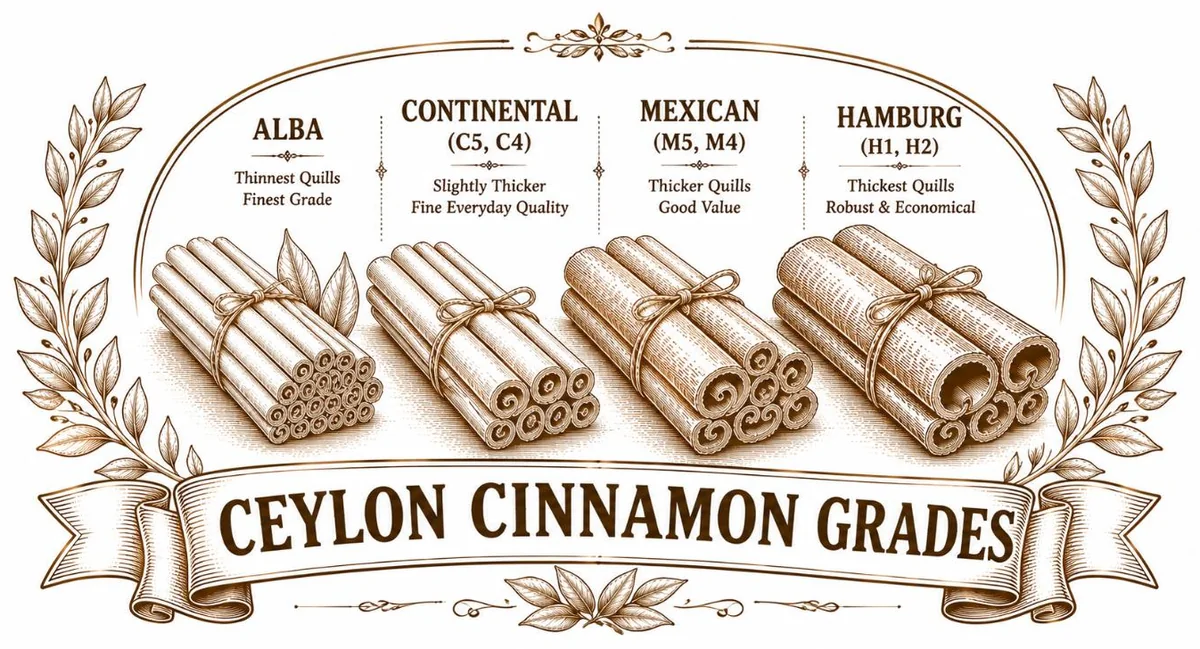
Ceylon cinnamon is graded mainly by the diameter and appearance of its quills, from the very fine, pale Alba grade through Continental, Mexican and Hamburg categories, each with coded sub-grades such as C5, M5 and H1. Thinner, lighter, more tightly rolled quills are considered higher grade. Alongside whole quills, the harvest also yields quillings, featherings, chips and powder. This guide decodes every grade so you know exactly what you are buying.
Grading can look baffling on a spice label, Alba, C5 Special, M4, H2, but the system is logical once you understand that it is largely about quill diameter and neatness. Grades describe appearance and size, not a different species: every grade below is still true Ceylon cinnamon (Cinnamomum verum). The internationally recognised reference for cinnamon specifications is the ISO 6539 standard.
How Ceylon cinnamon is graded
After the bark is peeled, rolled and dried, a process described in how Ceylon cinnamon is made, the finished quills are sorted by hand. The main criteria are the diameter of the quill, its colour, how tightly and cleanly it is rolled, and the absence of cracks or blemishes. In general, the finer and paler the quill, the higher the grade and the more delicate the flavour. Thicker quills are darker, more robust in taste and more affordable.
The four main grade families
| Grade family | Typical diameter | Character |
|---|---|---|
| Alba (finest) | about 6 mm or less | Palest, sweetest, most delicate; a small fraction of the harvest |
| Continental (C) | about 10, 13 mm | Light brown, well rolled; a popular everyday premium grade |
| Mexican (M) | about 14, 16 mm | Warmer amber tone, more rustic roll, punchier character |
| Hamburg (H) | about 17, 19 mm and up | Thicker, darker, boldest flavour; often used in bulk |
The names Continental, Mexican and Hamburg are traditional market categories, historically linked to the regions that favoured each thickness. They do not mean the cinnamon was grown in Mexico or Germany, it is all Sri Lankan.
The coded sub-grades (C, M and H numbers)
Within the main families you will see codes that further specify diameter. Smaller numbers usually indicate finer quills. Indicative ranges include:
- Alba, the finest of all, roughly 6 mm or under.
- C5 Special, a premium Continental quill, about 7, 9 mm.
- C5, about 10, 12 mm; C4, about 13, 14 mm.
- M5 / M4 (Mexican), roughly 16, 20 mm.
- H1 / H2 / H3 (Hamburg), roughly 17 mm and thicker.
Because exporters and standards differ slightly, treat these numbers as a practical guide rather than absolute cut-offs. What stays constant is the principle: lower number and family closer to Alba means finer, paler and more delicate.
Quills, quillings, featherings and chips
Not everything from the harvest becomes a perfect long quill. The trade recognises several forms:
- Quills, the classic rolled sticks, typically sold in lengths up to around a metre before being cut. These are the premium form.
- Quillings, small broken pieces of quill, often under 200 mm. They carry the same flavour at a lower price and are ideal for grinding or infusing.
- Featherings, thin, feathery inner-bark shavings and small curls left over from making quills. Economical and aromatic.
- Chips, small cut pieces of bark, sometimes including outer bark, generally the most affordable form and often used for extracting oil or for bulk infusions.
Ground cinnamon and powder
Ceylon cinnamon powder is made by grinding quills, quillings or featherings. Powder made from higher grades will be paler and more fragrant. Because ground cinnamon loses aroma faster than whole quills and cannot be inspected for authenticity by eye, buying reputable, clearly labelled Ceylon powder, or grinding your own from quills, is the safest way to be sure of quality. Our identification guide explains why powder demands extra care.
Which grade should you buy?
For most home cooks, the “best” grade is the one that fits the job and budget:
- Alba or C5 Special, for gifting, delicate desserts, drinks and anywhere the cinnamon flavour is the star.
- C5 / C4 (Continental), excellent all-rounders product premium quality at a sensible price.
- Mexican / Hamburg, great value for everyday baking, mulling, long simmering and grinding your own powder, where a bolder flavour is welcome.
Remember that a “lower” grade is not lower quality cinnamon, it is simply a thicker quill with a more robust flavour. The buying guide pairs grades with uses and budgets in more detail.
Where the grade names come from
The traditional grade names reflect the historic export trade rather than geography. Continental, Mexican and Hamburg were market categories associated with the regions and buyers that favoured particular quill thicknesses, for example, thinner quills for certain European markets and thicker ones for others. Over time these names became standardised descriptions of diameter. Alba, from the Latin for “white,” refers to the palest, finest quills. Knowing this helps explain why a “Mexican” grade is still entirely Sri Lankan cinnamon.
How grade affects flavour and price
Diameter is closely linked to both taste and cost. Finer quills such as Alba come from the youngest, most tender bark and tend to be the sweetest and most delicate, but they are scarce and labour-intensive to produce, so they command the highest prices. Thicker quills carry a more robust, woody flavour and are more plentiful, making them better value for everyday cooking. None of this changes authenticity, a thick Hamburg quill is just as genuinely Cinnamomum verum as a fine Alba.
Grades and the ISO standard
Internationally, cinnamon specifications are described by the ISO 6539 standard, which sets out characteristics such as dimensions and quality parameters for cinnamon quills. Sri Lankan grading builds on this framework, sorting quills by diameter and appearance into the familiar Alba, C, M and H categories. When buying, the practical takeaway is that a clearly stated grade, alongside the species and origin, is a sign of a well-organised, transparent supplier.
A quick buyer’s cheat-sheet
- Want the finest, most delicate quills? Choose Alba or C5 Special.
- Want the best balance of quality and price? Continental C5 or C4.
- Cooking in volume or grinding your own powder? Mexican, Hamburg, or quillings and featherings.
- Buying powder? Favour a trusted, clearly labelled Ceylon source, since grade cannot be judged by eye once ground.
Do grades change how you cook with it?
In practice, the grade you choose can subtly shape a dish. Finer grades like Alba dissolve their delicate flavour quickly and are lovely in drinks, dustings and gentle desserts where you want fragrance without any harsh edge. Thicker Hamburg-style quills, with their more robust, woody character, hold up well in long-simmered curries, stocks and mulled drinks where a sturdier flavour is welcome and the quill is removed before serving. Because all grades are the same species, you can move between them freely; think of grade as a way to fine-tune intensity and elegance rather than as a quality hierarchy. Our culinary guide shows where each shines.
Are thicker grades worse quality?
This is a common misunderstanding. A thicker Hamburg quill is not spoiled, stale or adulterated cinnamon, it is simply a larger-diameter roll from more mature bark, with a bolder, woodier flavour. It comes from the same Cinnamomum verum plant, grown and hand-peeled in the same way as Alba. The grade tells you about size and finesse, not integrity. For a busy kitchen that gets through cinnamon quickly, a thicker grade or quillings can be the smarter, more economical choice while still being completely genuine Ceylon cinnamon.
Reading grades on a label
When shopping, you may see grade codes printed alongside the species and origin, for example “Ceylon Cinnamon (Cinnamomum verum), Alba, Sri Lanka.” A clearly stated grade is a good sign of a careful, transparent supplier. If a product simply says “cinnamon sticks” with no species, origin or grade, you cannot assume it is Ceylon at all; it may well be cassia. Combining grade information with the authenticity checks in our identification guide gives you the fullest picture of what you are buying.
Summary
Ceylon cinnamon grades describe the size and appearance of the quills, not different plants. Alba is the finest and palest, followed by Continental (C), Mexican (M) and Hamburg (H) families, each with numbered sub-grades tied to diameter. Broken and offcut forms, quillings, featherings and chips, offer the same flavour more affordably, and powder is milled from these grades. Choose finer grades for delicate, showcase uses and thicker grades for everyday, robust cooking. Whatever the grade, genuine Ceylon cinnamon remains thin-barked, pale and low in coumarin.
Frequently asked questions
What is the best grade of Ceylon cinnamon?
Alba is the finest and most delicate, but “best” depends on use. Continental grades offer premium quality at better value, while thicker grades are ideal for everyday baking and grinding.
What does Alba cinnamon mean?
Alba is the top grade of Ceylon cinnamon: the thinnest, palest and sweetest quills, roughly 6 mm or less in diameter, and only a small share of each harvest.
Are quillings lower quality than quills?
No. Quillings are simply broken pieces of quill. They have the same flavour and are excellent value for grinding or infusing.
Do the grade numbers mean different quality?
They mainly indicate quill diameter. Finer grades are more delicate; thicker grades are bolder. All are genuine Ceylon cinnamon.
This website provides educational information about Ceylon Cinnamon as a spice and food ingredient. It is not intended to provide medical advice or make health claims.
Leave a Reply